Also known as “the school of Ryan Veeder”:
2 Likes
Hmm… that might be an interesting inclusion for a video game adaptation of a movie, a level or set of levels where you explore virtual recreations of the sets, fake facades and behind the scenes scaffolding included, and some kind of asset viewer included with a game or movie would be cool… Granted, I’m also the kind of guy who thinks its a bit of a shame physical music releases never evolved beyond full mix stereo recordings and that it would be cool if a format that allows for isolating each part(e.g. vocals, guitar, drums, bass for the rock quartet, strings(or even violin, cello, bass), brass, woodwinds, etc for Orchestral) had caught on at some point instead of being lucky if a song has an official karaoke or instrumental* version… Granted, even if holodecks became a reality, I suspect the novelty of being able to watch a static movie from any angle would be short lived for a lot of people.
*For the record, to my mind, a Karaoke version only needs to remove the main voacals and can still include any back up singing, while instrumental removes all vocals immediately recognizeable as such(e.g. Van Canto’s a cappella metal uses vocals to simulate guitar, but I’d probably still call a lyric free version of one of their songs instrumental, but that’san unusual situation).
Though there’s another idea for the video game devs, instead of building more facades for your gaming worlds that make it obvious when a player has broken out of bounds, build out the normally out of bounds parts of your world and perhaps even hide deliberate easter eggs out of bounds. Players are going to be looking for the seams regardless, and modeling the back side of those castle walls is probably easier than doubling the size of the castle in an interesting way, and even if all that lies beyond is an endless expanse of perfectly manicured courtyard, it’s still a step up from a black void, and unless you’re trying to render every individual hair on your hero’s exposed forearm, I’m guessing modern hardware doesn’t leave devs with such a tight polygon budget that making everything cardboard is mandatory to make things look nice. Granted, I was never that big on games that tried for maximum realism and generally preferred games with a more animesque or cartoony aesthetic… and also tended to prefer animation to live action when it came to television and movies.
4 Likes
Some more unsolicited recommendations for games which are high on plot, exploration and characters, and where murdering people isn’t the objective:
- Road 96
- Virginia
- Night in the Woods
- Life is Strange (any game in the series)
- Jusant
- Sable
- L.A. Noire
- The Stanley Parable
- Observation
- Firewatch
And pretty much any “walking simulator”, which like “krautrock” was intended as an insult but has kinda become the actual name of a genre. Some examples I’ve played: “Dear Esther”, “Gone Home”, “Everybody’s Gone to the Rapture”, “What Remains of Edith Finch”, “Tacoma”.
The Assassin’s Creed games are incredible for exploration of real places and for their historical detail, as long as you’re willing to accept all the murder.
The Bartle taxonomy is quite simplistic, but I think it’s revealing. I play games of all kinds, and I’m primarily interested in exploration, secondly interested in plot, thirdly interested in light puzzles, and really not interested in achievements or competing at all. I also absolutely hate arbitrary time limits. Unfortunately if you look at gamers as a whole, they tend to be Achievers and Killers and like to hurry through things and race against time. AAA games tend to reflect that.
Consider what has happened with movies in recent decades. When they did test screenings of Terry Gilliam’s “Brazil”, about half the audience came out saying it was one of the best movies they’d ever seen, and about half came out saying it was the worst movie they’d ever seen. Studios don’t want great movies that are polarizing like that; there’s too much money involved. They want mediocre movies that are acceptable and moderately entertaining to everyone. So nowadays we get superhero movie after superhero movie, because it’s easy to churn out a plot, they’ve got all the CGI assets already, and audiences seem to be willing to be somewhat entertained by an endless succession of superhero stories rather than take a risk on something unfamiliar that they might like better, but also they might not like at all.
AAA gaming is like that. Even though last year’s Call of Duty was apparently the worst in years, there will definitely be another one next year because it was still the seventh best selling game of the year. The multiplayer is apparently OK, and shooting other people is what sells. (The top selling game was this year’s Battlefield game, which is the other AAA shooting-people franchise.)
So it’s not really that AAA games are bad, it’s more that they are deliberately mediocre in order to broaden their appeal.
6 Likes
Dr. Langeskov, The Tiger, and The Terribly Cursed Emerald: A Whirlwind Heist, by one of The Stanley Parable’s creators, is this.
3 Likes
Stereo technology is pretty good and able to reproduce locational sound from headphones or an elaborate speaker set up.
As far as making the individual tracks of a recording available for public consumption they’re probably not going to do that because it invites remixing which may not be a license they freely provide. If you’re interested in it, there are often MIDI files of popular songs that can be viewed and manipulated in multitrack sound programs like GarageBand and Audacity.
3 Likes
And framing is an inherent part of capturing static images how? Do light-field cameras not take photographs?
But of course, even ignoring the path dependency here, there’s no need for a singular “what matters” in the first place even in film without any proposed technological augmentations. A selective process might be necessary in a broad sense, but nothing about film or any other medium forces what is being selected.
Horror vacui? You’re implementing a LucasArts-esque pick the verb interface? The story only matters in so far as it presents a surface to embed digressions and optional actions like this in?
Really? No failures? No refusals based on things other than plot?
I mean you might want to polish it by implementing reasonable responses for everything, but you’ve also given a default response that you could use for anything that isn’t the cue ball, so.
And this service towards narrative is binding on all IF works because…? Not to say that such aesthetic aims are bad per se, but I don’t see why an author ought to have to stick with them.
But this too is both stylistic—works in more space-constrained eras were more accepting of this sort of thing—and can also be used for artistic purposes—as I think A Normal Morning proved in ECTOCOMP recently.
But by the same token, in non-interactive literature, you can still build on these things by digressing and the like in ways that don’t serve the narrative and this may be a desired goal.
Wasn’t there a trend for versions of songs or albums rendered using N64 soundfonts?
1 Like
The discussion is about the art of film and photography, so I think it is unhelpful and frankly somewhat disingenuous of you to go “but there are some applications of capturing a static image with a camera that don’t involve a human choosing what is in frame, ergo framing is not an important part of photography, checkmate!”
Framing is an important part of photography as an artform. (I’m sure you could do some sort of an art project with images captured by a light-field camera, but once someone’s creating an art project with them there is almost certainly still an element of the artist choosing what to show and what not to, which is really what the discussion was originally about.)
13 Likes
Talking about the depth of player choice in a Choice vs. Parser game, I find it fascinating that while players may constantly complain about parser games having not enough interactivity (I tried to polish the silver on the shelf but the game wouldn’t let me), if you put those same options in a choice game, people complain about the overload of choices.
Something about making all those options explicit makes them oppressive?
6 Likes
To be fair, a creative could have any number of goals in mind when making something and those goals can be contradictory in a way that perfecting one necessarily means sacrificing others. If narrative is the primary goal, one might wish to trim away any detail that doesn’t serve the narrative, if hiding the imperfections of a simulated world is the primary goal, one might sacrifice a coherent narrative. If profit is the primary goal, one might discard anything that could be controversial, but if making a statement of belief is the primary goal, they might not care about alienating those with polar opposite beliefs. etc.
Granted, great art often violates what we might call the rule of trade offs, achieving several goals simultaneously and all to a degree that would usually require focusing on one at the expense of others, and often times, sacrifice everything for a singular goal can have worst results then a more balanced effort, even if no one aspect stands out… the saying, “A jack of all trades, master of none, is often better than a master of one.” comes to mind, though you could make the argument that the Master of all stands above all… Of course, games and movies are often collaborative affairs, so you don’t need a master of all, just many masters of one and a way to keep them coordinated(sadly, coordination problems are often some of the hardest “real world” problems out there), though the solo game dev or movie maker does kind of need to be a jack of all… and if text games have any inherent advantage, it’s that they cut out a few major categories of required skills.
Though, I see the argument for how choice might be a better fit for narrative first IF just as I’d imagine simulationists might argue parser is better for simulation first IF, and possibly for many of the same reasons(after all, one man’s con is another man’s pro).
2 Likes
Choice paralysis is a big problem! It all comes down to how those choices are presented. I’ve been trying to thread the needle in my hybrid games—present enough choices to feel like a parser, but not too many choices so it gets overwhelming with hyperlinks.
4 Likes
I think the difference for me is that if I type “polish silver” in a parser game I don’t actually think that polishing the silver is going to be an important action I need to perform (unless was specifically clued), I’m typing it because I want to see if the author thought of that, and expect at best to get a flavor response like “the silver is gleaming now” that doesn’t change the game state. A lot of the fun of parser games is typing silly things and seeing if the game has a custom response. I don’t get choice paralysis because I’m not really making a choice as to how I advance the game, I’m just messing around.
Meanwhile in a choice game you don’t get that sense of discovering little easter eggs like that. If the game prompts me to do something with the silver and then gives me a long list of choices, I’m either expected to pick one of them or lawnmower through it all. And if there are too many choices the former can lead to choice paralysis and the latter just feels like a chore.
(Of course this is a generalization, and not all parser games or choice games work that way. But a lot of time they do.)
7 Likes
Makes me wonder if there’s a nice way to present that sort of thing in a choice game. I wonder if it would have to be based on some sort of world model.
Or even if there’s some sort of arrangement of pop-ups, self-replacing links, revealing links, or what have you, that could present those options without them seeming like they would be required to click?
Maybe not, but it’s an interesting idea
4 Likes
Might I suggest a feature included (but poorly implemented as the dev team ran out of time to write and include much material for the feature) in the early Fallout games?
When speaking to someone in game, you had a typical branching dialogue tree. Something like this:
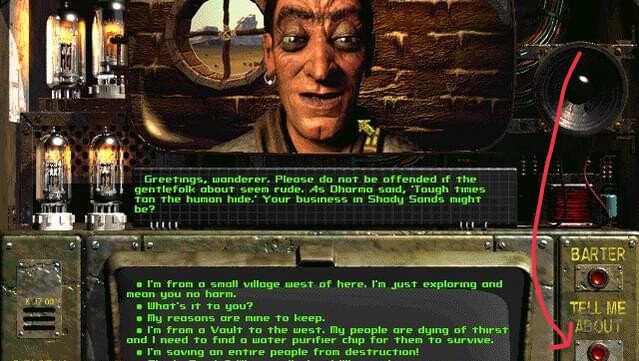
But they also had a “Tell Me About" button, which I drew an arrow at above. The idea being you could ask any NPC you run into about any given topic you might run into in the game. Originally, the team intended for the responses to not always be static or a single line, but as full-on genesis points for follow-on responses and a new branch of dialogue. They also wanted to have the NPC’s opening list of dialogue to then update with a, "Could you remind me again…” option which, if clicked, would list all of the valid topics you had previously found with that NPC, allowing you to bring up that dialogue branch again without retyping it. The reason I say originally is because none of these aspects were fleshed out in the shipped game due to time, and as experienced, the function ended up being fairly sparse. You’d click on the button and a text window would appear:
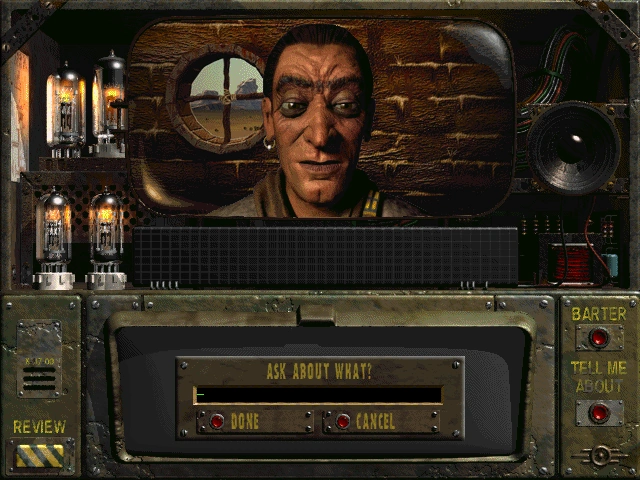
But more often than not, most topics in the shipped game came back with responses that should feel familiar to parser players:
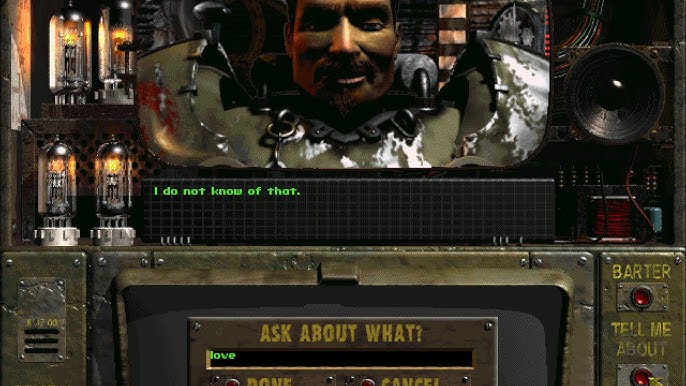
That said, I feel like that functionality could make plenty of mileage in choice games with an optional text input field. In fact, it has already been toyed with in the past. For those familiar with Aisle by Sam Barlow, he went on to write Her Story which uses a similar discovery mechanic to organically discover more non-linear video clips to uncover more of the story:
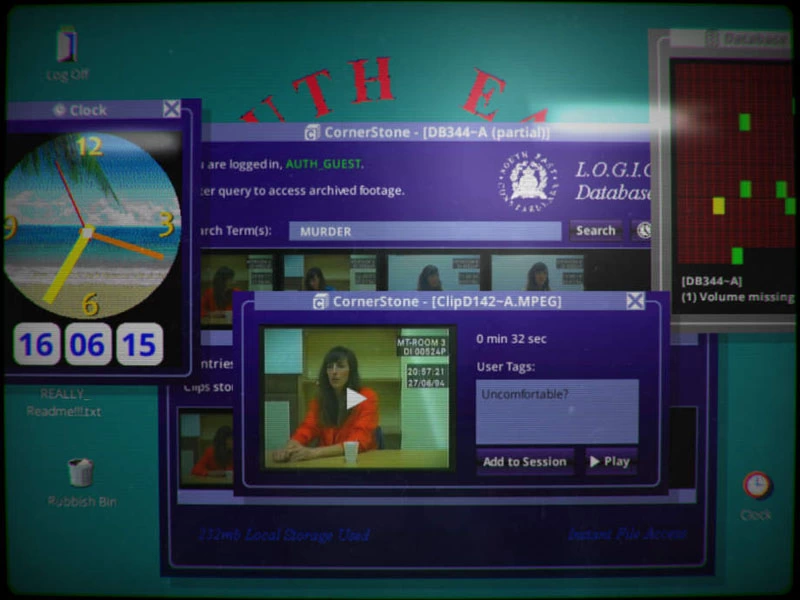
The best thing about it is the format implies topics and not commands, which neatly sidesteps much of the confusion and messiness of parsers. Just make sure you put some effort into synonyms.
6 Likes
A quick Google turned up this Web-based MIDI player. That might be a piece of the puzzle?
I think the important thing is properly indicating what’s “mechanical” and what’s “authored,” because it has different implications when trying to interpret the options presented to you.
If I see that every single item in the game has a “poke” option attached to it, then it’s clear that “poking” is a universal mechanic, and that the presence of a “poke” option on any given object isn’t really information-bearing and doesn’t imply a strong chance that I’m supposed to poke that object. On the other hand, if one particular object has a “poke” option that other objects don’t have, I’m going to assume it’s there for a reason.
3 Likes
Would that not produce the opposite reaction. By marking an option as “not authored” you are effectively telling the player they don’t need to bother with it. it’s a hard one!
Well, the implication of “non-authored” poke options is that there are some objects that you need to poke, but we’re not telling you which ones, and you should probably exercise some judgement and only poke things when you have a good reason, rather than poking everything just because the option is there (so, basically we’re back to something functioning similarly to a parser game).
3 Likes
From the player’s perspective, refusal messages are part of the point of a parser game though. In the old days it was death messages–you took the fatal action just to see the response. Modern tastes aren’t as entertained by deathtraps, but refusal messages have become much more entertaining than I can’t. One of my favorite lines from any game is:
Maybe in real life you could just walk out into the pond, but in this text adventure computer game, you’re required to stay reasonably dry.
Not only is it fun to read, it tells you a lot about what kind of game this is (in terms of how to approach solving or enjoying it), and makes a nod to counterfactuality–the game doesnt support jumping into the lake at this point, but it specifically knows it doesn’t support this (as opposed to generically knowing there is no exit to the west).
It even comments on the idea of wading out into the water in real life: of course I could, but under what circumstances would I actually? Maybe that’s not an important question, but a different refusal message might raise a different, more relevant question.
I’m not minimizing any additional labor for the author. It makes sense to write a choice game when the idea tends to paragraph and link presentation. But I think text contained in refusal messages is as inherently valuable as forward-moving narrative text connected by links. A player can get as much out of these messages as the author puts into them, just like any text in the game. Again, not to minimize the labor of writing them, or the fact that, generally being optional, a given player may read only a fraction of the text you write. Also not minimizing the tendency of objects to breed like rabbits with every sentence written–although I think tools could help make this less of a minefield (it would not be impossible to recognize nouns in your text and check for matching objects, for instance).
When we talk about refusal messages and facades like this, it makes me think of Bertolt Brecht’s distancing effect (Verfremdungseffekt)–the effect of certain techiniques intended to put the audience [of a play] in a state of mind suited to thoughtful consideration of the situation presented (as opposed to being caught up in the action).
Maybe sometimes we assume that the goal in developing a game is to never let the facade drop, or for the player to never encounter anything unimplemented, but it doesn’t need to be. “Thoughtful consideration” sounds very appropriate for solving adventures, for instance, and adventures habitually use other distancing techniques as well, like humor and directly addressing the player. Presentation via text is itself distancing. Potentially, unimplemented objects just reinforce tendencies that already exist in the style. Or maybe the challenges of implementing the world for a parser game influenced Adventure itself to adopt a puzzle-heavy, humorous style.
Sorry for the essay
10 Likes
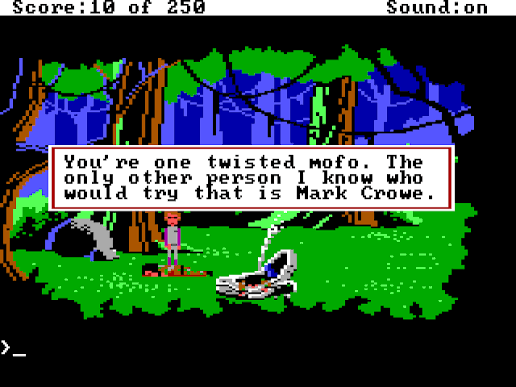
This reminds me of the instinct I had with Dr Morben’s Asylum. In some of the rooms there is a point to searching the bed, or the dresser (for example), in others there is not, but I put those search options in every room, because if it makes sense that you might check under the mattress in one room, why wouldn’t you do it in the next as well?
6 Likes