Outer Wilds is an amazing game. I’ve never played anything else like it.
4 Likes
If character-interaction is what someone seeks in a AAA game, then Baldur’s Gate III should be the most obvious choice. If world interaction is wanted, then a modded Zelda BOTW should cut it.
Thank you for your extensive reply jbg (˶ᵔ ᵕ ᵔ˶)
3 Likes
Ultima VII and Ultima Underworld were, long ago, AAA games…
5 Likes
So was E.T.
5 Likes
Loved the original, hated the reboot. Like you it took me about 10 minutes to figure out it was dumb. In college I briefly worked at Hartzell Propeller - the manufacturer of the propeller MacGyver leans against in the original show intro. 
3 Likes
I’m not sure “it would make no sense for this environment to be devoid of people” really holds up that well in practice. In the old days when bustling cities in video games where often a handful of set pieces with a few dozen residents at most, I don’t recall ever hearing anyone complaining about how unrealistically small towns and cities were. Sure, the tech has advanced and modern hardware can handle cities with more realistic proportions and throwing hundreds or thousands of extras into crowd scenes and even make them all unique by hitting random on the character creator if they allow the player to customize their in-game avatar, but actually populating the world with generic NPCs just kind of highlights the limitations of writing that become a big deal in an interactive medium that are practically a non-issue in linear story telling(a movie or television show can do massive crowd shots of extras, have the hero chase the minion through a crowded place, or have the hero walk into a crowded bar to speak with a contact and no one cares that the extras the hero never interacts with are nothing but bodies filling out the scenery, but put all those extras in a game outside of a cutscene and you either have to include an excuse for the player to never interact with anyone not plot important or give everyone something to say. Is bumping a city’s population from 50 to 50,000 worth it if it meansgoing from maybe 1-in-5 NPCs being actual characters to maybe 1-in-1000 being actual characters and the window dressing NPCs going from each having a unique paragraph of flavor text to not even having a unique one liner for everyone? I could be wrong, but I suspect many gamers would rather have fewer NPCs where talking to even the most inconsequential NPC has a decent chance of at least a useful game tip or interesting bit of world building to having so many NPCs finding anyone who says anything remotely interesting is the proverbial needle in the haystack and is one place where Triple-A’s tendency towards excess can be a detriment… Besides, Writing a thousand fleshed out NPCs is like writing characters of the day for a thousand episode television series… except the television series is probably making those thousand episodes over a period of decades and those episodes are being consumed over a period of decades while the game is probably being developed over a few years and will mostly be consumed over weeks or months, meaning more writing pressure and making character similarity more obvious, not to mention the NPC probably needs more personality and at least something of a dialog tree to feel fleshed out on par with a cotD… If a developer’s writing team can pull it off, more power to them, especially if they don’t involve an LLM, but honestly, I’m not sure all the writers in Hollywood could write enough backstory and dialog to fully populate a city of 50,000 with NPCs who all feel like a decent facsimile of a person, at least not on any reasonable timescale.
5 Likes
I’m normally in favor of giving things a little more consideration before writing it off, but in this case the thing seemed almost designed to be antithetical to the original. It’s funny how often reboots fail because they imagine that doing something new requires changing the basic thing that made the original good, or maybe by misreading what made the original good. Granted the original had flaws and could be pretty one dimensional, I’d say what made it good was its sense of adventure and optimism and likable characters, together with its curiosity and clever technical stuff. Keeping only the technical side and replacing the rest with cynicism and violence undermines the whole thing.
4 Likes
This was one of my reasons for migrating from parser to choice narrative. In choice narrative the author controls what the player can do and see, where the faux “do anything” nature of parser motivates a player to poke at every prop that’s just there for flavor and try to see around the scenery that is unpainted walls in back. Not having to deal with this for beta testing and troubleshooting solves a lot of development headaches despite parser’s charm.
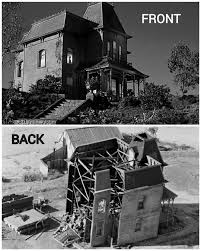
Even in movie and TV and stage production they know not to spend money and effort on the backsides of scenery facades that will never be seen - the classic Universal Psycho house everyone knows was only finished on three sides and when the tram drives behind it you can see it’s open to the air with bare wooden supports[1] because the actual interior sets were filmed on a soundstage; the house is a just facade and there was no point building out a back wall that the camera would never see.
Parser interactivity similarly allows the audience to explore a set and see the staples in scenery and walk around close enough to to discover the painted Trompe-l’œil texture that needs distance to maintain realism and aesthetic design.
Parser is like Sleep No More.
Sleep No More
On a normal stage set you’ve usually got muslin flats as walls and scenery only painted on the side facing the audience who all remain in their seats with a stationary POV and won’t ever have a chance to discover that the desk onstage has empty drawers only containing necessary props that the actors will use, or the shade of that Tiffany lamp is actually a cheap vacu-formed dome on a Target lamp base painted to look like stained glass. Sleep No More is a dance piece combining Rebecca and Macbeth [crosses self] that takes place (in the NYC production) inside a warehouse divided into interior rooms designed mostly as a hotel and the town near it that audience members can freely wander through during the performance experiencing different groups of actors in scenes that occur concurrently. They can follow any actor/NPC through their specific plot scenes and ‘in between’ time. Or not - an audience member could potentially miss every single important scene in the story by choice or bad luck even though the entire plot cycles three full times during a performance. Many people who’ve seen the show multiple times reported exploring empty rooms that don’t have a scene going on and just EXAMINEing things, so the designers had to fully furnish perhaps 80 interior rooms in the space with every bit of close-up-realistic random scenery - desk drawers with appropriate props and written paperwork that supported the story lore since anyone at any time might rifle through a file cabinet - and they wanted to reward exploration, or at least sustain suspension of disbelief. I imagine they also had spend time to glue down fragile or irreplaceable items (parser refusal: “That’s not important right now.”) which they didn’t want anyone to pick up and find a toilet to flush it down.
In choice narrative, the audience metaphorically remains in a stationary seat, or can only press buttons to move around like a Haunted Mansion DoomBuggy and interact how the author chooses; if you don’t have a button or a link to do something, it’s innately clear there’s no need nor facility to try to poke individuals in a “bustling crowded city” with every inventory item filling your pockets.
So in parser, there’s always the worry that if you tell the player about something they will want to interact with it - “this desk lamp was mentioned, it must be important to the murder; where can I carry it off to and flush it down a toilet?” - which requires implementation and troubleshooting and refusal rules and description in every corner and pre-guessing these audience impulses to pick up and examine every single leaf under a fallen tree which has nothing to do with the narrative.
(A black and white aerial image of Universal’s outdoor set for Psycho showing the house has no back wall with support beams visible.) ↩︎
14 Likes
There’s a lot of good points here. The thing is, an author CAN implement more out-of-the-box ideas in text games. I’d also argue that text games give us more diversity, too. @kamineko commented that IF enables us to create experiences without a team of experts. This is pretty cool, because games that would NEVER be greenlit with a large production team can be made by a passionate author. AAA games with high budgets tend to get made by a very small pool of safe-bet project leads. This is one of those really exciting technologies that gives everyone a voice. Anyone can make Interactive Fiction.
So your story can branch in unpredictable ways. A passionate author can make NPCs that interact more meaningfully than just “talk” or “hit” buttons. In fact, there’s pretty impressive technologies in, say, TADS and Inform, that are built to do exactly this!
Glance over the best-selling games list for Steam in 2025, you’ll see a lot of monotony. With a couple of exceptions, all the game stories are advanced through combat. As this discussion has brought out, there’s reasons for this.
But text games are different, and different is good.
2 Likes
People have brought up non-text indie games several times, so it’s odd that you’re still acting like this is a text games vs. AAA gaming dichotomy.
5 Likes
It’s true: game design used to be much more difficult due to technology and computer-power and text adventures were the way to create narratives in text without being an artist or learning how sprites move. Similar to how one person can write a book purely from imagination but creating a film requires potentially expensive equipment and group effort since someone has to hold the camera.
But now consumer cameras and editing software are ubiquitous, so one person or a very small group can independently create a passion project, and if it’s good, people will watch it.
Similarly, advanced home computers and easier game development systems makes game production - even with graphics - within reach of single developers or small groups and indie houses so you get single auteur works like Lucas Pope’s Papers, Please and a flood of exploratory interactive horror games by one person using Unity that may not have AAA visuals but are played and can sell.
I maintain that What Remains of Edith Finch (by a moderately-sized team due to graphics) feels the most like it would work as a descriptive parser game due to its exploratory/minigame nature and inner monologue narration. However, the graphic design of the game is beautiful and superior to paragraphs and paragraphs of text description - which is actually incorporated into the graphics in a unique manner.
It’s very rare nowadays that any motivated person doesn’t have access to media production tools. And the low-res aesthetic enjoyed in many current games proves AAA CGI graphics created by a Skywalker Ranch level sever farm are not necessary to break in.
2 Likes
I think there’s also a bit of a tension at play in mainstream gaming… on the one hand, there’s a constant desire to want bigger more expansive experiences, but at the same time, no one really wants that expansiveness to come at the cost of depth/quality/other harder to measure aspects. Sometimes Tripple-A devs thread that needle and deliver a once in a console generation experience, but sometimes they fumble the execution and end up with something technically pretty and massively expansive, but once that wow factor wears off, lots of players realize that massive world is mostly empty, a lot of the scenery is samey, there’s only a few truly unique types of quest, the NPCs are mostly pretty cardboard and their numbers only emphasizes their flatness, etc… and the more expansive the game world has to be to top what came before, the harder it is to thread that needle… In some ways, indie devs are actually in a better position since they don’t have the pressure to be bigger than everything that came before and can focus on picking the best of the content they make for the final project and can afford to be a bit more experimental without risk that their audience won’t be big enough to break even.
And yeah, it’s sad how often the people in charge of reboots completely miss the point of what made the original a hit.
3 Likes
That’s why I appreciated the MMORPG Runes of Magic (shameless plug: see my 15-years-old capsule review) for embracing its nature and pretty much acting like the theme park it really is. Made for some surprisingly good moments anyway.
Come to think of it, my eternal beef with videogames is that most people who make them never truly embraced the new medium, and kept wanting the games to be anything else instead: books, movies, whatever. Embracing a medium also means embracing its limitations, and taking advantage of them. Sadly, that’s anathema to a lot of creators. They have a Vision™, you know.
3 Likes
Reminds me of the brief time when technology came of age and there was serious talk of making movies where every viewer could choose the camera angles and focus on whatever they wanted. Thankfully that never came to pass. Presumably some people with common sense explained to the technologists how that completely misses the point of cinema as an art form.
That said, weren’t there some discussions right here on this forum about the necessity of getting the audience to play along? Not so much suspend their disbelief as accept that a cheap prop or special effect is part of the story, not a mistake or failure. Yet even in interactive fiction audiences expect absurd amounts of polish. Everything implemented. Everything described. A reaction to every dumb thing the player tries. A smarter parser than anyone needs. How many players ever type “drop all except the sword and hit the giant spider with it”? Who cares, each and every game is expected to understand that anyway, because of course.
But does it—what is there to film as a point or essential nature (if there is one) outside the raw capability of the moving image? And even if it does, would such technology—were it to be practicable—not give birth to a new form of art that could utilise such resources? Viewing camera angles, say, as part of a fixed component of the work is path dependent and not derived from the nature of the moving image as such. Yes, the considerable troubles with interactive film of any sort indicate that the path dependency has good practical reasons behind it, but it wouldn’t exile such experiments from being film anymore than the dominant aesthetic code of film exiles abstract film from being film.
Should realism necessarily be a goal for parser works, or choice?
Do you think every detail in IF works should serve the narrative? Do you think player interactions which don’t serve the narrative should be minimised?
Unless, of course, you have a link that implements a generic poking action for any inventory item you happen to have, etc. This makes it clear there might be a facility—but is it implemented…?
1 Like
Framing is pretty much part of the point, much like in photography. It’s an entire art within the bigger artistic medium. Focusing the viewer’s attention on what matters – what you’re trying to convey in the first place. Not coincidentally, that’s widely considered a hard problem in parser IF.
3 Likes
This would be a very funny way to port a famous choice IF to parser. Each and every thing in the Choice game is faithfully recreated in the parser version, but only two dimensionally, and the slightest of examination reveals fake drawers, scenery facades, and the back stage and makeup rooms.
6 Likes
Reminds me of Craverly Heights
1 Like
Mine too, though I still have at least one parser game I intend to complete. I’ve made both kinds and the parser games were an order of magnitude more complicated to make. There’s nothing more disheartening than when you’ve tried to anticipate every possible way a player could phrase a command and people still complain about a lack of synonyms, which is what happened with my last game. I felt so defeated I never even bothered with a post-comp release and have scarcely opened I7 since.
I think this might be part of the reason for the “limited parser” fad - with fewer things the player can try there’s simply less to debug.
One of the nice things about the choice-based format is that you can add details that are purely there to set the scene, or are even just throwaway gags, without having to worry about the player trying to interact with them.
6 Likes
Depends on the story. IF can be unrealistic but still well-implemented. I think what we’re discussing is actually mimesis[1]. There’s a difference between encountering a dragon in your kitchen (unrealistic) versus the player then typing >EXAMINE DRAGON and being told “You can’t see any such thing” directly after encountering it (broken mimesis).
“Ideally” in response to the first question; the second is a matter of style and expectation. Ryan Veeder wrote in a blog how he strips descriptions down to only what he wants the player to interact with so he doesn’t have to implement unnecessary scenery. Some authors may consider this a cramping of style, but if you write a verbose scene description mentioning wallpaper and cracks in the plaster and dust motes in the air, that naturally calls attention to scenery that in a book would just be rich description the reader can’t interact with. In IF the player might be curious about all that since attention was brought to it in the description, so the author should make sure that the player can reference anything described, even for a “That’s not important right now” refusal which is a bit better than “You can’t see any such thing,” when the player was just literally told they see a thing.
One of the cool things about parser fiction is authors can include a large amount of detail that wouldn’t be important in a book and parser players tend to like that amount of world building. However lots of rich descriptive detail creates a lot of implementation work and can take focus away from the main plot and pacing of the story, so it’s up to the author to decide how much they present and describe. One common mistake is over-detailing starting rooms and then slacking off later in the plot, so it’s important to be consistent with the implementation depth presented to the player so the first room isn’t elaborate and interactive and then the rest of the rooms are just boxes containing the one item the player needs.
Sure, but that’s still the author controlling when you can poke something. I only need implement a “poke” link when it’s needed - the player has the billiards cue stick in the room with a mysterious pool-cue-sized hole and I can add that interaction in a choice narrative only in the correct location when the proper resources are at hand. With that puzzle in parser it’s necessary to implement a POKE [something] command that redirects likely to INSERT CUE INTO HOLE, but since that action isn’t limited to where it’s useful you’d definitely need to figure out everything else the player might poke a stick at and make sure it responds logically. “That’s not likely something you want to poke a stick at.”
In choice, I could implement a universal-poke command if I want to and make every person in the town square react with a unique line when the player assaults them, but why do that work if it’s not important to the story? Sure, realistically a player can stand in Times Square with a pool queue and twirl it around like a ninja, but feels more sensible not offer that option when every response except poking a billiard ball and poking the hole in the wall would just amount to a “that’s pointless” refusal.
TL;DR: Parser allows the player to try any command on anything and thus frequently has to tell the player no, whereas in choice a player is only offered choices which will result in success or potentially a plot-based refusal for choices that would only apply to the mindset of the character and situation: “Although you feel like punching your boss in the face, that probably would result in an unsatisfactory mark on your review.” Or for a universal action “You don’t have enough mana points to heal yourself.”
Yep.
“As stated before, I see successful fiction as an imitation or “mimesis” of reality, be it this world’s or an alternate world’s. Well-written fiction leads the reader to temporarily enter and believe in the reality of that world. A crime against mimesis is any aspect of an IF game that breaks the coherence of its fictional world as a representation of reality.” – Crimes Against Mimesis; Roger S. G. Sorolla https://www.ifarchive.org/if-archive/books/IFTheoryBook.pdf ↩︎
4 Likes