Ah! A delicate balancing excercise indeed…
Welcome!
Ah! A delicate balancing excercise indeed…
Welcome!
Hi everyone. I’m Sean and I’m new here. I’m old (fifties), based in Australia and among other things a stand up comedian.
What I’m working on now, what brought me to this community, is an IF book which I’m mentally planning as maybe the first in a series. The theme is cosmic horror, with the idea that the player works for a secret government department dedicated to protecting the world from supernatural extra dimensional threats.
The format? Book. I loved the Fighting Fantasy, Lone Wolf and CYOA books as a kid - it was a perfect solution for a kid who was into D&D but lived remotely. I see there’s a bit of renewed interest in them, which warms my heart.
I was genuinely surprised to see that everyone authoring here is doing it in a software format with Twine or Ink or some kind of language which puts their IF online. I would love to hear if anyone else is doing it old-school without the screen interface?
It certainly comes with challenges in terms of wanting choices the player has made become relevant later in the story without an algorithm tracking it. I’ve gone with code words, but others use collected items (Ian Livingstone style) or some kind of tracker like hit points.
I’ve developed my own philosophies about the design of this stuff along the way and interested also to hear from anyone else who wants to geek out about that aspect.
For example, I’m avoiding dice and tracking stats. I know that lots of people in gamebook communities look down on “simple” books that don’t use “a system,” but I strongly disagree. I don’t think that leaving the immersive environment to go play some randomized minigame adds depth, and i don’t think that rolling dice and seeing which number goes to zero first adds any complexity.
Also, the results are a lot less strategic or tactical than anyone thinks. It’s random, which is probably why nobody feels guilty about cheating :)
Not using them brings it’s own challenges, because then I have to balance positive and negative consequences for prudent or stupid decisions and have to think about how much information to give for those choices.
Anyway there’s a lot of those aspects I’ve been agonizing about and happy to talk with anyone who has feelings about these aspects.
Happy to be here!
Hi all!
I guess I’m revealing my age when I say that I’ve been an avid player of interactive fiction since before “interactive fiction” was even a term and parsers seemed perversely designed to antagonise and frustrate the player. It was the Infocom adventures that first showed me the art of the possible with storytelling and technology. I still fondly remember playing Planetfall back in 1984 and marvelling at how Steve Meretzky was able to ramp up the tension towards the end of the game and lead the player towards a really satisfying conclusion. I think this played a significant part in my decision to follow a career in development.
I had a fairly lengthy and successful career in Finance Technology in the UK that was abruptly cut short after a stroke. Whilst I was recovering it was, bizarrely, interactive fiction that again played a key role. I was initially concerned that my cognitive abilities could have been impacted so I pushed myself to complete progressively harder challenges. So, after 40 years, I returned to those Infocom games as my first challenge.
I was amazed at what the IF community had achieved in reverse-engineering the Z-Machine and building tools to create new stories so my second challenge was to create my own interpreter that ran within Unity so I could incorporate a Z-Machine game to run on a virtual screen (or multiple screens) in a 3D environment. This may all seem a bit meta but as a disproportionate number of this community seem to have built their own interpreters it felt like an appropriate “rite of passage”.
My third and final remaining challenge (and the reason for creating my own interpreter) was to explore the possibility of auto-mapping as you play a game as manual mapping is a pet hate of mine. I’ve gone some way in creating an approach and implementation for this but I’d like to collaborate and share with this community as the combination of deep technical understanding and creative minds should be able to crack this. Please feel free to reach out to me if this is also an area of interest for you.
Have you looked at e.g. Trizbort’s code, or is the challenge to do it from scratch without looking at existing implementations?
Josh, thanks for the response. I haven’t looked at Trizbort’s code although reading up on the documentation it does seem to be a clever tool. I was looking to integrate the mapping into the interpreter as you then get access to the objects / locations from the story file and this should then solve some of the documented shortcomings of Trizbort such as problems with repeated room names.
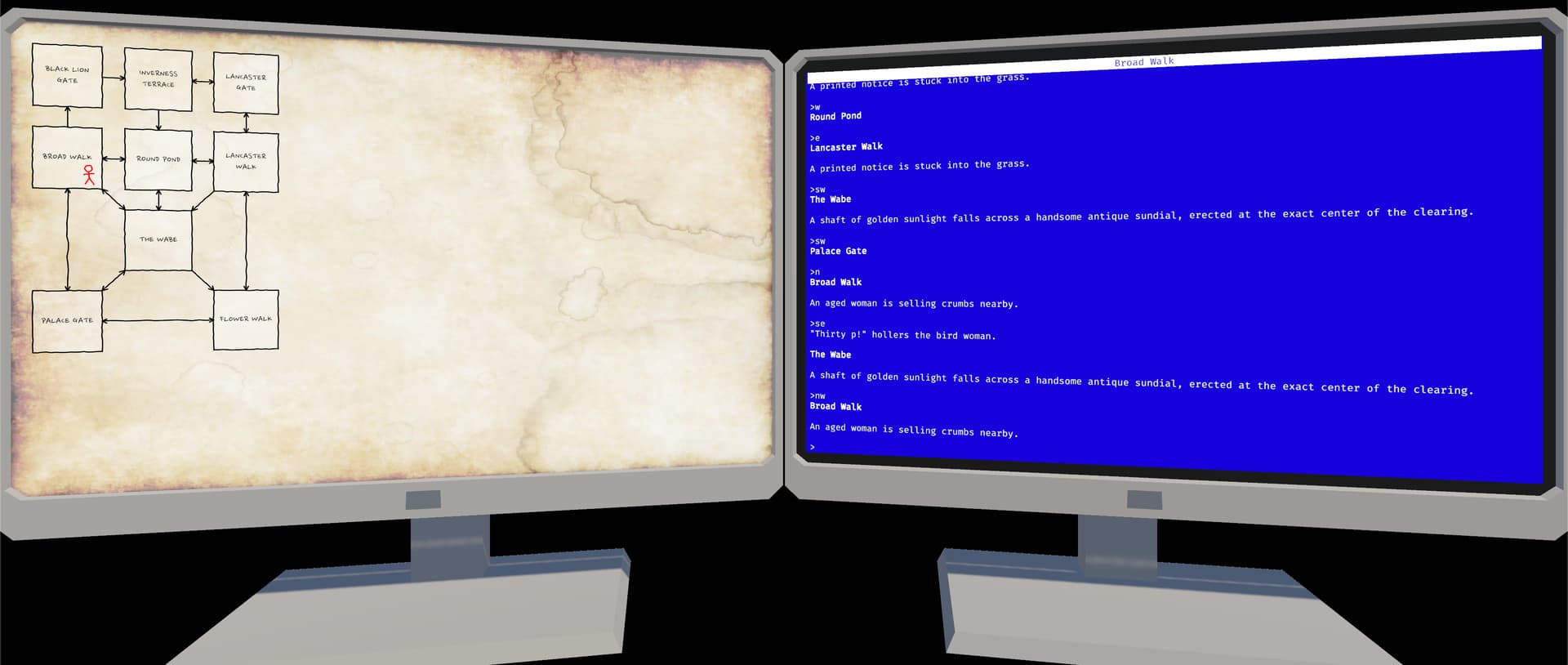
I’ve gone some way towards achieving the auto-mapping on my own. The screenshot shows Trinity being played on a virtual PC inside a Unity game with one monitor showing the game view and another monitor showing the map.
The problem IMHO with automapping is that there will always be cases that can’t work automatically. If you are ok with that then yeah building it into the interpreter works.
I went a different route with my interpreter and decided I prefer bespoke maps for each game. My code isn’t public (yet), but I can make a map file for a game and my interpreter will reveal it dynamically, along with items, player indicator, etc. It also allows for custom inventory screens and other grapical status indicators. Almost anything is possible, inlcuding supporting multiple maps per game using different art styles or layouts.
Hello. Could you please tell what Unity gives for you as the author of such interpreter?
I’m curious why did you choose this tool.
The mapping tool looks nice - although some games are difficult to auto-create a map in the planar graph.
----rolls up sleaves----raises hands in the traditional fisticuffs pose----
Arrrgh! Them is fighting words there mister!
Welcome!
Thanks Mike. I actually came across your thread yesterday and that’s a key reason I joined this group. I suspect you may well be right that could be some really nasty edge cases and/or some very devious IF authors that make auto-mapping challenging, e.g. the switchgear maze in Bureaucracy. However, I’d like to think that if my 12 year old self could map a game manually in the 1980s then 40+ years later my adult self can find a way to map a game automatically. I like solving challenges! 
Seriously though, I like the approach you are taking and I’ll follow your progress with interest. Good luck!
Thanks. Good luck to you too.
Edit: Suspended would be a good test case with its six robots moving even when not directly controlled by the player.
Hi Robert, the only reason I chose Unity was simply that I had a crazy idea that I would create a 3D game where one of the locations would be a 1980s development team office where they were creating an interactive fiction game that you could actually play on a virtual PC inside the game. With the foresight that the original Z-Machine implementors had to create a virtual machine model this made this task surprisingly straightforward.
I probably wouldn’t choose Unity if I was solely looking at building an interpreter as there are other simpler ways but, being a masochist, I chose to take on a slightly bigger problem!
I’m keen to know if you have any particular games in mind that are difficult to map.
I never used Unity but I’ve heard many people use it for 2D and 3D games (I was a computer-science student).
I myself like to code in C and C++. I was just curious why are you embedding the interpreter/game inside such environment. The only logical answer to me was the graphical output and keyboard input from the user or some other functions that can help with implementation.
I’m not sure, but the Unity library must provide some functions to process the text including parser and files manipulation.
This is how I see it. Of course I don’t criticize Unity, you can use it. 
Also the map looks fancy, so some graphical assets were used to draw it.
One example is the Colossal Cave. The rooms don’t form a consistent structure based on directions. And I don’t mean maze, which is there within. I can imagine how auto-mapping feature must be difficult to write.
I also wish you good luck with the project! And welcome to the board.
Speaking of Unity, @fatmarrow has been working on a hybrid text / 3d game in Unity. He’s described a fair bit of his process in this thread, including this video of the game in action.
Thanks Ivan, kudos to Matt / @fatmarrow for a seriously impressive demo. Actually, the whole parser discussion is really interesting to me as one aspect of the fundamental question of “how can we tell engaging stories that transport the player into a world we create?”. For me, the parser question was slightly simpler as I chose not to create my own from scratch. My game is set in the 1980s so it seems fitting to have a Z-Machine interpreter which is significantly easier to build for than a new parser. I don’t envy you… 
Hi everyone, I’m Matt. I’m 28 and from Massachusetts.
I’ve been loosely into interactive fiction for a while. It’s only recently I became interested in writing a game myself. So I’m studying the Inform 7 documentation, general game design and playing IF games from the classics to more recent releases.
Hi all, Luciano here. Grew up in Italy, now living in Singapore.
I came mostly a background reading Visual Novels. Recently got interested in IF as I see some similarities and overlap with VNs. I’m currently developing a tool for creating Visual Novels without any coding.
I want to create some interactive stories and improve my writing and storytelling, world building. Pretty new here, still learning!
Heh, same. I’m not about to dox myself but it’s a funny coincidence!
Hi everyone!
Having an account for over 3 years now, I should probably introduce myself after lurking for this long.
I’m Timmy, old enough that I bought an 8 bit computer (ZX Spectrum) back in the day from my own pocket money. It came with two games in the box, one of them was called The Neverending Story, a “simple” text adventure with good looking graphics, and a beautiful song from the movie. That’s probably the start of a long interest in text games, but it could also be the CYOA books as well.
People who knows the 8 bit scene might know me as well, as I’ve written several 8 bit games in this century. Among them, also 1 text adventure game, and I’m also the person who reverse engineered the Graphical Adventure Creator (GAC) format and wrote the game in it. (Hi Strident!)
As for the raif/rgif/if-scene, the last time I played/voted on if-comp was when Photopia was released, which is way too long ago, but I lurk mostly. I do see interesting stuff over here occasionally (usually about 8 bit related stuff) and sometimes I would like to react, but it’s probably easier to introduce myself first.
So erm, hi everyone!
(Note: at the moment I’m not doing that much at the creating front, due to some (hopefully temporary) health scares. And English is not my first language, and this post took me like an hour to write, so I can’t promise to write or read much on here, but at least know that I am lurking, and I might spend some time to reply about stuff. I usually read this forum once a week, so please don’t expect quick answers.)
Realized I’ve been lurking for months and never actually made an intro post, so saying hello, formally.
I first discovered IF through a let’s play of Adventure, and, from TV Tropes, played Galatea, the super early days of Choice of Games (Dragon, Broadsides, the first two parts of Affairs of the Court/Choice of Romance and of Choice of the Vampire) and following, Fallen London, 80 Days, Blue Lacuna, plus a whole bunch of visual novels. Though, if you count physical gamebooks as interactive fiction (are they?), Joe Dever’s Lone Wolf series was my first experience and a childhood favorite.
I heard about IFComp 2025 from a few posts on social media, looked through the website, and saw you are an ancient chinese poet at the neo-orchid pavilion. That was the game that made me create an account and go on to play most of the entries. I’ve enjoyed reading up in the forum for resources, people’s reviews, awesome essays about IF history, and other game jams (just finished playing most of ShuffleComp 2025 in fact). I’m excited to explore more games from the past to upcoming works!
That’s an awfully specific set of ticked boxes in the title to get you excited to the point of finally making an account. (As opposed to more generic IF classics such as Loot the Dungeon or Cure Your Amnesia by Wandering Around an Abandoned Space Station…)
Welcome!