If you’re looking for collaborative/example IF play with actual content, you might want to do a search for the phrase “let’s play” or the tag lets-play where usually someone plays a game and comments the transcript with their impressions as they go along.
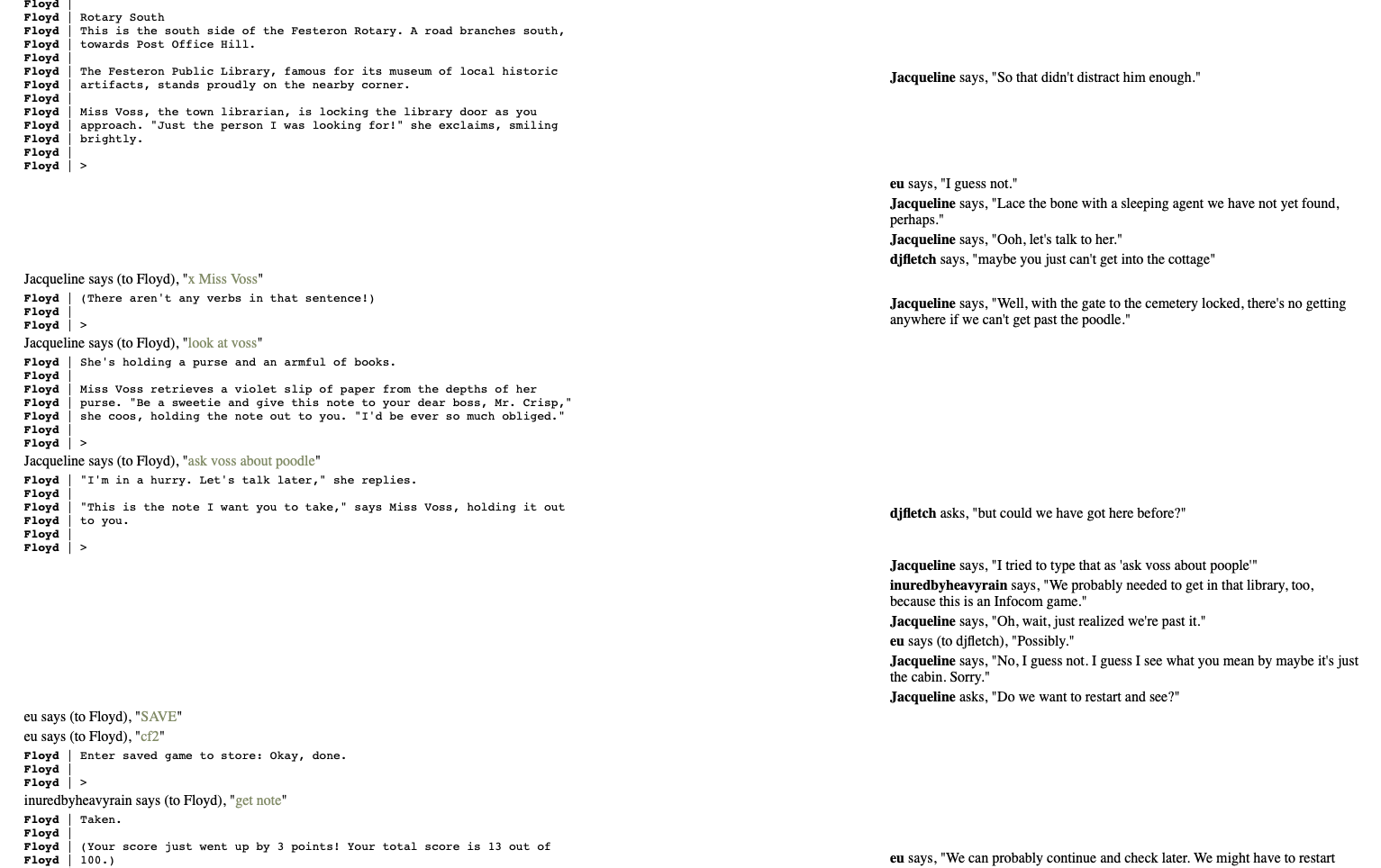
Another good source of collab play is the transcripts of ClubFloyd where people periodically gather in a MUD to play and discuss a game in a special interpreter that allows MST3K-style side chatter:
Which reminds me I never finished the Trinity one! I was going to come back to it after ECTOCOMP, but now that turned into coming back to it after Iron ChIF…
Hi everyone! I’ve been lurking for the past couple weeks mostly looking up questions about Twine which I recently started using, but some questions I struggle to find answers to, so I figured I’d sign up and ask them myself. I use the SugarCube format on the twinery.org online workspace. I work from a mobile because it is the only device I have and I am learning programming in the process, which is something I’d been wanting to do and am enjoying. Finding things to effectively learn from has been challenging, but Manonamora’s 100% good guide has been incredibly helpful and I’ve found a good deal of answers to my questions thanks to comments by HiEv, either here or on Reddit, so I’m very grateful for the both of them! I come more from a gamer’s background than a reader’s and I look forward to learning more, discovering cool IFs and meeting this community!
Hi everyone. I’m new here, but I’ve been a fan of IF all my life - from physical CYOA books to text-based adventure games like Dark Lord (Freeman) and DragonWorld (Trillium, Stephens/Priess), etc. I recently got the itch to play some of these types of games again and I figured technology has probably advanced enough so there must be something out there… I was pleasantly surprised to find a few options out there as well as this forum!
Hi everyone. I’ve loved interactive fiction for a long time, and I am the sort that wants the author to have maximum power over the game, so I like TADS 3 because it feels a bit like writing a game in C++ with an interactive fiction pre-processor. Or just write the game in Rust for total freedom.
Lately I’ve had a nagging idea that I can’t quite figure out and I’ve been searching the web for helpful resources, but it is not easy. I have been thinking: what if the author did not need to write the text. What if the text were written automatically based on the state of the game, and all the author had to do was design the game’s map, fill the game with objects and NPCs, and make the rules for how the player can interact with the world.
In other words, the author determines what the player can do and what the consequences will be, but the combinatorial explosion is avoided because the text to describe the current situation is not written until the game is being played. If the author does not need to worry about combinatorial explosion, then the author has far more freedom to create a dynamic and freely explorable world.
I am hoping to make a post about this if I can get my thoughts in order, but the more I ponder this possibility the more difficult it seems.
I certainly do not intend to use an LLM to generate text, such as GTP, since that produces creative writing which is the opposite of my goal. I do not want text that invents new ideas. I want text that expresses the current state of the game accurately and concisely.
Think of it like when a graphical game renders an image to the screen. There are certain enemies and certain items in certain places, and the renderer faithfully draws the scene as it should be, with no invention nor creativity nor AI. Now instead of rendering an image, let the renderer produce text that describes the same thing in words.
What if the text were written automatically based on the state of the game, and all the author had to do was design the game’s map, fill the game with objects and NPCs, and make the rules for how the player can interact with the world.
Perhaps it’s not what you’re looking for, but this sounds a lot like Dialog to me. In Dialog, you describe the rules for interaction by using predicates. Objects and the game’s map (e.g. navigating via compass directions) are implemented as pattern-matching under the hood, and the same goes for any kind of behaviour included in the game. The author just describes relationships between them, and the game will search for actions and consequences.
Some flavour text still has to be written though, since there often needs to be text printed for aspects of a character, like (name #guard), room descriptions and the like.
Text-adventures produce dynamic text. It’s like we have objects names “book”, “coin”, “bird”, “lamp”, “key”, the adjectives “small”, “red” and we put sentences which use these words, keeping the grammar correct, like “You see object name in the grass”. “There’s a object name on the table. Where the blank places can be replaced by any other string, constant or dynamic.
It’s easy to generate complex descriptions that way. Computer replaces the blanks with calculated strings and check the conditions whether to place one or another string.
Achieving grammar correctness of the sentences is up to the author of the adventure game. Also he can extend the descriptions in such manner that they are more interesting.
On the other hand objects in text-adventure work so well with data base or object tree. Thus there are systems that use these data storage methods.
Automation is very often used within text-adventures, but in my opinion, the “root” text is better when created by the author. Maybe something has changed in the meanwhile, but I recall narrative books (and games) from great authors. Note also that puns, that some authors use in their adventure games can’t be (easily) generated.
Computer-generated graphics is based on some data including the colors of the pixels calculated by various routines (shade, saturation etc.) grouped into objects with animation frames.
In text-adventure I expect the text to be unique and stimulate imagination. The dynamic text is OK to use.
Hello I see this is a very long introduction thread. I’m CT, and my interest in interactive fiction is relatively new but my interest in fiction isn’t. I played my first IF game less than a year ago after accidentally discovering them through Fallen London and have since become a bit enamoured with the art form. I have a little experience with both fiction writing and computer science, and I hope to one day produce my own work (It seems daunting but worth a shot). For now, I want to explore the vast range of IF that already exists and contribute to the community a little with reviews.
My favorite bit of IF is currently Excalibur (2021), but I keep finding new and exciting IF so it changes just about weekly.
Hello everyone. My name’s Eli. I’m here to learn, get to know people and help as much as I can. Happy New Year’s to everyone. Big hello from this side of the world "૮₍ ˶•⤙•˶ ₎ა
Hello, I’m a 16 year old American and I’m working on a text-based adventure project in my spare time. I actually know pretty much nothing about IF ha ha. I first got exposed to it a couple years back when we got out our old Atari 2600 and played some Zork. Unfortunately, we accidently saved over our copy of the game. That inspired my to attempt to create a “replacement” game. Long story short, I’m kinda making the third game in the series using a special framework/engine that I coded in Python.
Anyway, I joined this forum to see how other people go about making text-based games and such. I might reach out for tips or feedback here occasionally.
Hello! I’m Rylan, and I’m a 25 year old hobby artist who’s been lurking the IF community, in various spots across the web, for around…. ten years now? I have a few projects in development currently, and this forum has been a great help in expanding in horizons as to the IF out there, the history of it, and answering questions I have about the program I use, so it felt right to make an account and interact with the community more.
My current focus is in making semi-interactive narratives in Twine, the same stuff that inspired me a decade ago. My current biggest project is HERETIC, a single-player social deduction IF in the style of Werewolf/Mafia, played out over the course of a week at an all-girl’s summer camp, after the camp lead was discovered to have been murdered. I have a few others on the cooker, like Crash Blossoms, TSOCF, All We Know is Falling… all sorts of stories swimming around in my head, but I gotta remember to focus on one at a time (and not spend hours scrolling this forum!) if I wanna get something done!

 I see this is a very long introduction thread. I’m CT, and my interest in interactive fiction is relatively new but my interest in fiction isn’t. I played my first IF game less than a year ago after accidentally discovering them through Fallen London and have since become a bit enamoured with the art form. I have a little experience with both fiction writing and computer science, and I hope to one day produce my own work (It seems daunting but worth a shot). For now, I want to explore the vast range of IF that already exists and contribute to the community a little with reviews.
 I’ve had to do this for one or two games before, and it’s always a really rewarding journey!