Chapter I - Tutoria
So what exactly are we getting into here?
Anglophone Atlantis has been an independent nation since an April day in 1822, when a well-aimed shot from their depluralizing cannon reduced the British colonizing fleet to one ship.
Since then, Atlantis has been the world’s greatest center for linguistic manipulation, designing letter inserters, word synthesizers, the diminutive affixer, and a host of other tools for converting one thing to another. Inventors worldwide pay heavily for that technology, which is where a smuggler and industrial espionage agent such as yourself can really clean up.
Unfortunately, the Bureau of Orthography has taken a serious interest in your activities lately. Your face has been recorded and your cover is blown.
Your remaining assets: about eight more hours of a national holiday that’s spreading the police thin; the most inconvenient damn disguise you’ve ever worn in your life; and one full-alphabet letter remover.
Good luck getting off the island.
So yes, this is a whole game built around wordplay. As with so much in parser IF, it’s a subgenre launched by Infocom, the twin pioneers being the hit-and-miss minigame jumble of Nord and Bert and the justly-celebrated t-remover puzzle from Leather Goddesses of Phobos (I’ll get back to the blurb in a bit, but that depluralizer gag feels like a missed opportunity for a t-remover homage, since that would have made the fleet flee). I’ve played and enjoyed a couple of the big entries, like Letters from Home, a cryptic crossword in IF form, and Ad Verbum, which is more or less Nord and Bert but good. I feel like it’s become a bit less popular in recent years, possibly because Counterfeit Monkey feels like it occupies the field, though the massive asterisk here is Andrew Schultz, as a large portion of his prodigious output focuses on wordplay.
While there are a variety of different approaches, the unifying principle here tends to be that progress depends on solving puzzles that turn not on medium-dry-goods object manipulation, but on playing with words – beyond pulling letters out of them, there’s reversing them, alliterating them, shortening them from the front or the back… It’s a natural fit for the parser format, leveraging the you-can-type-anything magic of the interface; heck, it’s pretty clearly a more natural fit than the Zork-like adventuring framework that wound up predominating.
Anyway, what’s the blurb telling us? Well, first that letter-removal will indeed play a key role in the puzzle-solving, though we get a tease of other mechanics too (letter inserters and diminutive affixer seem clear enough – let’s turn a filet mignon into a filet mignonette! – though we’ll see what exactly a “word synthesizer” does). Second, we’re a spy, which is its own robust IF subgenre, and another good match for the look-and-steal-everything default mode of parser interaction. Third, that this Atlantis speaks English but isn’t British, having won its independence soon after Waterloo (presumably they relied on the Navy to protect them from Napoleon, but then took advantage of war-weariness and demobilization to break free of the monarchial lash). History-nerd that I am, I’ll be keeping an eye out for more hints about this backstory!
Enough throat-clearing, let’s get into it, and we get a short dialogue before the title drop:
Can you hear me? >> yes
(Just so we’re clear, that “>>” is a real prompt, that “yes” was my response).
Good, you’re conscious. We’re conscious. I’ve heard urban legends about synthesis going wrong, one half person getting lost.
Erm, OK, guess we’re learning more about what “word synthesis” actually entails!
Do you remember our name?
>no
To review, we’re Alexandra now. I was Alex, before the synthesis. You were…
I can recognize a pattern!
>andra
…yes! Okay. We’re both here, neither of us lost our minds in the synthesis process. As far as I can tell, the operation was a success. We’re meant to be one person now, unrecognizable to anyone who knew us before.
I would say that if the goal is to be unrecognizable, using “Alexandra” as our new name won’t exactly throw people looking for Alex and Andra off the scent as much as would be ideal, but since it seems like nominative determinism is the law of the land here, we might not have had much choice in the matter.
Counterfeit Monkey
A Removal by Emily Short
Release 11 / Serial number 230220 / Inform 7 build 6M62 (I6/v6.41 lib 6/12N)Let’s try to get a look around. I haven’t been able to run our body without your help, but maybe now you’re awake, it’ll work better.
To get a look around, type LOOK and press return. If you do not want help getting started, type TUTORIAL OFF.
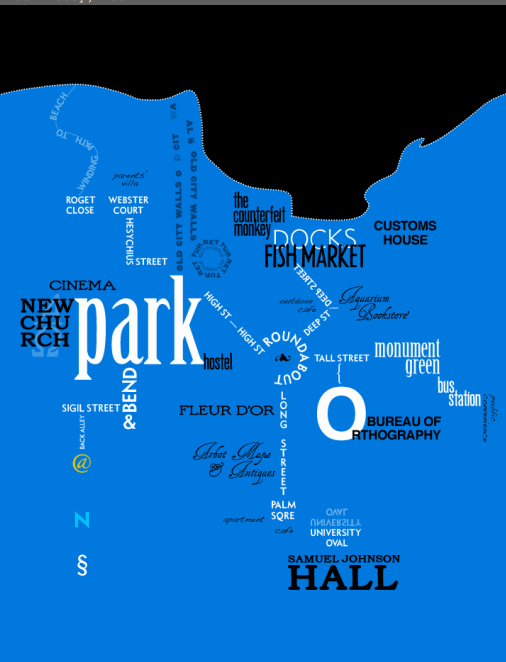
A title drop and a map drop all at once! As to the latter, there are obviously a lot of intriguing places laid out here – not least the ominous O of the bureau the blurb warned us about – but I’ll hold off on commenting on the names until we get to the locus in quo. One nice convenience is that the map is dynamic – the little @ marks where we are, and the compass rose marks potential exits, with unvisited ones blue and ones we’ve already gone to showing up in white. This definitely helps manage the agoraphobia I sometimes feel playing Short’s games!
One other interface note that’s not obvious from the transcript: in addition to the location and score, the status bar has been updated to show the time of day (noon – per the blurb, guess we need to escape by dusk ) and “Goals: 1”, indicating that we’ve currently got one goal (stay tuned for details on that).
I left the tutorial messages up through this play session, but didn’t always follow them to the letter, because that’s the kind of bold rebel I am, man. Here, though, looking about does seem like a good idea, though the keen-eyed among you will have already sussed out that we’re in the back alley:
Back Alley
This isn’t much, is it? Just the back sides of a couple of buildings, some peeling yellow paint, and not even much by way of windows to look in through. I think the place where we had the procedure done is just a block or two away, but I’ve already lost the door. I imagine they change it.This alley runs north to the open street, towards the town square. That’s the way we’ll want to go first.
You can find out more if you LOOK AT THE YELLOW BUILDINGS (or shorten it to L YELLOW BUILDINGS).
Nothing too exciting here in terms of scenery – though I did experience a brief stab of terror at the idea that I’d need to retrain my muscle memory to L everything in sight, rather than Xing; happily, in the event both work – but we are getting a sense of how the narrative voice is going to work: everything appears to be spoken by Alex, so I suppose “I” is him, “you” is us/Andra, and “we” is us/Alexandra. This suggests that the two people retain their distinct identities in the synthesis, and Andra is in charge of directing action while Alex handles perception? There are various psychological theories we could try to map this onto, but probably best to hold our horses on that front for a while until we get a clearer sense of how this all plays out.
On a more inconsequential note, when I noticed the status bar stuff mentioned above, I wrote a comment to myself (since that’s often how I flag stuff I want to talk about in an LP), and this happened:
>* says “noon” in the status line – also “Goals 1,” interestingly
(Adverbs are almost never necessary. Retrying that as "* says noon in status line – also goals 1, ".)
So that’s a fun bit of newbie-friendly action processing.
Anyway, back to this unprepossessing environment, there’s really only the one bit of scenery that the tutorial is pushing us towards checking out:
>x yellow
The buildings are no doubt due for renovation, but haven’t received it yet. There are no windows facing this way.
You have a fleeting thought of how we got here.
[MEMORIES will list your currently active memories]
There are other things around here that you can look at too, if you like. You can check out other things in your surroundings, or LOOK AT ME to see yourself.
We are definitely going to check ourselves out since the status of our physical body is currently an interesting question, but let’s investigation this MEMORIES system first:
>memories
Currently on your mind is how we got here.
[REMEMBER any memory to review it.]
So it’s a semi-interactive flashback system – really just making sure you don’t get overwhelmed with walls of text, I suppose. The cued syntax works a breeze:
>remember how we got here
Cluttered Industrial Room
The synthesizer was right at the center of the room, and we were inside it. An unshaven man in a blue jumper was prodding us with his foot. “Wake up! Wake up!”But we couldn’t move, even though you were half-conscious. So he panicked. We’d paid him to let us recover in comfort, but he wasn’t about to risk having a corpse on his hands, even an unidentified one. He picked us up and dumped our body in the Back Alley and left.
Then we’re back in the present.
Thing one, I’m not so sure that having an unidentified vs. an identified corpse laying about the place when the filth come calling makes that much difference in terms of how much trouble you’re going to be in, and thing two, the pronoun-details here seem worth calling out: “we” couldn’t move, confirming that that pretty much means our body, and “you”/Andra was half-conscious but unable to make said body move. Since this is a post-synthesis memory, the narrative voice is presumably still Alex, so perhaps that indicates he was aware of what was going on and that’s why we can remember things so clearly?
Speaking of bodies:
>x me
This body is more you than me ? well, it would be, since we came out a girl. Still, I feel a bit odd inspecting us too closely. It feels like invading your privacy.
Feel free to look around some more. When you’re ready to move on from here, try NORTH.
Oh blarg, transcript formatting issues rear their heads – that ? should be an em-dash. I’ll try to correct this stuff moving forward as I see it.
On the substance, this is more grist for the idea that Alex is our perceptual faculties and Andra is the active side of things. It does seem like the physical piece of the amalgamation is smoother than the personality one.
While musing on this, I also thought it was kinda funny that the female character’s name is “Andra” – I get you need that to make “Alexandra” work, but “andros” is Greek for man, so there’s a bit of confusion here.
After X ME, we check our inventory, as is traditional:
>i
You insisted that we bring almost nothing into the synthesis room, so the criminal who was performing the synthesis couldn’t rob us. I had hoped there was more honor among thieves, but you said no, there isn’t.
We are equipped with your R-remover – an essential we mustn’t part with.
So Andra was also a bit more street-smart and Alex, good to know. More importantly, looks like we’re starting out with one key bit of kit! I’m sure the tutorial will get to its use in time, but I can’t wait:
>x remover
It is a blunt-nosed plastic device, about the size of a laser pointer, that can be waved at things to remove excess Rs. It is not very powerful, and often fails against large items. On the other hand, it has a wide range of action: it can be set to any letter we choose.
These are, if not exactly cheap, hardly unknown in Atlantis.
It’s not just an R-remover if we can set it to anything we want, so I decide to adopt a more appropriate name:
>set remover to x
You flick our thumb over the small knob: we now have an X-remover.
Back to the scenery, or lack thereof, I stumble across the game’s implementation of numbered disambiguation:
>x buildings
Which do you mean, the 1) yellow buildings or the 2) beige buildings?
>2
A little more beige than the buildings facing them, but just as shabby and free of windows.
>x windows
The buildings are no doubt due for renovation, but haven’t received it yet. There are no windows facing this way.
>x paint
In this climate, of course, yellow paint lettering is quickly ruined by the sun.
That would imply “this climate” is pretty hot and bright; since we’re on Atlantis, presumably we’re in the Atlantic so potentially we’re near (or in fact are on) the Azores?
Anyway, it seems like we’ve exhausted this place and the tutorial has kept nagging us to go north, so let’s do that:
Sigil Street
The buildings here are two and three stories, with shops at ground level and elderly apartments above. The shops are closed for the holiday: a typographer’s office, tourist boutiques of colorful skirts and ethnic bodices (rarely if ever worn by natives) and t-shirts covered with font designs.Passing by the reflective window we catch the sight of our single blended body, and it creeps me out.
A narrow alley runs between buildings to the south, while the street continues east.
Now we’re in a new area, there are new things to see. Try LOOK AT THE SHOPS or L SHOPS.
Alex, unsurprisingly, is feeling some body dysphoria; I suspect that’s mostly a prompt to get the player to X ME. I tried, and what do you know, the description’s updated:
>x me
I don’t think anything about us looks out of place. We are female, though a little taller and leaner than average, and with slightly boyish facial features. It’s nothing that would attract attention, though.
OK, so our body does appear to have shifted somewhat Alex-ward from an Andra baseline. It’s hard not to read into that last aside about attracting attention – as spies on the lam, of course we’re focused on that, but I wonder whether how Atlantean society views use of this gestalt technology when it’s not being put to specifically skullduggerous ends?
Let’s check out the shops:
>x shops
We peruse the offerings: colorful skirts, font t-shirts, ethnic bodices, and a mourning dress.
I gather from your thoughts that you actually like some of the skirts, but I’d prefer that we skip the cross-dressing for now. Our synthesized body may be female but I’m still getting used to that.
Sometimes the things we examine have parts that we might also want to look at. That mourning dress, for instance.
Umm, Alex buddy, we’re a gestalt entity of ambiguous gender, albeit one who’s largely female-presenting – that you think wearing a skirt is “cross-dressing” says you might not be keeping up with events. Though I’m actually not sure what we’re currently wearing? Attempts to discover that through X CLOTHES and commands of that ilk are not successful, so I see if we can check that out via our reflection:
>x window
I have not gotten used to what we look like since we were synthesized into a single female body. The face that looks back is deeply scary. It’s not me. And it’s not you either. It’s more like one of those computer composites you can have done to envision future offspring: if you and I were to have a somewhat androgynous daughter she might look like this.
But I am uncomfortable sharing a body, and uncomfortable looking into a mirror and seeing something other than my own face looking out.
You seem calmer about it: perhaps you’ve just had more time to reflect, or perhaps somehow you’re filtering those emotions out for me. But I think we’ll both be happier when we’re split back into our own respective bodies.
Yeah, Alex isn’t having a great time. Good to know that this isn’t irreversible, though!
Anyway, the tutorial wants us to learn about second-order nouns, i.e. ones not mentioned in the top-level location description, so we’ll take the bait:
>x dress
A black vintage gown trimmed with much lace and dripping with jet beads.
There’s more we can do than just looking around. To check what you’re holding at the moment, try typing INVENTORY, or I for short.
Ah, I see what you’re getting at, but we’ll finish looking around before we start messing things up:
>x office
The office advertises custom fonts and symbols, though it is very unlikely that anyone decides to have a custom font made simply because they happened to catch a notice in a shop window. In honor of the holiday, there is also a display poster showing the form of the humble comma as it manifests itself in a variety of popular fonts.
That’s right, the blurb mentioned a holiday? Commas seem to be involved?
>x shirts
They feature more “serif” puns than anyone needs in a lifetime.
So that’s like, one?
>x bodices
Closed with ribbons and laces, to be worn over frilly white shirts.
>x skirts
Suitable for wearing while doing the local traditional dances, which are slightly Spanish.
Huh, maybe the Azores weren’t a bad guess – sounds like some British colonists might have taken Atlantis over from some Spanish-speakers back in the day?
Let’s make some (well, a very small amount of) mischief:
>set remover to u
You flick our thumb over the small knob: we now have a U-remover.
That letter-remover is going to be very important as we try to escape here. To test it out, try WAVE U-REMOVER AT MOURNING DRESS.
Don’t mind if we do!
>wave it at dress
In fact, to make life easier, we don’t even have to SET the letter-remover every time we use it. We can just type (say) WAVE P-REMOVER AT PRAM (or REMOVE P FROM PRAM), and the remover will automatically set itself to P.
Oh, that’s much smoother syntax, will use that moving forward.
Now, let’s see what happened as a result…
\There is a flash of crimson light, and the mourning dress turns into a morning dress. An outfit of striped trousers and fancy coat, such as men sometimes wear to fancy weddings in the morning.
Or Solicitors-General wear to Supreme Court oral arguments (this is the one context in which I’ve encountered morning suits; I don’t think they cut much of a profile in contemporary American life).
[Your score has gone up by one point.]
Something we did has just raised our score! We must be on the right track. To find out what exactly we did right, type SCORE.
>score
You have earned 1 point:
1 point for using the letter-removerYou have not yet removed a, b, c, d, e, f, g, h, i, j, k, l, m, n, o, p, q, r, s, t, v, w, x, y, or z from anything.
So looks like we’ve got points coming in for solving puzzles (no indication of what the maximum will be), and then a just-for-fun list helping us find a place to knock out every letter of the alphabet – I assume it’s possible to do so, otherwise this tracker feels like it’d just be trolling.
Speaking of trying to remove letters for fun, I have an idea:
>remove n from window
We smoothly, and almost without thinking about it, reset your device to be an N-remover. The reflective window flickers and there is a brief image of a reflective widow in its place, but a legal override kicks in: an N-remover is hardware-crippled to prevent generating any living creature.
Phooey. Still, I suppose that’s a plausible-enough rationale for restricting a feature that would open up all sorts of mechanical and philosophical cans of worms. Perhaps the game will throw us a sop:
>remove h from shops
The letter-remover finds no h in the tourist boutiques.
Ah, here’s another strategy to limit the possibility-space-explosion: more ornate “proper” names for things.
I continue experimenting in entirely innocent fashion:
>remove r from shirts
We reset the device to r. No doubt this would be a cogent statement about the commercialization of the body, if it weren’t for the fact that T-SHIT doesn’t describe anything anyone with a functional colon has ever heard of.
Well played, Ms. Short, well played.
I find the final (so far) major limitation on the remover as I try to conjure up a poser:
>remove t from poster
We reset the device to t. The device buzzes, puzzled. It has tried to create a “ypographer’s office”: evidently “office” is too tightly bound to its modifiers and can’t be manipulated separately. This is a serious problem in my field of study, incidentally. Or perhaps it just doesn’t have sufficient power to handle the typographer’s office.
So yeah, some objects appear to be more or less fenced-off from the letter-removal system by having additional words appended to them, such that it’s much harder to create a plausible mutation – I can’t make “skits” because the skirts are actually “colorful skirts” or “bodies” because the bodices are “ethnic bodices”, for example.
Confusingly, I also can’t make my self an elf:
>remove s from self
We reset the device to s. The letter-remover finds no s in ourselves.
An indication that the printed name of an object doesn’t always match its “real name”, perhaps? Or just wonkiness specific to the player/yourself object? Eventually I might check out the source code to see if I can figure out what’s going on here.
I’m a little disappointed, but it’s hard to begrudge the game limitations like this off the critical path.
[Continued]