I am also on team “way too many hours trying to draw, “ high five!
6 Likes
A Smörgåsbord of Pain now has over 15 minutes of custom in-game music! Quixe doesn’t have sound support, so make sure to download it and play it using Gargoyle. Otherwise, you’ll really be missing out.
9 Likes
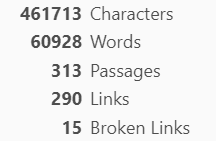
12 Likes
You’ve got me beat!
Info: Total word count: 48451
5 Likes
We’re two people though, so you’re still ahead on the words-per-person metric!
4 Likes
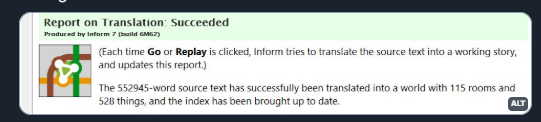
I don’t know if this specific game is being entered in IFComp, but one ifcomp entrant shared this a few months ago on bluesky:
6 Likes
To be fair, that’s source-code words, not printed words!
1 Like
That’s still 115 rooms and 528 things!
4 Likes
True that! I only have 82 rooms, I don’t know if I’ve ever crossed the 100 mark in any game before.
1 Like
Huh. My entry only has 7 rooms.
5 Likes
I have 14 rooms! Oh wait, that’s not really impressive, is it?
3 Likes
Very few rooms can be as impressive as very many rooms! It all depends what’s in them, after all!
2 Likes
I might know what game that is. Then again, maybe not…
I didn’t realise the Inform compiler provided a word count! I’ve been copy/pasting into a text file partly for the sake of easy backups, and that shows a count of 56,851. The compiler itself gives me 48,565:

I assume the difference is down to whether or not comments are counted. 8,000 words of comments wouldn’t be at all surprising since I’ve got big chunks of old code commented out.
3 Likes
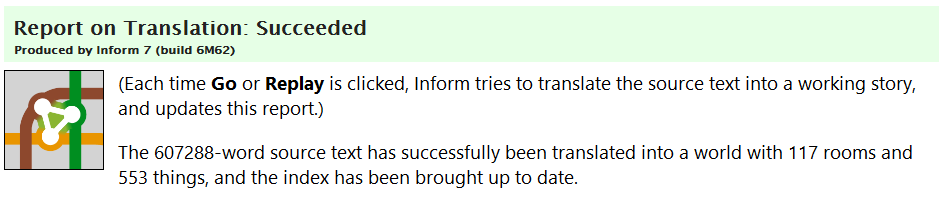
21044 from “I’ve now read your source text, which is 21044 words long.”
276 from “I’ve also read Standard Helping Metaverbs by Andrew Schultz, which is 276 words long.”
211 from “I’ve also read Versioning and Extensions Tweak by Andrew Schultz, which is 211 words long.”
5372 from “I’ve also read {CORE FILE 1} by Andrew Schultz, which is 5372 words long.”
999 from “I’ve also read {TITLE REDACTED} Globals by Andrew Schultz, which is 999 words long.”
1805 from “I’ve also read {TITLE REDACTED} Definitions by Andrew Schultz, which is 1805 words long.”
13387 from “I’ve also read {TITLE REDACTED} Tables by Andrew Schultz, which is 13387 words long.”
614 from “I’ve also read {TITLE REDACTED} Mistakes by Andrew Schultz, which is 614 words long.”
1537 from “I’ve also read {CORE FILE 2} by Andrew Schultz, which is 1537 words long.”
69 from “I’ve also read Revealing Passages by Andrew Schultz, which is 69 words long.”
45314 total, but much of the core file stuff is from previously released stuff. I have a Python script that pulls text between quotes, which counts ~20k words. (Obviously it’s not exact.)
Yes, I was curious now you mentioned it, and I verified this just now.
My project has 29 rooms (30 if you count the one where I send done items.) I had fun scrunching the map into a 5x6 rectangle. It has a hole in the center.
7 Likes
Mine is roughly 35,000 words, and there are 184 passages.
But length isn’t everything! Some of my favourite pieces of IF are extremely short (e.g. Queers in Love at the End of the World)
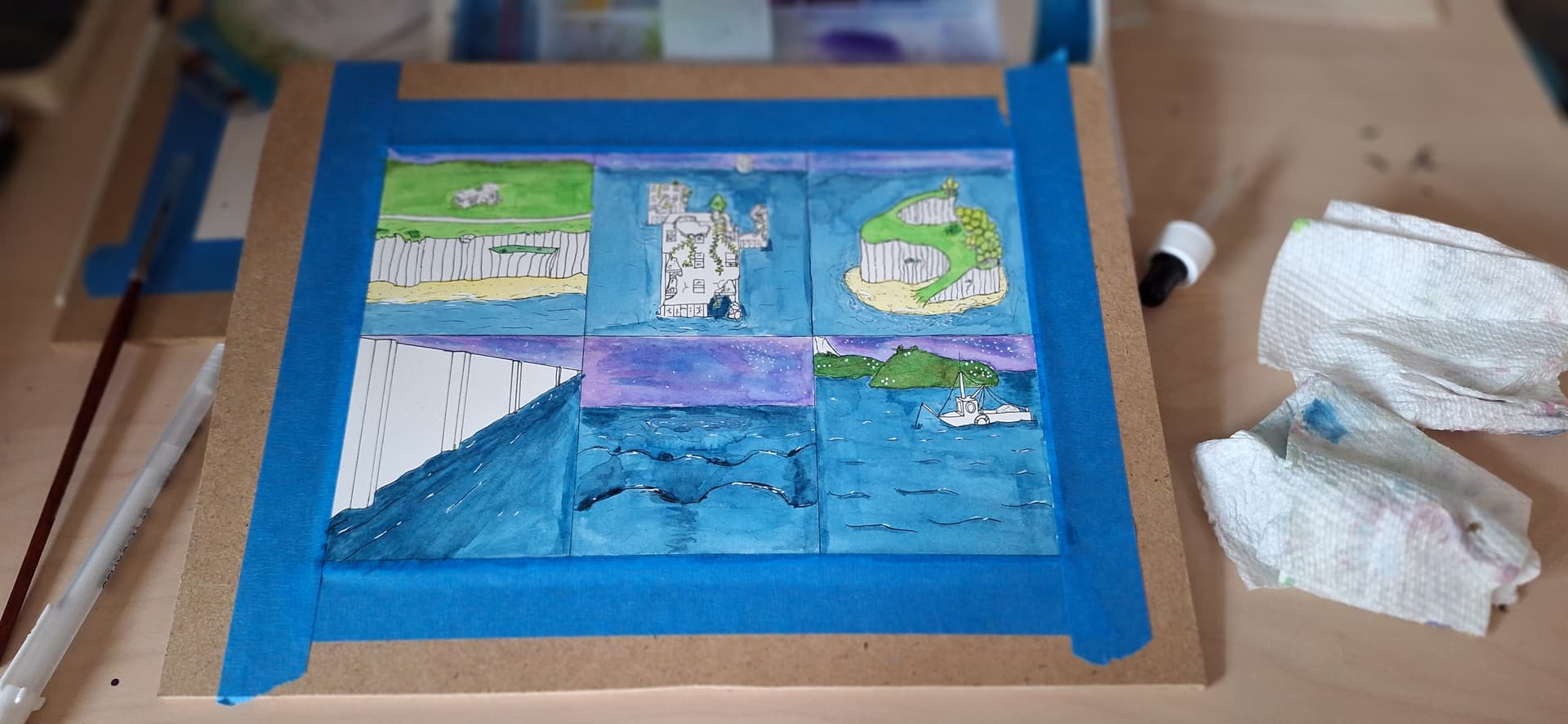
Speaking of rooms, I wonder what these images could represent? And, more importantly, whether they will actually be finished by tonight. 
11 Likes
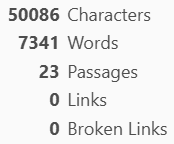
Oh, I didn’t know it was all judged on word count! I guess I have a few more hours to add some random words in…
| 358468 | Characters |
|---|---|
| 52932 | Words |
| 278 | Passages |
| 60 | Links |
| 0 | Broken Links |
7 Likes
Info: Word count for "zstyling.dg": 113
Info: Word count for "act1.dg": 2284
Info: Word count for "act2.dg": 7760
Info: Word count for "act3c.dg": 7201
Info: Word count for "act3w.dg": 7118
Info: Word count for "act3e.dg": 4251
Info: Word count for "act4.dg": 3128
Info: Word count for "spells.dg": 3390
Info: Word count for "footnotes.dg": 8714
Info: Word count for "actions.dg": 2565
Info: Word count for "interface.dg": 229
Info: Word count for "automap.dg": 26
Info: Word count for "nudge.dg": 67
Info: Word count for "plist.dg": 5
Info: Word count for "stdlib.dg": 1742
Info: Total word count: 48593
Debug: Adding Unicode character U+2019 (’) at ZSCII codepoint 224
Debug: Adding Unicode character U+2014 (—) at ZSCII codepoint 225
Debug: Adding Unicode character U+0161 (š) at ZSCII codepoint 226
Debug: Adding Unicode character U+015f (ş) at ZSCII codepoint 227
Debug: Adding Unicode character U+1e2b (ḫ) at ZSCII codepoint 228
Debug: Adding Unicode character U+201c (“) at ZSCII codepoint 229
Debug: Adding Unicode character U+201d (”) at ZSCII codepoint 230
Debug: Heap: 2500 words
Debug: Auxiliary heap: 500 words
Debug: Long-term heap: 750 words
Debug: Registers used: 118 of 240* (49%)
Debug: Properties used: 0 of 63 (0%)
Debug: Dynamic flags used: 7 of 48 (14%)
Debug: Total flags used: 43 native
Debug: Objects used: 340 of 8190 (4%)
Debug: Dictionary words used: 1434 of 7679 (18%)
Debug: Extended ZSCII characters used: 76 of 97 (78%)
Debug: Addressable memory used: 25576 of 65536 bytes (39%)
Debug:         Object table:     7612
Debug:         Object vars:      1360
Debug:         Unicode data:      161
Debug:         Wordmaps:            0
Debug:         Dictionary:       8201
Debug:         Main heap:        5000
Debug:         Auxiliary heap:   1000
Debug:         Long-term heap:   1500
Debug: Total filesize used:    504008 of 524288 bytes (96%)
Debug:         Routines:       282456
Debug:          Strings:       195976
The single wordiest source file is footnotes.dg which should either be exciting or alarming.
One of my favorite features in the new Dialog compiler is that it shows how close you are to various limits; we’ve been trying really hard to optimize RAM use, but now I’m at 39% of the RAM limit and 96% of the total file size limit, so we really need to switch to optimizing text and routines instead!
Also, I managed to make the parser sufficiently un-optimized that it can’t use wordmaps at all. Not a single one. Which is, ah…not great for speed of parsing.
8 Likes