IF 2025 Reviews Doug Egan

I’ve decided to add a table of contents here

*OVER* , by Audrey Larson

3XXX: NAKED HUMAN BOMBS, by Kastel

Anne of Green Cables, by Brett Witty

Backpackward, by Zach Dodson for Interactive Tragedy, Limited

The Breakup Game, by Trying Truly

The Burger Meme Personality Test, by Carlos Hernandez

By All Reasonable Knowledge, by BMB Johnson

Cart, by Brett Witty

Clickbait, by Reilly Olson

A Conversation in a Dark Room, by Leigh

Crescent Sea Story, by Stewart C Baker

A Day in a Hell Corp, by Hex

Dead Sea, by Binggang Zhuo

Detritus, by Ben Jackson

Eight Last Signs in the Desert, by Lichene (Laughingpineapple & McKid)

Errand Run, by Sophia Zhao

Escape the Pale, by Novy Pnin

Fable, by Sophia Zhao

Fantasy Opera: Mischief at the Masquerade, by Lamp Post Projects

Fascism - Off Topic, by eavesdropper

Fired, by Olaf Nowacki

Frankenfingers, by Charles Moore

Grove of Bones, by Jacic

HEN AP PRAT GETS SMACKED IN THE TWAT, by Larissa Janus

High On Grief, by Norbez Jones (call me Bez, e/em/eir)

Hobbiton Recall, by MR JD BARDI

Horse Whisperer, by nucky

Imperial Throne, by Alex Crossley

INPUT PROCESS, by HY

The Island Of Rhynin, by Ilias Seferiadis

Just Two Wishes, by Kozelek

The Kidnapping of a Tokyo Game Developer, by P.B. Parjeter

Lady Thalia and the Case of Clephan, by Emery Joyce and N. Cormier

Let Me Play!, by Interactive Dreams

The Litchfield Mystery, by thesleuthacademy

The Little Four, by Captain Arthur Hastings, O.B.E.

Monkeys and Car Keys, by Jim Fisher (OnyxRing)

Moon Logic, by Onno Brouwer

Mooncrash!, by Laura

Mr. Beaver, by Stefan Hoffmann (Beta Tested)

A murder of Crows, by Design Youkai

Murderworld, by Austin Auclair

My creation, by dino

Not so Happy Easter 2025, by Petr Kain

The Olive Tree, by Francesco Giovannangelo

One Step Ahead, by ZUO LIFAN

Operative Nine, by Arthur DiBianca

The Path of Totality, by Lamp Post Projects

Penny Nichols, Troubleshooter, by Sean Woods

Penthesileia, by Sophia Zhao

Pharaohs’ Heir, by smwhr

Pharos Fidelis, by DemonApologist

Phobos: A Galaxy Jones Story, by Phil Riley

The Promises of Mars, by George Larkwright

PURE, by PLAYPURPUR

Rain Check-in, by Zeno Pillan

The Reliquary of Epiphanius, by Francesco Giovannangelo

Retrograding, by Happy Cat Games

A Rock’s Tale, by Shane R.

Saltwrack, by Henry Kay Cecchini

The Secrets of Sylvan Gardens, by Lamp Post Projects

The Semantagician’s Assistant, by Lance Nathan

Slated For Demolition, by Meri Something

A Smörgåsbord of Pain, by FLACRabbit

Space Mission: 2045, by Benjamin Knob

The Tempest of Baraqiel, by Nathan Leigh

Temptation in the Village, by Anssi Räisänen

The Transformations of Dr. Watson, by Konstantin Taro

Under the Sea Winds, by dmarymac

Uninteractive Fiction 2, by Leah Thargic

Us Too, by Andrew Schultz

valley of glass, by Devan Wardrop-Saxton

Violent Delight, by Coral Nulla

A Visit to the Human Resources Administration, by Jesse

Warrior Poet of Mourdrascus, by Charles M Ball

WATT, by Joan, Ces and humikun

Who Whacked Jimmy Piñata?, by Damon L. Wakes

whoami, by n-n

Willy’s Manor, by Joshua Hetzel

A winter morning on the beach, by E. Cuchel

The Wise-Woman’s Dog, by Daniel M. Stelzer

The Witch Girls, by Amy Stevens

you are an ancient chinese poet at the neo-orchid pavilion, by KA Tan

You Cannot Speak, by Ted Tarnovski

Your Very Last Words, by Interactive Dreams

The opening of IF comp can be overwhelming. There are so many games. I recognize some of the author’s names, and see other games I would like to play from the title, but with so many I don’t know where to begin.

I started with the randomizer. Skipping the first game (for now) the second game was “The Litchfield Mystery” by thesleuthacademy. This is a point-click mystery (in Twine) very much in the style of Agatha Christie. The game is set in a British manor house with a full staff and upstairs-downstairs type architecture (the servants quarters are all linked through the kitchen). The game begins with an allusion to a prior case involving a suspect with heterochromic eye color. In researching afterwards, I could find no specific examples of Agatha Christie stories involving heterochromia, but it seems a common enough trope for other who-done-its.

The game proceeds with a thorough search of the manor house, sending clues off to the analysis lab, interviewing the suspects, waiting for the lab results to come back, then a follow up search and interview. I’m jealous of authors who can plot good mystery stories. This one is, with just the right balance of cover ups, deception, red herrings, and productive clues. I was able to solve about half the mystery on my own, and then (because I could find no internal or external hints file) I plumbed the raw JavaScript for hints. Well that’s kind of detective work also, isn’t it? I found the clue I had missed (I had overlooked hidden evidence in one of the family bedrooms) then completed the game.

I enjoyed this game. The clues all came together well, and the solution felt logical. If I were to be a bit more critical, I found the early stages of the investigation kind tedious (visiting every room and clicking on every link, but not having a good sense of whether any of it was important before the lab results came back). This may, in part, be the result of the game’s implementation of time. Time passing is indicated by infrequent popup messages telling the player that new lab results have been returned. These appear to be triggered by specific questions in the interview process (rather than a turn count or real time clock). This was all handled in a way which left me (the player) feeling a lack of urgency about the investigation. There was never a moment where the other characters jump out of the scene and became threatening to me. Yet my relationship with them was enough of a motivation to complete the investigation in my own lazy way.

The first game I played, “Valley of Glass” by Devan Wardrop-Saxton is a parser game which purports to be a re-imagined folk tale, one I didn’t recognize. The game feels like a beginner’s programming exercise. I began with some interesting objects in my inventory, but no customized response for “examine me”. There allowed directions for travel are not well cued in the text, so that even though this small map isn’t a featureless maze, movement became the first puzzle. Then quite abruptly, the game ends. Had I missed something? Nothing in the text implied there was anything more.
14 Likes

Skipped a few on the randomizer list before reaching “A Visit to the Human Resources” by Jesse. This caught my attention because of title and description. This Twine game imagines the experience of a Space Alien applying for SNAP benefits. Works well as a clever written piece of social satire, but not so much as an interactive fiction. The structure is too linear. I enjoyed reading the author’s bio and motivations for writing this at the end.

Played “Uninteractive Fiction 2”, the natural sequel to “Uninteractive Fiction” by Leah Thargic. You can play both games in less time than it would take you to watch Edison’s first film “The Sneeze”. Since “The Sneeze” (which simply shows a man sneezing) was copyrighted more than ninety five years ago, it is now in public domain and a suitable subject of inspiration for future interactive fiction competitions.

Without speculating about the true identity of Leah Thargic, I began playing “Who Wacked Jimmy Pinyata” by Damon Wakes. I haven’t played the prequel(s) to this game, so didn’t really know what to expect. Having fun so far. More tomorrow, once I finish it.

5 Likes

“Who Whacked Jimmy Piñata? A Bubble Gumshoe Mystery” is a parser game written by Damon L. Wakes. I believe this may be the third in a series, but somehow I have not played any of the preceding games. Perhaps this makes me the perfect impartial reviewer, I am unable to comment whether this series was more like the Star Wars, the Godfather, or Children of the Candy Corn in terms of the graph of “Episode number” vs “Awesomeness”.

Actually, this game was pretty good. The genre is crime noir, which I’m familiar with having read several James Ellroy novels. The gimmick is, this is set in a candy-land world. It’s a simple and silly premise, but avoids feeling like a one joke game in the implementation. Every character and set piece is some kind of sugary confection: Candy Kane, Kit Kat, Wax Lips. I can’t list all of the interactive characters, there are just too many (over a dozen) with new suspects introduced at every turn of the scene. This is a remarkable accomplishment in a parser game.

I found the puzzles very challenging, but the in-game hints are comprehensive, and hints are arranged in a way I found less seductive than the standard invisi-clues type menu. By that I mean I didn’t feel tempted to go past what I needed to solve the immediate problem. But yes, the puzzles were tough. At the two hour mark (after three days of discontinuous play) I eventually reached an ending which satisfied me, though I know it was not the winning ending. I’ll probably go back to it and try again.

4 Likes

“HEN AP PRAT GETS SMACKED IN THE TWAT: THE ORIGIN OF THE WORLD” by Larissa Janus

Tangent: Last night I read “A naughty boy” a non-interactive short fiction written in 1883 by Anton Chekhov. This was from a 1950s collection of short stories I recovered from my mother-in-law’s estate when we cleaned her house last summer. Previously I had only known Chekhov as the author of the Chekhov’s gun principle, advice to playwrights which recommends, if a gun appears above the mantle in the first act of a play, it must be fired at some later point. Remove all unnecessary elements from a short story. “A naughty boy” begins with a pair of young lovers who are observed making-out near the river by the woman’s little brother. Little brother coerces them into paying him a ruble, then continues to follow them and blackmail them for months after. Eventually the couple gets engaged, The now engaged couple chase the little blackmailer out to the garden where they pull him apart by the ears.

The last sentence of the story was striking and weird (warning spoiling an 1883 short story you’ll probably never read) “And afterwards they admitted that the whole time they had been in love with each other they had never once felt such happiness, such breath-taking bliss, as during those moments when they were pulling the wicked boy’s ears.”

I described this story to my wife, who agreed “most short stories are kind of weird” but since she knows a bit more Russian history than I do, she explained that it was all a metaphor for the Russian experience. Russia was rife with criminal surveillance, corruption, and the suppression of human joy even before the communist revolution.

“HEN AP PRAT GETS SMACKED IN THE TWAT: THE ORIGIN OF THE WORLD” by Larissa Janus is a modern non-interactive short story. It is bawdy, and funny, and sad, and politically incorrect, and inappropriate for all sorts of reasons. It reads like Roald Dahl on Viaqra (sic to avoid tradename). But it’s not interactive. “Hen AP” is better written than almost anything I’ve read in the interactive fiction comp. Like Chekhov, it reflects the zeitgeist of our time. Like Chekhov, it doesn’t include unnecessary elements. Like Chekhov it’s striking and weird. But it’s not interactive, and this is an interactive fiction competition.

2 Likes

But it’s not interactive.

I’m a bit puzzled by this claim, as I encountered lots of choice points and branching when I played…

2 Likes

I think the author randomized it so half of players get the full game and half get a non interactive game, but I’m not sure.

2 Likes

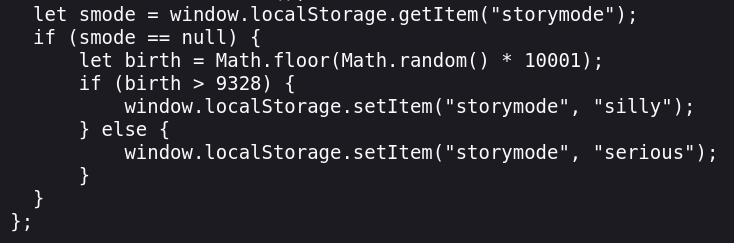
Well, if it’s anything like Dick McButts, its spiritual ancestor, there might be multiple versions of the game, with a random dice roll determining which a player gets.

3 Likes

I got the noninteractive version of McButts also. I’m feeling a little cheated. Comparing as non-interactives, “Hen Ap” was more entertaining to me.

93.28% vs. 6.72%, it seems (via @cchennnn)

4 Likes

Interesting ratio. I saw Damon’s explanation about how he decided on the ratio for his Dick McButts game, I am curious how he came up with this one.

Now I want to see the other version!

Update: I was able to download the game and edit the JS to make the static version display. :slightly_smiling_face:

1 Like

This round I skipped the randomizer and chose a game because I recognized the author’s name, “Operative Nine” by Arthur DiBianca.

“Operative Nine”, like many of the author’s previous puzzlers, is written with a parser engine (Inform) but employs only a limited verb set. The player character is an agent sent into a rival compound to complete a list of missions (specific acts of espionage or sabotage). The gimmick here is that obstacles to completing these missions are presented in the form of a series of sokoban mini games. Sokoban are a classic style of box pushing puzzles, here rendered in ASCII character graphics.

Hijacking a parser engine to play non-parser games is something which has been called “parser abuse” or “abuse of the z-machine” Here’s a whole list of examples on IFDB. I find these examples at once impressive and silly. If you want to write a non-parser game, why choose a parser engine? But then I’ve had my own fun subverting the Excel spreadsheet to play Conway’s game of Life, so why not.

I enjoy sokoban games, and completed “Operative Nine” in about an hour. There is a helpful tutorial game to get the player initiated to the keypad controls. Next, there are more than a dozen game-world puzzles (some of them multi-staged). The puzzles are unique, each one introducing a new and slightly different game mechanic. Most of them were intuitive and satisfying. I checked the hints three times: once to get just a nudge, once because I understood the solution but felt it would be too tedious to complete myself, and once (on the Mainframe puzzle) because I had no idea what was going on. My two favorite puzzles were dismantling the bomb, and the passodex box. But really, they were all so clever.

3 Likes

What was your strategy for disabling the bomb? I got my butt kicked by that one, and kept trying different things and being off by 1 or 2. I couldn’t figure out how to know for sure if what I was doing was optimal or not.

I worked clockwise starting from the top. I didn’t keep records of the exact moves, but found that other orders took several additional moves. Once I started working in that sequence, I knew intuitively that there would be enough time, but kept making mistakes. Got it on my third or fourth try with that sequence. 0 seconds remained. Probably couldn’t do it again if I tried.

2 Likes

This morning I played a couple of shorter games served up by the randomizer. “The Kidnapping of a Tokyo Game Developer” is a point click game written in Twine by PB Parjeter. A pair of a Italian brothers have kidnapped a Japanese game developer in order to steal his next game release. The PC is the lesser of the two brothers, someone who has long suffered his older brother’s scheming and abuse. The game developer remains surprisingly calm through most of this ordeal. He is known in the gaming community as someone with a puckish sense of rebellion aimed against censors and corporate overlords.

The game has some nice graphics throughout, including photos of a man whom I presume is the real Kenji Eno. As far as I’m aware, there is no sound, but my browser can be buggy with sound files.

The game includes a ton of cultural references including Kenji Eno (who is based on a real developer with the same name and personality), Teen age mutant Ninja turtles, and Mario Brothers. It’s all in good fun, with plenty of comical dialogue and descriptions. At first I didn’t think I would want to spend much time at this, but the game grew on me and I completed everything (including a long and amusing, but mostly linear post-script) in a little over an hour. In addition to the three men, the other central character is Eno’s pet turtle, who keeps escaping, and must be repreatedly re-captured from more and more distant locations. The game is funny and fun to play, and it feels like the author has a genuine affection for Eno. There were some messages in there about censorship and software development, but they won’t be as memorable to me as the jiggling graphic image of the turtle when I knocked it off the ceiling fan, or the vivid written description of the PC navigating through the sewer pipes like he was a turtle himself.

Other game I played today was “My Creation” by dino. Curiously this felt more like a TWINE game, and “Kidnapping” felt more like a parser game, even thought the development systems were just reversed. Why did “My Creation” feel like a TWINE game? In part because it deals with gender identity (and trans identity) themes which have been explored extensively through TWINE. But also due to weaknesses in the parser implementation which made this game feel like it has a broken world model. Lots of mentioned objects not implemented, or not in scope where they are first mentioned. Exits not mentioned in the location descriptions, which makes navigation difficult. Even a few spelling errors to interfere with the immersion. The end sequence (which can be reached after a few minutes of play) contains more text than the rest of the game combined. But the end sequence is also the highlight of the game, setting it apart from a mere programming exercise and giving it a sincere and heartfelt message that just needed more editing and beta testing.

6 Likes

Thanks for the review!

The game has some nice graphics throughout, including photos of a man whom I presume is the real Kenji Eno. As far as I’m aware, there is no sound, but my browser can be buggy with sound files.

Yep, I can confirm there is no sound. And anyone who’s curious about about the image source and (partially) factual basis for the interviews can check out the credits page at the start screen.

they won’t be as memorable to me as the jiggling graphic image of the turtle when I knocked it off the ceiling fan

Haha, thanks. I used a CSS styling trick here to make sure that every player gets the shaking turtle at ~80% of their browser height for, uh, maximum impact.

4 Likes

Played “Monkeys and Car Keys” a parser game by Jim Fisher. From the title, I expected it might be some kind of word play game, but that’s not what it is. Set in the jungle, a troop of monkeys have stolen your car keys. The game has an early 2000s feel about it; short, puzzle centric, story light. but more elaborately written than an 80s game played on a computer with limited memory. This work includes in-game hints, which were another convenience that became popular around the turn of the century.

The puzzles have a certain logic to them, but the parser isn’t quite robust enough to support them. One of the central props of the game were a circle of three stone monkey statues (see no evil, hear no evil, speak no evil). They behave differently from one another, but the error messages for trying a useful action on the wrong monkey are sometimes misleading. The words “monkey” and “statue” can sometimes be used interchangeably, and sometimes not.

The setting and characters are whimsical enough to keep me motivated. Who doesn’t like a monkey, or a mechanical puzzle involving a barrel of monkeys? But before the end, it started unraveling. I hit a non-fatal processing error (which I’ve reported to the author). Then started using the hints, then reached a point where even the in-game walk through wasn’t allowing me to make any progress

>put banana in monkey mouth
It’s just scenery. You don’t need to do anything with it.

Anyway, there is another review posted (VG) which suggest that the game can be finished, so I wonder if I’m just playing a different edition of the game (I see there was an update posted on September sixth. I’m not entirely sure which version I’m playing, but I assume it’s the update.

5 Likes

For what it’s worth, I think I used ‘put banana in mouth’, so one word less than you… maybe that somehow works? Just guessing! This is South of Wall.

2 Likes

I appreciate the review, and also the bug find. I’ll get these fixed, and have a new release out as quickly as I can.

Thanks again.

1 Like

I addressed the RTE you and @VictorGijsbers identified and will have an update out tonight, but I wasn’t able to reproduce this described behavior:

It would have been the same version as VG’s; I suspect that this may have been attempted in a different location than intended, and therefore against a statue’s mouth, rather than the engraved mouth on the cave wall. To better alert me if it happens again, I’ve updated the messaging to be more specific and to also to get rid of those mimesis-breaking “that’s just scenery” messages which I let creep in.

After some more thorough transcript reviews, I may push out another version this weekend, but I’m pushing these fixes out tonight, since the RTE feels somewhat urgent to me

Thanks again for looking at the game and posting your review.

1 Like