DemonApologist’s Spring Thing 2026 Responses

I really wanted to enter Spring Thing again this year, but I was not able to get myself together to come even close to being ready. I didn’t even submit an intent, so I don’t even have a partial project from trying and failing to write something in time, I just have… almost nothing. It’s pretty demoralizing. As a result, I have major Spring Thing FOMO.

However, I’m attempting to sublimate those negative feelings into something more positive—this response thread! I am not promising to respond to every entry, but we’ll see how it goes.

Here is the format I’m going to use:

Progress: How far did I get? How long did it take to play and what endings (if any) did I encounter?

Things I Appreciated: Pretty self-explanatory, these are the elements of the game or narrative experience that I want to highlight as unambiguously positive.

Miscellaneous Comments/Recommendations: This is a catch-all for anything that raised questions for me in terms of the experience that isn’t strictly positive. Is there a game mechanic or presentation element that I thought could be improved? Are there elements of the narrative or presentation that didn’t work for me? My goal is to approach this in a way that is constructive rather than mean-spirited.

What I learned about IF: I’m (still) approaching this as someone who wants to learn more about the genre and writing, and I think any work has a lot to offer in terms of its structure/presentation. I want to acknowledge elements of games that give me tools or insight to better understand the craft.

Memorable Moment: The moment in my experience of the game that leaves the strongest impression, looking back at it.

Well? Let’s get started then, I guess.

Response Index:

1. Unseelie (Back Garden)
2. Fantasy Opera: The Theater of Memory (Main Festival)
3. Enigmart (Main Festival)
4. The Perilous Plot (Main Festival)
5. Before the Snow Melts (Main Festival)
6. meminerimus (Main Festival)
7. Cryptid Hunter (Main Festival)
8. Exchange (Back Garden)
9. Crier (Main Festival)
10. A Quiet Scurry (Main Festival)
20 Likes
1 | UNSEELIE

1 | UNSEELIE
by: Alun Clewe

This is a Back Garden entry.

Progress:

  • I reached the (somewhat abrupt) end of this game in 1h57m. The “about” text states that this game is still in the process of being written/developed, so there are partial red herring puzzles that were not finished at the time I reached the end.

Things I Appreciated:

  • I really enjoy the general vibe of this game and the design of the various bits of fungus and how their uses are communicated. For example, there is a red creature that you need to lure toward a different room, and it turns out that the fungus it wants to eat is red. In hindsight, I was like, yeah, that color cue makes sense. Similarly, the shape of the fungus suggests its uses (having a cup-shaped yellow fungus, or a finger-shaped green fungus). The wacky organic feyworld nature of the objects makes it a lot enticing than if it had just been a regular cup.

  • I was excited when I met the prisoner and had someone to talk to about all the weird stuff I had been experiencing, it felt like a real breakthrough! When the game ended, even though I had been stuck for over an hour on a silly mistake that I made, I was still disappointed because I wanted to keep going and explore the story/world more.

  • Many of the puzzles that I did solve had really satisfying solutions. For example, when I figured out how to lure the creature to the platform in multiple stages to get the timing right, I felt like it really rewarded me for the time I spent thinking about the materials/mechanics that I had at my disposal. I felt like I was on the verge of solving another (using the hypodermic needle to draw out the oil from the hatch and then grease the red knob… uwu) when it ended.

Miscellaneous Comments/Recommendations:

  • I experienced a severe bottleneck as a result of not seeing one of the exits (see more in the “what I learned” section) and didn’t have much recourse. So a general recommendation I have would be to include a walkthrough, map, or some kind of hint system as part of the game. I was able to figure out what went wrong initially, but not after exhausting some very strange attempts to get around things.

  • Since this is a Back Garden entry that is still in development, there is a general issue with bugs and underimplementation, and puzzles that were red herrings because they haven’t been finished yet. I felt like I found plausible solutions that were not implemented or otherwise accounted for, like placing the ladder plus fungus on the platform to meet both the weight and living requirements, or trying to throw the red fungus down into the pit so that the creature would get stuck down there and not be able to guard its nest. I think the strongest example of this is when the prisoner asks you for a needle that he can pick the lock with, when he already has a needle in the cell with him. I got frustrated with my inability to communicate to him that he should use the needle that he already had on the lock.

  • I had some disambiguation woes when trying to accomplish things, e.g., “Which fingerlike piece of green fungus do you mean, your fingerlike piece of green fungus, or a fingerlike piece of green fungus on the platform?” I understand the duplicate items were probably necessary to avoid softlocks (at some point, I dropped an item in the dark room that I lost access to, for instance), and also for certain puzzles, but perhaps there would be a more elegant way of implementing the fungus that didn’t instigate this kind of linguistic turmoil.

What I Learned:

The big question that looms over me when thinking about my experience with Unseelie is, given the relatively compact layout of the area that I had access to, why was it so hard for me to notice the west exit from “Beneath the Opening” for hundreds of turns, even though the room description mentioning the west exit had printed twenty-four times? I eventually solved it by remembering a similar issue I had in the game Eat Me, where I had not been able to notice a critical extra exit from a room that I didn’t expect to have another exit. Like it’s very classically me to get stuck on something that was not even intended as a puzzle.

In a game like this, which did not come with a walkthrough, a map, a hint or help system, and no one else had posted a transcript of yet that I could read through to see how I messed up, it was on me to notice the west exit of this room on my own, and I didn’t, for about an hour and fifteen minutes.

Other than my own incompetence, which is obviously the main factor here, are there game design reasons that contributed to this? If so, how could this be adjusted? I think the issues here for me was two-fold. First, this room was in a series of nearly identical hallways going east and west, so I had become more attentive to details that were different (such as: the purple fungus, the red knob) rather than the details that were the same in every preceding room. As such, the opening in the ceiling drew my attention as the obvious puzzle to solve. Up was the way forward, so I never envisioned a west exit. Second, other hallways had ended in unique blocked exits (the purple energy barrier and brass door) so the opening in the ceiling fit into that pattern as the obstacle. When I got up into the next room using the ladder, I felt like there was nothing left in the previous room to solve.

What I take away from this reflection is something about managing the cognitive load of playing a parser game. A player has to do a lot in terms of navigation, fighting with the parser to be understood, recognize puzzle cues, and so forth. So if you want something to be noticed by the player, it needs to be specific and distinctive. Many of the other exits were memorable and distinctive, but this one wasn’t, and in this case, it tripped me up. And maybe it would not trip up anyone else, but it did remind me of this discussion of parser navigation issues.

Memorable Moment:

  • You might think my answer is going to be FINDING THE WEST EXIT, and like, yeah, it is, but my favorite moment is finding and talking to the prisoner after being lost for over an hour. It felt like I was finally making some real damn progress!

Unseelie_Transcript_DemonApologist.txt (236.4 KB)

12 Likes

A player has to do a lot in terms of navigation, fighting with the parser to be understood, recognize puzzle cues, and so forth.

In my experience, “fighting with the parser to be understood” is usually the sign of a parser game that hasn’t achieved its goal, rather than a load on the player. Rather than being part of the expected burden, it’s a game that for some reason failed at part of what it was doing, as a parser game. What the player usually, theoretically, has to do, is to think very hard sometimes about what they can do, what they could do, what they might try; and then possibly think up a verb, as simple as possible, that will convey that.

Maybe I have a higher baseline and expectations of what IF I find acceptably enjoyable, and a lower threshold for lesser implementation (although in at least two games I gave glowing reviews and had no trouble where others had stumbled mightily in the game’s implementation, so I don’t think that’s it), but I do not assume as a matter of fact that the player will be fighting against the parser. In my view, if that happens, the game has already failed to a degree. How bad of a degree, how memorable of a degree, or how much of a mere forgetabble hiccup, it is, depends on how quickly the player is able to regain their footing.

I don’t intend to negate what you’re saying; I just thought it would be relevant to bring a different set of expectations here.

In fact, I just had a rather similar “fighting” experience yesterday while playing Ad Verbum, and it was not in any of the extraordinarily fun wordplay rooms.

I was trying to get the pig to enter the dumpster, because I mistakenly thought that that’s where it should go. Now, I’m Portuguese. We don’t have pig latin over here. I am extremely comfortable with the English language, and also culture up to a point, but pig latin is not part of my cultural makeup at all, so while I knew it existed I had to learn it to use it. And I could not understand why the pig would not go into the dumpster. I was fighting the parser, trying different commands to enter dumpster, enter case, go in case, go dumpster, climb into case, whatever. All in pig latin, which I was never sure I was using correctly.

I was fighting the parser in this situation because it was not telling me what I needed to know: what I was trying to do was a valid command, but it was not the solution, and that was why it wasn’t having the desired effect. I should stop trying to do that and try something else, because that thing was not meant to go in there. The reason this is “fighting with the parser” is that the parser’s responses were of a vague “that can’t be done” that made me ask “why? why can’t it be done? It certainly should be possible, so what am I doing wrong?”, while forcing me to write in a variant of english with which I’m culturally unfamiliar; I always felt that the game was telling me that the problem was my wording and my command, as opposed to me trying to do something that simply wasn’t it.

6 Likes

Love how thorough and thoughtful this review is, thanks for taking a look at the games!

5 Likes
2 | FANTASY OPERA: THE THEATER OF MEMORY

2 | FANTASY OPERA: THE THEATER OF MEMORY
by: Lamp Post Projects

This is a Main Festival entry.

Progress:

  • I reached the ending of the game in 1h01m, scoring 95 points out of a possible 100. My custom character was Apollo, a tiefling architecture enthusiast with questionable social skills.

Things I Appreciated:

  • In general, this was a highly polished game with many thoughtful quality of life features. For instance, at one point I thought, oh, I really should be taking notes, but the game has a “notepad” tab that had already recorded that information. I ended up referring to that when I needed to and found it really useful. Additionally, the game is up front about indicating how its mechanics work, marking which choices you can return to later, and signaling when choices are about to run out (such as irritating someone by asking too many personal questions).

  • The character customization has some thoughtful and subtle effects. For instance, because I chose to play as a tiefling (obviously, lol), the tiefling character Lionella recognized and responded to that. This is a great way to, if you’re going to go the character customization route, have it have some subtle effects on the experience.

  • The central puzzle was elegant and I found it really interesting to actually be performing analysis in-game on the information that I had gathered during the day. I thought made the “detective” role feel more immersive and gave me at least the illusion that I had actually done some work to solve the puzzle and figure things out.

  • The visual presentation is stylistically cohesive, and I thought the watercolor portraits looked nice! I thought that the image of the tiers of five paintings was also mechanically helpful as a helpful visual aide.

  • I was fascinated by the worldbuilding implications of Vitale’s resentment toward Alvisa, envying her comparatively very long elvish lifespan and materially consequential contributions. It tapped into the very relatable horror that your time is slipping away and you haven’t been able to accomplish anything meaningful. This is something that I’ve been feeling lately, not to an extreme degree, but I’ve had a lot of nights thinking that I lost my chance to do something with that day. So I can connect with an antagonist who feels envy toward a long-lived elf. It made for an engaging conflict.

  • The most interesting choice in the game forces the player to decide what they think counts as justice in determining the fate of the antagonist. The options were things like, report the antagonist to the guards (legalistic, more punitive), let them go after fixing the theater (lax), try to leverage their guilt to get information about the mage (opportunistic). The option I chose was letting the victims of the crime decide, which I view as a kind of deferral of accountability on my part. They ended up choosing a more punitive option collectively than I expected, and in hindsight, I thought there was something kind of sinister about letting the orchestra vote by plurality to decide what happened. I thought this choice was an interesting Rorschach test.

Miscellaneous Comments/Recommendations:

  • At the selection of who to attend the opera with during Epilogo, the player is given a list of names with not much context. I picked someone called “My partner Benetto” and hoped for the best. This felt off to me because it is at odds with most of the game’s approach to customization, where you know a lot more about who/what you are choosing. Because Benetto only showed up at the very end, he didn’t feel very connected to my character or the game I had just been playing. I wonder if it would’ve been nice to have an interaction with the partner (or friend or colleague, etc, depending on the option the player chose) during the night before, so that they would feel more integrated in the game.

  • While the dream analysis task was a novel experience, it did also feel like the most tedious part of the game. I kept hoping that dreams corresponding to themes that I still needed would pop up, but I felt like I got a lot of repeats. After a few times, I was craving the agency to pick which two dreams from my notes to compare, rather than having that decision made for me.

  • Something I was really missing from the endgame was an emotional resolution for Vitale’s personal crisis that caused him to commit this crime. This could’ve been the result of the choices I made, but I wanted an opportunity to hear his reflections on his aging resentment after going through this whole ordeal and public scandal, and how he felt about me choosing to air all this stuff in front of everyone and then left them vote on what happened to him. Does he now resent me, for figuring it out, and letting the orchestra vote to get him arrested? Was he able to find a way to come to terms with his age and legacy in light of everything that happened? I wish there had been more of a beat there.

What I learned about IF:

  • The thing that most stands out to me about the design of this game that I want to focus on is how it arms the player with information about stat checks and choices. Personally, I don’t write very game-like IF, but despite that, I still think a lot about what how the choices I do include are presented and how much information to give to readers. This game gives you information about which choices you’ll be able to return to, which stats or interest areas are being invoked, when a dice roll is going to happen, when a choice is unavailable due to not meeting prerequisites, what personality trait the choice corresponds to, and so forth. Sometimes, information is withheld. When making a critical choice about the puzzle solution, for instance, you don’t necessarily know if you’ll be right or what the implications of an incorrect deduction/analysis will be. You also don’t know how difficult a check is (at least, I didn’t, but I may have missed an indicator of that) before rolling it. Another choice I was allowed to make as a player is to turn off mid-game indicators about score (which I chose to do because I didn’t want to be preoccupied with missing points and so on). That gave me the option to not have certain information in a way that I thought enhanced my experience. So I think my takeaway point here is that I would look to this game as an example of how giving the player a lot of information about their choices can feel empowering, and doesn’t necessarily have to detract from a sense of novelty or surprise.

Memorable Moment:

  • My favorite part of the game was the “final exam” where you have to prove that you understand the puzzle by severing the curse correctly on five of the musicians. I thought it was really satisfying to look at the list of options and know exactly what I was picking and why, and knowing that it would be correct because the game had demonstrated the puzzle mechanics so thoroughly to me.

FantasyOpera_Transcript_DemonApologist.txt (110.0 KB)

13 Likes

Thank you so much for playing, and for the detailed and thoughtful review! (And sharing your transcript, as well!)

5 Likes
3 | ENIGMART

3 | ENIGMART
by: Sarah Willson

This is a Main Festival entry.

Progress:

  • I reached an ending (solved 26 puzzles) in about 1h23m without hints, though there was a puzzle that I completed by accident without understanding how it worked.

Things I Appreciated:

  • I definitely had my eye on this game from the start of the event because it’s right up my alley. I found many of the word puzzles satisfying to figure out, and it also didn’t feel like I was under pressure to solve something if I was stuck. If I couldn’t figure something out right away, I would just go to the next one, and in most cases, when I returned to the puzzle with fresh eyes, I was able to figure it out.

  • I thought the game did a great job getting me into the flow state of solving puzzles, even when minor interruptions or inconsistencies got in my way, I felt like it was easy to get back into it. I also felt like as the game progressed, I was able to apply tactics that I had noticed from earlier puzzles in later puzzles, and would often find the information I needed by re-reading to notice a hint that was baked into the puzzle description up front.

  • I’m not a fan of the satirical corporate aesthetic in general. I don’t find it enticing because I feel like I am already surrounded by AI slop, spam texts about how I didn’t pay my traffic ticket in states I have never been to, email subscriptions that I never signed up for, marketing speak, ugly-ass emojis, apps obnoxiously interested in where I am and what I am doing, and so on, so I am a bit wary of choosing to actively engage with it even more. But, I did think that in this case, it led to some interesting thematic places. As I played, I was thinking about how much of the internet is funded by ads, or weird scammy sponsorships, and how it feels like the entire rest of the New York Times (for instance) is propped up by ad/subscription revenue from its puzzle games. And I also thought about how for me, a lot of puzzle solving is an anti-social activity. I’ve been really into crosswords lately, which probably helped me a lot for this game, but that also seems symptomatic of a greater alienation that I’ve been feeling. This game feels like a great case study in corporate intrusion into behavior/psychology.

Miscellaneous Comments/Recommendations:

  • There is a kind of unevenness of treatment in terms of the in-game tools each puzzle has. For instance, some puzzles come with a checklist of options that you can cross off once you’ve matched them up. But other puzzles involve static images. Looking through my image editor, there were seven puzzles that I took screenshots of in order to cross things off (or otherwise mark up the images) in order to keep track of things. There was also one puzzle—the one with the twelve sets of three letters—that I ended up writing out the codes on pieces of paper that I cut up to rearrange them. I think this is an interesting consequence of taking puzzles that work well in the print medium, and translating them into a digital format. So my recommendation would be to implement more tools to “mark up” the puzzles. I think ideally, you’d want to minimize swapping between different screens or needing to take outside notes for this type of game.

  • This isn’t necessarily a negative, but I personally did not understand the Creatine Crunch puzzle with the true/false quiz. It was the last one I had left over, and I ended up making some lucky guesses to accidentally solve it without ever understanding how the puzzle worked. For each of the other puzzles, I felt like by the time I got to the solution, I understood why the answer was what it was. So as a result, this was the only puzzle that didn’t feel in some way satisfying. As is the nature of these kinds of things, I’m sure other people really liked this puzzle and didn’t get other ones that I happened to click with.

  • A feature that I thought was missing was an update of how many puzzles I had left to solve in each supermarket aisle. I ended up re-clicking on categories that I had already fully solved and didn’t need to return to, since there wasn’t an indication on that screen of where I had puzzles left to solve. (This is, of course a very minor inconvenience. But I think it would help smooth things out just a little bit.)

  • This might have been the most literal example of a “crossword at war with a narrative” that I have played to date. I normally enjoy narrative-focused games, but I found the framing story disruptive to the flow state of solving puzzles. For instance, every time a story segment intervened, I got a little more annoyed that I got booted back to the main supermarket screen rather than the specific aisle I had been working on when the interruption happened. It was hard for me to fully switch modes between puzzle-flow-state and engaging with the characters and themes, and as a result, I ended up favoring the former at the expense of the latter. Toward the end of the game, I wondered if that would end up being a significant theme, and there would be a twist that punished me for ignoring the characters and their issues in favor of continuing to escape into puzzle solving. Like at the end, if a character from the story sections walked up to me and asked, “What is my name?” I wouldn’t have been able to answer that question.

What I learned about IF:

  • Something I admired about this game is the creativity in using choice-based mechanics like checklists and drop-down menus to assist in the structure and gameplay of the puzzles. I keep being reminded that I only use a tiny fraction of what Twine can do in my projects, and I think it would be very hard for me to suddenly reach for a tool like that in the moment in what I am working on. Interestingly, I think the checklists and drop down menus assist in the corporate aesthetic of the game, because it’s reminiscent of marketing surveys and such. Even so, I think it’s worthwhile for me to remember these are mechanics that I could try and think of creative uses for, even in wildly different form and genre contexts than this particular game.

Memorable Moment:

  • Because of the haze of doing most of the puzzles, I’ve forgotten most of the specifics already. However, the one I remember most vividly is the only one that I had an analog approach to in cutting out the strips of paper to rearrange. I still have the solution phrase lined up where I left it, and the tactile aspect of how I did that one puzzle made it stand out the most. I figured out the solution while I was still writing out the letters, and didn’t have to keep going, but I still went ahead anyway because it was satisfying to slide the pieces around. I notice that this seems contradictory to my comment above about unevenness, that this is a part I ended up finding memorable and charming. Maybe what it says is that sometimes you can make a game/story too smooth and polished, and the texture of things that didn’t quite work can actually make it feel more alive and (in the spirit of this game) less corporate and focus-grouped to death.
14 Likes
4 | THE PERILOUS PLOT

4 | THE PERILOUS PLOT
by: Carrie Berg

This is a Main Festival entry.

Progress:

  • I completed my first playthrough in about 16 minutes, then played through a second time the next day for another 15 minutes or so. I’ve attached the result stats from these playthroughs at the end of this post.

Things I Appreciated:

  • This entry jumped out at me from the outset as one I was immediately interested in. I write dark fantasy and really enjoy gothic vibes, and I also liked the idea of getting to play as the antagonist. I think I probably would’ve preferred a sincere version of a game like this, however, it turned out to be more of a humorous pastiche showcase of gothic tropes. In the author’s comment, they mentioned what I believe is this article from The Guardian as inspiration. I think this game was successful in terms of poking fun at these tropes and how ridiculous it can feel to have people fainting dramatically to a villainous glare amidst overwrought descriptions of the weather.

  • This game most reminded me of the board game Betrayal at House on the Hill, where players semi-randomly construct a weird manor out of room tiles before facing off in factions later in the game according to the haunt scenario that was rolled. That game has some serious design issues that I don’t really need to get into, but the thing that keeps it fun is the variations in which rooms are present and how the house is arranged, and how that ultimately impacts the haunt. Similarly, this game uses random combinations of weather, room types, items, and heroes to create variety in the playthroughs.

  • My favorite moments in this game were generally when I had direct interactions via the “Ooze insincere consideration” and made some kind of shady quip or gesture, it made the game feel a little more dynamic compared to just glaring at them.

Miscellaneous Comments/Recommendations:

  • My organic approach to playing this game started off a bit more experimental. I tried monologuing, stealing an item, and lurking in the shadows, to see what would happen. But after testing things out, my gameplay settled into the following: (1) I would compare the two location combinations offered against the strengths and weaknesses of the two heroes that I was assigned, and put myself in a position where I was more favored. (2) If I was in a disfavored location, I would do something passive to avoid any issues. Otherwise, (3) I would glare at them. Following this strategy, I never faced any meaningful opposition from the heroes. In their best round, they managed to be unaffected by the glare, but they didn’t affect me in any way either. It seemed like it didn’t make sense to split my efforts between causing faints and advancing my plans, as that would cause the game to last longer. So I kept glaring at them over and over until the counter reached seven, at which point, I won the game. Something I’ve heard said before is that players will optimize the fun out of a game if they are able to, and I felt like I was becoming consciously aware that this was happening during the playthrough.

  • In my second playthrough the next day, I mixed in a few different actions, but largely, it still made the most sense to pick a favorable location and then glare at the heroes. I didn’t feel like I got a lot out of playing the second time, and even one of the heroes I faced was randomized to be the same (the Dutiful Ward). So I guess what I’m saying is, the gameplay felt a bit hollow to me. One thought I had while playing the second time was that it might be more engaging if, instead of being given all the information about the hero strengths and weakness up front, I was forced to actually observe the heroes’ behavior to see how they were feeling about the space they were in. For instance, if the Nosy Neighbor is in the gardens and strong there, they could make a comment about how much they are enjoying the gloomy gray roses or whatever, so I would have to decode their commentary to determine which action I wanted to proceed with. Learned information about strengths/weaknesses uncovered could accumulate in the stats page. I think there’s just an overall lack of stakes when given all this information up front, because even in the very rare situation that I was forced to pick between two locations that might be strong for the heroes, I could evade any risk by lurking in the shadows.

  • Another idea I have would be to make the location selection have an adversarial component. Imagine, for example, that there are three location options per turn, the player gets to veto one of them, and then the heroes get to veto one based on their own self-awareness of their strengths and weaknesses, causing the (compromise) third location to be the one visited. In that case, you might not get exactly the conditions you want and face a weather-room combination that lends more potential risk to the choices you are making. Maybe this specific thing wouldn’t work (and I’m sure it would be annoying to implement, lmao) but the gist of what I’m getting at is, I feel like the heroes have a real lack of agency that undermines the gameplay, and I think it would be more satisfying if I felt like I was gaining or losing momentum throughout the course of the game.

  • Something I encountered that I think was a glitch is that, when successfully glaring at the heroes, I was sometimes offered a choice between stealing and item or causing them to faint. However, if I chose to cause them to faint, it wouldn’t register and their faint count would remain the same, essentially wasting the round.

  • When playing a second time, in the final stat printout, the number of times I caused the heroes to faint failed to reset and instead kept accumulating. (It should have said 9/9, instead of 16/16).

What I Learned About IF:

  • In my previous discussion about Fantasy Opera: The Theater of Memory, something I observed was that the game worked well while giving the player a lot of information about how its mechanics worked and the potential consequences of choices. Here, I felt like being given all the information upfront somewhat detracted from the experience, because it gave me the ability to adopt risk-averse but efficient tactics that reduced the potential for whimsy and chaos. I think that’s an interesting counterpoint. Honestly, it makes me feel even less inclined toward trying to write a more game-like IF project, just because it seems really challenging to balance all of these factors and successfully onboard players to the different mechanics you want them to use. Sometimes players need to have more information, sometimes they would be better off having to discover that information through experimentation, and what to do when seems very context-dependent, but you may not even realize the context until you see people actually interacting with it. But to end on a more positive note, I think that The Perilous Plot could be adjusted in any number of interesting ways and produce different gameplay sensations that may end up being more engaging, since there are a lot of good mechanical ideas in here that are working.

Memorable Moment:

  • There was one specific description that caught my attention, of the country road in broad daylight: “The day is warm and bright, yet there is a chill of dread in the air. The road is mosly [sic] empty, as is the country around it. And yet, even illuminated by the sun, something seems amiss. It is an insidious sort of darkness that lurks in the light. Much like yourself.” The vibe of this is like… I’m imagining someone narrating a ghost story and desperately trying to think of any justification as to how a sunny road could actually be framed as dark and scary. It’s very tongue in cheek. I don’t know, it just tickled me a little.

PerilousPlot_Results_DemonApologist.txt (1.1 KB)

10 Likes
5 | BEFORE THE SNOW MELTS

5 | BEFORE THE SNOW MELTS
by: Zach Crowe

This is a Main Festival entry.

Progress:

  • I reached an ending in around 40 minutes.

Things I Appreciated:

  • I think the atmosphere of this story taps into a powerful feeling that is difficult to describe, akin to the feeling of summer vacation being about to end. The presentation, including the subdued musical track and painterly filter applied to the backdrops, helps contribute toward that bittersweet melancholy feeling of an ending slowly but inevitably approaching.

  • Related to that, I liked the dream-like quality provided by the omission of information about where the characters live and what they are doing. The story feels believable while simultaneously being unmoored from a particular time and place, which caused me to focus more on the feeling that was being curated rather than trying to work out what was happening mechanically or logistical questions about having a long-distance relationship. The story lends itself to a more vibes-based approach to engaging with it.

  • I like that there was a third party (Iris) involved to mix up some of the conversation dynamics. Given how much of the story is a slow burn, gradual approach retreading the same emotional beats as Sunday gets closer and closer, I think having 3-way conversations helped break up some of the days so that the story felt more dynamic and lived-in.

Miscellaneous Comments/Recommendations:

  • I found the curly font somewhat difficult to read, and if I had been given the option to switch to a different font, I definitely would have. The white curly font on a light blue background was a consistent distraction for me, especially with how off-positioned the punctuation in the font is. I think there may have also been a missing character in the font (either an em-dash or ellipsis) which caused occasional extra-wide spaces where it seems like there should have been punctuation. Overall, I am not sure the stylization of the font is worth these downsides. But regardless, having the option to switch to a more readable font would definitely be appreciated! I also like having the option to speed up the text to reduce clicking to get the text to show up instead of typing itself at slower than my reading speed.

  • The story as written does a great job focusing on subtle emotions that are difficult to express, and it has kind of a gentle build-up as the week progresses. However, I think some of the sprite expressions, being so exaggerated, undermine that. The shocked sprites felt especially out of proportion with the more subdued emotion indicated by the text. I think using the bigger emotional sprites more sparingly, and/or adjusting the expressions themselves to be more subtle, would help bring the visual art and text in closer alignment with one another.

  • I found it a bit distracting that Iris’s sprites are much larger than Clover’s. This gives the sensation that Iris is much closer to the “camera” than Clover is, and I kept wondering if there was a reason why this was the case. If not, I think it would make sense to rescale Iris’s portraits to be in proportion with Clover’s, since Clover appears first and sets the expectations for what the sprites will be like.

  • It was a bit hard to place the ages of the characters. From the outset, based on how the sprites looked and the tone of the story, I imagined them maybe being high school seniors, but then later they go to a bar together (this could easily be a cultural difference, since I live somewhere that the legal drinking age is 21), so I was surprised when that happened and tried to recalibrate to thinking of them as being older than the sprites and story suggested.

  • The story has kind of a floaty, ethereal quality when it comes to the setting, making it difficult to tell where it is happening. The one thing that undermined that for me was the allusion to the Wizard of Oz, when the emerald city was mentioned. Having that specific mention of real-world media kind of disrupted me from the flow state of vibing with the story, because I was suddenly asking myself when and where this story was happening.

What I Learned About IF:

  • I admit that I don’t know much about VNs, since I haven’t read too many of them. But this entry really helped me appreciate how much craft goes into every screen! The author is making all kinds of choices about what settings to make available, fonts to use, colors, what sprites to use, what expressions to use on those sprites, how to style the background, how to time the writing to fit properly into the display box, etc., so there are many opportunities to double down on a particular vibe you are going for, and consequently, also many ways to create a mismatch between the story and what the player is experiencing visually. I think if I were making a VN, I would find it quite challenging to have to manage all these things at once. I thought this was a good showcase in building a more understated atmosphere for a story, and showing how elements can contribute toward (or against) that atmosphere.

Memorable Moment:

  • After all the build-up to the big moment, I like that instead of being a dramatic emotional climax, it ended up being simple, direct, and more subdued. It felt like a satisfying period on the statement the game was making leading up to it.
9 Likes
6 | MEMINERIMUS

6 | MEMINERIMUS
by: diluculum

This is a Main Festival entry.

Progress:

  • I reached an ending in around 5 minutes, and spent another 10 minutes or so replaying to test strategies for resisting the narrator. However, I did not end up finding any alternate endings, if they do exist.

Things I Appreciated:

  • From the opening Prologue, I got the impression that the game was being narrated by the abuser of someone who had died, so I played through the game two ways. First, I just followed the stated instructions and got to the end of the story. Then, I played a second time more experimentally, to see if I could come up with a strategy for defying or otherwise thwarting the narrator, but I personally did not find a way to do that effectively. Overall, I thought this interplay between an unreliable narrator and a skeptical player was meaningful and engaging.

  • Because this is a very limited parser (other than the metacommands) allowing only “look,” “examine,” or “wait,” the decision on which commands the author included feels significant to me. “Look” refreshes the room description. “Examine,” when used toward the four museum items, is what progresses the game, which ends once you’ve looked at the four museum items. The most curious option is “wait,” which causes the narrator to tell you this won’t “achieve anything of substance,” and prompt you to look at one of the items that you have not yet looked at (or yourself). Because this wasn’t tied to any in-game “progress,” it felt like the strongest avenue for defiance available, so I ended up spamming this command for many turns trying to see if I could cause the narrator to snap or break in some way. I did not discover any way to materially change the outcome of the game, but it didn’t feel meaningless to me either. The in-universe narrator chose to program this version of the player-character in such away that allows temporary resistance that (as far as I could figure out) inevitably fails. Telling the player character that waiting is pointless was another way to reenact the abuse dynamic, who has “failed” by not meeting the insidiously unobtainable expectations imposed upon them.

  • So, setting aside my attempts to subvert the narrator and now taking a closer look at the main text of the game, I find this an interesting game to think about. We do not actually know much about the player character, because every bit of information is curated (literally, it is a digital museum) and therefore distorted by the narrator. The game begins and ends with an apology: “Dear, I’m so sorry for everything,” and at the end, “I’m so sorry for everything, dear.” Based on everything that comes between the beginning and end, it’s hard to feel that this is in any way a sincere apology, in the sense that the narrator does not seem truly conscious of the harm they have done. I do get the sense that they have a feeling of guilt, which they have masked over, and that’s what caused them to try and recreate this digital version of the player character to puppeteer around. This is a short game, but I think it lends itself well to different interpretive lenses/approaches. I would be surprised if other players didn’t get something quite different out of this based on the lived perspective that they are bringing with them into the game.

Miscellaneous Comments/Recommendations:

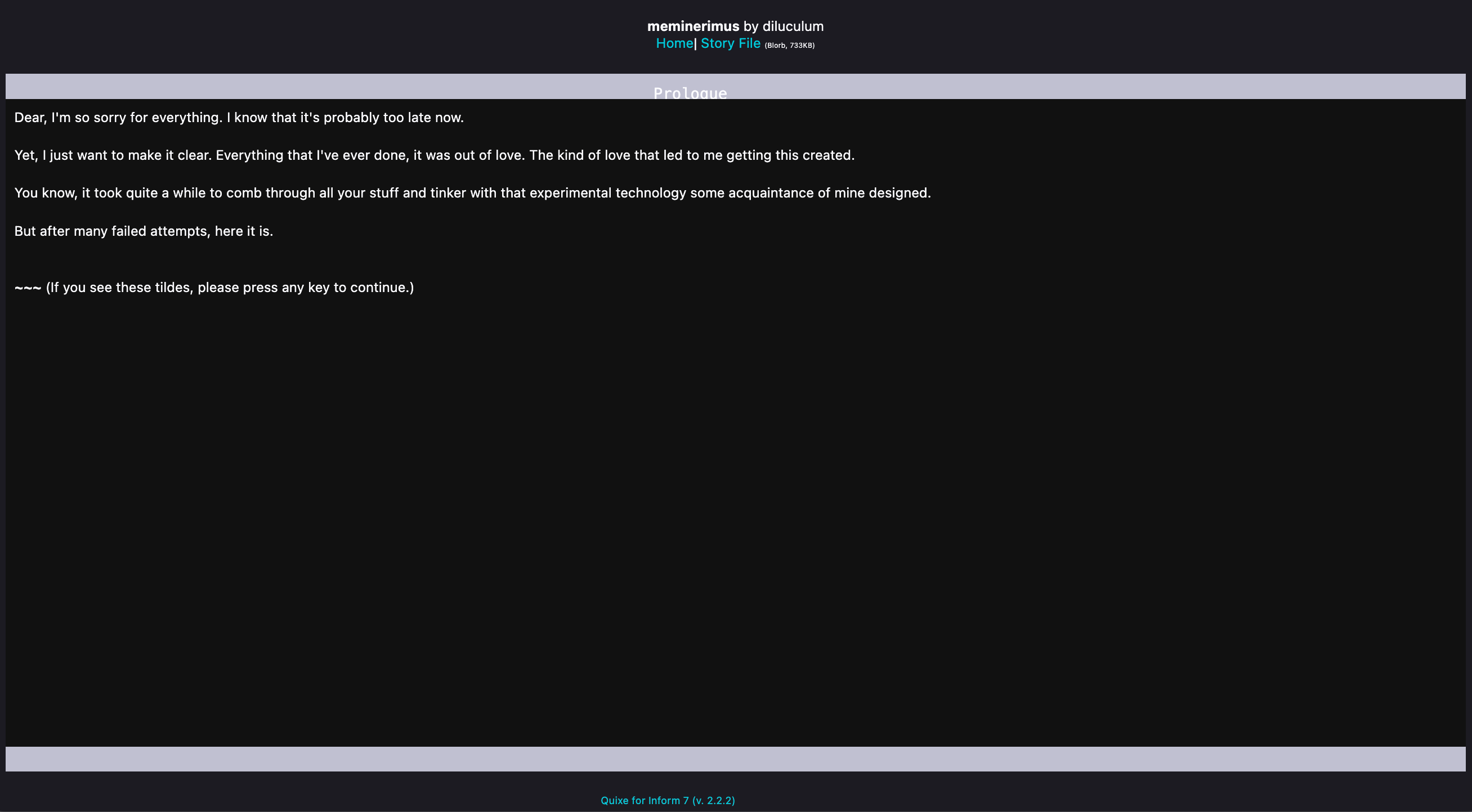
  • I first launched this game through the Spring Thing website (desktop, Firefox browser). It looked a bit off, because the “Prologue” text was cut off and was white text on a very light background (hopefully I’ll remember to include a screenshot). As a result, I ended up choosing to play in the interpreter Lectrote instead. I would definitely recommend avoiding a situation where white text is on a very light background, but it may be an accidental result of the specific browser I used or something.

  • While I think the game is effective and meaningful enough as it currently stands, something I was hoping for was more of a buildup in the storytelling. Because the Prologue almost directly tells the player that the narrator is the abuser and the player character has died, I felt like the story had plateaued, as each subsequent object examined reiterated that same level of abuser-speak. An alternate strategy that the game could have used would be to start out with the mask firmly in place, that slipped the further through the museum the player gets. For instance, instead of giving all the information about the item after examining it once, the player could instead be asked to keep examining the same object multiple times to draw out more and more information (starting with the most innocuous and building toward the most disconcerting).

What I Learned About IF:

  • The thing that really stood out to me in this case is the “limited parser” approach, and how by paring down the possible commands to a smaller scope, previously innocuous commands like “examine” or “wait” gain new significance. These are commands that, when you play a lot of parser games, become default commands that fade into the architecture of the game as they are not what you are actively thinking about. So making a game that is directly about examining and waiting, it de-naturalizes those commands. I don’t think I have ever wondered why a parser game included a “wait” command before, but in this case, I did. It feels like a success in terms of using a compact version of the medium to create some interesting effects.

Memorable Moment:

  • The arch-like structure of the game, mirroring the opening line with the ending line.

meminerimus_DemonApologist_Transcript.txt (29.5 KB)

13 Likes
7 | CRYPTID HUNTER

7 | CRYPTID HUNTER
by: Adam Wade, Alex Kutza, and Skye Murrell

This is a Main Festival entry.

Progress:

  • I reached the ending with a score of 3 out of 3 in 15 minutes, then played a second time for another 5 minutes.

Things I Appreciated:

  • I really enjoyed my first playthrough of this game! What I liked most was the sense of discovery, going through the different environments to see what eldritch creatures would show up. My favorite of the cryptids was probably the infinitely burrowing centipede, but I enjoyed all the descriptions and the grainy black and white images of them.

  • I found the overall puzzle satisfying, because it was not too hard, but also not trivial to solve. When I visited a location, I would find some things that matched a description, and some things that didn’t match, so I felt like I really had to evaluate whether there was enough evidence to confirm that this was the cryptid I was looking for. For example, the last one I solved for was the algae cryptid, and I was not 100% sure that I was correct because I questioned whether I had seen enough evidence of “elemental manipulation.” When dealing with something as enigmatic as cryptids, I liked that the guidebook didn’t feel like a completely straightforward checklist. It felt “realistic,” in the sense that sometimes when using a guidebook in real life to identify an insect or bird or whatever, you might see an individual that looks a bit different than the description (or see colors in different lighting or whatever).

  • I liked that there was a story-related payoff for the player’s treatment of the cryptids. I was put off by how my character cut the centipede in half without much regard for whether the other half would survive (for instance), so I liked that the end of the game not only drew attention to that but also gave me the agency to decide whether to follow through with the bargain. I personally chose to release the cryptids, because they’re cute little horrors that deserve to be free.

Miscellaneous Comments/Recommendations:

  • I was pretty satisfied with playing this game once, as I enjoyed the process of decoding the puzzle and figuring out what the best fit for each set of characteristics was. However, the blurb, tags, and author’s comment all encourage replaying the game, so I decided to go for it. On my second playthrough, I was re-assigned two of the same three cryptids. I went to the location where I had found the previous cryptids, and learned that they stayed at the same locations for both playthroughs, so 2/3rds of the puzzle had been already solved. Based on my memory of the last playthrough, I also knew where the last cryptid was since it matched the new description, and it turned out to be correct. As a result, I felt like playing again kind of detracted from the experience, because I didn’t get to experience much that was new, other than trying out the alternate paths at the end for a bit more narrative text.

  • When I originally got two of the same cryptids again, I thought, oh wow, that’s unlucky. But then I thought about it more, and realized that it might be a relatively common experience. The reason I bring this up at all is because one of my previous IF projects used randomization in a similar way. In that case, there were 24 possible routes through the encounters. I ended up being dissatisfied with “true randomness,” because when readers re-read the story to see different combinations, they would often encounter at least one identical event from the previous route, and when I wrote out the combinations, I realized that this was actually very likely rather than unlikely to occur. I ended up releasing an update of that story that restructured the randomness to prevent identical encounters from being possible in consecutive playthroughs.

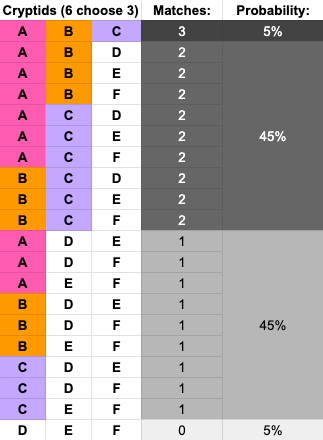
  • Based on that experience I decided to write out the combinations for this game to see what the odds are. In this game, the player is given 3 out of a possible 6 cryptids to solve for. 6 choose 3 is twenty total combinations, so if you play back to back games, your odds of repeats look like this:

  • To summarize the data, you have a 5% chance of getting the exact same three cryptids again, a 45% chance of getting two that were the same (my result when playing), a 45% chance of getting one that is the same, and a 5% chance of getting all new cryptids to look for. Taken together, the expected value for overlaps is 1.5, so the player is extremely likely to have either one or two that are the same between playthroughs.

  • Taking this in, I think if the game’s goal is to encourage satisfying replays, the elements of randomness could be modified in some way. Adding even two more cryptids (so it becomes 8 choose 3) would reduce the odds of overlaps, and the randomization could be modified to exclude combinations with repeats rather than being “true random.” Alternatively, different combinations of location/cryptid could be added to the game, so the player has to re-explore the areas to know which cryptid is at each place. I’m sure there are other things that could be done, but my overall point is that the current structure of the game’s randomness is in friction with the stated intent for players to play it multiple times.

What I Learned About IF:

  • I think this is a great example of how much the blurb/front matter can affect the experience of a game. Had this been presented without an encouragement to replay it, I would’ve played through once, which was (for me) a satisfying experience, and stopped. However, given the emphasis on replayability in the presentation of the game, I ended up playing again and feeling a bit disappointed that there wasn’t more puzzle to solve. Front matter can be quite powerful in setting expectations and influencing what a player chooses to focus on, so bringing it into alignment with the game/narrative is tricky but important.

Memorable Moment:

  • For sure the twist when it turned out I was delivering cryptids to a restaurant. I legitimately did not expect that and I like how it recontextualized the things I had felt uneasy about during the game itself.
11 Likes
8 | EXCHANGE

8 | EXCHANGE
by: Peter Johnston

This is a Back Garden entry.

Progress:

  • I reached the end of the “Vrnnt” route in around 5 minutes, then reached the end of the “Tink” route in about 3 minutes.

Things I Appreciated:

  • I think this kind of near-future sci fi setting is a good vehicle for the premise and themes of a story like this. Billionaires attempting to leverage their wealth to stave off mortality at the expense of everyone else is something already happening in real life, but the consciousness-transfer technology allows the story to explore that theme further. It is a well-worn sci fi trope, for sure, but that doesn’t mean that you can’t tell an interesting story with it.

  • My favorite aspect of the demo was getting information about the setting and how the world has changed. Even though the characters know all about the world they live in, the reader doesn’t, so we have to rely on incidentally learning key information. For instance, Aloysius mentions that he at some point “shorted plasma” (implying that this stock prediction was a source of his wealth), which could refer to either blood plasma or some kind of plasma-based power source (other than the sun, I mean). Either way, it made me curious to know more about the world and I would’ve loved even more of those kinds of intriguing details.

Miscellaneous Comments/Recommendations:

  • The blurb for the demo mentions that the game “goes back and forth between the perspectives” which I don’t feel is clearly mechanically demonstrated here. In this setup, you pick one of the two routes at the beginning, and then stick with that perspective until the end when the characters meet face-to-face. As such, it doesn’t seem like the choices that you make within a route have any effect on the other route. For instance, I picked the “Vrnnt” route (corresponding to Aloyusius Menfer) first, and generally picked the most polite/least abrasive dialogue options. When I then played the “Tink” route (corresponding to Dr. Marquez), it ended as thought I had chosen the more aggressive option. Similarly, when I played them in reverse order to check again, it gives the impression that Dr. Marquez has chosen to take the deal, when in reality, I did not pick that. Reaching the final scene, it plays out differently based on who you are playing as, with the non-player character taking the initiative to speak first.

  • I think what I’m getting at with this is that mechanically, what seems to be happening is that you play through the game from one perspective, and the person you are not controlling will always choose the “worse” dialogue options, rather than the reader going back and forth between the characters to influence both sides of what is happening.

  • In the future, if switching back and forth within the same narrative (rather than fully following the two separate versions of the story from each character’s perspective), I foresee there being issues in terms of managing conflict in the story. I would be most likely to always choose options that force the characters to work together as well as possible, defusing their potentially antagonistic relationship. There isn’t much incentive to work against “myself” when I am being both of these people at the same time, vs. if the story was just strictly from one character’s perspective. It might be interesting to see if certain choices get marked as “unavailable” based on earlier choices, to demonstrate that the player’s earlier characterization of the protagonists has an effect on what is possible later.

  • How would the game handle direct conversations between the characters? Would it jump back and forth line by line, or stay in one character’s point of view per scene, and then switch to the other in the next scene? In that case, how would the conversations adapt to how I’ve chosen to respond as my version of each character leading up to that moment? I think it would’ve been helpful for the demo to have included a full conversation between the two point of view characters as a mechanical demonstration for how the switching would work going forward.

  • There are a lot of different ways this story could go and be structured and result in an interesting reading experience, so I would curious to see how the final version of the game ends up working through the point of view challenges invoked by this demo.

  • I’m not super familiar with Ink, but one thing I’ve seen in previous Ink games that I appreciated is that the choice selection doesn’t clear previous scenes and instead adds on to the end, making it possible to scroll back up to see previous scenes. In this instance of Ink, each choice clears the screen, making that impossible. I personally would recommend using the additive version rather than the screen-clearing version if that’s available!

What I Learned About IF:

  • Something I found myself reflecting on is personality-based choices and how that affects the reader experience. In this case, I would roughly divide the Aloyusius choices into “polite” vs. “rude.” The version of the character chosen by the author to appear in the Dr. Marquez route seems to be the “rude” version. This makes me think, well, should the choices have instead been framed as, “which expression of rudeness would you like to choose?” but that would’ve made the choices seem less consequential as they were happening (like the beloathed “yes/yes/sarcastic yes/no, but actually yes” kind of choices). Having multiple characters with player-malleable personalities in the same story seems to really draw attention to whether events can actually unfold the same way between characters with variable personality traits, because the more divergent the personality traits the player can roleplay with, the more divergent you would expect conversations to be. It was interesting to think about the logistical challenges of playing as multiple characters within the same story.

Memorable Moment:

  • I think the most memorable moment is at the end of your second playthrough, when you meet a version of the character you previously played as. It shows a lot of potential to be engaging once the game is fully developed.
7 Likes

I love that you mathed this out. If there were an award for Spring Thing reviews, I’d nominate this one.

4 Likes
9 | CRIER

9 | CRIER
by: Antemaion

This is a Main Festival entry.

Progress:

  • I reached what seemed like the main ending on my first playthrough which took about 16 minutes. I spent another 20 minutes or so re-playing and trying different routes, arriving at a few game-over states along the way. In hindsight, I would recommend that players save the game since I was naïve to the possibility of getting game-overs (maybe because I’ve more often encountered non-branching renpy projects) during my first playthrough and hadn’t saved at all.

Things I Appreciated:

  • For some transparency, I was a little worried up front that this would feel like indecipherable semantic soup. My sensitive palate cannot always handle evasive abstraction for the sake of it. However, I felt like this game struck a great balance of being challenging and stimulating without feeling like it was trying to push me away as a reader, and I found myself enjoying the creative linguistic flourishes. Despite its rank and disconcerting aesthetics, I still felt invited invited in. Once I got to the end, I immediately went back in to see more branches, not out of a sense of obligation, but because I found the experience legitimately engaging. “A puppet-theatre of murk and slime” turned out to be a pretty accurate self-description of what it was like. This isn’t to say that I have some grand analysis of what any of this means—I don’t know that I feel equipped to delve that much into the poetics and such—but I felt like there were a lot of encounters with interesting characters and a general sense of progression toward the end.

  • The presentation of this game is a delight. It feels like an eclectic audiovisual collage, the underground groaning and echoing and squeaking as dithered sprites of fantastical entities drift into and out of the narrative. Each character had unique and distinct characteristics while still feeling at home in the techno-organic environments.

  • I enjoyed the way the tone slid between seriousness and unseriousness. For all that is murky and dismal, there is also a sense of playfulness to the piece. One moment you’ll be contemplating the violence of, say, whaling, and in the next you’ll have an opportunity to ask whether you can pet Glospia’s “dogs.” The Mad Prophet offers up some incredibly self-serious dialogue, all the while interacting with characters that say typos and textspeak like “u” instead of “you” (it kind of reminded me of the Homestuck trolls, of all things).

  • I really appreciated that there was a menu that allowed me to turn the cool stylized font into something that I could comfortably read. It was the first thing I looked for, so I’m glad it was possible.

Miscellaneous Comments/Recommendations:

  • I’ll offer a little bit of analysis, I guess. This game seems very concerned with the power of creating and interpreting language. The Mad Prophet’s exile underground is precisely because their words had the power to threaten the “sovran,” while a mysterious lichen, when not directly serving as Glospia’s surveillance network, has “evolved to maximize attention … emulat[ing] written speech,” which the Mad Prophet can interpret as contradictory prophecies, and the lichen itself is craved on the surface, collecting in places of power, or that become nodes of power because of its presence. There’s got to be something here in terms of the idea of capitalist algorithms co-opting the ideas/art of marginalized people into its systems, and the tension inherent in trying to navigate one’s relationship to that extraction. But maybe that’s just what I was expecting to see, and therefore, I saw it.

  • The game has a number of game-over choices. On my first playthrough, I happened to make it to what I think was the main ending, but after that I found myself bogged down in either trying to speed through the story to get back to the choices I left off at, or mucking about in the save/load menu. After a few playthroughs I felt like it wasn’t going to be worth searching every permutation, as they kept eventually routing back into a familiar scene (such as proxydrone humorously peacing out before it had a chance to affect the Duchess of Limbs encounter, for instance). I still feel like there are interesting things that could be possible that I missed, but hopefully other people will encounter and talk about them in their own responses to the game. So I guess I would say that the mechanics (of renpy itself maybe?) created some friction in exploring the narrative.

What I Learned About IF:

  • While there’s a lot of different things you could look at for this game, something I want to draw attention to is the quality of the soundscapes. They were eerie and disconcerting, but also looped and transitioned pretty seamlessly. I can only imagine how much work went into that, the one time I looked into anything related to sound in Twine I was like, haha, no, I’m not figuring that out. But the soundscapes really contributed a ton to the atmosphere and characterization, it felt like a very thoughtful and worthwhile inclusion.

Memorable Moment:

  • The line that rattles around in my head the most is “All communication must be destroyed,” perhaps because it is repeated even in the “about” menu for the game. It’s kind of an interesting paradox, perhaps sincerely, perhaps sarcastically using language to invoke its own end.
7 Likes
10 | A QUIET SCURRY

10 | A QUIET SCURRY
by: Moss & Quill Studios

This is a Main Festival entry.

Progress:

  • About 10 minutes total, encompassing a few playthroughs to explore the branches of the narrative.

Things I Appreciated:

  • I thought this piece was successful in its small-scale depiction of a harvest mouse’s night life. From exploring the game in Twine, it seems like in the three main encounters (fox, owl, road), there is one choice that guarantees survival, one choice that guarantees death, and one choice that causes a 50% chance of survival or death. I thought that random element was an elegant way to, in the small scope of the game, illustrate the arbitrariness of survival in some situations.

  • Related to this, I thought the game was effective in managing the player’s agency. The sudden appearance of a predator, or Instinctual responses like hunger and thirst force the player to take some kind of action rather than responding passively to everything. Personally, I tend to make more passive choices in games, especially if there is a threat of game overs or deaths, so I think it was good that the game forced my hand to make active decisions, even if I still had flexibility to decide which approach seemed the best given the information provided.

  • I liked the inclusion of human-related benefits and threats to the harvest mouse. Rather than portraying an environment devoid of human influence, the story illustrates that human influence is an essential facet of the world of this mouse. I feel like as a result of this, the story gently invites the reader to consider their own relationship to mice. I think it’s fair to say that many humans view mice as a pest animal, but are simultaneously creating and reinforcing the conditions that instigate “pest” behavior. I’m not from the UK, but the presence of the fox in the story made me think of the history of fox hunting and how killing the predators of mice probably resulted in there being more mice. Actually, okay, you know what, I wasn’t going to go on this tangent, but whatever, anyone reading this far into an obscure forum post about interactive fiction is here for the tangents anyway. When I was a kid, there was a poetry contest at the local library, where the people who submitted poems would read them for the group. And this one older lady, I guess she was from a rural part of the state, recited what I now look back on as a dramatic polemic piece about how unfair it was that her dad was arrested for shooting and killing a gray wolf in defense of the farm because it was on the federal endangered species list. I remember her performance having this vivid intensity, like the absolute malice and hatred of the evil, slobbering wolf that steamed off every word, not to mention the baleful presence of the state with its city-dweller ideology swooping in to tell Real Americans™ which animals they can and cannot kill. I guess this ultimately is why you should fund libraries—because ten-year-olds absolutely need to be exposed to this level of camp at the hands of amateur local poets to have any real shot at surviving into adulthood. At any rate, the game invited me to recall this incident because to me it illustrates how dysfunctional relationships between humans and animals can have these downstream effects, like everyone complaining about how there are way too many deer eating their plants at the same time as they actively are trying to kill the wolves that would’ve hunted those deer. So I think there is value in stories that invite readers to reflect on and recontextualize their relationships to animals that they have categorized as pests, or threats, or food, or pets, or whatever else.

Miscellaneous Comments/Recommendations:

  • In general, I dislike having text over a photograph background because of the legibility issues it can create. However, I didn’t have as much of an issue with it here, because the image was a dark enough tint that the text popped out fine. Still, I would recommend having some kind of designated reading area that has a more static background. It could be a semi-translucent box, for instance, that keeps the reading area darker while still allowing some of the backdrop behind the box to seep through.

  • Because this is interactive fiction and quick/easy to replay due to the short length of the game, I didn’t really feel that emotionally invested in the outcome, knowing that if I chose wrong, it’s trivial to get back to the point I was at to choose differently. I definitely wanted the little mouse to survive, don’t get me wrong! But I did get a sense of distance between the player and the mouse, because the stakes are very different for the mouse (life and death) vs. the player (trying again and clicking back for a few seconds to return to where I was). Perhaps there was a mechanical way to subtly bring the stakes closer in alignment? I think if the game had been longer with a longer build up of decisions, and/or a writing style that was more focused on emotions, I would’ve felt the weight of my choices more intensely, and felt a stronger sense of risk knowing it might be difficult to get back to where I was at if I messed up. The tone of the game suggests that maybe the intent was to keep the game lighter and more educational, which is fine! I think I was craving for it to dig a little deeper and elicit a stronger emotional response, though. I went on a longer tangent related to point of view below, but an example here is in the owl encounter, where the author writes, “Your eyes look up, reflecting the silent barn owl, claws outstretched towards you.” Because the mouse cannot see their own eyes, this created a slight point-of-view disruption where I felt like I was seeing the mouse from the outside (looking at a reflection in their eyes) rather than seeing the owl directly through the mouse’s eyes. A moment like this where there is real danger to the mouse is when I want to be most immersed in the mouse’s perspective.

What I Learned About IF:

  • One of the deceptively tricky aspects of a work like this is managing the competing factors for point of view. On one hand, the narration has a clear educational bent. The author (I assume) wants the reader/player to learn more information about the harvest mouse and come to better appreciate this tiny creature and its relationship to other animals, including humans. On the other hand, for the work to feel immersive in a second-person point of view embodying a non-human animal, the text has to use human linguistic tools while signaling non-humanness. I think this produces an interesting tension that the piece manages mostly well.

  • For instance, a strategy that this piece uses to balance these factors is to defamiliarize something a human would recognize and understand, a road. The “coarse expanse,” through a tiny mouse’s senses, poses a nearly incomprehensible alien threat that human readers should be able to recognize through the description, even though “road” is not an available concept for the mouse to think of. But then, there are examples that strain this tension. I found myself wondering, when the narrator describes the mouse’s paws as “the size of sesame seeds” whether it was likely that this mouse living in a field had ever encountered a “sesame seed” before as a point of comparison. Similarly, when a plant called “False Brome” is mentioned, I thought that was an unnatural-sounding way for a mouse to think of a plant—it’s a very human style of classification to name a plant in a way that penalizes it for its similarity to another plant. Uh, at this point I should probably say, I realize this is getting very ticky-tack, I swear I am going somewhere with this. You have to believe me. Anyway, I view these examples as places where the educational goals of the game take precedence over immersion. It’s helpful for a human reader to understand the scale of the mouse with a familiar point of comparison, or for that human reader to learn about a real-life plant that could serve as a home for UK-based harvest mice.

  • So the point of all that is to say, that I sometimes felt more immersed in the mouse’s point of view, and other times, I felt self-conscious that I was being educated in an immersion-straining way. I don’t think this is a good or bad thing, really. I mainly wanted to draw attention to this as an interesting case study in point of view, especially because it seems like there are a lot of cases where authors in IF write second-person animal point-of-view, for various reasons. If I were to do so, I would want to think about what degree of defamiliarization with human concepts is necessary to aid the simulation/immersion, and how to balance that with other competing concerns (clarity, tone, puzzle mechanics, etc).

Memorable Moment:

  • I liked the amicable encounter with the hedgehog, it was nice to see another creature that didn’t specifically want to eat the mouse.
13 Likes

Really good response - I particularly agree with the “What I learned about IF” and “Memorable Moment” bits. This was a really thought-provoking game, and review.

2 Likes