7 | CRYPTID HUNTER
7 | CRYPTID HUNTER
by: Adam Wade, Alex Kutza, and Skye Murrell
This is a Main Festival entry.
Progress:
- I reached the ending with a score of 3 out of 3 in 15 minutes, then played a second time for another 5 minutes.
Things I Appreciated:
-
I really enjoyed my first playthrough of this game! What I liked most was the sense of discovery, going through the different environments to see what eldritch creatures would show up. My favorite of the cryptids was probably the infinitely burrowing centipede, but I enjoyed all the descriptions and the grainy black and white images of them.
-
I found the overall puzzle satisfying, because it was not too hard, but also not trivial to solve. When I visited a location, I would find some things that matched a description, and some things that didn’t match, so I felt like I really had to evaluate whether there was enough evidence to confirm that this was the cryptid I was looking for. For example, the last one I solved for was the algae cryptid, and I was not 100% sure that I was correct because I questioned whether I had seen enough evidence of “elemental manipulation.” When dealing with something as enigmatic as cryptids, I liked that the guidebook didn’t feel like a completely straightforward checklist. It felt “realistic,” in the sense that sometimes when using a guidebook in real life to identify an insect or bird or whatever, you might see an individual that looks a bit different than the description (or see colors in different lighting or whatever).
-
I liked that there was a story-related payoff for the player’s treatment of the cryptids. I was put off by how my character cut the centipede in half without much regard for whether the other half would survive (for instance), so I liked that the end of the game not only drew attention to that but also gave me the agency to decide whether to follow through with the bargain. I personally chose to release the cryptids, because they’re cute little horrors that deserve to be free.
Miscellaneous Comments/Recommendations:
-
I was pretty satisfied with playing this game once, as I enjoyed the process of decoding the puzzle and figuring out what the best fit for each set of characteristics was. However, the blurb, tags, and author’s comment all encourage replaying the game, so I decided to go for it. On my second playthrough, I was re-assigned two of the same three cryptids. I went to the location where I had found the previous cryptids, and learned that they stayed at the same locations for both playthroughs, so 2/3rds of the puzzle had been already solved. Based on my memory of the last playthrough, I also knew where the last cryptid was since it matched the new description, and it turned out to be correct. As a result, I felt like playing again kind of detracted from the experience, because I didn’t get to experience much that was new, other than trying out the alternate paths at the end for a bit more narrative text.
-
When I originally got two of the same cryptids again, I thought, oh wow, that’s unlucky. But then I thought about it more, and realized that it might be a relatively common experience. The reason I bring this up at all is because one of my previous IF projects used randomization in a similar way. In that case, there were 24 possible routes through the encounters. I ended up being dissatisfied with “true randomness,” because when readers re-read the story to see different combinations, they would often encounter at least one identical event from the previous route, and when I wrote out the combinations, I realized that this was actually very likely rather than unlikely to occur. I ended up releasing an update of that story that restructured the randomness to prevent identical encounters from being possible in consecutive playthroughs.
-
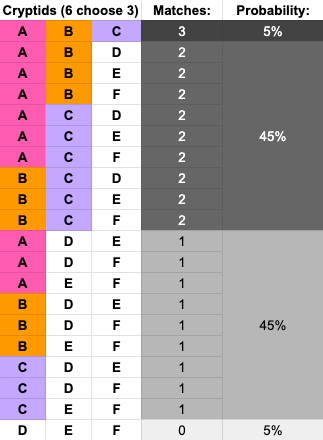
Based on that experience I decided to write out the combinations for this game to see what the odds are. In this game, the player is given 3 out of a possible 6 cryptids to solve for. 6 choose 3 is twenty total combinations, so if you play back to back games, your odds of repeats look like this:
-
To summarize the data, you have a 5% chance of getting the exact same three cryptids again, a 45% chance of getting two that were the same (my result when playing), a 45% chance of getting one that is the same, and a 5% chance of getting all new cryptids to look for. Taken together, the expected value for overlaps is 1.5, so the player is extremely likely to have either one or two that are the same between playthroughs.
-
Taking this in, I think if the game’s goal is to encourage satisfying replays, the elements of randomness could be modified in some way. Adding even two more cryptids (so it becomes 8 choose 3) would reduce the odds of overlaps, and the randomization could be modified to exclude combinations with repeats rather than being “true random.” Alternatively, different combinations of location/cryptid could be added to the game, so the player has to re-explore the areas to know which cryptid is at each place. I’m sure there are other things that could be done, but my overall point is that the current structure of the game’s randomness is in friction with the stated intent for players to play it multiple times.
What I Learned About IF:
- I think this is a great example of how much the blurb/front matter can affect the experience of a game. Had this been presented without an encouragement to replay it, I would’ve played through once, which was (for me) a satisfying experience, and stopped. However, given the emphasis on replayability in the presentation of the game, I ended up playing again and feeling a bit disappointed that there wasn’t more puzzle to solve. Front matter can be quite powerful in setting expectations and influencing what a player chooses to focus on, so bringing it into alignment with the game/narrative is tricky but important.
Memorable Moment:
- For sure the twist when it turned out I was delivering cryptids to a restaurant. I legitimately did not expect that and I like how it recontextualized the things I had felt uneasy about during the game itself.