6 | MEMINERIMUS
6 | MEMINERIMUS
by: diluculum
This is a Main Festival entry.
Progress:
- I reached an ending in around 5 minutes, and spent another 10 minutes or so replaying to test strategies for resisting the narrator. However, I did not end up finding any alternate endings, if they do exist.
Things I Appreciated:
-
From the opening Prologue, I got the impression that the game was being narrated by the abuser of someone who had died, so I played through the game two ways. First, I just followed the stated instructions and got to the end of the story. Then, I played a second time more experimentally, to see if I could come up with a strategy for defying or otherwise thwarting the narrator, but I personally did not find a way to do that effectively. Overall, I thought this interplay between an unreliable narrator and a skeptical player was meaningful and engaging.
-
Because this is a very limited parser (other than the metacommands) allowing only “look,” “examine,” or “wait,” the decision on which commands the author included feels significant to me. “Look” refreshes the room description. “Examine,” when used toward the four museum items, is what progresses the game, which ends once you’ve looked at the four museum items. The most curious option is “wait,” which causes the narrator to tell you this won’t “achieve anything of substance,” and prompt you to look at one of the items that you have not yet looked at (or yourself). Because this wasn’t tied to any in-game “progress,” it felt like the strongest avenue for defiance available, so I ended up spamming this command for many turns trying to see if I could cause the narrator to snap or break in some way. I did not discover any way to materially change the outcome of the game, but it didn’t feel meaningless to me either. The in-universe narrator chose to program this version of the player-character in such away that allows temporary resistance that (as far as I could figure out) inevitably fails. Telling the player character that waiting is pointless was another way to reenact the abuse dynamic, who has “failed” by not meeting the insidiously unobtainable expectations imposed upon them.
-
So, setting aside my attempts to subvert the narrator and now taking a closer look at the main text of the game, I find this an interesting game to think about. We do not actually know much about the player character, because every bit of information is curated (literally, it is a digital museum) and therefore distorted by the narrator. The game begins and ends with an apology: “Dear, I’m so sorry for everything,” and at the end, “I’m so sorry for everything, dear.” Based on everything that comes between the beginning and end, it’s hard to feel that this is in any way a sincere apology, in the sense that the narrator does not seem truly conscious of the harm they have done. I do get the sense that they have a feeling of guilt, which they have masked over, and that’s what caused them to try and recreate this digital version of the player character to puppeteer around. This is a short game, but I think it lends itself well to different interpretive lenses/approaches. I would be surprised if other players didn’t get something quite different out of this based on the lived perspective that they are bringing with them into the game.
Miscellaneous Comments/Recommendations:
-
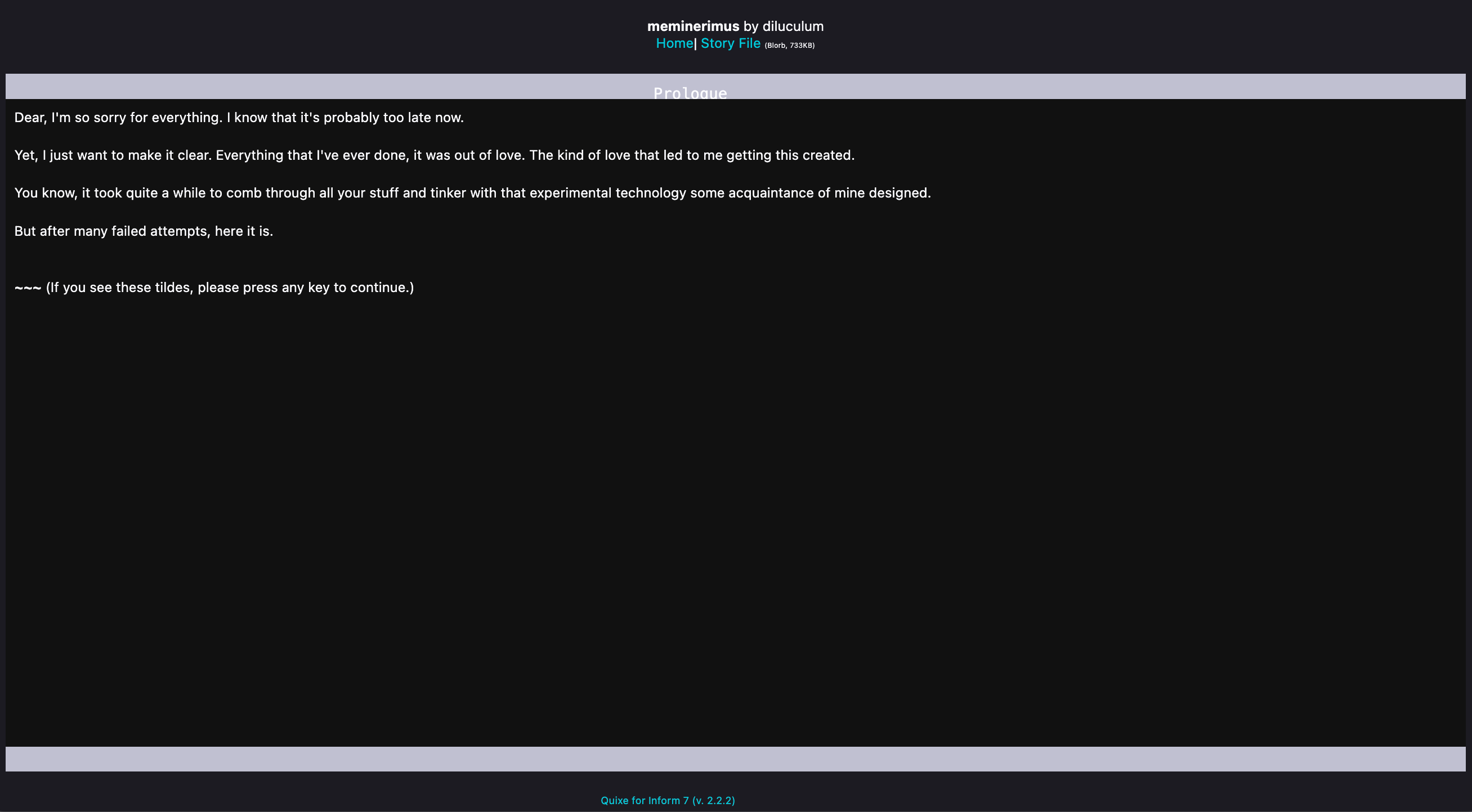
I first launched this game through the Spring Thing website (desktop, Firefox browser). It looked a bit off, because the “Prologue” text was cut off and was white text on a very light background (hopefully I’ll remember to include a screenshot). As a result, I ended up choosing to play in the interpreter Lectrote instead. I would definitely recommend avoiding a situation where white text is on a very light background, but it may be an accidental result of the specific browser I used or something.
-
While I think the game is effective and meaningful enough as it currently stands, something I was hoping for was more of a buildup in the storytelling. Because the Prologue almost directly tells the player that the narrator is the abuser and the player character has died, I felt like the story had plateaued, as each subsequent object examined reiterated that same level of abuser-speak. An alternate strategy that the game could have used would be to start out with the mask firmly in place, that slipped the further through the museum the player gets. For instance, instead of giving all the information about the item after examining it once, the player could instead be asked to keep examining the same object multiple times to draw out more and more information (starting with the most innocuous and building toward the most disconcerting).
What I Learned About IF:
- The thing that really stood out to me in this case is the “limited parser” approach, and how by paring down the possible commands to a smaller scope, previously innocuous commands like “examine” or “wait” gain new significance. These are commands that, when you play a lot of parser games, become default commands that fade into the architecture of the game as they are not what you are actively thinking about. So making a game that is directly about examining and waiting, it de-naturalizes those commands. I don’t think I have ever wondered why a parser game included a “wait” command before, but in this case, I did. It feels like a success in terms of using a compact version of the medium to create some interesting effects.
Memorable Moment:
- The arch-like structure of the game, mirroring the opening line with the ending line.