baezil's Spring Thing '26 Reviews (23 Minutes)

Review thread! Full disclosure, I’m a participant. All my reviews are subjective opinions; I want to talk about my thoughts, not make blanket statements on quality. YMMV. Also, I’ll be nice.

Index:

First up is the game that felt most targeted at me…

A Quiet Scurry (Moss & Quill Studios)

I loved naturalistic animal stories as a kid. I loved imagining different senses, loved pretending to avoid predators and forage for food; a game my first real friends and I made up and played a lot was called hawks and chipmunks (tag with a nature aesthetic, basically). I even tried to write a choose your own adventure story about a fox with only a pen and a spiral notebook. (Tried; I had terrible follow through as a kid.) Young me would love this game. Young me wanted to make this sort of thing. Young me would also want it to have a resource management component, and would want it to cover the mouse’s entire life and let you have babies and then let you play as one of the babies and and and..

As it is, this was lovely. It felt like a beautifully illustrated children’s book. This deserves moody, beautiful illustrations with a lot of purples and blues and some beautifully stylized yellow lighting for the roadside scene. Maybe it was the written imagery that made this feel oddly chill, despite the fact that you can die. (If you’re bad at being a rodent, which I am not; I lived through my first playthrough, probably because of my extensive training in being a chipmunk.)

My only note: I don’t love photos as backgrounds, generally. This one was alright, but the contrast wasn’t always ideal. That said, the photo was gorgeous and perfect for the story, and the text was always readable.

I’m really fond of this game, and as always I’m incredibly jealous of the UK for having harvest mice. Huge native wildlife W for you guys. What a great start to the Festival!

14 Likes

Ooh, another fun one: Cryptid Hunter (Adam Wade, Alex Kutza, Skye Murrell)

I love cryptids! I want to believe! Or, I did, back before the US govt was neck deep in bloodthirsty chuds who believe aliens are real and are actually demons. Despite the present-day overlap of fun cryptid stuff and truly insidious conspiracy theories that guide US policy, in my heart I love this kind of thing.

In Cryptid Hunter you play as a scientist who’s a true believer but has never been taken seriously. (Again, IRL this sets off alarm bells, but I recognize the character trope and enjoy it.) You receive a mysterious package: a description of three cryptids (three traits per beastie but no overall descriptions) and a map with descriptions of likely sites. You can visit a site to observe, photograph (which gets you a delightfully grainy, spooky pic), and/or capture the resident cryptid, but you can only capture three total. Nab the wrong critter/s and you’ve failed. It’s a kind of deduction game in the vein of Phasmophobia & similar. It looks like which of the three are on your list is randomized, too. Neat!

I really liked the gameplay. Individual traits are shared by multiple creatures, and while I got them all right on my first try I had to actually think about it and even revisit sites. The photographs were such a fun and were genuinely helpful (I looked for credits for the art but couldn’t find any). At no point did I feel like it was tedious to navigate between places on the map or access my notes, even when doubling back, which was an achievement in itself. This game felt finely tuned in design and length (about 20 mins), and I had actual fun playing this game. I’m really picky about puzzles and IF gameplay, and I often enjoy the story more than the core loop/mechanics/puzzle (I’m sure anyone who plays strings will confirm, it’s hard to get it right). I enjoyed Cryptid Hunter as a game.

On the flip side, I found the surrounding story to be the weakest aspect. The character felt unrealistically naïve: the Venn diagram, of “cryptid believers” and “people who’d be suspicious of a mysterious employer with unstated goals” is probably a circle. The reveal at the end that your employer is a Dungeon Meshi-style monster restaurant was a nice bit of dark comedy (imagine being a customer: “I’d like the filet of child-mimicking well ghoul, please”), but how was the PC surprised? (Even if they were going to a shadowy zoo or research institution, that really more humane than eating them). Why would this person suddenly care, when they clearly hadn’t before, especially considering that you capture the elongated cryptid in a way that felt VERY cruel and unscientific.

Still, I had a lot of fun playing this game. It had a neat concept that aligned with my personal taste (always a mark in a game’s favor, lol), solid execution and scope, and graceful integration of some visual elements into the puzzle. My only other note: if it were me, I’d have saved this for Ectocomp ‘26!

9 Likes

Missing City Council (Solarius)

This game signals almost nothing to the player; I think it’s impossible to finish without the walkthrough. It’s pure mechanics, no padding, no signposting. This made it difficult to play (the word hostile may have been used to describe my playthrough), but it was kind of fascinating, artistically speaking, especially with that truly gonzo ending. Something is going on here that I find compelling.

There is one aspect of the gameplay that I thought was interesting: this game doesn’t use any of the cardinal directions. It’s all ENTER [room]/EXIT. Cardinal directions are the most player-friendly because they’re the default , but they’re so artificial. It’s easier to ignore in a fantasy or outdoor setting, but I’m thinking of When The TV Decides to Murder Your Girlfriend, which was set mostly in apartments. Having to go west to the living room or north to the closet just felt weird, and it would’ve felt weird here.

I’m interested in attempts to do something different with how you navigate the space, and this game certainly made an effort. Enter X/exit isn’t the worst compromise, but it does limit the type of places you can write into your story, it took me a while to figure out, and the input wasn’t as convenient as just typing “n.” On the other hand, it wasn’t nearly as clunky as my game, which lays out directions you can go in bold at the end of every room description.

Digression: Dialog’s link features befuddle me, but the visual map elements, while very retro, can be a fun alternative; Daniel Stelzer’s Wise Woman’s Dog is a good example of a Dialog map I found pretty helpful. (I bet Twaiyn would’ve had an even better solution, Twaiyn could do EVERYTHING. RIP, Twaiyn. :cry: )

This was a weird game! It definitely wasn’t player-friendly! That said, there was imagery here that was delightfully and memorably bizarre, and I respect what the author was doing with navigation.

10 Likes

Been too busy to play very much this past week, unfortunately, and I’m still trying to figure out how to pet the cat in Our Lady of Thorns. That said, I did sneak in a short Twine game, so here’s some thoughts on *MYRTDPI (*Ellric Smith):

In this game, when you have to talk or fight, you choose a spirit to conjure and hope they do a good job. The premise fits Twine quite well, and I can imagine that with more elaborate CSS/design work you could really class up the design with a little bordered section for your summon choices (or something, you get it, this isn’t y area). I think it also makes this a very hard kind of game to write; if the central mechanic is repeated often, the author has to think of ways to make each choice/response 1) in character for the choice of summon, 2) mechanically distinct and somewhat strategic or predictable, and 3) continually fresh and interesting. I think this game achieved the first, had variable success for the second, and wasn’t long enough to need to worry about the third.

One of the summons be the default PoV/narrative voice; very clever! It justifies the second person that a lot of games naturally fall into and allows for some humorous commentary on what’s happening (we’ve got a tsundere sort of situation here). The choice does put more pressure on the writing, and I think we lost the distinct voice at times. This outsider PoV could’ve been used to provide info/lore that I think we need and don’t get, too; more on that in a sec.

This is a short game that feels more like a proof of concept than a complete work (not a dig, it literally ends “to be continued”). We jump into the middle of a character’s quest and don’t see the impact of the quest’s success. We don’t have a great sense of their personality because they aren’t narrating and they don’t speak, but they’re not a blank slate. They have a history and feelings and information the player doesn’t ever get to access.

And I wanted to access it! Summoning is a common trope—just off the top of my head there’s Pokemon, Yugioh, Fromsoft games, Ender Lilies-- and I wanted to know more about this world’s take on it. Similary, what’s up with the main char? What does the censer really look like and how does it work? Are spirits conversing on their summoners behalf very rare? Is it hard to achieve? Is summoning rare or valued, and is our main char particularly skilled? Are these spirits slaves, friends, contractors?

I needed more info and more immediately personal stakes to be really invested (especially for the fight scenes), but I wanted to be more invested. A good sign. I think this is a clever concept well-suited to the chosen medium, and it’s worth developing further.

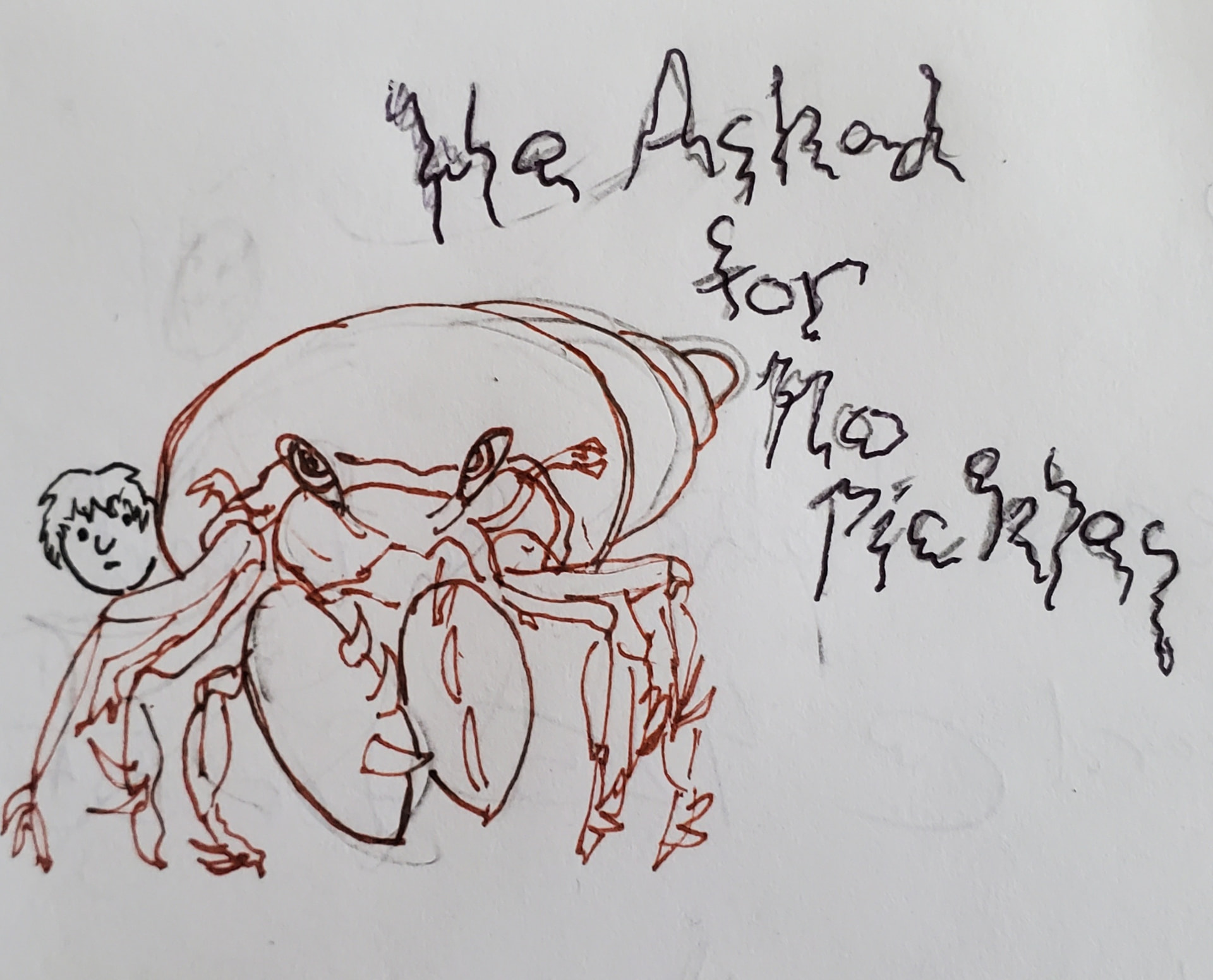
Anyway, here’s a crappy meme I doodled in about three minutes: Yultholth helping the main char with a Mickey Ds order. (Yes, I know that Yultholth doesn’t talk; artistic license.)

12 Likes

I’ve read a bunch of transcripts for Our Lady of Thorns, @baezil , and the one thing that every single one had in common is that the player tries to pet the cat :slight_smile:

No spoiler, but: you can once you win her over. Good luck!

6 Likes

I think I’ve basically won the game at this point, no matter what else happens.

11 Likes

The Universal Robot (Assembled By Hex) (Agnieszka Trzaska)

We’re at that point in the Festival where others have already reviewed most games more intelligently than I will. I’ve only got my personal impressions to offer at this point! More than usual, this is a review about my very subjective reaction to the game.

There’s often a moment (to a greater or lesser degree) in a puzzle-forward game where you know SOMETHING has to happen, but you haven’t found or remembered the hint, and the character has no reason try anything in particular. You’re left to just Try Stuff. I find this Try Stuff phase is where I start losing interest. I need narrative reasons to put the Florb on the Fleem and toggle the Floop; it’s not usually inherently fun for me to do. I’ve never been a completionist; finishing for its own sake isn’t my thing.

Missing City Council is only Trying Stuff. On the other end of the spectrum is Our Lady of Thorns, which is lavishly implemented and fun to inhabit but does hit a Try Stuff phase after about 20 minutes (for me, at least). Universal Robot is in the middle. This game is cleverly made and written, and there is a certain pleasure in just trying stuff to see what’ll happen… to a point. While many puzzles have at least an implied goal, I, the player, messed with the secretary’s computer because it was there, and it seemed like the game wanted me to. The story then told me I scheduled a meeting. Why? I didn’t find out until I had Tried Enough Stuff to see the end result. This keeps me at a distance, lessens my investment; I tried the giving up ending, then got to a real ending (bought the wrong robot), and I was satisfied.

Speaking of distance… Stories speak to me more clearly when they don’t have their tongue constantly in their cheek. Dark subject matter relayed with the distancing effect of a light tone and absurdly heightened setting bums me out. I can’t take the story seriously, because it isn’t a serious story; but then, it IS serious, the stakes are high for this character! I find this dissonance unpleasant and existentially dreary, and not in a productive or compelling way. I know things are often hopeless and we’re trapped by arbitrary constructions of pointless systems beyond our control! That’s our day to day, man! I want someone, the narrative in this case, to care! Look, I’m a simple and also a self-serious creature, which is why the game we started to make before strings was shelved… more on that later.

This game is for the puzzle freaks (said affectionately) and the completionists (said with more weariness than affection). There was a lot of clicking to navigate, and the difference between combining items vs using one item on another wasn’t clear, but otherwise the mechanics were well deployed. When I made the connection between the snake and the secretary I laughed out loud. I liked Sniffy. The map was very slick. I think this was creative, enjoyable, engagingly written, and mechanically polished. This is a good game, and the endings thread has been busy, so it clearly connected with its intended audience. That wasn’t me, but that’s okay.

10 Likes

Crier (Antemaion)

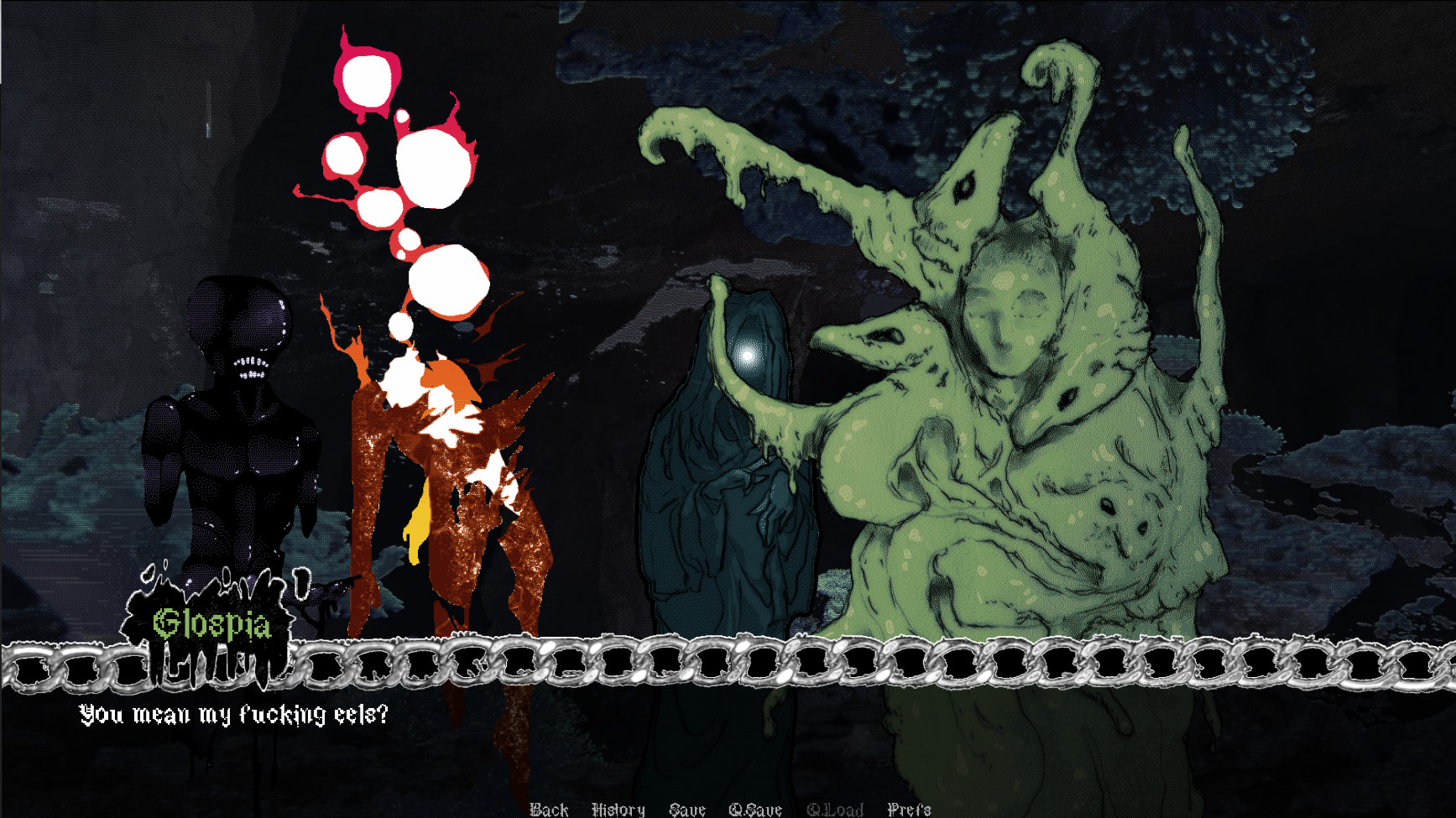
Oh, hell yeah. Love this game and its twisty ideas, crunchy art, and “shit graveyard ambience FOR SLEEP ~ unintelligible whispers, nature :leaf_fluttering_in_wind: sounds~ (ASMR) (LOOPED)” soundtrack. Like its setting, the narrative has more branches than you’d think at first glance. I like how it gets a little freaky with it (I was erotically eaten by a spider, which isn’t My Thing in that way but is my thing as a player).

Formally, it’s not actually that weird. I expected (somewhat apprehensively) a fever dream collage, but this is very much a story with an internally coherent (if slightly vague) setting, and the gameplay is straightforward narrative choice.

It’s more narratively comprehensible than I feared, too. You’re a mad prophet condemned to a catabatic exile in a hellish underdark of discarded history, waste, and people. Exiled for prophesying a ruler’s death, you hope to return topside so you can continue to insist the sovran will die. It doesn’t look good, but you have to try: “The worst thing I could imagine,” you say of your previous attempt, “was that nothing would happen.” SOMETHING has to change, regardless of what happens after. As you say, “All I have is speech. I hone it in the fine grit of obsession.”

And speech isn’t nothing. A whimsically sapient and corrosive guide tells us that “everyone needs you to speak to them, to act on them; you make us real!!” Feral moss imitates the structure and form of communication for “maximum attention” because it feeds on info. Words are fuel, communication and ideas the raw substance that constitutes bodies in a cyclical flow of refuse-reuse-resell. Organisms descended from biotech torture tools still carry “Genetic echoes of inquisition,” dangerous despite the absence of any controllers. Neither technology nor nature are neutral or acultural forces; it’s all a construct, baby, everything can be rendered and re-rendered, in words or flesh or both. There is nothing external to the system; the entire world is one big shit dungeon, its walls made of discourse. No escape from the slop, only adaptation or opposition.

But if discourse shapes everything, maybe our prophet isn’t so mad after all. Obsessed, sure, but as the prophet says, “I foretell what is to be. […] I can shape the future. But I can’t pry into the present.” So we’re helpless against the now, but if plant yourself on a hill and die hard enough, and something will happen. That might be an aneurysm induced how much you want the sovran to die (relatable), but if your dying rant poisons the discursive well from which we all sip, including the sovran… At least you did something, imagined a different future. Worth it? The next step may be extinction, or another iteration of tyranny, but isn’t anything better than stasis?

A good question, worth considering. I replayed this one a couple times because the world was enjoyably unpleasant to inhabit, and I wanted a better sense of what it was saying and doing, and on top of that it’s fun to look at and well-built. I encountered no bugs, thought the soundtrack was perfectly suited to the content, and I even kept the pixely gothic font. Clear inspirations notwithstanding (we’re all shaped by what came before, after all), I think Crier is something special.

Bonus: there’s a lotta good quotes in this one. "Sorry I defiled your tentacle” was up there, but my personal favorite was….

9 Likes

Fantasy Opera: The Theater of Memory (Lamp Post Projects)

I love a game with stats and dice. Part of this is D&D withdrawal (I haven’t had a group for years at this point), but there’s an extra investment in a character: I made the choices that will shape (or at least texture) my experience, which lets me RP a little, makes the stakes of each roll or choice more personal. I think the dice and stats were very well done here. Simple, never overwhelming, breaking up the story-heavy passages with just enough gamey elements to maintain both the feeling that I was making choices without losing narrative momentum. I don’t think your dice rolls matter to the overall narrative, but it still feels good and adds a little personalized flair, and I had tons of fun, and I’ll be looking up the first trio of LPP games. I hope that Nell continues playing in this space.

The world is interesting, too. Post-medieval and pre-modern aesthetics are arguably under-utilized in fantasy, especially for the complex and diverse world that most D&D takes places in. I say D&D because that’s a conscious influence here and not because it’s set anywhere specific to D&D, as far as I know.

I do think there was an unevenness to the actual handling of the mystery. The player has probably already notice connections between dreams during day 1, but the intermezzo still asks us to perform a lengthy matching mini-game to further hone in on these parallels, “coding” the main themes or emotions that occur across all dreams. It is skippable, and I did skip it. On the other hand, I hadn’t realized the full significance of the painted emblems on the seats; the intermezzo makes that connection for you, no participation required. I’d have liked the dream matching minigame as an optional puzzle you could play if you needed a hint (I think this sort of participatory hint system would work well for a mystery game as something you have to seek out), and maybe a library visit or chat with a knowledgeable contact to get us more clues for the second half of the mystery. I wanted to feel like I did at least some of the work for that second piece of the puzzle.

My longest thoughts are about this story. This game made me think about justice, because as a mystery, it’s at least partly about what justice is, who seeks it and why[1] . We’re asked to decide the appropriate fate once the culprit is unmasked, and alarmingly this justice system has no set punishment for the crime. We need to carefully consider what the appropriate response is.

When I do, I find that something is rotten in Lyra. I don’t know if the story knows this, and I’m quite sure most of these characters don’t. These thoughts are longer, less about ToM as a game than as a narrative, and spoilery; it’s going under a readmore so it’s easier to skip.

An indulgent close reading

The dreams aren’t harmful, that’s clear to all, but one of the first things the director says to us emphasizes the gravity of the crime: “As you well know, unlicensed spellcasting is against the law. If someone has been dabbling in malevolent magic, we will see them brought to justice.” Unlicensed immediately grabbed me! By whom? The state, since it’s punishable by the state’s laws? Who can be licensed? For what purposes? Also, malevolent? More nuisance than malevolent, surely?

The real harm becomes clear as we talk to others. Alvisa the architect dismisses “these magic types” as liars, cons, exploitative hucksters. She says this while we’re standing in an enchanted opera house; there’s clearly some cognitive dissonance, some persistent socio-political narratives in play here. Later, we can choose to let Vitale off easy if he gives up info on a mage, and the game tells us our reasoning is that the mage is surely more dangerous than Vitale. If you leave the decision up to the opera troupe, they’ll vote to turn him in (even some of the ones who had good or sympathetic dreams about his life). The game shows us that the majority believe that unlicensed magic use must be punished, regardless of how harmful the effect is.

Why this impulse to punish regardless of (lack of) harm or danger? Let us use our leetle grey cells and sum up: Alvisa calls the tiefling mage a con. Vitale (whose motives I find stunningly unsympathetic, the sort of desire to be special and immortal held by tech bros and insecure tyrants) spent a lot of time and money (“I bribed the right people”) seeking out this mage, then paid her more money to perform complex but benign magic. If turned in, Vitale’s happy to rat for the cops indefinitely because he feels the mage “preyed on his weakness [by taking the money he offered], and he [is] as eager as anyone to see her magical practices put to an end.”

The only harm we’ve seen, the only danger that anyone has actually named, is economic. We can’t punish Vitale, he’s just a poor little guy, look, he’s crying! Vitale is the real victim, and the really dangerous criminal is this highly skilled mage who had the gall to take money for services. The harm, then, is not in the magic “these magic types” do, but the way they undercut the monopoly on magic (and, likely, the lucrative contracts that licensure can bring). The system has strong reasons to frame them as both unskilled but somehow still dangerous, to foster an attitude in its citizens that punishment is deserved but that the state is still ultimately in control. Whenever there’s a widely held attitude that a group is somehow both petty/lesser/weaker yet also dangerous, I get pretty suspicious, especially when the state hasn’t bothered to settle on consistent punishment for this group. Vitale gets off pretty easy; you get the sense that the mage, if ever caught, probably won’t.

There’s something to be said, too, about race. The mage who did this magic for Vitale is a tiefling. In the world of D&D tieflings are often regarded with suspicion and distrust as dangerous liars, thieves, cons whose magic comes from infernal ancestry. The mage’s bouncer was a kobold, another literal underclass (they live in tunnels under cities and make good thieves). We don’t see racism on page anywhere else, but this choice is interesting given the discourse about “these magic types.”

The story is overall pretty breezy, pleasant; a low-stakes mystery with very little opposition to your efforts to solve it, so the dissonance between the harm done and the eagerness to bring the mage to justice stuck out. This isn’t a criticism; it makes the story more complex to notice something the characters seem unaware of, and it gives greater weight to that final choice you make. I am on that mage’s side, though. Fuck the fantasy police and Vitale’s pathetic grasping for immortality; get ‘em, Lunetta, I hope you take all those old men’s money and never get caught. Magic for all!

Finally, a word about the art—it was great. It enhanced the design, was skillfully done, and matched the tone of the writing perfectly. There’s something quite special about a game by one person that does writing, art, and coding As an overall work, this is one to be proud of.

Footnote 1

As a fantasy mystery set in an opera house, it reminded me of Katherine Addison’s Cemeteries of Amalo fantasy novellas, the first of which is about murder in an opera house that features heavily in all three books. These books are similarly preoccupied with justice, personal and systemic, and this game strongly invited the comparison, apparently by accident. A fun coincidence! I love these novellas and the novel they spun off from, but because I love them I’m protectively hesitant to rec them. In addition to the opera house, they also feature a plot about illicit pornographers using recently invented photography to exploit underage orphans; the high stakes of the municipal cemetery’s dysfunction and politics in a world where the dead rise if their graves aren’t tended; plot-relevant systemic homophobia; radical political factions in the airship maker’s labor union; the racial politics of giving the big opera solo to a goblin performer rather than an elf; and a traumatized, anhedonic protagonist with a martyr complex. They’re something special (though I think the ending of the third and most recent is quite bad), and if this sounds like your thing you should read them.

11 Likes

Ha! Excellent. That was in the back of my mind when I was playing it, but it wouldn’t have occurred to me to say anything about it. It’s so much a part of the contract when engaging with most things that lean cozy: that you’ll allow yourself to be distracted by the magic show and pay no attention to the externalities behind the curtain, you won’t ask “what is this story hiding over there?” or “cozy for whom?”

2 Likes

Thanks so much for playing and reviewing, baezil!

I thought Strings was lovely, by the way! Hooray for music-themed games. I was delighted by the central puzzle mechanic (using materials in the environment as strings). And the passages about the “libidinous” peeper made me laugh. We’ve been hearing a lot of peepers in my area lately, so the game does feel very seasonally appropriate for Spring Thing.

About the intermezzo (Spoilers)

A small point of clarification: participation isn’t strictly required, but it is supported (and boosts the final score). If the player proceeds with the dream analysis activity, and succeeds in finding the relevant connections between the dreams, there’s a segment that guides them through the process of making the connection between the themes of the dreams and the paintings.

The PC’s dream that occurs afterwards effectively “catches up” players who skipped the intermezzo puzzle activity or might have missed some portion of it.

About the story (Spoilers)

We might just all find out in the sequel I’m tentatively planning to write… :wink:

I’m not sure if this comment is specifically in reference to my game or other “cozy”-leaning stories, but I hope it’s clear that it’s hardly my goal as an author to encourage people to ignore the themes I incorporate into my work! :sweat_smile: (I wrote about this briefly in the postmortem for my 2025 IFComp games.)

5 Likes

Oooh, good! I didn’t want to be like “I hope we get more on this” because that’s obnoxious and this is complete experience in itself, but I am glad to hear! The end felt like a setup for a possible reappearances, and I love the “recurring, sympathetic (or at least fun) criminal” trope.

In the review, I think I said something like “I’m not sure the story knows” exactly what’s happening within, and I definitely think the author and the story (and the chars) are all different elements. I think sometimes when a story doesn’t know what it is, that can be an accident or make it likely to fall apart under any analysis; that definitely wasn’t the case here. You can read ToM as cozy, but nothing the story’s doing is less successful because of/totally broken by a more cynical reading, it’s just more complicated. To me that’s the sign of a healthy narrative ecosystem!

3 Likes

Our Lady of Thorns (Joel Burton)

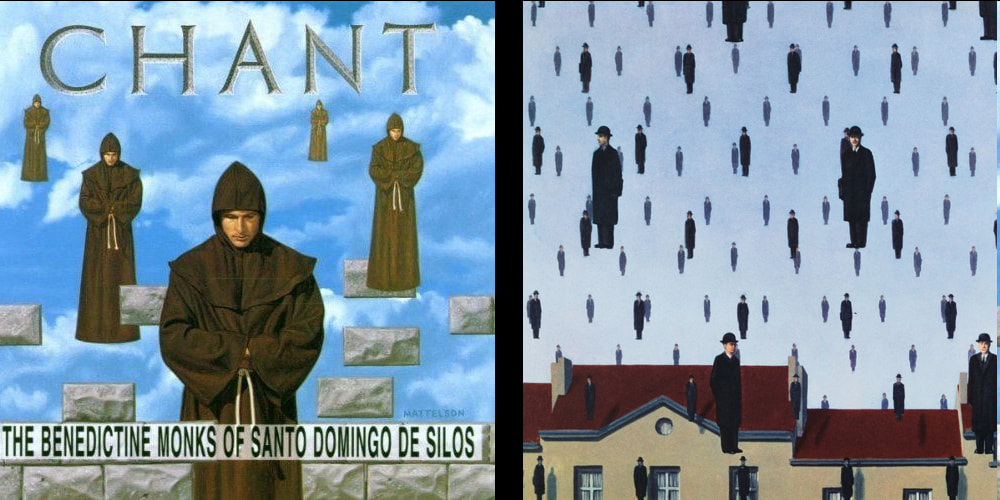
I was about 8 when I became obsessed with Redwall, which I blame (along with the Benedictine Monks of Santo Domingo de Silos and with their trippy, vaguely Magritte-esque1 cover art) for my long fascination with monasticism. I wasn’t Catholic, I just liked the idea of monastic life. I no longer want to be a monk, unless it’s of the Redwall variety2, but I’m still fascinated with monasteries and nunneries as hubs of literacy and ecclesiastical politics, contradictory sites of extreme restraint and opportunities that were hard to find elsewhere, and settings that make for great stories. Name of the Rose and Pentiment were my biggest touchstones going in, and I was interested in what OLoT’s take on religion would be, particularly after learning that the author has not played Pentiment. How would it use its setting?

The setting

Beautifully, for a start. What an astounding debut. The world of this parser is an achievement by any standards, but for a first game… you could retire satisfied after this. Examine a shelf: you find linens, robes, and a generic set of vestry items. Examine vestry items and you’re given several specifics, including some objects that can be taken for a puzzle that you wouldn’t know about otherwise. So much of the gameplay is rooted in attention to this world and its layers of detail, attention that is a delight to give. I appreciated the map, but ultimately didn’t need it, in part because I found this to be vividly but straightforwardly described. There’s a perfectly calibrated style, not too wordy but not at all vague or spare. Really excellently done. I can’t speak highly enough about how good it feels to just inhabit this world.

The gameplay

Spoilers and a general misunderstanding of cats below!

Going to start this section off with my own shortcomings: I’m bad at parsers! After about 15-20 minutes, the game turns you loose and tells you to just Try Stuff. I wrote in an earlier review that the Try Stuff phase is my least favorite part of games because I’m bad at making the connections, and I made some very silly mistakes playing this game that are all on me, though. An example: I had to restart, and in my second game I mis-remembered what herb Remigio liked and took his nonreaction to rosemary as indication that the herb thing was story flavor, not function.

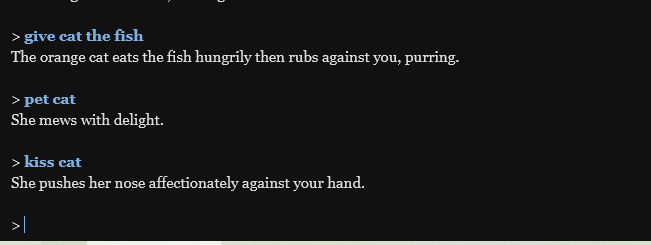
Another example: I forgot that cats are animals you can pick up. I’m very, very allergic to cats, so I haven’t spent much time with them. The encounters I’ve had with them have been polite, even friendly if the cat is outgoing, but no cat has ever given my any indication they would enjoy being scooped. It sounds like it’s different for some of you, and I’m very jealous. For me, this meant that after feeding, petting, and giving a little kiss to Pax, I was out of ideas for how to interact with this cat. Picking him up never occurred to me; Tabitha had to clue me in there. So this is the filter we’re working with; my perspective is clearly flawed.

I did have some real points of friction with the game that I think weren’t my own quirks but rather signals that contradicted what the game meant you to do. A big one: I got a hard-fail at one point because I’d left too many doors open and then got spotted with candle and had to restart the game (remember to save, baezil!). Later, I needed to light a candle to access the crypt. The fires to light the candle are in the scriptorium, occupied by Wilfred (who’s described as being close to the fire), or the kitchens, occupied by Martin & Remigio. Normally I’d wait until everyone was in the quire before using my contraband candle, but you need to pass through the quire to get to the crypt, so that wouldn’t work. I was stymied; apparently the solution is that Wilfred simply doesn’t notice you light the candle, despite noticing other indiscretions I’d committed. Writing this I realize I should’ve tried to put Wilfred to sleep again, but at the time I felt that the game had told me to be very cautious but then asked me to do something quite risky.

Another example: some interactions with items—taking or manipulating—are shut down by the game with a response that warns you about getting caught or that emphasizes it’s disrespectful/against the rules; others, though not outwardly different, are allowed because they’re part of a puzzle. With the candle, the game just says “somehow, you justify it.” Again, you’ve got to Try Stuff—take, climb, touch-- and endure a certain amount of the game scolding you until you find something that you can take/climb/touch.

One more: talking to people got me shushed so often at first that I assumed talking to them wasn’t really a part of the game play. Clever, I thought, to make everyone bound by the Rule to be silent and avoid dialog without blocking the action entirely. Then I hit a wall and was told that you’ve got to chat with specific brothers. Fair enough, you’ve got to Try Stuff, and the game hints that Wilfred is amenable. Still, when I tried to tell people (even Wilfred) about my suspicions, they dismissed it. The game signaled that general topics (ask about cat, about other brothers, etc) were alright, but the specifics of the case, no matter how compelling, weren’t fruitful avenues of conversation.

This meant that near the end, when the game told me it was now time to accuse Hugh during an office or consult a sympathetic brother, I didn’t realize it was really a choice between “justice” or “mercy.” For one, everyone was pretty hard on me for that business with the candle/key, so mercy was not the overriding sense I got from anyone, including ol’ Wilf. For another, Wilfred scolded me for gossiping when I told him about compelling evidence. I didn’t consider Wilfred a trusted confidant in murder-related intel. The weight of that choice, and why Aldwin would try to go to any one brother after being shot down even with evidence in hand, felt unclear.

Nearly all these puzzles felt solvable, though. These mixed signals were fairly minor hiccups. (I nabbed the candle without issue, the issue with talking to people was fairly minor, and crypt is optional), and my overwhelming impression was that this game is a huge flex. I wish I’d had more patience and solved more of this without hints, both for the satisfaction and because the price of asking Tabitha for a hint (at least for me) is that the it’s given with juuust a dash of smugness. Any frustrations were quickly forgiven because of how lovely it is to step into this world. I almost wish there was no murder and we could just work in the garden and sing. (Hm, do I still want to be a monk?)

The Religion

So with our muder solved, what is OLoT doing with its setting, with religion? It’s not NotR 2, and it’s not really about the church being changed by a shifting secular world like Pentiment. Here it’s structural. Religion is the clock and the schedule, determining who can be where at what time, setting limitations on what you can and can’t openly carry or touch. It’s baked into the physical walls, with Gordian’s precepts literally locking one door.

The walls are porous, though. The monastery is struggling financially, not selling enough candles or manuscripts, buying flour from the nearest town to get through the winter. Holy isolation is not materially feasible, and the day-to-day needs are a constant mundane worry.

Similarly, for these characters, the religious rhythms and duties are often at odds with what they feel or need as individuals. Religion is not a personal matter for them so much as the structure in which they try to live. This feels fittingly historical, and it means they’re often motivated to break the rules. Aldwin wants justice for his kind mentor and will steal and snoop to achieve it. Remigio will facilitate your rule-breaking in exchange for a reminder of the home he misses. Hugh will steal from and kill his holy brothers to help his earthly nephew. The space of the monastery is beautiful to explore and examine, but as a player there’s a claustrophobia, a feeling of surveillance.

I don’t think this game is anti-religion; Hugh’s mundane ties are what caused the murder. But he had to kill and steal because the walls of the monastery and the restrictions of his vows keep him from being there to help his sister. The strictures of a holy life are incompatible with human needs, no matter how much the monks may try to isolate themselves, and that tension between the impersonal structures of your order and the very personal needs of you and your brothers are what makes this game tick. That was an interesting focus, and an interesting tension to center when, like I said, this place is so much fun to inhabit as a player.


[1]

Tell me I’m wrong:

[2] Redwall monasticism involves seemingly no dogma or formal orders or actual religion, focusing instead on being a woodland critter, throwing lavish community meals, microbrewing seasonal alcohol, and helping youth with elaborate, sword-themed puzzle quests.

10 Likes

An assorted lineup of games I checked out but but didn’t play, or games I played but didn’t love, or games I played but which were very short. Less reviews than impressions, really.

Enigmart (Sarah Willson)

Peeked in; failed to clock the trick for puzzle one, got the solution from Tabitha; some horrible kid got my muffins. Peeked at another puzzle at random: cubes and arithmetic. Not for me, I said! This one is for the true puzzle sickos. Looked great, though, design-wise, and next time my puzzle sicko father-in-law visits and I need to entertain him for 90min-1 hr, I’ll give him a tablet and boot this up, he’ll be enthralled. He’ll say, “Oh, that’s interesting, there’s a connecting story in between the puzzles. I’m not sure that I really, you know, understand it, but I found it interesting.” You don’t know it, but that was a killer impression of him. If you were one of his kids you’d be laughing so hard right now.

Social Democracy: Popular Front (Autumn Chen)

Social Democracy: Popular Front– oh, this one’s a GAME game. This is the sort of thing that usually comes with an enthusiastic friend reading directions at you for 45 minutes. There’s cards and resources and turn action limits and a lot of very nitty gritty history happening here. It isn’t that there’s no narrative, but it’s on such a broad, impersonal level. Individuals exist, but they’re a part of the larger story. Some games are all fiction, very little interaction; this is on the other end of the spectrum. It’s fun to see this kind of thing, makes for a diverse ludo-ecosystem, and it seems hellishly complicated to make.

I peeked in, muddled around, decided I had insufficient knowledge about 1) France, 2) history, 3) politics, 4) governance to meaningfully engage, and (impressed and dazed) I bailed. Only later did I find out this series has found a very specific and relatively large audience. Heck yeah, this thing is intricate and calibrated, and it deserves the attention from the right crowd.

meminerimus (diluculum)

Unrealistic, this type of parent would never be so honest about what actually happened, they’d be like, “No, you got bored of that raspberry pi, I didn’t take it away” and “we could finally play that game without you deciding to shout at me.” I’m being tongue in cheek here, of course, though there was something in the tone that felt more heightened than the subject matter warranted. (Maybe all the direct addresses– “my dear”– felt a little affected? But then, the type of person narrating would make a meal of grief.) Anyway, one of those games that is very short and makes you feel disproportionately bad.

The choice of medium is interesting. It’s Inform with hyperlinks, but the choice elements are so unimportant that it could’ve been a linear click to proceed Twine or similar. Twine Harlowe would probably have been easier to use than Inform. I don’t think the form choice hurts what it’s doing, there isn’t anything happening here that couldn’t happen in a different program– there’s minimal variance in custom responses to repeated/blocked actions, e.g. Unless using a form that usually has more freedom and then restricting that freedom is part of the point. Oof, now I feel worse; I take it back, Inform was probably the right choice just for that procedural argument alone.

Coffee Cake Caper (Darius Foo)

Very Encyclopedia Brown, this. Read a story, catch the inconsistencies, solve a low-stakes mystery. Which is a good thing, I like this concept, but Caper desperately needs more QoL revisions. A notes tab that auto-adds salient points and some red herrings after an interview should’ve been feasible, especially since we’re told the PC takes notes. (I’m not 100%, though, because I think this is an author-made system. Impressive!) The fill in the blank system suffers from comparisons to similar, more player-friendly systems (Case of the Golden Idol, Obra Dinn); it needed a lock-in for correct guesses, or at the least should’ve removed options from the dropdown after a fully correct guess, or at the very very least it should not have randomized the dropdown options after each guess. (The word hostile may have been used during play to describe a play experience for the second time during the festival.) That said, I think it’s a fun concept, worth polishing. I wouldn’t say no to future mysteries in the same vein, as long as they’re fully baked.

Kudos where they’re due, though, this game taught me that traditional coffee cake is yeasted; I didn’t know. Fun! I do have to ask, though: why are so many IF games set in amusement parks or circuses? They just seem disproportionately represented in the genre. Maybe I’ll make a spreadsheet.

Alternate review: where’s the option to say “Diffany, do you feel this too? Is there something, y’know, happening here? :smirking_face:

Cyclic Fruition Number One (D E Haynes)

Huh. Weird.

explore

7 Likes

Lol, amazing observation. MATH CHECKS OUT. Finally breaking my review embargo. I have been missing so many great reviews!

4 Likes

Getting a being of infinite malice and casual cruelty to notice you IS NOT WINNING!!

(It’s been a while since I’ve aired my felinophobia. That’s been building. :] )

^^^ Things the protagonist of A Quiet Scurry would post.

6 Likes

Interestingly, back when I was still hoping to ship a .z3 version of my game (by removing inessential parts and tightening text and such), there was a constant for the cat, and #IfDef to not include her (she is an alternate solution to a puzzle, but not strictly essential). So you could have compiled a cat-free version. :slight_smile:

4 Likes

snl season 44 GIF by Saturday Night Live|100%x100%

2 Likes

23 Minutes (George Larklight)

A different version of me tried to become a professor. I spent two years in a doctoral program, paid for by teaching sections of intro to college writing courses (the ones they make engineering and athletics majors take). I’m an anxious person, especially socially; this has been true since I was old enough to have a personality. I loved the work, my cohort, the place I lived, but the combined stress of the academics (I was adequate) and teaching (I was a mess) meant I was barely keeping it together. Anxiety eats your memories, but something I vividly remember: there was a turn the bus took on the route to/from campus that gave me a perfect view of the mountains across the strait, always snow-capped and dramatic and unbelievably beautiful. I looked forward to that turn; hard to be anxious when you’re so lucky, living in the most beautiful place on earth.

Except it isn’t hard. Anxiety saturates you; it lingers, it accumulates, emotional heavy metal. Anxiety makes me forgetful (short- and long-term), brain-fogged, hesitant, avoidant, constantly tense. It makes me a weaker person, unkind to myself and, at a certain point, to others. I passed my written and oral comprehensive exams, thought about doing this forever, and a few weeks later notified the school I was leaving, thanks and sorry.[1] We had to move as soon as the term ended: no student status, no legal permission to be present in that country. A full demolition of my life. I think you’re supposed to end these sorts of stories with something like “this was the right call and ten years later I’m thriving,” but that time weakened the structural integrity of my self. A decade later I’ve still got panic attack triggers I didn’t have before, a heavy failure I still carry, chunks of my life that I can’t remember.

After a minute with this game, I could feel my heart beat faster, my body reacting to familiar situations and emotions. I’ve never had a kid, never will (see above), but I’ve lived a version of this commute. I recognized the gnawing, distracted, frenetic change of topics, the attempts (ultimately ineffective) to stave off a Very Bad Memory. The knowledge that you’re too brittle to be good. 23 Minutes effectively captures a specific experience of the world that I recognize. I don’t know if this game effectively communicates that experience to people who don’t already know what this feels like, just based on other reviews I’ve seen. It was so immediately familiar to me that I’m inclined to think that you get it or you don’t. I got it, though; my body felt this one. Didn’t expect that.

So much for the Fiction. The Interaction… Hm. On one level, I liked the procedural argument made by the only I in this F being a repetitive, monotonous action, not so different from the way anxious thoughts loop back to the same things, the intense emotion you can feel while you make your dull daily commute, the way anxiety can sap your agency and lessen the ways you can interact with the world around you. On another level, it was a lot of clicking.

I liked the use of images that almost but don’t quite line up. I read it as a way to visualize not just distraction, but the way an anxious life is just blurred fragments and not a whole, the way being consumed by your thoughts makes you miss most of what’s around you. I went back to read Drew’s review of the visuals. They say it much better than I could: this is really well designed for the ideas it presents.

I like that in this one festival we’ve got this, which is, per its own subtitle, a poem and not really a game, and Social Democracy, which is 100% game and has very little poetry (probably not none, that stuff gets everywhere). It’s made me think about how wildly different creations can share the same IF label. Entirely different species sharing the same ecosystem. What’s here that causes these to coexist?

Maybe it’s just our attention and care: organizers, creators, reviewers, players, all swapping kinds of time and attention and energy and vulnerability that brings these works into existence, gather the together, bring them to life with different kinds of engagement. The label isn’t about the content of a work, it’s about the attention that’s given to them. We’re the link!

What a nice, community-focused thought. This is going to be my last review, I think, and I need a nice button to add at the end here, so let’s say that’s it and not think much more about it for now. Regardless of the answer, I’m really grateful that this experience exists. So much generosity went into it all. What a gift this has all been.


[1] It’s funny, actually, because I told them I was leaving, and a trusted and very kind professor told me that they’d start by putting me on personal leave to make it easier to come back if I changed my mind. I didn’t care at that point, and I never changed my mind, and a procedural quirk means that I think I’m still down as absent without leave. On the lam from the academic elite. What a rebel!

8 Likes