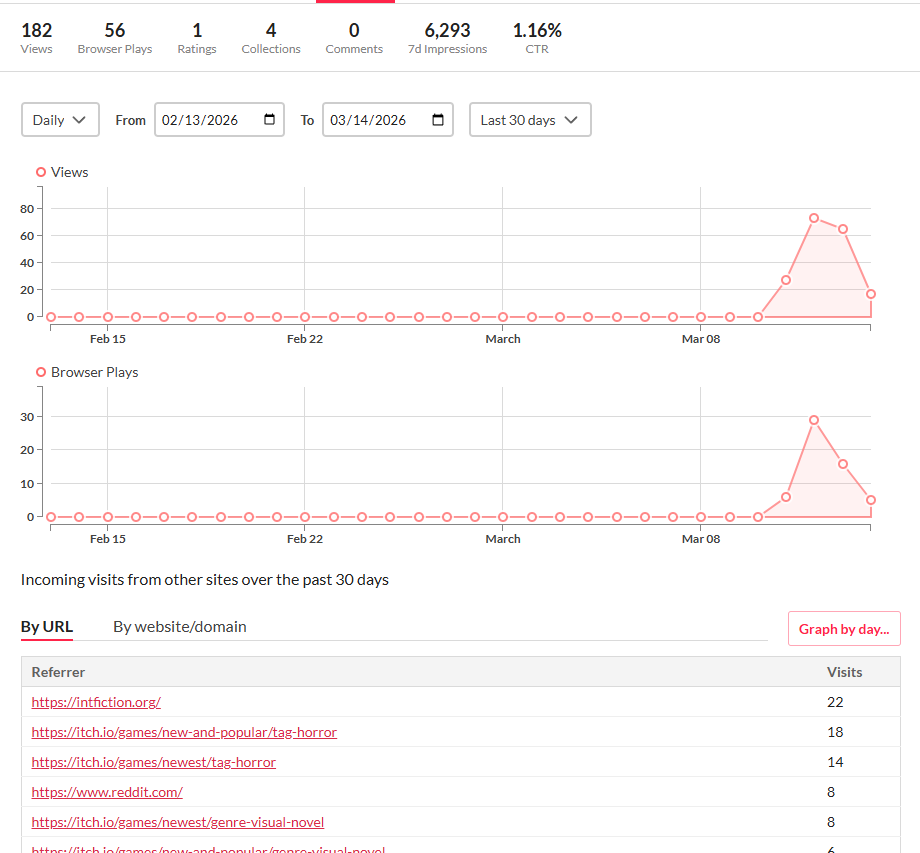
One thing I want to mention is that the amount of attention a project from an unknown creator gets is largely a factor of luck. This is true regardless of whether it’s commercial or not. Commercial projects need even more attention than noncommercial ones to be successful, because commercial viability is a factor of how much attention your project gets and how many people see it and are willing to spend money on it.
Most projects get very very little attention — 182 views is normal for the average game released on Itch, might even be on the high end — and a few lucky ones will go viral and get thousands of views, or tens of thousands, or even hundreds of thousands. Maybe you’ll win that lottery and a popular Youtuber will make a video about your thing and thousands of people will see it. Then for an indie game, you can spin that attention into hype for the larger, full, updated version of your small free game that will be released on Steam as a commercial product in a few months. It seems like a lot of popular indie games on Steam achieved attention and an audience via this route. But it is highly likely that the average small project, no matter how much time has been put into it, won’t get that much traction.
I say “project” instead of game because this applies to other web-medium art besides games: weird indie animations, horror ARGs, music albums, and so on.
If you don’t have an existing following or fanbase, than the only methods for people to discover what you’ve made is through the randomness of the algorithm. Even if you do “marketing”, which includes simple social media stuff like posting to a random forum or Reddit or what have you asking people to play your game, whether people actually see those posts is up to chance, and whether they pay attention to that marketing is also up to chance.
You can make a game more or less eye-catching, but if you’re obscure online than chances are it won’t matter much. There are a lot of games out there, so people need a really compelling reason to play yours over all the others out there. Jams and comps on Itch can help because they usually guarantee at least one or two people will play your game and offer feedback, but they’re absolutely no guarantee of popularity.
For games, visuals can help. From what I see, most games that go viral have some level of compelling visuals because that’s what makes a game stand out and immediately grab people’s attention. But the popularity of Type Help proves it’s not a solid rule that you need visuals for your game to go viral. You can also look at Social Democracy: An Alternate History, which is pretty light on visuals but went viral because of the political simulation part. As a side note, both of these two games are going to have Steam versions release soon. I expect a decent number of people to play them on Steam.
I’ll repost one of my favorite articles about game development, which I’ve posted here before:
There’s 1000 posts on reddit and twitter and GDC postmortems and everywhere from devs who poured everything into their game, went into debt, quit their jobs, dropped out of school, only to release and earn $0 (or very close to $0). There’s often tons of posts and comments coming up with reasons why the game earned $0, lack of marketing, bad art, no multiplayer, whatever.
But the thing is… there doesn’t need to be a specific reason why a game earned $0. MOST GAMES EARN $0. If its your first game its especially going to earn $0. Those comments people give… the feedback isn’t wrong, but even if you did do marketing, fixed the art, added multiplayer, or whatever else they were suggesting… the likely outcome is you still earn $0. And comments would have a whole new set of justifications as for why. But again, games don’t need a reason to make $0. They need a reason to not make $0.
Anyway, this isn’t a business advice post, so I’m not gonna tell you all the ways you can make a game not make $0, though I will say one great path towards that is to uh… make a lot of little games, and maybe one of those might get some kind of viral attention or win some awards or attract the attention of a publisher or something. Expanding on that game is a good way to not make $0.
The games industry is weird. There’s a ton of dumb luck involved in success. The more games you make, the more chances you have that any individual one takes off in ways you weren’t expecting, and hey that’s something that could be the trigger you need to turn it into a bigger project.
It’s not just about the attention tho, it’s also possible that you might just stumble onto a game concept that turns out to have far more potential than you originally thought. My first big commercial game project, Closure, was the result of one of these. The flash game it was based off of took 2 months, but god damn it was really cool and got a million plays on Newgrounds, and it was hard not to look at that game and just think of all the potential ways to make it bigger and cooler.
Making tons of small games also helps you build up an audience and fanbase that can support you and help hype up your bigger projects. Marketing’s hard after all, “do marketing” is correct advice but not really actionable for a lot of games as you cant just start that process as an afterthought at the end of development, it just doesn’t work that way. It needs to be part of the project from pretty early on, and the game needs to be marketable. You gotta practice that too, and smaller projects are once again a great way to practice that so you don’t mistakes on your larger ones. Having an existing fanbase makes the whole thing easier too, so anything you can do to build up that fanbase is great.