Hi everyone,
I’d like to share a development log for a tool I’ve been working on: Visual Novel Nodal Editor, a node-based authoring environment for creating visual novels and branching interactive narratives.
The software is currently Coming Soon on Steam and will launch in Early Access so I can iterate based on community feedback.
I may also release a demo version before or during Early Access. feel free to whislit & share
so here are my answers to the new dev system questionnary
Development
Where is the documentation for creating a game?
→ Documentation is under development, will be released in a few weeks
Is there documentation for how a programmer could extend the system?
→ No extension for the system actually.
Is there built-in support for managing extensions/modules/libraries?
→ No support for extensions/modules/libraries
How easy is it to pick up and use?
→ Will be avalaible on Steam soon.
What does the syntax look like?
→ Does Not apply, full interactive approach
Environment
Is development and hosting on the website only or is there a separate IDE?
→ It’s a full standalone software for windows actually
Can you save projects locally?
→ yes
Offline editing?
→ yes
If you have a WYSIWYG/no-code editor, can you switch between that and some sort of programming language/pseudocode?
→ No
Does it support spell check?
→ No
Exporting/publishing
Are games exportable as playable websites?
→ Only executables for the moment, I may study a webapp export soon
Can you download/play games outside the platform?
→ you can freely distribute an executable actually
Can you share the resulting game freely?
→ yes
What license do games made with your platform have?
→ it’s not a platform but a standalone software
Can people play without an account?
→ For editing, you need Steam account, but for playing executables no
Logic/mechanics
Are there ways to get complicated mechanics made (e.g. variables, functions)?
→ for the moment no variables (working on it for a future release)
How complex can the logic be?
→ For the moment it’s just normal story branchings
Random number generation?
→ no
Text input?
→ no (only on editing)
Random cycling text variation?
→ not for the moment
Repeatable choices?
→ no unless you connect a choice to a previous node
World model support?
→ no
Can you make relatively linear storylines easily?
→ yes, create nodes edit them , drag and drop connections between them
UI/UX
Is it easy to style your stories, without elaborate knowledge of CSS?
→ no CSS, replace the images or add new ones
Are there alternative color schemes for the site interface?
→ no color scheme for the moment
Platform comparison
What does it do that other well-known IF platforms struggle with?
→ fully graphical edition
What does it struggle with that those platforms do well?
→ no code at all, write your text, connect
AI
Was AI involved in the making of this system?
→ yes
Is AI a part of the features?
→ it is optional
(If the answer to these questions is “yes”, please add the ai tag!)
→ ai parts :
- you can connect to a local or distant Stable diffusion server
- you can ask translations directly in the interface to google translation
Business model
Is it paid or free to play/write/use?
→ it will be pay for editing, free to play exported executables (I’m studying protection for authors that want to sell their exported novels)
If paid, how do you intend to attract paying readers?
→ if an author want to get paid, it will be it’s duty to attract readers
How does the monetization model compare to something like Itch?
→ No monetization system, only authors will choose where to sell her/his creations
Proof of concept
(Most people choose an IF platform by playing a great game from it first.)
→ Does not apply for the moment
Is there an example game written using the system?
→ there will be one or more small example novels
Which examples do you think best demonstrate its strengths?
→ just the examples for the moment
Accessibility
Support for languages other than English (possibly diacritics and non-Latin alphabets)?
→ yes, interface will be in english, french, spanish , portuguese, deutch, japanese
Screen-reader friendly?
→ not for the moment
Can any timed text/quicktime events be altered by the reader?
→ all text can be skipped, no quicktime event for the moment
some more details about this software
. Node-Based Story
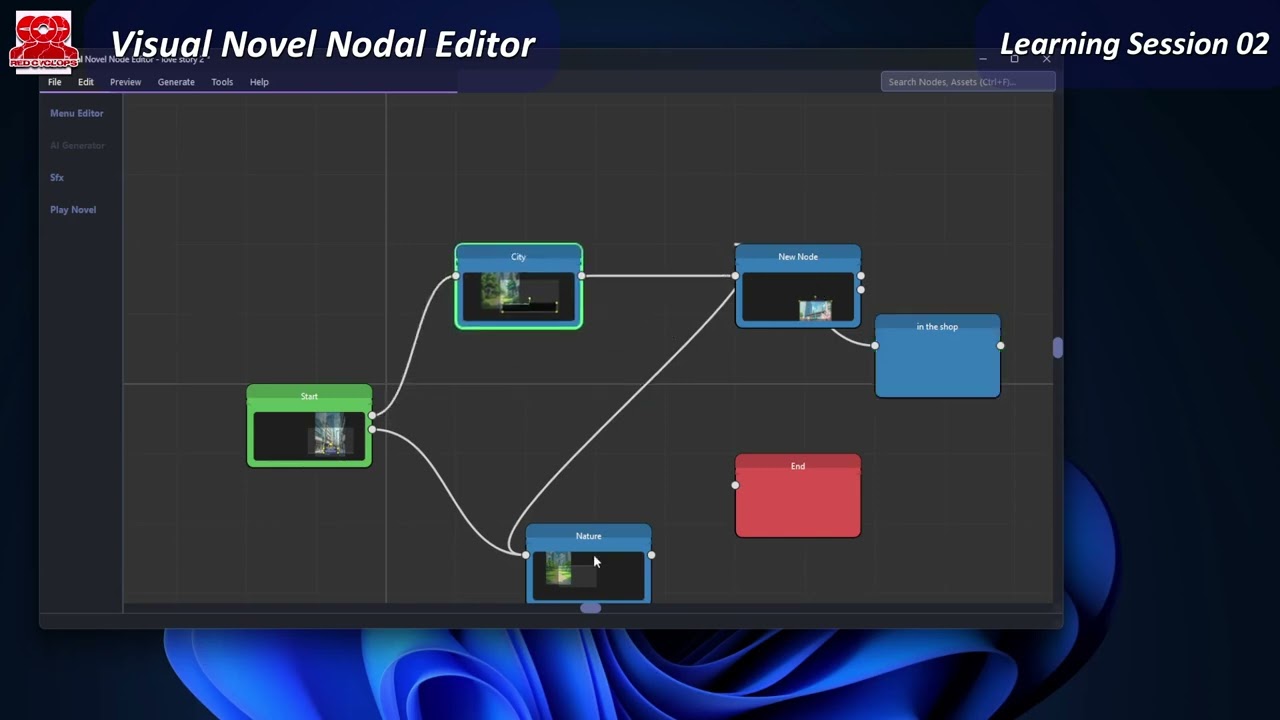
Nodes are in the core editor interface allowing branching choices.
.Node-Based Dialogs
A nodal dialog editor interface allows as for the story to branch choices between nodes.
Each node represents a narrative unit (dialogue, choice, etc.), and connections define execution flow.
My main objective was to allow complex logic without requiring scripting knowledge, this will been soon fully achieved with variables and conditionning branching
.Menu Customisation
I made a menu editor, to change aspects of the novel menus
I focused on reducing friction during writing:
-
Fast text editing
-
Character assignment
-
Expression / asset references
-
Inline actions and events ( to come)
One ongoing question is how much information should be visible directly in the node versus in a side panel.
.Particles system editor
I made a simple particle editor, to create effects like rain, fire, snow, etc… imagination is yours
One of the harder problems has been balancing flexibility with usability — especially preventing users from creating inconsistent states.
Optional AI Integration
The editor can connect to external AI services (for example image generation), but nothing is bundled. Users connect their own Stable Diffusion server if they want to — the core tool remains fully usable without AI.
Feedback I’d Love
Since many people here have experience with IF tools:
-
Do you see advantages in node-based narrative authoring?
-
What features are essential for large projects?
-
What are your biggest frustrations with existing tools?
-
Would export to other IF formats matter to you?
-
Same question with imports?
I’m happy to answer any questions — technical or design-related.
Thanks for reading!
Filipe