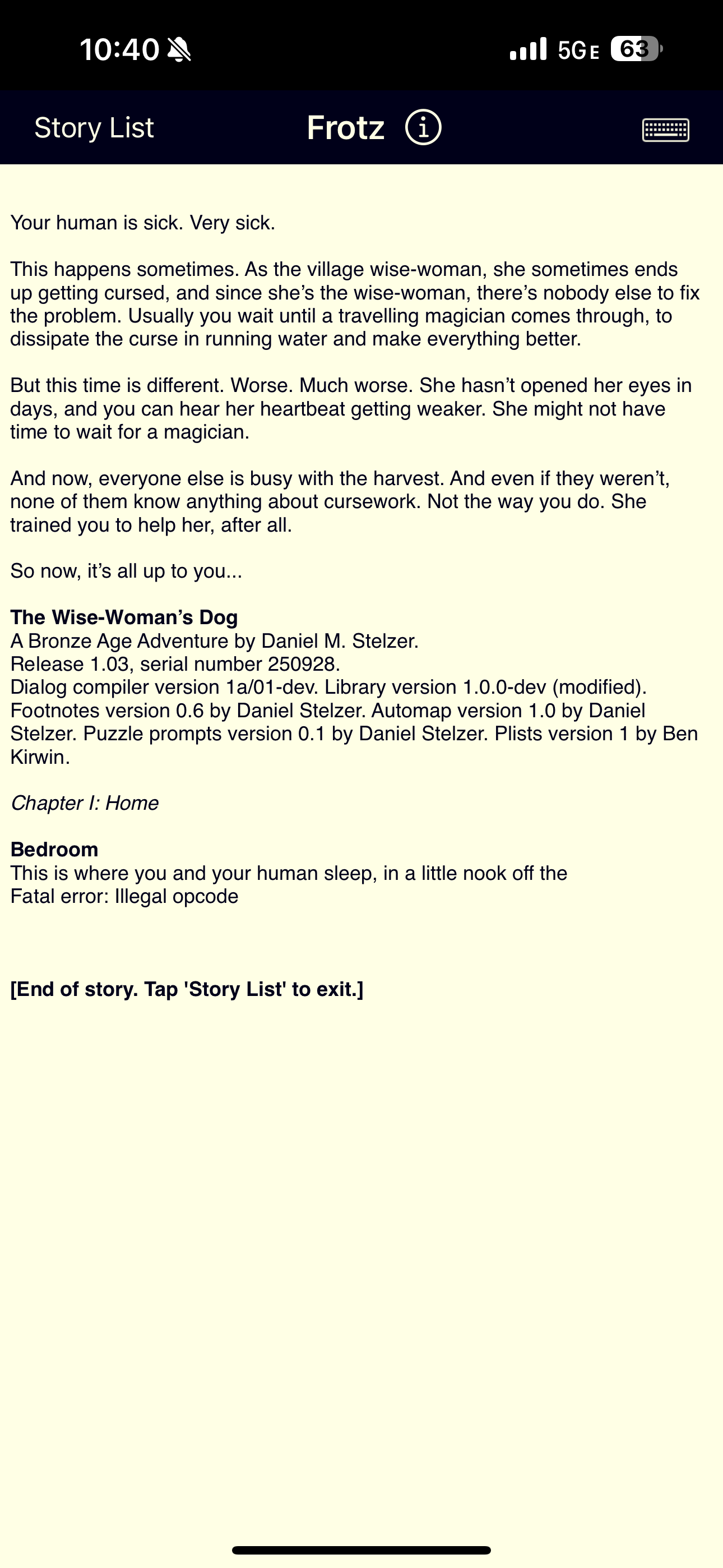
Wow! Miss Congeniality and second place! I’m still absolutely floored by the reception this game got, and I’m so glad that people enjoyed it so much. It’s also gratifying, because this is a game I’m not sure I’ll be able to top in the future; I think my next IFComp entries will be pushing in more experimental directions. (And there will definitely be more of those—I still have two WIPs I ran out of time to enter this year, and I owe Chandler Groover last year’s IFComp prize!) With a Miss Congeniality ribbon under my belt, my pride and vanity can worry less about mass appeal in the future.
And now, before I move on to a post-comp bugfix release, I’m going to indulge myself a little more and talk about the game and why I made it.
The subtitle on the IFComp site is “A Bronze Age Adventure”, which I meant in a few different ways. One is that it’s literally set in the Bronze Age, the period when metalworking was common but ironworking was not. But another is that it’s meant to be a throwback to classic text adventures. My first introduction to IF was Colossal Cave Adventure, and I’ve always had a love for the old-school puzzle games, with their light source puzzles and inventory limits and mazes to navigate. But at the same time, I no longer have the patience for all the frustrations of the genre; I like my modern conveniences. So I now get my periodic dose of old-school goodness from blogs like Jason Dyer’s instead.
And when even an old-school parser aficionado is getting frustrated with some of the genre conventions, that’s a good sign that they need to change! Parser games are infamously unapproachable for new players who don’t know those conventions. So part of the goal of this Bronze Age Adventure was to keep the best of the old style while smoothing away the frustrations. Inventory limits, but a menu to stash and retrieve any objects you’ve interacted with; convoluted mazes, but an automap that lets you navigate with one click; a parser interface, but also hyperlinked verbs to show you what’s possible. My goal was a love letter to the old text adventures that’s still fun and playable by modern standards. And as part of that, bringing in some old features that have fallen by the wayside, like not requiring 100% completion. If you’re stuck on a puzzle, just try another instead!
Separate from that is, of course, the actual Bronze Age. I’m currently doing a PhD on the Hittite language, which means reading tons and tons of sources about a culture that almost nobody knows about. For millennia, our only sources on the Hittites came from their enemies—they were the Trojans who held off the Greeks for ten years, the foreigners Ramesses II pushed back from his borders, the first empire to fall to the mysterious Sea Peoples in the Bronze Age Collapse.
(They also show up a bit in the Hebrew Bible, but those are the Iron Age “Neo-Hittite” kingdoms, a few centuries after this game is set. Uriah the Hittite, who gets murdered by King David, is probably a Hebrew transliteration of uriya-, the Luwian word for “commander”. That’s also where the name “Hittite” comes from—they called their own language Nesili, “in the style of Nesa”.)
Then, in the last century or so, the Hittite language was deciphered, and suddenly we could read their own histories in their own words! Year-by-year annals of their military campaigns, a translation of the Epic of Gilgamesh localized for a Hittite audience, letters addressed to Paris of Troy, rituals and prayers, dizzyingly long lists of gods…even now, quite a lot remains untranslated (clay tablets are hard to transport and harder to photograph), and even more remains undiscovered (Tarhuntassa, the imperial capital featured in this game, has never been found).
I find it all fascinating, and a couple specific points—sickness, including mental illness, was grouped into the same category as curses; curses were treated like physical substances that needed to be redirected or disposed of after extracting them from the victim; dogs and pigs absorbed any curses they came in contact with, which could be used in cleansing rituals but also meant they should never set foot in a temple—made me think “wait a moment, that could be a cool IF concept”. Parser IF has always been good at “medium-sized dry goods” puzzles. Well, what if magic spells were themselves medium-sized dry goods?
That’s how the game mechanics were born. On top of that, though…to put it simply, the world is a pretty scary place right now. The past year has upended all my plans for my post-graduate life and work and nothing seems certain any more. The news just reports one disaster after another, ecological or humanitarian or political or more.
But one of the nice things about history is seeing commonalities across it. I don’t envy the people living through the late Bronze Age—it was a brutal time. The Hittites didn’t even have a concept of “peacetime”: their calendar was divided into the summers of constant war and military campaigns, and the cold winters when the troops couldn’t march. Their economy was built around a constant influx of captive labor. And it’s not like their neighbors were any better; the Homeric epics make it clear that raiding foreign coasts, burning their cities, and carrying off plunder and slaves were the defining features of a hero.
And yet…
Most people weren’t great kings or heroes or even soldiers. And they still lived their lives, and raised their families, and told stories, and worked hard to pay their taxes, and visited the wise-woman when they were sick, and helped their neighbors when the harvest was bad, and held long and furious grudges about misplaced tools. We don’t see as much of them in the historical record—their lives weren’t recorded year by year like the great kings’ were—but we can still get a sense of them from the laws, the accounting records, the annual festivals.
So that’s what I tried to write a game about. The footnotes talk about gods and kings and heroes, since most of our records are focused on them, but to our canine protagonist, they’re never anything more than a vague name in the background. The people the dog interacts with are the farmers, the hunters, the merchants, dealing with the little problems of everyday life. Even with the Cypriot noblewoman at the docks, it’s really her servants’ problems that you’re solving. (Or making worse, if you prefer.)
I also tried to show the logic behind some of the ancient practices, since we so often see them without any context. For example, it’s pretty well known that Bronze Age men would pay a bride-price to a woman’s father in order to marry her. But it wasn’t really a case of “women had no rights and were sold as property”; most families depended on every single person’s labor, so the bride-price was compensation for the father’s family losing a person and the husband’s family gaining one. And it could also go the other direction: the bride could pay a price to her husband’s father, and then the groom would become part of his wife’s family instead. If a woman didn’t like her father’s choice of husband, she was legally allowed to elope instead (but her father had to return the bride-price), and vice versa.
Similarly, the Hittites were very proud of their law courts, where everyone had a chance to plead their case in a fair (at least, ostensibly-fair) trial—if you solve a certain puzzle in the game by getting someone arrested on false charges, he’ll most likely be released due to lack of evidence. And unlike the Code of Hammurabi, the Hittite laws were focused on restitution over retribution; the main goal was making up for the harm done, and if this bankrupted someone and ruined their life, that was just a necessary side effect. Capital punishment was mostly reserved for crimes that offended the gods and risked hurting the entire Empire.
This isn’t to say the Hittite Empire was an egalitarian utopia. Far from it! People who romanticize the past tend to imagine themselves being part of the upper 1%, when more likely you’d be a captive working the fields without freedom to travel. But those captives still had their own lives and hopes and troubles and desires, which so often get overlooked in the historical record. It was a fun challenge trying to reconstruct and extrapolate and fill in the gaps enough to focus the story on them.
Did I succeed in that? I’m not sure! I’ve always been better at the technical mechanics of writing and game design than at the broader-artistic-themes-and-goals part. But it sounds like people enjoyed it, and that was biggest goal of all.
Thank you all so much for reading this, and for playing and voting on the game! And a special thanks to everyone who posted reviews; I tried not to respond in detail to them during the comp period, but know that I read and appreciated every one, and the post-comp release has been improved by all of them.