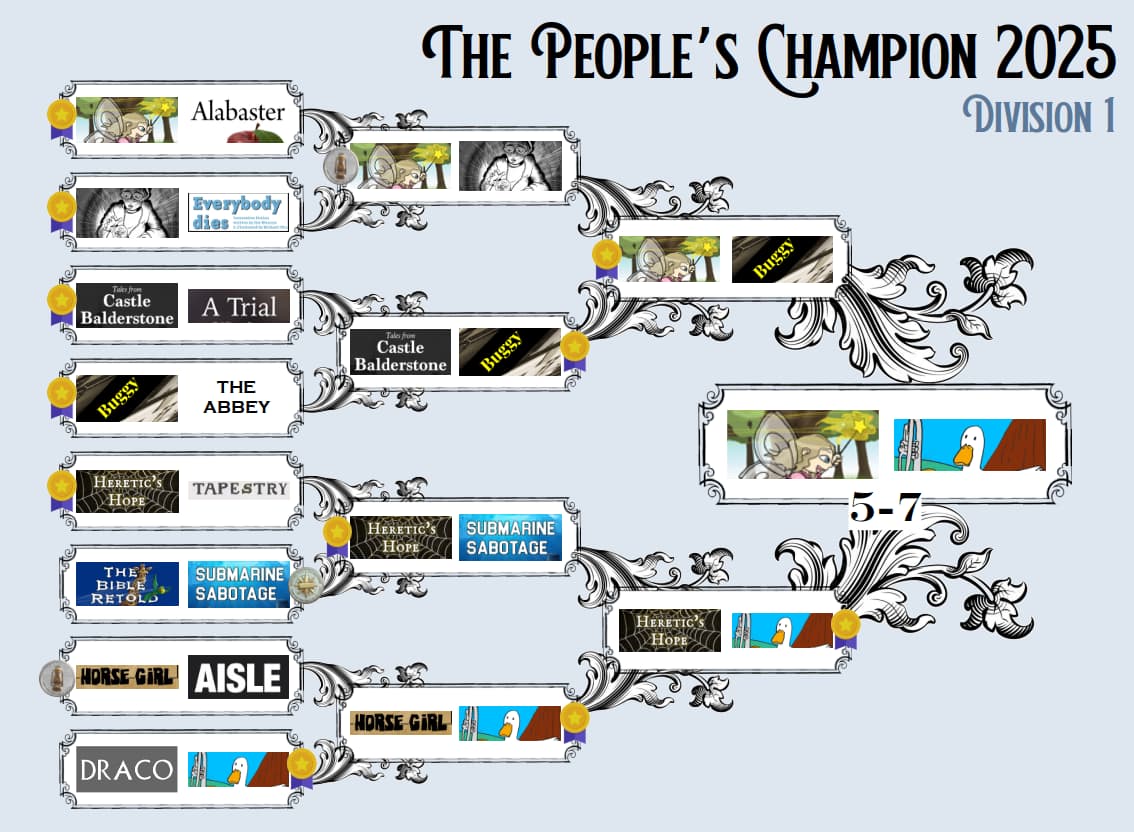
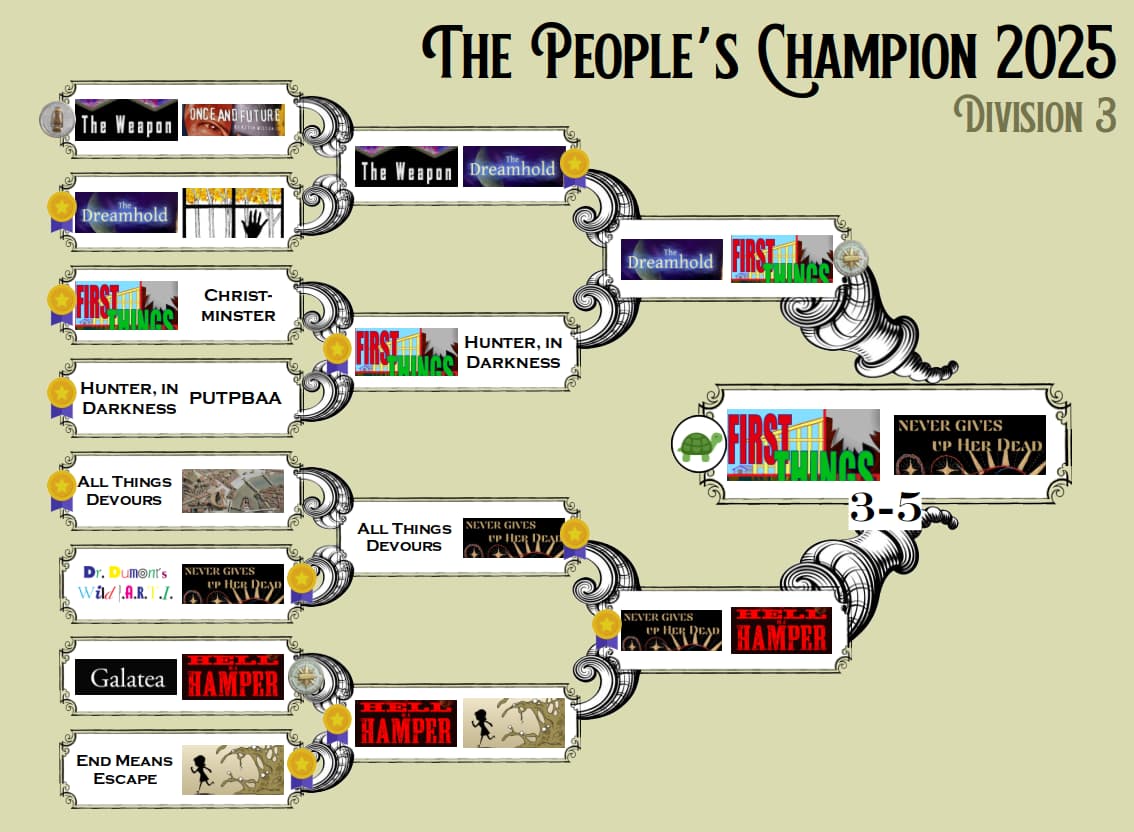
The performance of First Things First in the People’s Champion Tournament significantly exceeded crowd expectations, and with its Round 3 victory came very close to the arbitrary cutoff used to determine an “upset” victory (as used to trigger an author interview).
After seeing a post by jrobinsonwheeler last year that indicated an unfinished sequel called No Time to Lose, I contacted him via the forum to see whether he would be willing (belatedly) to do the interview that he just missed during the tournament.
The interview has been completed, prompted by jwalrus’s selection of First Things First for a new Let’s Play thread. Without further ado, here are some thoughts by author J. Robinson Wheeler:
Q What got you into IF? What was the first game that you played, and what do you recall about the experience?
JRW: I was of the generation who had an Apple II at the same time that Infocom was producing its iconic 1980s catalogue. However, even earlier, in the late ’70’s, I had the special benefit of a father who was a university professor, and who had a terminal in his office connected to the VAX 11/780 mainframe that was intended for scientific modeling. However, there was from the beginning a little Unix directory on there called /games. In it were early text games: Advent [ed. note: ADVENT was a common file name for Colossal Cave Adventure], Haunt, Aardvark, and Zork. My brother and I both would spend time in his office after school trying to play those games. Then we got the Infocom games later, when were already hooked.
I had the itch pretty early on to create IF games. It often goes along with the desire to play them, to want to try to make something yourself. Even though I had an Apple II, I really had no serious idea how to program a game, but a look at my programming diskettes from then is just filled with attempts at it.
10 PRINT “YOU ARE ON THE DOORSTEP. YOU SEE A FRONT DOORMAT.”
20 INPUT A$.
30 IF A$ = “LOOK DOORMAT” PRINT “YOU FIND A KEY!”
All that sort of thing. In fact, I was highly amused to discover one of these early Applesoft Basic games bore a very, very strong resemblance to the start of First Things First. It had been in my head since I was 11 years old, only finally realized when I was closer to 30.
I remember trying in frustration during college to get some kind of language running and compiling to make IF games, but the one I chose was based on LISP (the one with lots of parentheses), advsys or something like that. And I just could not get it to work. I had ideas in my head I just could not get out because I didn’t know how to. I never really was that natural a programmer, like some IF authors are, who are just wired in the brain for computer science. I just had ideas for puzzles and no idea how to code them and make them so someone else could play them.
Q Your earliest works were written in TADS 2, but everything that you’ve published since 2001 has been in Inform 6 or Inform 7. How do you compare your experiences as an author in those three languages? Have you tried any others?
JRW: Right, so what got me into the modern IF community was that my older brother, mentioned above, somehow on his own found out about TADS around 1996, when Michael J. Roberts was still publishing it as shareware. My brother bought TADS, and he and I both sat down to play with it, and my brother wrote a little test game in a weekend, and then waited to play mine. Except what started coming out of me was, straight out of the gate, First Things First in proto-form, and it kept flooding out of me, the gate was unlocked and here all the pent-up ideas rushed out. My brother waited weeks, then months, then years, as what was supposed to be my first test game became this sprawling full sized work in progress. I feel a little bad that I sort of trod on my brother’s enthusiasm to be an author, too, but I think he’s always been proud that he started me on my IF career.
TADS was, finally, a language and a tool that could allow me to get my IF ideas into a compiled playable game of my own, and that was thrilling. But it was also really, really challenging to understand the parts of TADS that were fiddly and complicated, especially the — oh, I can’t quite remember now, it’s literally 30 years later, but it was notorious for a particular way it went about handling verbs with direct and indirect objects. So, that led me to the newsgroups, rec.arts.int-fiction and rec.games.int-fiction, where everyone else was struggling with the same things. But they were also struggling with Inform as well, and though that language intrigued me for a few years, what with its compiling-to-Z-machine cachet and growing body of games, I was pretty intimidated by the completely different language that it was. I was already up to my elbows in TADS-2 and First Things First and I couldn’t imagine learning a whole separate language at the same time.
That changed, however, when I wanted to participate in a collective game experiment called Coke Is It! All of the participants had to use the same language so that there could be a linking game that was a sort of launcher for the whole bundle. Therefore, I had to learn Inform well enough to produce a short game, and by an agreed-upon deadline. I managed to do it by piggy-backing on code that already existed, the Inform port of the opening scenes of the original Colossal Cave Adventure. However, that success gave me the confidence to do another game, probably one of the early Speed-IF challenges, in Inform.
From that point on, I basically had two parallel development set-ups active. The TADS, for working on First Things First, which come to think of it I think I also had largely been using a Mac desktop for coding, because that’s what the original shareware version was running on, and for my Inform work I was using a cheap Windows laptop and doing all the file management and running the compiler in MS-DOS. I would do all the speed-IFs and minicomps in Inform, and basically stopped using TADS for those because it was just slower and harder than Inform was, once I learned how to navigate I6’s quirks.
When Inform 7 came around, I tried to embrace it but it bounced off of my brain. I was in my 30s and I felt like too old a dog to learn new tricks. However, with the help of Aaron Reed’s tutorial book [ed. note: Creating Interactive Fiction with Inform 7] and a lot of sticktuitiveness, I eventually succeeded in writing a couple of minor things in I7. It was like a life’s mission, to at least get something published that I wrote in I7. As usual, it was a minicomp that came out of ifMUD (Indigo New Language Speed-IF) that got me over the hump. I didn’t finish Moonbase Indigo by the deadline but I know it was from that because “Indigo” is in the title.
Over the past ten or so years I’ve looked at storywriting apps and languages that are more modern and from outside the central IF community, inklewriter and other such things, and never got beyond a few experiments with them. (Probably because there was no minicomp to push me, now that I think about it.)
Q Many of your published works are speed IF. What draws you to that format? How strict have you been about adhering to time limits?
JRW: Well, I just happened to be there (on ifMUD) at the time they were invented in October 1998, and thereafter I was always part of them whenever they happened. However, I eventually turned into a more active advocate for them as an exercise and a tool for an IF author, especially a young one without a ton of chops yet, because the demands of them push you, and you can make some quantum jumps in ability just from that. Without enough time to think or fiddle around, you learn how to do a few solid interactions, you really get them under your belt. And you might have one crazy idea you just have to figure out how to do, only time for one, but you manage it, and that’s a triumph you really feel, even if the game is completely silly. It just gives you license to create without being self-critical.
My thing was that I quickly found I couldn’t constrain myself and would blow the deadline and stretch the concept of what was supposed to be a speed-IF by taking three weeks instead of three hours, and that’s how I made several of the short games I’m known for. Even Being Andrew Plotkin was originally supposed to just be something quick and one-off, it was a joke title tossed off by someone else (Lenny Pitts) as sort of a “make a game called ______” challenge. (ASCII and the Argonauts was also a make-a-game-with-a-title-someone-else-makes-up creation.)
Q Your breakout hit was Being Andrew Plotkin (2000), which won that year’s XYZZY Awards for Best Game and Best NPCs and was nominated for four others. Obviously, the film Being John Malkovich is the most important inspiration, but what prompted you to substitute Andrew Plotkin, and what convinced you to actually start writing the game?
JRW: I guess I just answered that at the end of the last question! If I really dug around I might even have a transcript of the chat room when someone threw out the title as an idea. Everyone chuckled, but it stuck like a seed in my head and started growing into a real idea. I think due to the timing of when I heard the title, I sort of had the 3 months of the summer to get it done for the fall competition, and I just got to work on it.
A lot of what the game became was sort of invented on the fly when I was doing it, but it started with the notion of translating the conceit of the movie into IF. As a movie afficionado, I was very familiar with the film, but of course what made the gimmick in the movie fun for audiences is that it put you in the head of someone, looking out through their eyes, which (to me) is exactly what IF does.
Taking that more literally, I started to get some really fun ideas about what you could do with that if you kept switching PCs (something that Inform always allowed, but that hadn’t been utilized by very many games or authors) and really saw the world through different pairs of eyes. And then as I got to the point of needing the game to hit a narrative climax and crash through various realities in quick sequence, like the movie did, I hit on the idea that inside Andrew Plotkin’s brain would be all the classic Infocom games he played growing up, as well as his own work, so I sent emails to both Zarf and to what Infocom implementors I could find contact email for, asking for permission to excerpt little bits of their work.
Inside the game code, it’s all really inelegant chunks of case/switch statements. If it’s this turn, print this. Nothing is tidy clever way of doing anything, but it’s all solid-state and less prone to error at run-time. That’s sort of that speed-IF philosophy at work under the hood. Do it in a way that’s fast to write and that works reliably, and don’t try to be fancy or it’ll break all the time. And a game like Being Andrew Plotkin was sort of an exercise in writing seven or eight speed-IFs serially for the length of a summer, one scene at a time is another speed run at coding the next bit. That the end result feels like a narrative that knows what it’s doing with some confidence has more to do with the surprise and fun of me pulling off a series of tricks, and utilizing what I know about narrative storytelling from my side career as a filmmaker. One of the better reviews I got said that it was the most movie-like experience playing IF they’d ever had, like they didn’t know IF could do that, was the trick I managed.
I feel like the game is dated and probably a hard sell to people just picking up IF now and saying “what games used to be good?” but I remain completely proud of it and that it won those awards.
Q According to IFDB data, your second most-played solo work (after Being Andrew Plotkin) is The Tale of the Kissing Bandit. It, too, won a XYZZY Award, for Best Individual PC in 2001. What was the inspiration for that work, and what challenges do you recall from the development process?
JRW: A lot of my works came from semi-formal mini competitions started spontaneously on ifMUD. This one in particular was SmoochieComp, which was a Valentine’s Day romantic theme that Emily Short proposed, if I recall correctly. There was no other direction other than this general theme, and I have to say that I cannot recall where I pulled my specific inspiration from. It was written very quickly, during a period when I was writing a lot of IF all the time, so I had all of my infrastructure set up and I was essentially a well-oiled machine if an idea did strike.
Like with my Centipede game, I spent a lot of time at first on what you would see if you typed “>X ME” and “>INVENTORY” up front, and all of this crazy gear would suggest a lot about the PC right away. I also used to write a mock transcript right away, and then figure out how to write the code that produced it. It created an authoring style that produced games that seemed well-written but wereincredibly on-rails as an experience. This one in particular was very guilty of that. If you deviated from the premise, there was basically nothing to it. All of the commands you typed, however, were heavily hinted in the game’s output. If you took the hints and typed the otherwise very-unlikely sorts of commands like “>SNEAK UP (behind Lily Whitestone)” and “>PLANT ONE ON HER” the game rewarded you with that special IF gift, of having anticipated exactly what you were inputting and had a tailored response. It lights up your brain as a player to get that, I was was basically just goosing that to the max at the expense of any world-depth.
Perhaps that’s why I went the strange other direction in the same game, in a room that’s not necessary to finish the story. There’s a library where there are at least 66 unique book titles to read, all of which I made up. I watched some people play the game collectively, and saw that they were slightly confused by this, and a little disappointed that the titles weren’t funny jokes.
Another thing I recall is that this was an era when all of my colleagues were very busy doing incredibly good work. My philosophy was that a good way to react to an IF game, to respond to what turned you on about it, was to write a game of your own in reply. I recall that I wanted the end of this game, in which the illusion of what’s going on gradually breaks down to reveal a different reality altogether, to be an allusion to Andrew Plotkin’s then-recent masterpiece, Spider and Web.
Q First Things First (2001) was your last TADS game, though according to the in-game >ABOUT text it was the first game you ever started, and coding for it had begun five years prior in 1996. What were your inspirations for the game? Were there times when you thought that you might not finish it?
JRW: I always knew I was going to finish it, but it was touchy subject for five years about exactly when that would be! It could have kept growing, and in fact there’s a lot of material I wrote for a sequel that takes the original game and expands the map in all sorts of directions. It got to be too big to manage, but I still think about trying to complete something out of all of the extra imaginings.
And in the meantime I have effectively time traveled a quarter century into the future of when I published the game in 2001. Time really gets away from you! There was even supposed to be a third game, though I never had any concrete plans, it’s more the thing of if you do two games, now it has to be a trilogy type thing. But it’s still just the one game.
Q When I look at certain parts of First Things First, I see what might be echoes of or homages to earlier games. An example is Infocom’s A Mind Forever Voyaging, which is also structured as five “time zones” each a decade apart. There is also the largely decorative passage through a cave system, which is remniscent of the style of description found in Colossal Cave Adventure. Are these just coincidence?
JRW: The Colossal Cave bit is not a coincidence at all, it’s definitely an homage. FTF is built from all the daydreamed IF notions from when I was age 9 to age 25 all jumbled around and looking for somewhere to go.
I did have A Mind Forever Voyaging but it was the most disappointing Infocom game I ever played. The game never made much sense to me, I got stuck really early on, and there was no internet or help line to get me unstuck, so I quit with basically 95% of the game never having been seen by me, and a lingering sense that it wasn’t any good. I was surprised when I joined the community that everyone thought it was an underrated masterpiece. Then again, I got stuck in Deadline and never finished that, either, but I came away thinking it was terrific, so who knows.
Q When I played First Things First, I was struck by the scale of it, which is quite large. As I continued playing, it seemed to me that the tone of the game kept shifting steadily, and growing more serious as the plot progressed. Was this something that you set out to do, or does it just reflect your changing style as a writer over the course of five years?
JRW: I think it’s more of the latter. However, I recognized as I proceeded that this development was happening, and I leaned into it. It became kind of a theme and an allegory of its own development, you can kind of see it that way. And so therefore I didn’t try to rewrite the early, simpler descriptions of the first part of the game to match the later, serious parts. That would have been a mistake, for sure, but at times over the development you can muse about “should I rewrite so it all matches?” Nope, you let the early part of FTF continue to feel almost like an early adventure game, and let the later part feel like a (then-) modern style of IF, and it should feel organic.
Despite the loose and sprawling map of it, the gameplay is once again really linear. I always say that with a sigh, because my aspirations are always to write something with real choices and branching storylines to follow, but I am one of the most linear and rail-roady of IF authors when you look at everything I’ve done.
But so that means that you do progress from the beginning to the end, following the stylistic development, at the same organic pace whenever you play through it, whoever the player is, and so I think it basically always works.
Q Did you have a complete plan for First Things First when you started writing it, or did it evolve as you went along? Do you recall any significant changes to the core idea or the plot during development?
JRW: What would be really helpful here is referring to my development log and notes, which I kept the whole time. I think the main surprise I kept for myself was the “Future” time period. I think Far Past, Past, and Present time periods and their puzzles were all laid out in my head and they were just about learning the right amount of TADS to do what already had thought of. I don’t think I came up with much of the writing and puzzle planning for the Future (and Far Future) until I had gotten all of the other bits written, because (as we were just discussing) I had grown as an IF programmer (capable of more technically tricky coding) and an IF author (who was also an IF player, continuing to play everybody else’s groundbreaking work) by then, so I was ready to tackle those later parts by the time I had arrived there 3 years after I started and was a fully engaged member of the IF community.
The only other thing it occurs to me to say is that I was so focused on all of the fun of changing blueprints back in the past to create a secret passage in the present (and wanting a secret passage in your house is an idea that goes back to being more like 6 or 7 years old, pre-dating any exposure to IF at all, it’s just being a daydreaming kid), it never struck me until late in the process that I didn’t have a good reason in the context of the story for Why Do You Need a Secret Passage? And ultimately it’s a pretty thin reason I came up with, if you recall what you actually do at the end of the game in there. But it was a Reason, and I never came up with a better one. It is sort of embarassing, though.
Oh, similarly, you go to a lot of trouble to get in the little attic window. And what do you do in there? Pick up a blue pencil? That’s it? I have to laugh a little at that, too.
Both of those are from having this overwhelming desire to make the puzzles on the way there, that’s all, and nothing of what a more mature IF author would do, which is think of the plausible (and interesting, and engaging) story reasons first, and then plot out all of the puzzle obstacles you want to challenge the player with, because then the story will be motivating the need to overcome those challenges. And so that the payoff is not just [You are in the attic. +10 points.] but because the story will significantly deepen and develop as a result. That’s how I’d think about these things now.
Q Aside from bug fixes, what are the most significant changes between versions 1.00 (the original release) and 3.00 (the current release)?
JRW: Now where did I put those development notes, again? I wonder if I should send them to you.
[ed. note: Wheeler did, in fact send his development notes for version 3.00, which are included as a file due to their size.]
ftf-v3-changelog.txt (27.4 KB)
Q The instruction manual for First Things First says that you were a filmmaker at that time. Is that still what you do? What film(s) of yours would you recommend most to those interested in learning more about your film work?
JRW: I made one feature film, called The Krone Experiment. [ed. note: see also http://thekroneexperiment.com, but note that https is not supported. update: Wheeler has since made the film available online. See this post for more detail.] It currently is not available online anywhere. There are out of print DVDs floating around in the world. I have plans to actually put it up on YouTube but I haven’t done that yet.
There is a documentary I made that reveals some of my genesis as a filmmaker as part of a science fiction miniseries made when I was in college. You can find it by searching youtube for “The Making of Invasion Stanford”.
Q In addition to works already mentioned, IFDB lists other thirteen solo works by you. Of which of these are you the most proud? Which one(s) do you wish would get more attention?
JRW: I do like ASCII and the Argonauts, which is a really solid bit of interlocking puzzle work that I improvised over a weekend. The underlying structure is so good that I always wanted to put a LucasArts graphic adventure skin on top of it, and made a lot of art and various attempts over the years to realize it, but it still hasn’t come together. I suppose if I wait another couple of months I’ll be able to ask an AI to build the UI and finish the art and I can just stick my text game architecture inside it. I might be okay with that…
Which one would I wish would get more attention? I think I’m fairly content with the recognition I get at all. A lot of my peers and their contemporaneous works have always been way more famous than me and my works have been, so I’ve had a lot of time to get over the slight ego bruising of that.
Most of my games have some component that I meant to get into the game and couldn’t pull off in time, so I cut it out. For example, Being Andrew Plotkin was going to have my first experiment in having Glulx audio cues playing in a text game. I can’t remember if there are still commented-out remnants of the aspiration to play sounds in the code. It was going to be just when you were actually inside Zarf’s brain, it would have a weird ambience loop and a couple of short sound effects for going through the doorways.
That has nothing to do with what you asked. Maybe what I’m trying to say is that “I wish people knew that I had a whole lot more ideas that I didn’t get to deliver!”
(Oh, and I think Centipede needs more attention. I like that one a lot.)
Q In addition to solo works, you’ve contributed to three multi-author projects: Pick Up the Phone Booth and Aisle, Coke Is It! and The Corn Identity. How did you like being part of a larger group of authors? What are the particular challenges and benefits of that format, as you see them?
JRW: I really enjoyed it every time. It’s the cameraderie, the shared effort. It really is worth it, and a lot of fun. And as I mentioned, it got me coding in Inform in the first place, which is an invaluable gift I got out of it, that I re-gifted with every I6 game I produced after that. These things also always have a shared deadline, so that is a big motivator. There is no substitute for actually finishing a piece of work, even a small part of a collective game, rather than having a work-in-progress languishing on your hard drive.
Q Some of your works are spoofs, or at least spoof-leaning. A good example is Moonbase Indigo, which is a playful approach to a James Bond-style story that simultaneously revels in and chides the tropes of that series. What is it about spoofs that appeals to you? Is there a different kind of appeal for the audience?
JRW: Well, I enjoy my own sense of humor, and I like being able to deploy it. I was the type of kid who read MAD magazine was drawing my own cartoon spoofs in 5th grade to amuse myself and my best friends. The ifMUD community was full of genuinely witty people, and humor was very much a currency of conversation and thought. It was almost weird if I were funny all the time in the chat room and then wrote terribly serious, brooding IF games, it made more sense to just keep doing funny things. In fact I was very self conscious about the parts of my games, like later portions of FTF and The 12:54 to Asgard that were meant to be serious, it almost felt embarrassing. Because humor is also a defense mechanism, I suppose.
Q You’ve posted some materials to the forum that indicate you started on a sequel to First Things First called No Time to Lose. Do you plan to finish it? Is there anything that you’re willing to disclose about the plot or other details? What more of the story is there to tell?
JRW: The story starts the next day, after you’ve crashed into bed following the events of FTF. You hear the sound and smell the familiar ozone that tells you a time machine has just either appeared or disappeared. But it’s not you piloting it, so — who and what’s going on? You eventually find out that there are more secret locations in and around your house than you ever discovered before.
And a central mechanic of the game is that instead of being bound to one location, a time machine can be physically moved from one place to another, multiplying the number of time-locations you can get to. I think also there is a villain trying to undo what you did right the first time, which is a little Back to the Future-ish, but this is the time travel genre we’re playing around with, so what the heck.
All of these ideas are so ambitious I had a hard time keeping track of it in my head and the sprawl became enormous. And there was a lot of the same thing I noted — I have puzzle areas worked out without having thought through the story purpose of all of it enough yet. That’s really what I should do if I wanted to make a real effort to produce the game. I also think, possibly, I would need a collaborator or two at this point. A team of younger coders and authors would be really helpful for an older guy like me at this point. But hey — Ron Gilbert managed to make a new Monkey Island game a couple of years ago, so these things are possible.
Q You’ve been a part of the IF community for a long time. What are the most significant changes that you’ve seen in that time? What are the most valuable new things to come along?
JRW: I wish I were more involved and active these days. Apart from getting an email digest from the mailing list, I don’t really keep up, and that’s kind of a shame. Time and life have raced along, and IF unfortunately feels like a thing from the past. I haven’t completely abandoned it or these WIPs I have lying around, but finding the time and summoning the energy are big, real problems. Although I know from experience, some of what I’m talking about is inertia. The amount of energy needed at the beginning to set a mass in motion, is huge, but once that is overcome and the mass is in motion, it has a tendency to stay moving in that direction. I sense that some of these games Want to be finished, in a way.
I can’t make any promises, but these are still real possibilities.
[ed. note: Thanks to @jrobinsonwheeler for indulging my curiosity, and I hope that you all enjoyed this, too.]