Mike Russo's IF Comp 2026 Reviews

(continuing the bug discussion of MAD WARRIOR; perhaps this should be split)

I investigated this when it was first mentioned (ISTR seeing a screenshot but I can’t find it now), despite not currently having access to any version of Windows, because it sounded so much like a lack of ANSI.SYS from the DOS days.

It’s obviously not that, but further investigation suggests it may be possible to make this game work as intended on Windows 10. (Obviously I haven’t tested any of this.)

It turns out that the ability for the Windows console to interpret ANSI/VT100/ECMA-48 escape sequences was added sometime in the Windows 10 era (I guess when ConPTY came in), but it started out off by default. See Console Virtual Terminal Sequences on Microsoft’s website.
I infer that this feature may later have been turned on by default, and perhaps the developer of MAD WARRIOR relies on this default?

Originally, the idea was that the developer would call SetConsoleMode(handle, ENABLE_VIRTUAL_TERMINAL_PROCESSING) to opt-in to escape sequence processing. Presumably MAD_WARRIOR.EXE doesn’t do this (I haven’t checked). Obviously there’s not a lot a player can do about this. (If the author is reading, perhaps they are able to update the game for this.)

However! I’ve found stuff that suggests there’s a registry setting to change the default. This answer talks about a VirtualTerminalLevel key.
That is a thing a player could try (at your own risk, obviously). You probably want to change it back afterward.
(You may also have to turn off a setting called “Use Legacy Console” for this to make a difference, if I’m reading this correctly. Or, I suppose it’s possible that MAD_WARRIOR.EXE is doing everything right and this was the problem on Mike’s computer all along?)

3 Likes

I’ve looked into this since my post above, and for the setting part, I’ve found the same registry suggestion that JTN describes.

Alternatively, you could try a different terminal software like Microsoft’s own “Windows Terminal”, which is practically the successor to the older Console/Conhost, or “Cmder”, from a third party.

For Windows Terminal, this download (from here) would work, for example: https://github.com/microsoft/terminal/releases/download/v1.24.11911.0/Microsoft.WindowsTerminal_1.24.11911.0_x64.zip

For Cmder, the “Mini” download would work: https://github.com/cmderdev/cmder/releases/download/v1.3.25/cmder_mini.zip

You wouldn’t need to install them; you can download either of them as a zip file, unzip it and just start WindowsTerminal.exe or Cmder.exe, respectively, and navigate to the “Mad Warrior” folder and start the game.

I’ve only tried them on Windows 11, so I can’t say whether they work the same on 10 (or whether, for example, even Windows Terminal still hinges on the registry setting there or not).

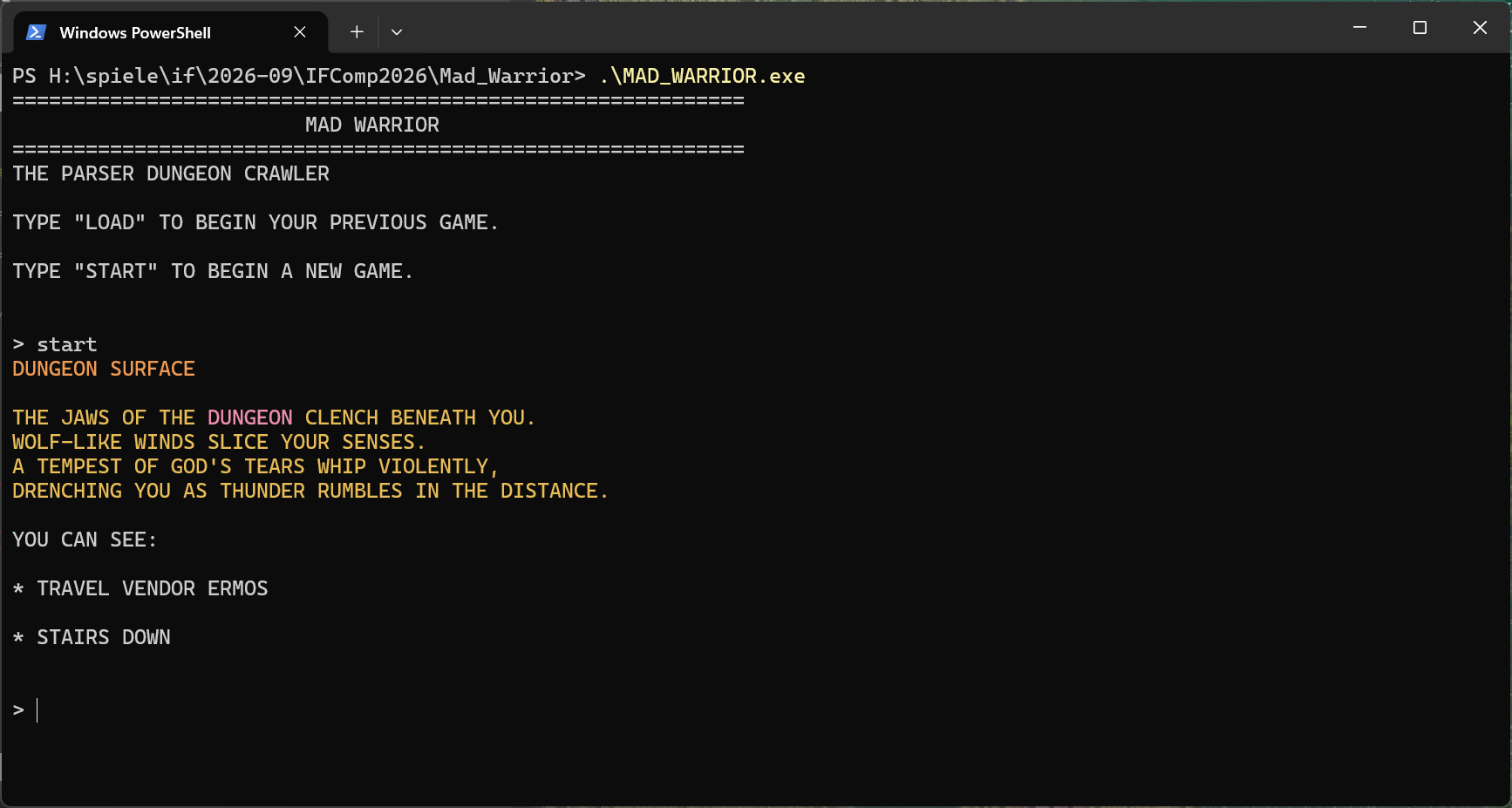
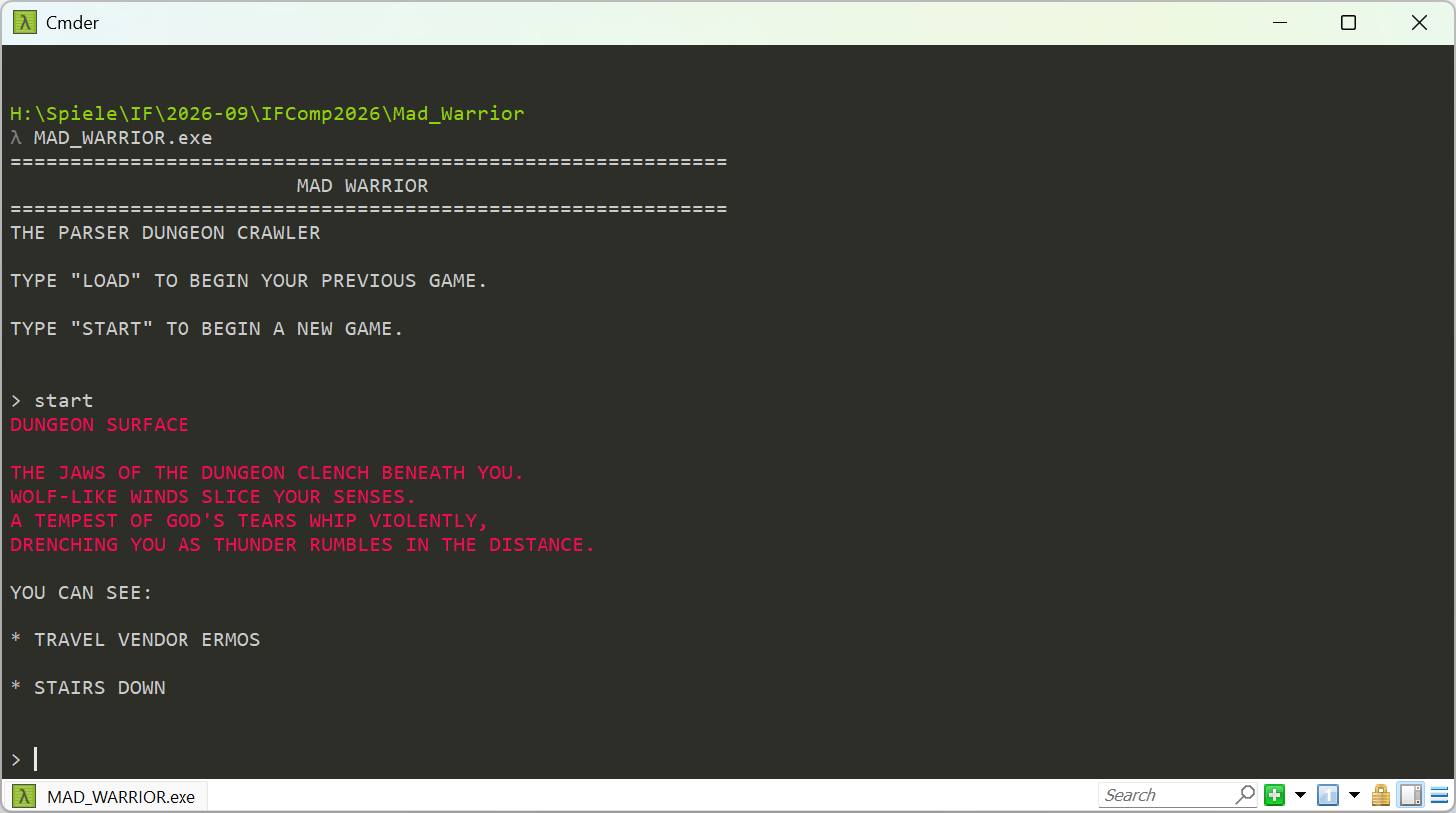
Interestingly, the colours vary between Windows Terminal and Cmder, at least out of the box; the former seems to deliver a more accurate experience, with different colours for the location title and description (I assume that’s what the developer intended), whereas Cmder shows it all in red.

Screenshots:

3 Likes

Escape the Wumpus, by Vitalii Blinov

It’s easy to accuse IF of being a past-obsessed medium: much as the scene has evolved over the decades, to a certain degree we exist in the long shadow of mass-market successes of the 80s (Infocom and Choose Your Own Adventure looming perhaps largest), and practically from the beginning we’ve been commenting on what came before. The obvious, correct rebuttal is that this is an age dominated by remakes, reboots, and legacy sequels, so why should IF be so different? But “everyone else is doing it” concedes the point; as your mom always said, if everyone else was jumping off the Brooklyn Bridge, would you do it too?

All of which is to say that Escape the Wumpus, while a reasonably fun time on its own terms, didn’t truly justify its link to OG maybe-IF Hunt the Wumpus. The original is a seminal game of the 1970s, laying out a very specific gameplay paradigm for hide-and-seek as you navigate around a complex maze (famously laid out along the edges of a dodecahedron) and try to get the jump on the eponymous monster. Heck, it’s so seminal that it even has a seminal homage-game, Andrew Plotkin’s Hunter, in Darkness which sticks with the same overall setup but interrogates how an embodied player avatar and evocate prose would change the clinical math puzzle.

So to my mind making a new Wumpus game is a challenging proposition: there’s a high bar to clear, and also, the raw material (geometrically-precise maze, omnipotent monster) isn’t necessarily super compelling on its own. It’s both good and bad, then, that it doesn’t feel like Escape the Wumpus is trying very hard to link itself to this ongoing mythology. Rather than trying to track down and kill the monster, here you’re just trying to get out of the maze before it finds and devours you – but actually, you very much need to do that because this time out the Wumpus is entirely static, just hanging out in a single room and not pursuing you at all. The dodecahedron is correctly set up, so the navigation challenge is familiar, but the gameplay is a straightforward choice-based affair, with simple puzzles (locks, fetch-quests, etc.) scattered about the nodes. You do need to contend with gravity, since some connections leave you plummeting to the ground of a particular cavern, and many of the puzzles are a bit oblique, but in general, you mostly just need to take notes about which nodes connect to which other ones, and which still have an outstanding barrier to resolve, and you can just jog through the maze in a regular pattern, unlocking new doors and getting new items as you go.

There’s an entertainingly offbeat vibe to many of the specifics; the writing isn’t afraid to linger on odd details, presenting totally off-the-wall situations with a minimum of fuss or worldbuilding, and I liked the counterintuitive way the shiny key allows you to progress (it doesn’t unlock a door), but all this does mean that a combination of unclear prose and surprising mechanics often left me unclear of what I should be doing or where I should be going, leading me to run the aforementioned laps instead. Like, this is an engaging piece of writing, but I at least find it hard to picture what’s being described:

The opposite side of the room has another buttoned compartment, almost hidden with a large body of a stone creature. One of its wings covers the creature as a fluffy blanket, and another curtains the door leading to the next room. The creature seemingly sleeping wakes up a bit and tells me: “Hello, little stranger!”

This trend reached its nadir in the final puzzle, which required me to consult the walkthrough – turns out you need to attempt an action that leads to failure twice more in order to progress, which isn’t an approach that’s totally verboten but still one that often leaves me frustrated. Doing so allows you to escape, having never interacted with the Wumpus at all, which again contributes to my sense that this is a game that could have worked equally well on cartesian coordinates with no Wumpus at all. Admittedly, I didn’t fully explore a couple of rooms, making me wonder whether there’s a “true ending” that comments more directly on its inspiration. But given the experience I actually had, I think I would have preferred that non-Wumpus version, as the overhang of expectations (and, I admit, slight annoyance at nostalgia-baiting) didn’t do much to enhance my enjoyment of what’s otherwise a fun enough fantasy adventure.

9 Likes

IF Derby, by Hella Deadline

I’ve been playing, reviewing, and rating the Comp for more years now than I care to contemplate, and while some thing have become second nature, I still do struggle with that last element when it comes to judging the incredible range of games on offer according to a single ten-point scale, especially where length is the primary axis of difference. Is there a principled reason to rate two games of comparable quality differently when one lasts five minutes and the other goes well beyond the two-hour judging window? Does it even make sense to talk about “comparable quality” when the difference in what a super-short game can do and be good at, and what a longer game can do and be good at, often yawns so large that it becomes a difference of kind, not degree? I dunno, man, it’s tough. But what I do know is that when it comes to these amuse-bouche style experiences, I’m more than content if I get a single moment of intense engagement, which could be an “aha!” at a clever gameplay trick, or a laugh at a committing-to-the-bit joke, or just deep appreciation at one or two haunting, poetic lines of writing. Even if I’m not sure how to score such things later, I’m clear that that’s more than enough for success in my book.

IF Derby confounded my well-honed framework, though, by offering two distinct experiences of intense pleasure. But before getting to those, I have to describe what’s admittedly a pretty baroque setup for a piece of micro-IF. See, this is a meta game that transposes the action of the Comp into a literal horse-race: upon opening up the game, you’re presented with an octet of game titles – some of which are recognizable riffs on real games or genres, some of which are pure, entertaining nonsense – each of which is assigned to a different, lightly-animated horse (the game runs in Decker, and makes good use of the system’s pleasing Game Boy aesthetic). You start with $500, and are prompted to lay some or all of your stake on the horse of your choice. To help make your choice more informed, you’re given a smattering of data, including the number of reviews the game has received, both overall and on IFDB, as well as the IFDB average rating, and the all-important length of the game. And then you see the race, and if your horse comes in first, you pocket the winnings and get to try again.

This is a pretty basic set of interactions, elevated by the way the names create a rooting interest (I was personally very invested in Manly Napoleonic High Seas Adventure’s success, and vacillated on whether it was worth taking a flyer on dark horse Flying to Sydney in Real Time) but still clearly the purest trifle. Except that somehow this trifle managed to make me smile broadly to myself two different times, for two entirely different reasons.

The first is because as soon as I saw the oddmakers’ sheet of data, I thought to myself “hang on, is this implementing Autumn’s ranking-prediction algorithm?” XXLINK. But I didn’t content myself with a laugh, I went and tracked down the original spreadsheet, extracted the formulas, and created my own Excel doc that I could plug IF Derby’s entrants into in order to see whether this helped my luck (which I confess had been quite poor until I took this step). I won’t spoil the outcome of this little bit of extracurricular activity, but I will say that it’s always a good thing when a game makes me create a spreadsheet, so it wins plenty of plaudits from me on this score.

The second is perhaps more in line with the game’s intended effect. I won’t spoil this one either – though for those who just played a round or two and bounced off, it’s worth going back and looking for something that appears slightly different in the post-race screen after you’ve been around the track a couple of times – but suffice to say that there’s a bit of writing that constitutes the game’s real ending, and while it’s as short, funny, and allegorical as the rest of IF Derby, I still felt like it had something real and worthwhile to say about the Comp, authorship, reviewing, and why we all keep going around doing this crazy thing year after year after year. If anything, that means I’ll have an even harder time than usual coming up with a rating – but believe me, I feel very, very happy to be faced with this particular dilemma.

14 Likes

Devils of Terminology, by Project Bon Voyage

The political theorist Isaiah Berlin has a famous essay where he proposes that there are two kinds of thinkers: hedgehogs and foxes. Hedgehogs have one big idea, a totalizing framework they bring to bear on every phenomenon they encounter with maniacal, monotonous fervor. Foxes, by contrast, refuse to be pinned down, flitting from topic to topic, idea to idea, carrying perhaps a unifying vibe or approach to each of their latest obsessions but in it for the quick burst of novel insight rather than the grinding endurance of a monumental life’s work. In truth, human beings can’t be typified quite so neatly – though of course I’d say that, since I count myself among the foxes – but perhaps pieces of IF can, and if so, Devils of Terminology leaves me yearning for a fretful porpentine.

A recitation of the themes and elements this modest-length visual novel employs over the course of its breathless plot is only slightly less bewildering than experiencing them in gameplay. There’s a teenager who orphans herself by getting angry at her parents for forgetting her birthday, two different supernatural trains, a typewriter automaton named Nihil who can come up with magical names for places (and which is patterned after a human with maybe-related powers?), a seaside town called “Lost, the Clockwork City” and which plays host to a pair of Dark-Souls-style minibosses (he’s a giant, she’s a wizard), a horned she-devil who is allegedly also Dante Alighieri, paired trinities of past, present, and future, and hell, purgatory, and heaven, a fracture in the sky that destabilizes the world, a sword made of bone and sinew, and the world’s most confusing Sherlock-and-Watson double-act (right, this all allegedly playing in out in late-Victorian London).

I’m not so simple a rube as to require everything that happens in a game to have an explanation, much less one telegraphed to the player, but this cavalcade of *stuff* created two issues for me. First, there are few connections drawn between the disparate material, either thematic or narrative. Actually, almost as soon as one idea is introduced, it’s dropped in favor of the next: the Dante reveal is played as a big deal, for example, and despite it making no sense I was curious where the game was going with it, like were we going to get into the details of their travels to the underworld, or rhapsodies on their encounter with the divine, or at least some parallels drawn between the way the devil acts as a sort of guide to the main character, mirroring Virgil’s role in the Divine Comedy? No, everyone just goes “no way, you’re really Dante?!” and then never mentions it again. As a result, rather than a thematic bricolage where each new idea helps recontextualize those it’s placed next to, the game comes across as just a jumble of stuff, growing less compelling with each new twist.

The second issue is that the narrative stakes were never made clear. If Devils were a picaresque where a simple journey narrative took the player through a series of unconnected but memorable vignettes, with the ultimate destination clearly telegraphed, that might not be the most compelling thing in the world but at least you’d have a sense of where you were headed. But while the game feints towards such a structure by having the main character be a detective who investigates a series of cases, and allots a few of its portentous revelations to establishing the aforementioned trinities which at least give a sense of *when* the game is ending, the climactic plot elements felt just as much like rug-pulls as the earlier ones.

Now, I need to acknowledge the elephant in the room and point out that the game’s English text is a translation of the Korean original, so it could be that things are much smoother in the author’s mother tongue. But still, having to judge the game by the language in which I can engage with it, at both the macro and the micro levels the writing left me struggling. Like, here’s a bit of what I think is supposed to be playful banter between the main character and their devil sidekick:

Us: the person who returned claimed to have seen Heaven. Do you remember anything about them?

Renua thought for a moment, then answered readily.

R: They were called a genius, right? That’s all I remember~

Us: ..A genius.

She was always like this.

Always thinking about ways to play around, yet somehow useful at moments like these.

The deeper elements of the game’s design doesn’t help matters, unfortunately. It uses a custom system whose interface is superficially similar to VN-standby RenPy. But while I’ve figured out how to tweak that platform to my liking, here I was frustrated by the inability to set text to display instantly and the lack of a quick scroll forward/scrollback system (or easy undo), and small pieces of friction like long lines of dialogue being cut off and the redundant-but-not-identical Log and History features eventually added up. Meanwhile, the game’s only mechanics are a scant handful of choices, spread thinly across the game’s hour and a half running time, with the player’s input rarely feeling especially impactful – there’s an early bit where I took the option to press a client on some details before accepting their case, but actually clicking that led to some commentary on stuff happening outside the window and then yet more sidekick banter.

All told this means I spent most of my time with Devils of Terminology just clicking to see what was going to happen next, not especially invested in or comprehending whatever left-turn was waiting around the corner. This is a shame, because there is a lot of invention and imagination to the game, and the basic tropes and themes are I think appealing ones. But it’s ultimately too hyperactive for its own good – rather than desperately prancing about as though it were just one step ahead of the hounds, Devils would have been better off hunkering down, sniffing out a promising direction, and digging in.

11 Likes

Oh, gods, Paw Patrol! The pain, the pain! My younger nephew had all the toys, despite the number of times I tried to steer him towards The Amazing World of Gumball instead…

3 Likes

Verb Noun Adjective, by Rybread

Holy crap. I know 90s nostalgia is all the rage these days – a trend that I’m not super psyched about in any objective sense, to be honest, but to the extent that it will only fade when it’s replaced by the aughts varietal I guess you’d have to count me in favor – but never on my IF Comp bingo card would I have put the triumphant (?) return to the community of Rybread Celsius. His heyday was a bit before my time (02 was my first Comp), and I’m not sure if he was still rattling around the newsgroups at that point, but his legend definitely persisted: a maybe-troll famous for broken, buggy, sloppy, but sometimes oddly-compellingly-mind-bending games straining against their constraints. And now somehow, he’s returned.

The opening of Verb, Noun, Adjective sure seems of a piece with that reputation: it introduces itself as a thin Zork parody (you’re standing outside a miniature house, with a miniature mailbox, and told that you need to find some treasures without any diegetic motivation or plot to put things in motion), there are numerous typos immediately in evidence, plus confusing dream-logic descriptions (“there’s a regal pull to the south, and a holy one to the north” – unless wait, is “pull” just a typo for “pile”?), the listing of exits is haphazard and best and actively misleading at worst, and of course there are no testers listed.

And that’s just the first impression: as you progress, likely making frequent reference to the walkthrough (which is actually just an incomplete collection of hints, often missing the proper context), you discover that the game has not one but two underexplained and underleveraged key mechanics: first, in keeping with the game’s title, you find a machine that lets you swap some specifically-designated words from their noun form to a verb or adjective homophone, and then apply them to stuff in the world to alter their properties, and then you also discover that there are some items that allow the parser to recognize whole new actions. Either of these ideas are enough to build a robust game around, but in the half or so of the game I saw, they were only used once and then discarded.

Meanwhile, even when you have a sense of what you’re trying to do, the puzzles are often broken (I got the coin from the wishing well without realizing I was supposed to have unlocked the previously-referenced action before being allowed to retrieve it – whatever barrier was intended to prevent that never fired), overly difficult due to implementation issues (there’s a “dead adventurer” I had to search with TAKE ALL because I couldn’t figure out what noun to use to refer to it – turns out it was a “corpse”, a word nowhere else used by the game), have incredibly player-unfriendly constraints (one treasure can only be found if you’re in the right place, with the right item, on turn 127 – the game’s hints and paratext gesture towards justifying this by claiming it’s an optimization puzzle, you know, like in Sugarlawn), or just inadequately clued unless you count the magic book that occasionally spouts a cryptic hint about one of the treasures you’re looking for, which isn’t particularly satisfying.

So yeah, this is an untested first draft of a game with inadequate clueing, obtuse design, plenty of dead ends, and sketchy mechanics.

Also I kind of liked it?

There aren’t really any grounds on which I can justify that feeling: the above critiques are all spot on, and objectively it’s hard to claim that anyone should waste their time with Verb Noun Adjective. But there in fact is something about it that worked for me. Maybe it’s just that given the context I spelled out in that first paragraph, I went into this one with low expectations and no real intention of playing it through to the end: if I had been hell-bent on getting all the treasures down to the last lousy point, I would certainly have been intensely frustrated. But as an illogical congeries of unexpected stuff to poke at as long as it holds your interest, it’s good for an hour or so of fun. Like, there’s a hidden thief who talks exclusively in Victorian criminal slang, with the puzzle being to figure out what the heck he’s saying. There’s a corrupt priest, an overcomplicated washer/dryer (I got as fair as figuring out how to use DIY corn starch to make clothes super stiff), a monkey. Those abortive stabs at unique mechanics are fun when they show up. And the writing is loopily engaging, warts and all – like, here’s that priest:

The priest looks you up and down and sees cradle of sin. He casually mentions he has an indulgence you can buy to wipe that sin away.

Would I like Verb Noun Adjective better if it had been polished, tested, and sanded into something resembling a modern text adventure, rather than a relic of the rough-and-tumble 20th Century? Undoubtedly. But I still enjoyed coming across it in its present form too – maybe I’m not as immune to 90s nostalgia as I thought…

VNA mr.txt (150.8 KB)

10 Likes

Logic Land, by Rybread

Two Rybread Celsius games? In this economy?

You can refer back to my previous review for the backstory, but after finding Verb Noun Adjective surprisingly welcoming to at least dabble around in, I was amused by the randomizer deciding to cram Rybread’s other Comp entry right next to it. I also experienced some dread, since “text adventure you need an Atari 2600 emulator to play” sure sounds like a troll calling his shot. After spending ten minutes wrestling with the emulator – at least the blurb recommended one and gives a few tips, but for some reason it refused to recognize any keyboard inputs until it suddenly did – I was definitely frustrated. But after mostly-finishing the game, once again I found some things to enjoy, even if I’m a little more skeptical about authorial intent this time out.

My grandparents had a 2600 when I was a kid, and from wresting with it to force my sister to play Combat with me whenever we visited, I’m familiar with the two main forms of input used by the system: either a one-button joystick, or a one-button paddle for Breakout. Given those affordances a text parser is of course right out, so Logic Land adopts a choice-based interface where pressing the button toggles you between movement mode, where the joystick allows you to select a direction, and action mode, where it lets you select one of half a dozen standard text-adventure verbs (USE opens up an additional submenu where you can indicate which item from the inventory you want to try). This allows for a reasonably robust design, albeit it adds quite a lot of friction to each interaction, especially when you add in an input delay that, again per my memories of Combat, is at least authentic to the original hardware. The other constraint of the platform is that there’s not a lot of screen real-estate – some quick googling indicates a resolution of 160 x 192 – and the game makes sure no bit of text takes up more than one screen, which was certainly the correct decision.

If you were to outline the above affordances to me and ask me to come up with a piece of IF that would be a reasonable fit, I have to say that I’d probably come up with something like Logic Land: simple mechanics, medium size, highly abstract. You explore a sort of philosophical Wonderland, with different rooms standing in for various tropes, arguments, and thought experiments across a wide range of subjects – Zeno’s paradox, the theory of relativity, Schrodinger’s Cat, stuff like that. Entering each gives you a short blurb establishing what it is, with LOOK sometimes giving you a further clue about what’s going on and what you might need to do. Sometimes there’s just an object to take, sometimes there’s someone to talk to, sometimes you need to use one of your collection of inventory objects, and – well, that’s pretty much it, aside for the fact that there are some non-obvious dependencies requiring you to solve room A before room B.

The required actions are sometimes intuitive, and map to a certain degree to their philosophical inspirations – you use the plank of wood to repair a part of the Ship of Theseus, for example – but they also sometimes require you to squint to suss out the logic – I guess the idea is that in the room that says there may or may not be an exit, Descarte’s Cogito is a bold statement of existence that resolves the question, but the exit isn’t actually supposed to be sentient, I don’t think, and why is the Cogito implemented as ERGO? Anyway I solved about half the puzzles by having an idea of what to try, and the other half via trial and error. And I didn’t actually finish the game, because I think I used an item prematurely to unlock one of the endgame puzzles, rather than first deploy it so I could carry the box with Schrodinger’s Cat around, and I didn’t feel up to doing everything again.

It’s not a bad little game, in other words, with a design that minimizes the pain of its archaic platform, and if the philosophy is mostly there for flavor rather than to say something, eh, at least it passes the time. So for what it is, it’s reasonably well done – the question is just why you would enter an Atari 2600 game in the first place. And here’s where Occam’s Razor can be deployed to intuitive effect: if the simplest explanation is that it’s an attempt to épater la bourgeoisie, well, it probably is.

10 Likes

Postgrad. Chapter one (beta), by Smith Geursen

What does a work of realist fiction owe its readers? Or to put the question another way, once a game has tipped its hand that it’s working in a realist mode, what exactly is being promised, and what can shake that promise? See, despite all the text coming in screenplay format and some biopunk sci-fi elements around the margins, Postgrad is very clearly trying to be a slice of life story; we follow the protagonist, Bel’s, experiences in close detail, with verisimilitudinous signifiers of clothes and music, and while her struggles aren’t exactly grounded – she’s juggling a PhD program, two business startups, and repaying favors to her grand-dad, who’s moonlighting as a veterinary pathologist and needs a place to set up shop – it’s all pitched pretty relatable, from the annoyances of dealing with governmental and academic authority, to going along with the hijinks of a friend you know is bad for you, to asides lingering on the goofy stuff you get up to when you’ve been working too hard and need a break.

I’m a big fan of literary fiction and realism, so go figure, I like all this! But then an occasional weird detail intrudes and it takes me more out of the game than if I was playing something more explicitly coded as genre fiction. To be clear, of course the world here isn’t the real one – those aforementioned sci-fi notes involve a pandemic caused by an arcane interaction of viruses with pre-existing parasite infections, and which has led to intensive study of the significant impacts it’s had on some patients’ brain function – but the game largely sticks to the rules it sets out for itself. No, it’s stuff like this two-person startup run by kids barely out of undergrad, and which is located in New Zealand, working directly with the U.S. FDA to get some kind of approval to manufacture and eventually bring to market an experimental drug they’ve developed by growing mushrooms in clean-rooms they’ve set up in the seat-rows of a long-shuttered cinema. Or the way that Bel hears rumors of a video game with psychotropic effects via a peer-reviewed academic paper, not fearmongering journalism or word on the street.

The biggest issue, though, is the game’s approach to time. See, the player’s main interaction with the game is that each day, you’re presented with a map of Wellington, NZ boasting one or more icons, representing the four storylines that make up the plot, and you pick which vignette you want to read (there’s no further interactivity in these sequences). Then after that concludes and time advances to the next decision point – usually the next day – you go through the process again. But this segregation and spacing-out of story beats leads to decidedly un-realist results: at first, I tried to juggle each of the story threads, but that meant that flunking a building code inspection had no immediate effects as the consequences were paused while I helped a friend with her theses, or that after getting some frozen cat-corpses from a storage container (don’t ask, this plot thread is a bit odd) it took like a week for them to defrost enough to be able to start examining them. It doesn’t make for great plotting, sure, but to go back to the point about realism, this cavalier approach to temporality and causation really threw me for a loop even though I don’t blink twice at the way that when I’m playing an RPG, quest-relevant events are always just about to happen whenever I arrive.

When I type all this out, perhaps I am focusing too much on what’s a minor element of a large game – just suspend belief and get over it! But I think I partially keep worrying away at these questions because Postgrad is up-front about the fact that it’s an incomplete beta, with each of the storylines petering out at more or less satisfying cliffhangers. So critiquing the narrative progression or characterization feels like it would be premature, since there’s clearly a lot more to come, and some of the more minor issues are things that would likely get worked out as the game approaches its final form.

(Just to note some of those down, though, in the interests of helping the author get to that point: the map should really let you click on the icons, not just the titles, to select a storylet. Kicking off the narrative with the Pop strand isn’t a great choice, since his provides the least immediate context on what Bel’s deal is and the cat stuff, in addition to being potentially off-putting for some players, is a slow burn. There are a fair number of typos that could be tightened up, and having the two engineers named Gavin and Giles meant I kept confusing one for the other. And the stand-up comedy bits are a fun idea in theory but in practice I found them twee and unfunny).

Oh, but there is one more thing that’s maybe worth talking about at this stage: the real-time mode! See, when you start the game, you’ve got a choice of two ways of playing it, either being able to advance the in-game clock by clicking, or by imposing a real-time timer. I think for a time-limited event like the Comp, pretty much everybody, myself included, would choose the former, but the game really seems excited about the latter option. Obviously, I haven’t seen it in action, but I admit I’m pretty dubious. While there have been some successful games using this approach, like the Lifeline series, I think those tend to be more built around narrative roller-coasters, with much of the draw involving the player waiting to see how their choices will play out. This seems like an awkward fit for Postgrad’s already-deliberate plot progression and the way it loves to through you into situations without explaining them, trusting you to remember key details or pick them up from context. It also could make the screwy timeline feel even screwier – imagine waiting a literal real-life fortnight to hear back from Giles (or Gavin?) on the inspection! It might be worth playing with, but I’d be tempted to lard this option up with a lot more warnings, as I suspect most players will take a little bit of time to build up the momentum needed to keep progressing in Postgrad.

I did eventually get to that point, though, and I’m curious to see how all the balls chapter one throws into the air eventually get caught (or don’t). There are definitely some rough edges to sand down on this early slice, but Postgrad I think will be worth the effort, even if its commitment to realism is sometimes shaky.

6 Likes

Skeletrom Crew on the Loose, by Kai Stewart

You know, we’re over halfway into the Comp (this is review number 33, but I’ve played a couple more that are awaiting their reviews, plus I tested half a dozen others that I’ll write up after I finish the new-to-me games) and I just realized there’s been a decided lack of games in the wacky-Twine-anthology subgenre. OK, I guess that’s not one of the canonical Treaty-of-Babel-recognized genres, but if you’ve been around the scene you know what I’m talking about: just about every IF event has at least a couple games, usually implemented in default-style Twine, where you get an initial choice that shunts you down one of several short, mutually-exclusive paths. Sometimes there’ll be some simple choice-based gameplay, sometimes it’ll be pretty much linear, but you’re almost always in and out and under ten minutes so it doesn’t matter that much. And then you’re popped back to the beginning to see if you want to sample one of the other options on offer.

There’s not much to the structure, and because of that, I tend to have polarized reactions to these games: their minimalism can provide a wonderful stage for comedy, off-the-wall gags, and intensely poetic turns of phrase that couldn’t easily fit coherently together into a longer work. But that all hinges on pure writerly skill – if the prose isn’t sufficiently punchy, the ideas just a bit on the stale side, the game isn’t providing much to fall back on.

Anyway, that’s the kind of thing Skeletrom Crew is, and turns out it’s the good version of this kind of thing! Here the framing conceit is that a posse of five animated skeletons (well, six, but there’s a pair who are a package deal) have dragged themselves out of the grave one night, and you pick which to follow as they pursue their widely-varied interests. There’s a consistent authorial – well, not voice, since that jumps around a lot, but let’s call it a consistent authorial tone, of good-natured silliness that’s smarter than it needs to be. I can’t say there were too many moments that made me laugh out loud, but I had a smile plastered to my face pretty much the whole time, as every click revealed some new bon mot or funny plot twist.

The game also commits to its myriad bits. Like, the first skeleton on the list was a carpenter in life, so every description from his point of view includes minute details of architectural design and materials; meanwhile, the Romantic poet Aubrey bemoans his lot in richly-adorned prose:

You used to write poems for virgins to murmur as they strolled along the tide-wracked strand. The poems had to be engaging enough to support many hours of murmuring, but not so engaging that the virgins were surprised by waves and carried out to sea. Sure, a couple murmuring virgins carried out to sea was good for your reputation, but after that, people started to make jokes.

I won’t spoil the others, but they’re decidedly more out there than these warm-up vignettes, and just as enthusiastic about embracing the opportunities these idiosyncratic protagonists present (actually, now that I think about it, having a wide range of stuff on offer is a best practice in the anthology-of-interest format – if it’s all going to be one-note, all the starts and stops can feel exhausting). And while it’s the writing that’s the star, the game also makes good use of some ASCII art and surprising interactions – beyond some limited branching, there are a couple of interactive bits that are real highlights and help set the mood of goofy fun.

Does this mean Skeletrom Crew is one for the ages, destined to last as long as its necromantic protagonists? Probably not, but it doesn’t need to; I had a lot of fun exhausting its delights, which made me realize how much I’d been missing this very particular sub-genre. Hopefully the randomizer has just sequenced the others in the latter part of my random shuffle, but even if that’s not the case, at least I’ve had this one lovely example of the form that very much scratches the itch.

10 Likes

Under Loch, by Mertie MacLeod

Under Loch gives an initial impression of being simple to the point of trollishness: a single straightforward Twine passage narrating a disappointing tourist trip to an artificial loch, with the only interactivity being a link at the bottom of the page that allows a bit of time to pass and cycles through a few small bits of color. After futzing around with that for a few times, it tells you that something might eventually happen if you come back later. And in fact it will! But getting into the what and how of that is quite spoiler-y, so here’s where those who haven’t played it yet (or who have and haven’t figured out the trick – don’t worry, it’s not too hard to suss out) should leave us.

So, as the alliterative authorial names (and matching email addresses, if you think to check) suggesting, Under Loch and Enkii are actually two parts of a single whole, one game split across two files, where you need to ping-pong from one to the other, advancing the plot and making choices for each in turn, in order to allow the other to progress through the next scene. This is pretty cool! We’ve seen this sort of thing before, like the obfuscated interconnections of 2020’s Knot games, where solving the final puzzle in each of three games required gathering information from the others (but the player wasn’t informed of that in advance), but actually I think the clearest reference point is the multiplayer Twine games Milo van Mesdag by Travis Moy from a couple of years ago: sure, the idea here is that you’re playing both games by yourself, but technically, it’s same approach of having decisions in one Twine game/tab picked up on and influencing another.

The two games have different color schemes and different initial vibes – unlike the peaceful opening scene of Under Loch, Enkii starts off in more of a thriller mode, with the latter game’s protagonist bent on blowing the whistle about corporate environmental malfeasance, before being trapped by an astonishing bit of bad luck. But once the two protagonists connect via walkie-talkie (the Under Loch protagonist has to help the Enkii one find a key that’s gone missing somewhere in the park in order to let her out of the control room she’s accidentally locked herself into) these differences are quickly blunted: the urgency of the Enkii-protagonist’s predicament injects a bit of tension into Under Loch’s peaceful scene, while the conversation between the two quickly turns lower-key and personal as they get to know each other during the search for the key, for the lack of anything better to do.

The author wisely keeps the prose, design, and plot straightforward, given the complexity of what’s going on under the hood and how the player winds up interfacing with it. The writing is always clear, perhaps a bit over-earnest, but never puts a foot wrong either, giving you immediate access to what each of the two main characters are thinking. Meanwhile, neither has much in the way of impactful decisions to make – there are a few options here and there, but they’re mostly just choosing slightly different topics of conversation or unremarked-upon reactions as the two chit-chat. And the game never goes much beyond the initial setup – I was actually hoping there’d be more details on the Enkii side on exactly what the company was doing that was so bad, and exactly what the protagonist’s plans were – save for one big narrative twist at the very end of the game. It’s admittedly a bit arbitrary, but I enjoyed having a second rug-pull moment to mirror the mechanical one, and it instantly made sense of a couple of small details that had been nagging at me since they seemed off.

But again, I think this comparative simplicity was a good call. The game is written in relatively short passages, so you need to jump back and forth between the tabs quite frequently. This foregrounds the game’s key strength, but also means that having distinctly different protagonists, each with a unique voice, or complex game mechanics, or too twisty of a plot, could have felt disorienting as you juddered your way through in a series of start-stop-start engagements. As it is, both Under Loch and Enkii go down easy, eliciting an impressed nod at how easy it makes its technical innovation work and a smile at how pleasant it is to spend a little bit of time with such nice characters. The games definitely land more as proofs of concept than as mature masterworks, but we need the former to get to the latter, after all.

8 Likes

Ultraviolent Unicorn Deathmatch of Destiny 4: This Time it’s Personnel, by Damon L. Wakes

“Everything in war is very simple,” Clausewitz tells us, “but the simplest thing is difficult.” The same is true in the business world, posits Ultraviolent Unicorn Deathmatch of Destiny 4, especially if you’re a quadruped with poor coordination, worse impulse control, and a giant chainsaw where your horn should be.

UUDD4 is identifiably of a piece with comedy games like QWOP or Octodad, where the joke is that you’re trying to do something relatively straightforward, but the controls are completely unintuitive and overtuned, so you wind up flopping wildly about and crashing into the scenery, the floor, and everyone around you as you attempt to run down a straight track or open a door. It’s a funny gag, but if you asked me whether you could translate it into parser IF, I would have suspected you were making fun of me. Shows what I know! The secret sauce is the way game adopts the single-press extension Arthur DiBianca has used to good effect to streamline some of his recent limited-parser games, and reimagines it as a source of mayhem.

See, every single letter on your keyboard does something, and what they do isn’t intuitive. Sure, the shortcuts for compass directions work as usual, so getting around is straightforward, but after that things get wacky: K for kick is reasonable enough, I suppose, but almost every other key on the keyboard causes your quite-large equine to wreak havoc with hooves, teeth, eye-beams, or that terrifying chainhorn. Crucially, the game doesn’t provide a cheat-sheet informing you of what key does what, so the only way to understand the 26 tools at your disposal is to try them out, which will inadvertently lead to some horrible, horrible things happening to those bystanders unfortunate enough to be in the background as you experiment (we don’t talk about the receptionist, we don’t talk about the receptionist…) And then you’ll have to play out the same process again many times over, as you try to actually solve the puzzles.

The writing, unsurprisingly for Damon Wakes, is hilarious, going into enough detail to communicate the level of chaos you are inadvertently creating while lightly gliding over the potential horror (seriously, that poor receptionist). And the design is very well put together too – the map is just big enough to get you a bit turned around, the puzzles just hard enough that you won’t get them right on the first try, and the number of things you have to do just long enough to really put the joke through its paces without wearing out its welcome. I won’t spoil any of the tasks you wind up taking on, but they’re an inspired bunch, all totally reasonable things one does at the office and pretty much all ticking time-bombs. It’s great fun to roll up into a new location, realize there’s something you can do here to check an item off your quest list, but simultaneously see the ways things could go horribly wrong if you try the wrong thing. And try the wrong thing you will, because the list of possible actions is too long to hold in your head so you’ll probably slip up even if you don’t make any typos, and the solutions are sometimes just complicated enough that the first thing you try won’t work, or won’t work yet, and so off to the races it’ll be.

The critique of UUDD4 is that it’s really just a collection of individual set-pieces; there’s not even a persistent inventory, and while there are a few places where what order you do things matters (for example, various of the available verbs won’t work if you haven’t eaten or drank anything lately, and no, I’m not going to elaborate), for the most part there’s no interdependence of anything you do, save for a ticker at the top of the screen displaying the dollar value of all the damage you’ve caused so far. Similarly, there’s not really a climax, with your encounter with the boss of the whole company being a big nothingburger, and the game actually ending only when you choose to walk out the front door, satisfied that your work here is done. Still, when the set-pieces are this inspired, that’s hardly much of a critique – for a game built around a single one-note gag, UUDD4 really commits to the bit.

uu mr.txt (144.3 KB)

10 Likes

Testify, brother!

2 Likes

Enkii, by Mélodie Marcet

The best thing about Enkii’s opening is the pacing. We start in medias res, having snuck into a facility that’s harming the eponymous fish, ready to blow the whole thing wide open – when suddenly a twist of fate leaves the protagonist trapped, reliant on a walkie-talkie to try to get help from someone, anyone, waiting and waiting for a signal. The shift from thriller-style cliffhanger to the tedium of actually having to sit there until the cliffhanger is resolved is very effective – but not as effective as the aha moment of realizing what it takes to make progress. Those details are spoilery, though, so bring on the blurry-text.

Hi! Good to see you again! Well, I’ve already reviewed Enkii, of course, as part of my writeup on Under Loch. So you get two reviews for the price of one. It looks a little lame to just have a single short paragraph of spoiler-text, though, so it’s time for some padding. Maybe just lorem ipsum text, or is there something else we could talk about? Let’s see…

Welp, I just swiveled my chair to look around my office to see if anything in there would spark inspiration, and I wound up staring at some of my bookshelves, so maybe that’s the world telling me the path of least resistance is to talk about some books. I’d never say no to that! So first thing on this shelf is Harvest of Sorrow, a scholarly study of the holodomor (the terror-famine inflicted on Ukraine by the Soviet Union) and related attempts by Stalin to quash any separate cultural or linguistic identity for the country. The book is notable for having been written in the mid-80s, when Western scholars didn’t have any access to Russian archives, so my understanding is that it was actually fairly groundbreaking. It’s fairly dry and downbeat, given the subject matter, and even more so than it was before given recent events, but looking at it always makes me smile because a decade or so ago an out-of-town colleague was crashing in my spare room for the night as saw that I had this book; she had a Masters in Russian Studies and told me she’d never heard of anyone not pursuing an advanced degree in that field having the book, much less reading it for fun, and man, when I tell you that basically nothing in my life has left me feeling more flattered, I think that says a lot – little of it good – about my basic character.

Anyway, funnily enough skipping down a couple of spines we come to Deus Irae, by Philip K. Dick and Roger Zelazny – yup, it’s the book from which I stole my forum screenname! I must have read it when I was twelve or thirteen; it’s only OK as such things go, a shaggy dog story abandoned by Dick when he realized it was going to be about Christianity, and he only cared about religion if there were aliens involved. Zelazny then picked up the ball and fleshed it out, but though the setup is entertainingly off – a collection of post-apocalyptic weirdos go on a pilgrimage in search of the hallowed weapons-designer who ushered in the nuclear winter – I remember the middle bits as a picaresque holding pattern, while the ending is rushed and left a bad taste in my mouth. The title is badass, though, so when I was a teenager I thought it was a cool thing to type in for my callsign in Wing Commander II, and once I got used to using it as an alias it just stuck. And here we are.

What else do we have here… there’s a bunch of Wodehouse on the shelf, though that’s all my wife’s (if you’ve read my postmortem for Eleusinian Miseries, you’ll have seen my confession that I’ve actually read very little of his stuff myself, but my wife is a big fan so I’ve gotten a lot of it by osmosis). Some less-ambitious Ali Smith books, Hotel World and Public Library, which are well-written but mostly just remind me of how amazing How to Be Both was – either my favorite or second-favorite novel of the teens, depending on how I’m feeling about Wolf Hall on any given day. New England Bound, a book about slavery in colonial New England which blew my mind when I read it, since actually there was a reasonable amount of it in the early days, but they mostly enslaved indigenous people rather than importing Africans – in particular, that means that Tituba, an enslaved resident of Salem who was one of the first people to be accused of and brought to trial for witchcraft when the panic struck that town, was probably not Black, despite the popular depictions, but from the Caribbean or Peru. And a biography of John Donne wraps things up.

Speaking of wrapping things up, this feels like a reasonable length of padding, so I think we can stop here. Thanks for letting me monologue! And if you haven’t already, for the love of God go read the Under Loch review.

8 Likes

Purgatory, by Lorenzo Cellier

I don’t tend to have many unpopular opinions or hot takes, both because I’m generally a pretty easygoing let-a-hundred-flowers-bloom sort of person, and also because let’s be real, “unpopular opinions” and “hot takes” are usually just conventional wisdom being dressed up, unconvincingly, in the trappings of reaction, and who has time for that? But with that said, here’s one that might actually qualify: the best book of the Divine Comedy is Purgatorio. I probably don’t need to convince you that Paradiso’s slow victory lap through the heavens is pretty draggy (though I remember the climax actually being pretty good), but I think most people prefer the Inferno to its sequel: it’s the first bit, so it’s got all the opening-gun energy of setting the stage, meeting with Virgil, and kicking things into motion, plus the parade of grotesques meeting punishments equally grotesque as Dante descends circle by circle boast memorable stories and great visuals to go along with them.

Purgatorio has the classic second-act problem, the plot just being a journey from point A to point B, while the theologically-suspect setting (purgatory was never an actual place in Catholic doctrine, to my knowledge) is drab by contrast, its inhabitants mostly just regular people who did some good, some bad in their lives, and who are now embarked on a gradual course of penitence. But, hear me out! When you think about, don’t those depraved gargoyles in the Inferno sort of bleed into monotony after a while, and doesn’t the constant Guelph vs. Ghibelline score-settling get old after a while? And beyond that, there’s no drama, we know these people are terrible and have made bad choices; learning their stories doesn’t provide any lesson or illumination, just the presumed catharsis of finding out that bad things are happening to them after death even if they eluded punishment in life. Those souls making their slow pilgrimage around and around the mount of purgatory, though? Those are, to repeat myself, people, people with high aspirations, giant blind spots, moments of triumph and terrible mistakes, and they abide in hope that their sins may nonetheless be forgiven. And there’s nothing more relatable, and nothing has higher stakes, than that.

This self-indulgent intro is here to provide context for my perhaps-also-a-hot-take critique of Purgatory the game, which is that it doesn’t have enough purgatory-the-concept in it. Not that there’s anything overtly supernatural here – the game starts out as a workplace horror-story, as your unreasonable boss triggers a wave of indignities to be visited upon you, until you finally snap. The default-Twine presentation is livened up by the occasional special effect – the text pointing out that there’s a flickering fluorescent light likewise flashes in and out of visibility – but I found the dreary black background and dark-blue links were a good fit for the story’s oppressive vibe.

Similarly, I did note the occasional typo, but the prose effectively conveys the increasingly-disordered cognition of a person coming apart at the seams without getting too florid:

You can’t take this anymore. You gently remove the TV from its stand (but not before turning it off). While weirdly hugging it on the balcony, you can hear the seagulls and the laughs of the pub patrons downstairs. You release it from the railing.

Everything is heightened, your reactions seeming disproportionate to the stimuli you encounter; the protagonist is clearly nursing deep physical and mental wounds, which make them too sensitive, too vicious in their responses. As the story moves further and further from that initial office setting – and then returns to it, under different circumstances – the player’s given fractured glimpses at what might be at the root of all this, but it’s glimpses, plural: not everything added up for me, nor I think was it meant to, the game more focused on portraying the disintegration of the self than providing a clinical, causal story. Time starts to loop, facts contradict themselves and reveal themselves as contingent, bodies start showing up.

Your choices also start to matter more. At first, these all seem to lead to the same place, with perhaps a bit of slightly-different suffering along the way depending on your decisions, and often at climactic moments, you’ll see a grayed-out choice that the protagonist perhaps can recognize, but by no means has the capability to act on. But as the game progresses it becomes clear that there are several quite distinct branches to the story, and some consequential decision-points that eventually move you to the endgame.

It’s to the game’s credit that I have an intuitive sense of how that process works, but the precise mechanics remain sufficiently obfuscated; the process of working through a crisis of this magnitude shouldn’t be linear one. And for those understandably put off by the bleakness of the game’s opening, it’s probably worth stating that the game does end in a more hopeful place. But here’s where that initial critique comes in: it’s hard to ignore the religious overtones of a story that starts with the protagonist lost in deprivation and sin, and ends with them seeking someone named Mary and hoping for a measure of redemption, but Purgatory remains vague on what the process of contrition looks like.

I don’t mean I was disappointed not to find doctrinaire Christianity, of course, but I felt like the game provided an inadequate explanation for what finally allows the protagonist to start to change. A few choices do indicate that they’re building their willpower and mental fortitude, and there’s a key choice to pray that, when it becomes available, seems to signal a new openness to grace. But it was hard for me to detect any differences in what the protagonist was doing or how they were thinking about things that would have made these shifts feel more plausible or psychologically grounded. Which is just another way of saying that the protagonist – much less all the other characters in the game, who are much more thinly drawn – comes off as a plot contrivance rather than a human being, heir to all the flaws and potential of our kind. And without that element, Purgatory (and the Purgatorio) would be drab indeed.

9 Likes

On Repeat, by Sarah Willson

We are many years on from the times when Karl Rove bestrode the country as the dark impresario of the right, and the increasing degradation of the body politic since those years mean that it can be tempting to look back with a certain degree of nostalgia on the man christened “Turd Blossom” by his chief patron and friend. But for all that the depravity of the Trumpists is even worse than what came before, it’s worth remembering how absolutely infuriating his main trick could be: somehow turning the chief strengths of his opponents into weaknesses. Transforming awkwardly earnest Al Gore into a prevaricator, making John Kerry’s principled service in and critique of the Vietnam war as evidence of disloyalty… it was a species of rage-inducing black magic.

I bring this up because On Repeat manages the inverse trick – I suppose that would be white magic – by turning its weakest elements into its core strengths. This is a simple Twine game that starts out with the flimsiest of premises: you come across a new album that you’re super into, and as you go through your daily routine, and choose how to spend your limited free time out of four or so choices, no matter what else is going on in your life, the option to give it one more spin is always right there. It’s a portrait of a person obsessed, but the game is curiously lackadaisical about evoking that obsession in the player. Where something like 9 Days in a Van has loving, subjective descriptions trying to communication the experience of listening to music, On Repeat is instead content to narrate its effects and get on with things. Like, here’s a representative sample:

you pop in your headphones.

track 7 still makes you want to cry. pure poetry.

(That’s the full passage).

This brusque approach to text extends to just about everything else in the game – you can have dinner with a friend to catch up on her love life, or play with your dog, or buy a pillow online, and you’ll get a couple of sentences that give a general impression of what the activity was like, but without much in the way of incident or especially strong feelings. There are some things to enjoy along the way, like the ongoing ticker of news (it’s set in LA, during the summer of this year, so I enjoyed being reminded about the “losing candidate for mayor” – so sad that the right-wing reality tv guy get his butt kicked – and winced when the Boyle Heights warehouse fire ignited – there was one day when we could even smell it where I live, just north of the LA County line), and if you choose to stick with any of the choices you’re offered more than once, like calling your mom or playing a mobile game, you get a tiny little story arc that advances a bit each time. But it’s all decidedly low-key and unengaging.

And then it turns out that’s exactly the point. I won’t spoil exactly where the game is headed, but rest assured, there is a payoff, and while On Repeat never entirely abandons its quotidian prose, the last act of the game feels more expansive and riskier by virtue of this plot shift – a shift that would have had far less impact if the early going had been as robustly written and designed as I’d initially wanted it to be. If it’s not a portrait of music changing someone’s life, it’s at least a portrait of someone’s life changing, and music being the tool they use to make meaning of what they’ll do next

12 Likes

Pegasus Crew, by Dildemma

Here’s a typology of CRPGs, take it or leave it: some are epic sagas where the main character is deeply tied into the business of the plot. There will be innumerable side quests, of course, and (romanceable, natch) companions with their own tortured backstories to explore, but there is a spine running through all this rigmarole: you’ve got a special destiny or a curse or you’re seeking vengeance, and once that gets figured out the game is over. We can call this the Baldur’s Gate 3 model. Then, there are CRPGs that if they include a main plot, do so more out of obligation than passion; sure, you’ve got an overall goal, but the protagonist is more of a cipher, probably propelled into the action just because they were in the wrong place at the wrong time. It’s more of a picaresque approach, with individual episodes standing on their own and often wildly varying in tone and theme, and when you get tired of trying new things out, only then is it time to run through the perfunctory main quest just so you can say you beat the thing. Call this the Skyrim paradigm.

Pegasus Crew isn’t an RPG, properly speaking. It tracks the approval of the two members of your spaceship’s crew, but other than that there’s no math, and it looks just like a traditional choice-based adventure. But I couldn’t help make these comparisons, both because the basic setup strongly reminded me of Mass Effect (you’re a rogue space-marine jogging around an alien base accompanied by the aforementioned pair of unprofessionally-horny companions) and because it feels like the game is trying to split the difference between the two above-mentioned approaches.

Okay, a bit of elaboration so you can see what I mean. The game’s intro provides a few glimpses of traumatic backstory for your character: you were a supersoldier created by an authoritarian regime, committing terrible crimes before coming to your senses and rebelling. After winning your freedom, you took command of a small ship and gathered an even smaller crew, taking on odd jobs across the stars. Now, however, you’ve come to a notorious pleasure-planet, but for business, not shore leave: it turns out that the mysterious Preserver who run things here has access to your lost memories, so you’re going to visit it and see if you can make a deal.

That all sounds pretty tightly plotted – that’d be the BG3 DNA – but in practice, I experienced it as more open-ended. The reason for your visit isn’t revealed for the first fifteen minutes, which is largely taken up by an extended bout of bickering or bantering with your crew, and the protagonist’s life history is very bottom-lined; you get a few high-level sentences summing up what was so awful about it, but there’s little specificity and less emotion behind it. The structure of your visit to the planet also feels more Skyrim-y: you can’t just make a beeline to the Preserver, instead there are a series of arbitrary hoops to jump through which require you to range all over the installation experiencing self-contained vignettes before you’re finally allowed to just go to the place you wanted to be heading from the get-go.

You have a fair bit to do in each of these episodes, as there’s a generally high density of choices. Some are mostly just reflective, putting a particular spin on your version of the captain, though their personality doesn’t seem to vary that much, but while there’s not that much explicit branching in the middle part of the game, your decisions of what exactly to say or do can have a significant impact on how your companions feel about you. There are also a pair of flashbacks delving into your first encounters with your crew, and revealing a few layers of their own tortured pasts.

It’s an entertaining enough structure, though in practice I found I was only moderately engaged through this middle segment of the game, with the characterizations and the prose being a bit too weak to make this hangout-game portion really sing. One of your crew is a dark-haired, edgy, brooding loner, while the other is an enthusiastically twee empath named Chicken. They’re the tropiest tropes who ever troped a trope, and while you do learn a bit more about them as the game proceeds – and there is at least one scene where I thought their respective jokes really landed (the sequence after the “well-ness examination”) – they never really blossom into feeling like interesting, independent characters. This isn’t helped by the writing. It often feels like it’s belaboring and restating details, dialogue spells out themes and internal though processes in a way that feels forced, and the descriptions of the alien world have a consistent stylistic tic of listing three concrete details that are never elaborated upon while incorporating at least one phrase that doesn’t really make sense. Exempli gratia:

The Entertainment District rises before us like a city built from a child’s violent dream. Every street competes for attention. Floating arenas hang between towers, alien performers dance across holographic stages and visitors chase impossible prizes.

Still, for all that by the 2/3 mark, I was in a bit of a groove with the game, my initial coldness towards the characters starting to wear off and the random phenomena we kept bumping into occasionally managing to be actually charming. Unfortunately, the ending sequence makes a hard pivot back to the BG3 model. Your character’s backstory is thrust back into the forefront of the plot, but again, without much in the way of emotionally-engaging specifics. As a result, the series of moral dilemmas that are meant to provide a climax to the game landed with all the heft of a wet tissue. “What will you sacrifice to learn the truth about yourself?” isn’t a very interesting question when the last time the truth about myself was mentioned was an hour ago, in a perfunctory introduction that seemed to tell me all the important stuff there was to know. What’s worse, those potential sacrifices often involve doing terrible things to the crewmembers whose approval you’ve spent the whole rest of the game winning over, which made me even more unwilling to entertain the trolley problem that caps off the plot. Sure, it’s pretty clear that the intended ending is the one where you decide the present is more important than the past, but the stakes needed to have been way higher to make this a satisfying resolution (all the more so because if you take one of the dumb choices, the revelation of what exactly you’ve given up so much to learn is hilariously banal).

Again, some of this these flaws are just a matter of craft, since better writing and more vivid characters would have helped bridge over a lot of these gaps. But I think a big part of the problem is that Pegasus Crew is trying to straddle two very gameplay and narrative models, without committing to either: if the main character’s pre-rebellion memories were going to be so important, they needed to be much more deeply integrated into the rest of the game. The companion-centric flashbacks would have needed to shift to focus on the main character’s uncertainty about who they used to be, for example. Or, contrariwise, the intensity of the final confrontation could have been dialed down and shifted from internal to external conflict, so as to not suck oxygen away from the episodic relationship-building that makes up the meat of the game, and which is frankly better done than the angsty main-character stuff. Either of those choices could have worked, but this attempt to split the difference wasn’t, I think, the right call.
8 Likes

Tableaux Vivants, by Lamp Post Projects

I have a lot of admiration for IF authors who come to the scene via one of its two main branches – choice-based and parser – and then make the leap to the other. In the abstract, I think mussing up the easy-to-make dichotomy between the two styles helps keep the community unified and can lead to fertile cross-pollination, but in the specific, it’s also pretty cool to see a particular author’s strengths, thematic preoccupations, and approach refracted through the lens of a different set of interface assumptions. Sometimes, admittedly, the shift makes clear that an author should stick to what they know. More often, though, it’s a chance to encounter a familiar voice as if for the first time.

Heading into Tableaux Vivants, I was reasonably confident that this would be one of the positive examples. I’ve played four previous games by Lamp Post Projects, all choice-based games with a specific style: character-forward stories set in a DnD-style fantasy world advanced to the early Modern era, usually with a central mystery or plot that you slowly work away at while getting to know (and perhaps lightly flirting with) an engaging set of supporting characters. There’s a lot about this that doesn’t easily translate into the traditional parser format – not least, the drawings and lush audiovisual presentation – but there’s a lot that I thought would: all those games did a good job of telling stories through their physical settings, with an emphasis on architecture and art, which is a good fit for parser IF, and all of them boasted solidly-designed puzzles that likewise bode well for working in this typically-more-puzzley medium.

Having now played the game, I’m pleased that those assumptions were right – Tableaux Vivants is definitely part of the author’s broader oeuvre, while feeling like a natural fit for the parser medium. Admittedly, I believe they did a short parser game for this year’s TALP, though I haven’t played that one, so this isn’t their very first time dabbling in these waters, but it’s still an assured transition. I think it helps that this game, like so many of their others, focuses on art. As the title indicates, the main action of Tableaux Vivants turns on the amnesiac protagonist investigating a series of paintings that have unaccountably come to life in her elegant country manor (the setting appears to be an alternate version of early-20th-Century Britain, no orcs or dragonborn around). The forgetful main character is a hoary trope, admittedly, but so many authors have gone to that well because it’s a good fit for a parser game, allowing the player and protagonist alike to learn as they go, and providing an internal mirror for external exploration as solving puzzles unlocks the keys of memory.

So it goes here, and while the story doesn’t go in too many unexpected directions, I thought the ultimate explanation for what’s going on to be thematically sound, while the pace of remembering new information is fast enough that I never got frustrated. By virtue of a compact map and including only a few, well-chosen objects in each location, the game is able to quickly transition from the initial round of seeing what and who is around the house to actually resolving its main puzzles, which all turn on finding and delivering a missing element in each of the quartet of paintings.

The first step is identifying what you need to track down, which is generally fairly simple, though it did make me feel smart when a basic familiarity with the particular real-world work of art provided a bit of a shortcut. The second step, though, often involves working with a unique magic system that enables you to transform certain categories of objects into representations of them (or vice versa). It’s generally well designed and well-clued, despite one element of it being potentially very open-ended, as puzzles sometimes hinge on typing in a specific topic to look up in the manor’s library. There’s a real risk that systems like this can go awry if the clueing is inadequate, and admittedly there is one puzzle here where I did find myself having to look up a hint (I thought I just wasn’t coming up with the right topic to try to find Napoleon’s saddle, and after coming empty with HORSE and RIDING and HUNTING I was at a loss; if the side-saddle flower was more familiar, possibly looking up PLANTS would have occurred to me, though), but other than that it worked well, and the multi-step solution to helping the woman in the upstairs bedroom was very satisfying to work through.

Throughout, the sense of specific place with real-world cultural inspirations that animated the author’s previous work again shines through – all the clearer, perhaps, for working with a setting that isn’t strictly fantasy. There are a lot of references to William Morris (and an achievement for finding all the wallpaper patterns, a nice touch) and the Pre-Raphs, all rendered in clear, effective prose that sometimes strays towards the didactic, but perhaps provides a better picture of the main character as a result:

Memories arise as I recover from the outburst. The decades of futile love that I have carried for Eudocia, just as I carry a piece of her golden hair in the locket that I wear. The day I impulsively burned two years’ worth of research notes in a fit of frustration. The tenderness that arose in me when I observed wild boar piglets in a forest. The presence of divinity that was impressed upon my soul when I witnessed a lightning storm over the moor of Twyn Llech.

The details of parser implementation are solid as well – I didn’t experience any notable bugs, and the game handled commands like TAKE ALL FOOD with aplomb.

Am I hoping all Lamp Post Projects games take the parser route from here on out? No, because as I said up top, I prefer it when authors hop back and forth. I think I also missed the warmth and companionship that suffused their previous work: Tableaux Vivants is a cooler game, partially by virtue of the particular psychology of its protagonist, who had grown closed off even before the mishap that sets the plot in motion, but also because the affordances of most parser systems are a better fit for antisocial main characters. Still, I found this a satisfying departure indeed, with nicely-designed puzzles and a unique set of magical metaphors animating the story. So wherever the author decides to go next, I’m glad to follow.

11 Likes

The Very Last Night I Spent at Ethelred Estate, by Kai DeJesus

More than any other genre – yes, I’m including you, hard sci-fi – horror depends on rules. This is maybe a counterintuitive position, but hear me out! Much of what makes horror, well, horrible, is watching a seemingly-unavoidable bad outcome come closer and closer to fruition, which works best if you can predict how to get from point A to point B. Similarly, desperate characters are often pushed to take risks or try unorthodox tactics to escape their fates, and their successes and failures feel arbitrary, the stakes are much lower. And of course one of the signature moves in horror is the sinking feeling of despair when suddenly, the rules *don’t* hold anymore, and the situation is even worse than it seemed – but this is a move that only works if this is an irruption of unreason into a heretofore-logical world, otherwise it’s just yet more weird stuff happening without much of a rationale.

Ethelred Estate boasts some solid horror bona fides, from a premise that entertainingly remixes Fall of the House of Usher (like most people, my first association with “Ethelred” is the misleadingly-nicknamed English king, but the name is also used in Poe’s story) to overwrought Lovecraft-baiting prose:

In my immensurable dreams, I find myself remembering the last night I spent at Ethelred Estate.

In the eternal darkness, it is the only thing I can do. I am doomed to remember, but forget when I doomed myself that night.

It falls down (er, so to speak) when it comes time to bring these strands together, because neither the rules pertaining to the unfortunate protagonist, nor those governing the player’s interactions, are especially clear.

Let’s take the latter point first and talk about the Texture of it all. This drag-and-drop system of combining actions with nouns found in each of a game’s passages in theory opens up quite a lot of space for interactivity, but in practice I find many authors struggle with its affordances, and Ethelred Estate is no exception. Many passages only have one interactable noun, meaning that the player just has two or three choices, like in a simple Twine game, but without as much understanding of what you’re actually deciding on. In fact the game branches substantially based on seemingly innocuous choices, but confusingly also seems to assume multiple branches are true simultaneously. For example, you make an early decision on whether an important ceremony is a funeral (as it turns out, for your brother), or a wedding (as it turns out, yours, to a man who’s already gotten you pregnant), but whichever you choose your brother is dead and you’re about to give birth, you just might not have much explanation of one of those facts depending on which way you went (the husband is also oddly a nonentity no matter what).

There are some sequences that do make good use of the system, most notably a repeated setup where you apply a choice of three adjectives to three nouns to better characterize a scene, which feels like a good way to allow for player expression. On the flip side, I also ran into what seems like a substantial implementation bug, as my first play-through finished prematurely when I wound up a dead end passage where I only had the “listen close” action available, and nothing to attach it to.

Restarting and trying again, I was able to make it through to the end, and proceedings did generally make more sense since I had the added context from the different choices I’d made the first time out. The writing also muddies the waters, either because the author hasn’t decided on what’s going on, or isn’t quite able to clearly convey it. As a small example, take this passage:

In the blue heart of the flame I could the door to my father’s study, austere, inexorable, separating me from my father even in his absence. And yet the door was plain, unlike the foyer of the house, because my father had neglected to spend money on it before he had bled the family coffers dry.

On a ploddingly literal note, “austere” and “inexorable” are odd adjectives for a stationary door that’s plain just because the money ran out, and the game hadn’t previously established that the protagonist had much of a connection with her father at all, making this assertion of separation rather dubious even before we get to the fact that he vanished years ago and there’s not really anything of interest left in the study. There’s also a missing word (probably just “see”, but maybe it’s something else) that doesn’t help matters.

But even as a series of revelations about the familial crimes that were now putting the protagonist at risk played out, I had a hard time understanding how they all were meant to fit together, and their implications for the price she’d have to pay to give her hereditary curse the slip. The climax is a series of shocking events that don’t, to my eye, have much in the way of buildup, so unlike the House of Usher, the collapse of Ethelred Estate felt somewhat arbitrary. So much has happened – the archangel Michael visits! There are weird bug-people! Revenants! – and it’s unclear what’s literal, what’s metaphorical, and why any of this is going on. It makes for a story that begins with promise but goes out as a muddle rather than a tragedy or triumph, all for lack of some rules.

9 Likes

Gambler’s Quest, by Chris

I have a little ritual I follow at the beginning of every parser game I play: I turn on transcripting, I type ABOUT, I type CREDITS, I type X ME, and I type I(NVENTORY). I find it works well to start grounding myself in the world, providing both out-of-game and in-game context for what’s to come. It also serves as a brown-M&Ms-style heuristic for the amount of effort the author put into the game – no testers listed in the credits or a default “as good looking as ever” for the player’s description aren’t a great sign, and I adjust my expectations accordingly. Gambler’s Quest I think has the unfortunate distinction of being the first game to fail four out of five of these simple steps: the protagonist is wearing a nightgown but otherwise has no custom description, neither ABOUT nor CREDITS are recognized, and somehow TRANSCRIPT has even been turned off.

The game’s opening at least contains a note that this is a “demo”, so hopefully these oversights are just due to a lack of time. There are some glimmers of promise in what’s so far a generic comedy-fantasy adventure: I liked that one of the trophies in the adventurer’s guild is of a sock with a hole in it, and there’s at least a mean-spirited energy in the way the protagonist reacts to the king announcing new common-sense regulation of gambling by deciding to plot a royal assassination. But the game currently ends just as it’s getting started, there are locations and characters that seem like they’re standing around waiting to get included in a puzzle, and too high a proportion of what few words there are in this five-minute stub don’t aspire to do anything in particular:

> x table

A sturdy small oak table.

> x chair

A wooden chair matched with the oak table.

> x bed

An unmade bed where you just slept.

> make bed

That is not a verb I recognize.

> x nightstand

A modest bedside nightstand.

I won’t belabor my other complaints because I don’t think there’s much point; both in scope and polish, this is maybe 10% of a game. Could that game be good once the other 90% is filled in? On the evidence of what we see here, I think that could certainly happen. But it’s hard to recommend spending time on the limited excerpt available now while we wait to find out.

5 Likes