Iron ChIF: Season One Episode 1 (lpsmith vs. Afterward, using Inform 7)

Yeah, about that…

I was writing new content until 7:28 PM today. That’s when I wrote the last sentence of the last scene. I literally made myself tear up. Every sentence I wrote, I discovered new things, about the backstory, about the world, about the kind of woman our protagonist was.

You all! She didn’t exist five days ago! Her entire world was ‘mole people? Nah, bird people.’ But I care so much now about what she did and why she did it!

At 7:30, I was utterly emotionally drained. I went to choir practice. I sang, after writing about birdsong.

I was home by 10 to fix the most egregious of bugs. I figured if I really wanted to, I could maybe stay up until 1:00?

It is 4:19 AM. I sent off the final version 23 minutes ago. I am still jittery.

I was indeed polishing! I was alternating pretty heavily between polishing the track behind the train and laying the track in front of it. For the last several hours, @Ally volunteered her time online to help me prioritize polishing the most unsightly blemishes. “What about this?” >fix fix fix< “And this?” >fix fix fix< “This?” >No.< “Please?” >Fine<. She is a saint.

As a result of her prodding, I discovered that I had used stop; in several places. I had thought it meant ‘exit this routine’. It turns out to instead means something more like ‘exit all the routines’. Half of my every turn during [scene] rules just… stopped. Because of someone else’s stop; So many weird things suddenly worked again when I went I instituted a more robust ‘always use otherwise’ rubric. So, so many.

This has been an amazing, amazing week. I can’t even tell you what I thought I expected when I started, but ‘caring about characters I made up’ was not on my bingo card. Maybe it should have been! I’ll have to talk to the bingo card manufacturer; these things are crap.

Thank you all for sharing the time with me. I went into this knowing I wanted to be completely open about everything. Every one of you took that openness and honored it.

I’m proud to be a member of this community.

32 Likes

I’ve spent about two hours on the Chef’s game, which is of impressive length, complexity, and depth of interpretation. Hard to say how far I am, but I’ll give an indication below… and then it’s off to bed for me!

Heavy spoilers ahead! Though I’ll try to make my notes as cryptic as possible.

I have so far visited 22 rooms, excepting only rooms A, F, and S. One suspects that the bed in altered room B would lead to room A, but I haven’t been able to open it yet. I have, I think, pieced together the ‘first letter’ puzzle. I think this is relevant for the clue that X marks the spot. One suspects that the X in question – which is missing from the normal grid, but appears in the suspected solution to the first letter puzzle – must be accessed from room Y, but I am not certain about that. The huge laser also feels relevant, but it seems you can’t do much with it. I wonder if there’s a way to visit altered Noble Gases? Should one count the stars or not? What about the underground / verticality clues? I’ve also just now placed the homunculi, but this did not seem to do anything – but it was the last thing I did before closing, so clearly I need to investigate more.

5 Likes

Post-match interview with Challenger lpsmith

After taking a few hours to recover from his mad dash toward the finish line, audacious and hard-working Challenger lpsmith was ready to answer a handful of post-match questions…


Q: You took the approach of radical transparency for your dish, even going so far as to share a video of your initial brainstorming process. What was the motivation for this approach?

LPS: There are so, so many answers to that question. Perhaps the summary is ‘because that approach most closely matches how I want to live my life’.

First: it was the most compelling-to-me part of the pilot episode. I’ve long been fascinated with examining the creative process itself, because it’s so fundamental to who we are as humans, and yet simultaneously so mysterious, and so deeply, deeply personal. The art we create in our most vulnerable moments is so powerful. It’s like it takes that vulnerability and weaponizes it against the insincere. And if I hunger for radical vulnerability, I must, then, display radical vulnerability to others.

I also feel like I personally have been incredibly privileged to have always, always known, to the core of my being, that I was loved. By my parents, by God, by my immediate family, by my chosen family. That shields me from having to care about anyone else’s opinion, and is the jet engine fuel for my overconfidence. It gives me an avenue to accept–if I choose–any external criticism of me as if it came from a place of love. If someone says, “I love you, but you gotta cut that shit out,” and you know they mean both parts of that message, then there is a very good chance that you gotta cut that shit out.

So, as with any privilege, it comes with responsibility. Since it’s (relatively) easy for me to be vulnerable, then I need to share that. Maybe the more people are vulnerable in a community, the more empathy and support that community develops. Maybe by demonstrating vulnerability and by emerging unscathed on the other end, I can help show someone else the vulnerability is possible, so they can take steps in that direction as well, and reap the same rewards.

Another reason: it’s a gift to myself. If I hope to be a better person–a better coder, more creative, better ideas, more disciplined, more insightful–I must know where I stand, and be critical of that stance. I can’t improve on any of those axes without knowing where I fail on any of those axes. I knew beforehand that if I succeeded anywhere, I would later be able to look back on that recorded moment and be able to tell myself later, “Hey, this is what you can do.” And if I failed anywhere, I would be able to look back on that recorded moment and be able to tell myself “Hey, you need to cut that shit out.” There was no downside.

And it was a gift to myself in other ways, as well. I love my walks with my son where we muse about dumb stuff and creative stuff and hard stuff and make each other laugh. And I had no concrete record of that; only soft memories that fade with time. Now I have an artifact of one of those moments, and I have no doubt that it will be personally significant to me for years to come.

Also, people looked at my source code and they found the jokes I put there. I don’t know if there’s anything that says ‘Lucian Smith’ more than ‘he makes people laugh with jokes in his source code’. At least that’s what I aspire to.


Q: It’s clear from your mid-match updates that some ideas that you had were left on the cutting room floor. Do you think there’s any chance you might expand this game to include them later?

LPS: No. If any of my discarded ideas have value, they can live on as pieces of other works. I do want a post-comp version that fixes the things that are already there! Anything that refines an existing idea: better clueing, more alternate puzzle solutions, clearer messages; those are all fair game. (Note: and perfect fodder for a submission at the game’s issue tracker!) But in any creative endeavor, refining and discarding good ideas is part of the process. As far as ‘what ended up in it’, I feel like that’s complete, and I’m happy with it.


Q: What advice would you offer to future challengers?

LPS: Take the leap and make the trust fall. This is a great community, and I promise they’ll support you. I was looking up basic information about Inform 7 the entire time, and it was okay! Even if you fail miserably, you’ll learn so much!

It’s one of the reasons I included all my dumb basic-I7-question searches in my daily ‘open tabs’ wrapup. If I’m out here frantically googling “HOW TO CHEF” while in a cooking competition, and I do OK, everyone else should realize it might not be as hard as all that. And if I do terribly, it’s a sign that I should have googled ‘HOW TO CHEF’ earlier!

(although, spoiler alert, I was also frantically googling HOW TO CHEF in the weeks before the competition, too.)


Q: Did you discover anything new about Inform 7 while working on your dish?

LPS: I mostly discovered how to not only use Instead rules! I ended up leaning heavily on ‘check’ rules, which almost always did what I wanted. I think I don’t understand ‘carry out’ rules yet, because I had a lot of bugs related to trying to use ‘carry out’, and it not doing what I wanted. And using Before’s to redirect and After’s to add context also worked a treat! Huge shout-out to When to use which action processing rules (Zed’s summary at the end in particular, but the whole thread for understanding why you need that summary). That thread is basically the entire reason why ‘course correction’ uses anything but Instead rules at all.

Apart from that, I feel like if you had asked ‘did you rediscover anything old about Inform 7 while working on your dish’ the answer would be, “Yes, every single possible thing.”


Q: How do you feel about your final result?

LPS: It is my child baby and I will love it forever, warts and all.

Seriously, it was wild to me how invested I got in this story that I didn’t have in my head a mere five days ago! And now that I type that out, I realize that of course it was in my head before five days ago, just in different forms. My philosophy of dealing with hard situations. My desperate yearning for the kind of grace the universe showed the PC at the end. My grief about my own sick mother. My delight at the goofiness of the spells in the Enchanter universe. All summoned through the medium of creativity to let me see myself from a different angle.

I hope it makes people laugh, and I hope it makes people get a goofy look on their faces and go ‘awwww’. But if not, whatever! I already laughed and went ‘awww’ at it myself, so mission accomplished. (Did I mention I have jet-fueled overconfidence? I have jet-fueled overconfidence. I will always laugh at my own jokes.)[1]


Q: How will you celebrate if you win?

LPS: OK, so don’t tell anyone this, but in my head and in my heart, I already won. I already won, and so did Ryan Veeder and so did the judges and so did the tasters, and so did you, Otis, creating this beautiful crucible of creativity for everyone to enjoy. Your unbridled enthusiasm and joy and miles-long FAQs are a wonder to behold, and I love it and I take my hat off to you.

I will celebrate with pancakes.


  1. Me, re-reading this very parenthetical: ‘Ha ha ha, how true!’ ↩︎

26 Likes

Post-match interview with Iron Chef Inform 7 Afterward

We’ve heard from the Challenger; now let’s hear from our defending Iron Chef, Afterward…


Q: I did not realize that you had written 50 games (not including collaborations) until I started planning for this event. What compels you?

RV: I really like making things. I know some people have an inner voice that asks them, “I know this is a fun idea, but is this the right project for you? Is it worthy of your talent? Does it measure up to what you’ve done before? Is it too much like what someone else did? Will anyone appreciate it?” But when I’m excited about an idea, the joy of pursuing that idea has enough value for me to outweigh all those concerns. I am okay with making something unimpressive or repetitive or dumb, because it means I get to MAKE SOMETHING. I also have a lot of free time.


Q: Any advice to other Iron Chefs for when it’s their turn in the spotlight?

RV: I did not anticipate what kind of effect the judges’ commentary would have on my process and productivity. Eventually I realized the commentary is for the AUDIENCE. But I had to keep telling myself not to look at it.

Imagine you’re in one of those cutthroat competitive landscape-painting arenas. You reach for some blue paint. Over the PA system, you hear the commentators speculating: “He’s reaching for the blue paint. Is he planning to depict a sky of some sort?” “Could be, but remember that water is also blue.” “That’s a good point—or maybe he’s just entering his blue period!” “You know, speaking of Picasso…” Meanwhile, you are trying to get the cap off of the paint tube. You have forgotten what you were going to paint.

It was kind of like that. So my advice to Iron Chefs (to those Iron Chefs who share my disposition about this sort of thing, I guess) is: don’t read the comments.


Q: You were very quick to make your choice about which challenge ingredient candidate to eliminate. Was the one that lpsmith chose the one that you were hoping for? Did you have any ideas in mind for the other possibility?

RV: I hadn’t picked a favorite when I eliminated the first ingredient, but like two seconds after I did, I was struck with one of those oh-now-I’m-excited-let’s-make-something-yippee ideas in reference to one of the two that were left.

Knowing that Lucian might pick the other one, I racked my brain for another concept, so I’d have both bases covered. Nothing good made itself known to me. So I was very pleased when Lucian picked the ingredient that was already dancing around in my head.


Q: How do you think your dish will do with the judges? With the audience?

RV: As the week wore on, I realized that this game is considerably weirder than I had anticipated. It has a lot of layers. I worry that the judges and the voters won’t be able to excavate all of these layers within the judging period. They might be dissatisfied if they only get to appreciate the features of the surface level, or they might spoil their experiences by digging too deep too fast. I was supposed to use a culinary metaphor, wasn’t I? Shoot.

But people who play the game after the judging period should be able to percolate on it for longer, and “percolate” is kind of a culinary metaphor. They can slowly lick the Tootsie Roll Pop and discover everything that “The Van der Nagel Papyrus” has going on, and I think that’s the best way to appreciate this one. Which, I mean, obviously in hindsight, given the nature of the competition, this isn’t exactly, an ideal state of affairs.


Q: Is there anything that you want to tell the audience about your current projects?

RV: I have noticed that everybody talks about the Little Match Girl games as if they’re going to get around to playing them eventually. I feel like I am picking up a notion that “everybody else already likes this thing, so what’s the point of me looking at it too?” Like how I am with Stranger Things.

Go ahead and play some of these games! I have SO MUCH FUN making them. The five or six people who play them have ALMOST AS MUCH FUN playing them. You’re missing out.


[editor’s note: The Little Match Girl series is definitely all caps FUN. In case anyone missed it, another short episode was released earlier this week.]

The hours are counting down to the start of audience voting, which begins right here on this thread in less than a day, at noon UTC Sunday March 1st.

21 Likes

The judges have finished their scoring, each with one eye cast toward the shared rubric and another toward the subjective “X-factors” that influence his or her personal opinions about what makes interactive fiction great. They have pondered at length before rendering their well-considered judgment. That judgment is not binding, however. In mere moments, audience voting will begin, and the rules of the contest place the ultimate choice within your hands.

Will the judges’ verdict stand? Will their influence be decisive? Only time will tell! We now reveal the judges’ numeric scores, and their determination of the most exemplary dish…

(text version of scoring results)
Chandler Groover
	Challenger:  Writing 8, Playability 8, Design 7, Inventiveness 8, Challenge 10 / TOTAL 41
	 Iron Chef*: Writing 9, Playability 6, Design 9, Inventiveness 8, Challenge 10 / TOTAL 42

N. Cormier
	Challenger*: Writing 8, Playability 7, Design 9, Inventiveness  7, Challenge  8 / TOTAL 39
	 Iron Chef:  Writing 7, Playability 6, Design 6, Inventiveness 10, Challenge 10 / TOTAL 39

JJ McC
	Challenger*: Writing 9, Playability 9, Design  7, Inventiveness 8, Challenge 9 / TOTAL 42
	 Iron Chef:  Writing 8, Playability 7, Design 10, Inventiveness 9, Challenge 7 / TOTAL 41

Brian Rushton
	Challenger:  Writing 8, Playability 6, Design 7, Inventiveness 8, Challenge 9 / TOTAL 38
	 Iron Chef*: Writing 7, Playability 6, Design 9, Inventiveness 9, Challenge 8 / TOTAL 39

Victor Gijsbers
	Challenger:  Writing 8, Playability 7, Design 7, Inventiveness 7, Challenge 10 / TOTAL 39
	 Iron Chef*: Writing 9, Playability 9, Design 8, Inventiveness 8, Challenge 10 / TOTAL 44

JUDGES CHOOSE:  IRON CHEF

NOTE: Asterisks denote each judge’s choice for winner, which may contradict that judge’s assigned scores.

We’ll be hearing more from the judges soon as they post their written evaluations of each dish, providing some insight into the reasoning behind their decisions and the laudatory qualities they observed in each dish. In the meantime, there is one last question to decide…


Which dish do you, the audience, prefer?
  • course correction by Challenger lpsmith
  • The Van der Nagel Papyrus by Iron Chef Inform 7 Afterward
0 voters

Make your choice in the poll above, and share your thoughts on the audience discussion thread. Voting will close in 48 hours, and the victor in this episode will be declared at noon UTC on Tuesday March 3rd. Don’t miss it!

13 Likes

The Horseman of Famine now sits down to review each dish. Hunger piqued, pangs sharpened throughout the contest, is it any surprise that he finally launches himself at the table like a ravenous hound?

What a sumptuous banquet both the Challenger and the Iron ChIF have prepared for our delectation! Two plates with their own unique flavors, almost entirely unalike. So unalike, in fact, that they seem to operate almost at separate ends of the IF spectrum.

First, let us study the Challenger’s dish. It is narratively rich. An entire avian world suggested! With dueling clans, censored gods, political prisoners, war, espionage, and not one but two protagonists: Constance and Horatio. Our perspective flips between them. We briefly play as both birds, each with different abilities, and the unexpected change to play Horatio struck this judge as a particularly satisfying turn of the plot. I knew about Horatio beforehand, from peeking at the Challenger’s code; I did not know about his introduction – a little jailbreak sequence! The “escape from prison” spice is a classic, and here it is employed well. The world constricts from Constance’s “go anywhere” map to Horatio’s small, unadorned cell. This narrows the player’s focus, ensuring that the action will be driven along without too much loitering, while also providing a glimpse into Horatio’s unjustly impoverished life.

In contrast, the Iron ChIF’s game begins with this banner: “a puzzle game by Ryan Veeder, easy on the plot.” An accurate summary! There are touches of a plot here, to be sure. The game revolves around a pair of married magicians – around their empty house, anyway, soon slated to be demolished – and their personalities and ambitions are sprinkled throughout the environment. But the story takes a backseat – a far, far backseat – to the puzzles. The puzzles are complex, demanding, and frankly devious. As the player grapples with their confounding logic, the game’s fictional world quickly flakes away as mechanical elements rise into a more dominant prominence. Soon enough, the player is treating the world not like a “world” at all, but like a device, a machine, indeed like a game: something to be poked and prodded and manipulated and conquered.

With course correction, we have a dish steeped in human warmth. It is a light game, nothing too heavy or depressing, but it develops emotional depths, and it strikes universal chords, posing moral questions about the nature of religion, of civilization, of tribalism, of compassion. With The Van der Nagel Papyrus, on the other hand, we have a dish whose calculations shine like surgical implements. There is warmth in the Van der Nagel marriage, and the game touches briefly upon profound questions – “What is reality?” – but the atmosphere that develops is intellectual, distant, chilly. Still, the prose glimmers and glints! In the smallest snippets, the Iron ChIF evokes powerful sensory impressions.

Like The Eleventh Hour, from which it draws inspiration (and upon which at least one puzzle depends, requiring the player to plunder the book for information to solve a cipher in the game!), The Van der Nagel Papyrus is a fun-house of puzzles first, and everything else second. The puzzles are diverse. Two levels of reality are involved, between which the player must swap back and forth. The entire map ultimately transforms. The geography is wildly unstable. I have not played all of the Iron ChIF’s games, so perhaps he has other items like this on his menu, but Papyrus strikes me as far more mechanically-minded than his standard fare. It reminds me, not of Veeder games, but of Plotkin games – Dual Transform and Delightful Wallpaper – and DiBianca games – The Wand and The Temple of Shorgil. But unlike Plotkin’s and DiBianca’s games, Papyrus doesn’t ramp up gradually; it plunges the player into the deep end, and “sink” and “swim” are both very realistic possibilities. Some people may find Papyrus outright hostile. Although it may offer a balm in the shape of the philosophy that “you are done whenever you choose to be done; everyone is a winner, and you can stop at any time,” this doesn’t actually soften the game’s difficulty. For players who stick with it, though, the depths will open! Puzzle-fiends may find themselves in heaven (or in another place).

(At the time of this writing, I have only found 5/6 papyri myself, and therefore have not completed 100% of the game. But the clock ticks, and reviews must be written!)

course correction is a far more approachable game. Even its demands upon the player’s time are more lenient: I finished the game in perhaps one hour, versus 8+ for Papyrus. The Challenger expressed some concern, during the competition, that his compass navigation system might confuse players – but I’m pleased to report that he has ironed out the wrinkles in the final dish, and I never had any problems with navigation. A few implementation bumps persisted, true. But nothing game-breaking. The puzzles were simple and intuitive, arranged more in the service of narrative texture than as brain-teasers. Could they have been more elaborate? Perhaps. Although the player has multiple magical abilities as Constance, I finished the game without using them all. Maybe I could have used them but inadvertently solved certain puzzles without needing to. This is possible! Multiple puzzle solutions are generally a boon for a game. Still, I would have liked to find applications for every magic spell during my playthrough.

Speaking of magic spells, I must mention the challenge ingredient: a scroll that alters the world around it. Both the Challenger and the Iron ChIF embraced this ingredient wholeheartedly! It infuses course correction and Papyrus to the marrow. Everything in both these games revolves completely around their scrolls.

Curiously, both the Challenger and the Iron ChIF implemented not the reading of the scrolls as the main mechanic by which the player interacts with them (although the scrolls can indeed be read), but rather the opening/closing of the scrolls! When a scroll is open, it has one effect; when closed, another – in both games. Perhaps the fact that scrolls unroll gives their opening/closing a bit more attraction for the imagination, and prompted both chefs to focus on opening/closing as a primary mechanic (even if the opening/closing is managed by other devices like rings and capsae).

But to return to the question of approachability – allow me to reiterate the care that course correction takes re: the player’s ease of interaction. It wants to be easy to play, and it largely succeeds! It occasionally slides from a pure parser into a choice-based interface, presenting the player with numbered dialogue options. Anyone who is familiar with the IF canon should have no great trouble working their way through this game. It is solidly designed all the way around.

The same, I am afraid, cannot be said of The Van der Nagel Papyrus. It innovates more than course correction, but that innovation involves the creation of a fiendishly complex, rearrangable map – (the movie Murder by Death comes to mind, with its rearrangable mansion) – and the map is not easy to rearrange! It is really a visual puzzle embedded in text, and the player must constantly refer to an ASCII map for orientation. One nudge, and then check the map; another nudge, and check the map; another nudge, map; another, map – and this process must be repeated quite literally hundreds of times. Hence my largest strike against the Iron ChIF’s dish in the “playability” category. We type into parser games; that is their nature; but there is typing, and then there is typing. Too much can become an obstacle as tricky to surmount as any puzzle. (A later addendum – far too late: it is apparently possible to display the ASCII map automatically when the rooms change, but this is an “opt-in” feature. I would make it the default! In the whirlwind of puzzle madness, I missed the “opt-in” direction and only learned about it from another judge, hours and hours after the fact.)

The ambition of this map, however, is somewhat staggering. Earlier in the competition, the Iron ChIF reported his re-engineering of the standard navigation model, an effort that for most games would have been purposelessly convoluted – but Papyrus is purposefully convoluted! Its convolutions are mind-boggling. I can only stare slack-jawed at what the Iron ChIF has accomplished – in five days – and gawp, furthermore, at the fact that it works. In how many ways might this system have gone wrong? The danger of catastrophic failure is everywhere, but the Iron ChIF walks the technical tightrope breezily and never falters. I did not encounter a single bug.

In the end, my scores for both dishes brushed so closely against each other that they were almost identical, although for very different reasons. “Apples and oranges,” the saying goes, and that is certainly true here! But when I tallied up my little scorecard, Papyrus barely eked out a victory – by one point. I must bow before the Iron ChIF’s astonishing mastery of Inform 7 on a systems level, and his ability to twist its language, much like a magician, to reshape reality.

But I must also commend the Challenger, and indeed, I would not be surprised if the Challenger’s dish, far more palatable and warmly-spiced, ultimately wins the favor of the audience! Not everyone possesses the Horseman of Famine’s penchant for meta nonsense, but who will not resonate, at least partially, with the story of our exiled Constance and imprisoned Horatio, struggling against the odds to make their world a safer place? What a “safer place” means is not something the game clarifies beyond a doubt; the player is left to make their own choice at the end, deciding to employ a pivotal scroll either for local but guaranteed benefits, or for global but uncertain benefits. It happens to be a scroll bestowing “health,” and as someone who lives in the USA, I could not help comparing the situation in-game to the USA’s utterly criminal healthcare system. But I will spare everyone a political rant! We are here to celebrate the games, and there is enough strife outside Keyboard Stadium; we needn’t invite it to sit down at the table too.

I must finally mention the Challenger’s “old school” approach to game design, something that he highlights in his original video diary. In the white-hot fervor of Keyboard Stadium, where the chefs clash upon the culinary field, they bring their own backstories like standards borne into battle, representing This or That philosophy or attitude – and the Challenger has stepped across a span of almost three decades to prepare his dish! He has contributed to other games in the interim, but his last solo-authored games (including IFComp winner The Edifice) cluster in the late 1990s – and yet the Challenger is not bound by the design principles of the '90s. He arrives right here, right now, as a cutting-edge author, crafting an exquisite game under a tight deadline and immense public pressure – as far from “old school” as one can get! He has collapsed the timeline. He has bridged the gap. IF is not an art-form consigned to the past, but one that lives and breathes just as powerfully in the present.

18 Likes

The challenge is over. After a day or two of glutting myself on the dishes it’s time to talk about them.

Speed-IF is a trap. Parser games are complicated things that are characterized by their openness and freedom of choice. This takes a lot of care and effort and testing to smooth things out. You might think that relying on a limited parser might make things easier, but sometimes that entails even more work than a regular one.

Which means that, to be successful, our two ChIFs had to find a way to use the constraints for their own benefit.

Our Challenger used the technique which I like to call ‘faking it’. Not in a derogatory sense; this is a longstanding tradition which I most associate with Jon Ingold. Rather than writing a big, sprawling game with a deep universe, you make a thing, linear game with the appearance of a deep universe, and then paint it to look like something much larger, like a false front of a western saloon. Ingold did this with the IFComp-winning All Roads, most of which he (if I recall right) wrote in a day, then tested for a long time.

Our Iron ChIF took a different other road, which is one favored by Inform and other old school games, which I might call the Dozer method from Fraggle Rock:

The Dozers were creatures that made buildings out of raddish dust compressed into thin sticks. These provide a frame, using a small amount of material to make a low-density but high-volume structure.

Similarly, a game with a small amount of ‘true’ content can be made large and complex by dispersing it structurally: putting the question and answer of a puzzle far away from each other (like a key far from a lock); adding extra state spaces to hide the true one (like adding a combination lock); incorporating motion into a puzzle (requiring traversal of a big map and seeing more content).

Techniques like these made it easy for Infocom to construct games that are quite a bit smaller than some modern ones in terms of wordcount but which took months to complete. Another rare strategy (not used here, but in Ryan’s Fly Fishing game and in Fallen London) is to gate things by time.

This ‘dozer’ strategy is a strong one, and once I saw Ryan’s map I assumed it was what he was going for. In the best of situations, it creates emergent gameplay, and I think we see that here.

The benefit of having more gameplay is the ‘big game effect’. Big games are rated higher on IFDB than small games. Why? People are less likely to rate games they don’t finish, and big games don’t get finished except by people who like them. In a vote-off between two games, bet on big.

I’m going to break down my scores. They are arbitrary of course, and I think most of us judges gave similar scores not only because both games are good but also because it feels more right (or fun?) in a competition like this. But I tried hard to be fair. Here’s my reasoning.

Lucian’s game was a lot of fun. The worldbuilding and characters were interesting and compelling. I loved the idea of padlocks rippling off of people as a warning detection system. In fact, I’d say this is perhaps the most fun story of this year so far for me. I did think that it had a miss at the ending. To me it felt like there was a clear path from the author on what he wanted us to do, but we were presented with a lot of options to not do the good thing. It reminded me a bit of some choice-based games where the choices are basically ‘continue the story’ or ‘stop playing’. I didn’t fully explore every path, so perhaps I was too harsh, but I felt like it could have landed a bit better. Still, this is a minor gripe, and that’s why the score is an 8, because it’s still great.

Ryan’s writing is good, and I loved his characterization of the van der Nagel’s and his contrasting world descriptions (I love any game with dual worlds). He focused more on ambiance and atmosphere in the part of the game I encountered, and I felt less of a strong narrative thread (which makes sense! I don’t imagine a scenario where anyone gets all 10s, the point of a timed competition like this is to see what people focus on and while the writing is amazing here, I don’t feel it was the core content of this entry).

I gave low marks to both for playability. I think the best Inform games (including The Edifice and Fly Fishing Simulator) are extremely smooth and polished and react to any input. That takes a lot of time and testers. We didn’t have those, and both suffered. Lucian self-identified his map as a problem, and I struggled with it quite a bit (trying to get into Royal Quarters was a pain. It say’s it’s North and Up but both commands don’t work, only IN does). Ryan’s marching room with the buttons was deeply confusing. That’s part of the fun, but I can’t help feel that with more time he may have smoothed things out there. Both games left me flustered fairly often, while I don’t think that was the intent (to be fair, I am definitely being dumb here, but both authors, when given full power and time, know how to handle and plan for dumb players).

Ryan’s design was beautiful and amazing. The concept of the rooms, the two worlds, and the techniques used to interact with them, the idea of the gasses blocking things off. Maybe I should have given a 10.

Lucian’s was really good, but I felt he focused more on story, so the design, while great, didn’t innovate as much as his story did. The capsa could have been replaced by a few other objects (spy tools, trained animals) and the story wouldn’t have changed as much. Ryan’s was more procedural.

Both were very creative. I’ve listed most of my favorite points earlier (the padlock, the noble gasses). It was close here.

I did think that Lucian used the Challenge ingredient in a more central way. The entire story and plot revolves around these things. In Ryan’s, the papyrus was fundamental to the game as a tool, but was only one of a collection of many odd objects. Both did great, and both had high scores, but Lucian nudged it over the edge for me.

It was very hard to decide the winner. I considered which would be more narratively interesting (if this series continues, it would be good to make the Iron ChIF’s more of a narrative threat that is hard to overcome), but I thought that if I were in a competition I’d hate to win or lose based on such capricious things. So I went with my gut, and that was Ryan’s. It may be due to big game bias (I didn’t finish), but if a judge likes bigger games then it makes sense in a competition to make a bigger game. Both were wonderful, similar in quality to the last entry, and I predict that they will be two of the most popular non-IFComp games on IFDB this year. Congrats to all!

20 Likes

As a brief side note, I didn’t expect that all 4 Iron ChIF games so far would be so high quality. Making a game in a short time frame is hard. I was so pleased and surprised to see how great each game came out. The Challenger’s game reminded me of Deadline Enchanter, one of my favorite games, with its unique worldbuilding and perspective shifts. And Ryan’s game feels unique to me, a real treat from a game design perspective. Whatever the reason, this format seems conducive to making good games.

14 Likes

course correction

Writing

The writing in this game is overall pretty good! The world feels realized without resorting to too much unnecessary info-dumping (although some of the conversations with Horatio walked the line). The characters have clear and unique personalities and Constance has a distinct character arc that is satisfyingly resolved regardless of what ending you pick (and all feel natural, as the consequence of being put in an impossible situation.) I did find Constance’s dialogue to be jarringly modern at times in contrast to other characters, probably as a consequence of establishing her as an independent free spirit unafraid to speak her mind. Further editing passes probably would have smoothed this out and brought her into line with everyone else, but that’s the nature of the competition!

Overall, I found all of the characters compelling and interesting. I wanted to see what would happen to them and how their story would end. It took me a minute to understand the impact of the final capsa being located in the nursery but once I got it: oh, how heartbreaking.

Also, enemies to lovers bird yuri (possibly lovers to enemies to lovers bird yuri)? Sign me right up.

Playability

There were some lumps and bumps along the way here, as expected for a game made on such a short timeline. I found the chase sequence hard to parse, and while I only died twice on it I’m still not 100% sure what I actually did to beat it. (Using the speed capsa and diving enough seems to do it, but it required a bunch of trial and error. The down capsa felt like it should have been helpful but I never quite figured out how to use it.)

The bigger issue was a big glitch when I first took over as Horatio - as I navigated out of the prison I got some room text that was clearly written for Constance, confusing me as to who I was controlling. (Sorry I forgot to save a transcript, Lucian – I’ll see if I can recreate this later.)

But none of this got in the way of going from one scene to another and making steady progress towards the end of the game, so given the time crunch it’s understandable! I think it could be cleaned up a lot in a post-comp release.

Design

The design here relies on a tried and true formula, as Mathbrush pointed out – it’s a linear game with one challenge after another, but never in a way that gets old. I think it helps that the challenges are varied. First you have to explore the Aerie, then you trigger a chase sequence, then you’re navigating around as a different character, and so on, which helps keep interest high. Each segment is giving the player something new to do or think about! The long expository sequence with Horatio in the middle is also bookended by scenes of an entirely different texture, which helps it feel more like a palate cleanser between courses instead of something that stops the momentum of the game.

The only fly in the ointment I felt in this category was the 3D layout of the Aerie, as Lucian predicted - representing a 3D space in a 2D medium is no mean feat, but it could have been a lot more straightforward and as a result I spent the early game stumbling awkwardly around a place the player character is supposed to know well.

Inventiveness and Challenge Ingredient

The flip side of using a tried-and-true design is that the inventiveness here is mostly in the story. I love the concept of the scrolls and the abilities they grant, and I think that it succeeds at making a fascinating story in a fascinating world! But in terms of gameplay I would have liked to see a better attempt at integrating the scrolls and their abilities. Of the five scrolls in the story: Two are only important to the plot, one is the solution to a puzzle and kicks off a big (scripted) ruckus, and the remaining two can optionally be used in the chase sequence. I would have liked to see those last two be mandatory, and maybe for some of them to be relevant in another puzzle.

On the plot front of course the challenge ingredient is very well integrated! The various scrolls are key to every step in the plot, from genesis to evolution to climax. And the exact nature of these scrolls feels specific and well-thought; these can’t be replaced by any old magical MacGuffin. I’m not sure Lucian could have done any better here.

The Van der Nagel Papyrus

Writing

The Van der Nagel Papyrus is not a story focused game. How then, do I judge it on the same playing field as course correction? It’s not easy, but I can look at what I think each game is trying to do with the writing and judge them accordingly.

Since TVDNP is a puzzle game, the writing here exists mostly to support the puzzles. And to that end I think it works well! Descriptions are short but evocative, and while the humor isn’t as pervasive as it is in the previous Veeder games I think I actually prefer this more understated mode – there are funny moments, and they pop more when contrasted with the more workmanlike regular prose. We also get a good sense of the mansion and its rooms as well as the kind of people the Van der Nagels were.

I think my biggest gripe is that the writing feels sparse relative to the size of the game. I understand that this is entirely due to the time limit and the number of things that needed to be described, but I feel that reining the scope in a bit would have allowed the writing to get more focus.

Playability and Design

I need to talk for a minute about puzzle hunts.

A puzzle hunt is an event where people or teams solve puzzles – easy, right? But they follow a specific structure. Solve the first part of the puzzle, and then use another technique to extract a word or phrase that will be used in another puzzle down the road. The types of puzzles and extraction techniques can be extremely varied, but if you do enough you start learning the common tricks. Numbers between 1 and 26 can be turned into letters of the English alphabet, a question spelled out can imply an answer, and of course the first letters of a phrase often spell out an answer or a hint. So when I saw the last one was explicitly called out as a technique needed to complete the game, I knew what was going on, and I kept my eye out for more puzzly elements. I am the least useful member of my puzzle team when it comes to word trickery, but at this point I am at least well attuned to the signs of it happening!

IF and puzzle hunts seem like they go together hand in hand, and there’s definitely a subset of the IF community that’s into both, but given the time investment required the overlap isn’t as extensive as one might expect. The fact that I personally have experience with both is a happy accident as they were both pandemic pastimes I got sucked into and then stuck with. (This was in fact the genesis of EJ and I’s otherwise-pretty-mid game Starbreakers that was inspired by having spent the previous year doing nothing but puzzles and IF for fun. It needed at least another month in the oven, but it is inspired by the same tradition as TVDNP.)

When things opened up again my team and I started attending in-person puzzle hunts, and at one of these I learned a framework for puzzle design that’s stuck with me ever since. Each puzzle in this event was given a difficulty rating in terms of both “hammers” and “lightbulbs” – hammers to represent the amount of grunt work required to reach a conclusion, and lightbulbs to represent the amount of lateral thinking or brain bending required. I’ve found this to be a really useful shorthand for puzzle design both in hunts and in IF, especially in terms of what needs to be tweaked in order to make something fun. You want to mix up the types of puzzles you have, you want most puzzles to have both elements in some proportion, and you want to avoid the common pitfalls of each type. (These metrics are a measure of difficulty, not of quality, but if you do enough you’ll see patterns in which difficult puzzles are fun versus which feel tedious or unfair.) The failure mode of a lightbulb-heavy puzzle is that it requires you to read the author’s mind or relies on a single piece of information that you either know or don’t. The failure mode of a hammer-heavy puzzle is that it requires a lot of tedious work relative to the payoff. (IF players should be intimately familiar with the former, since it’s what we call “moon logic”!)

I’ve written a bunch of words here that are very much not about The Van der Nagel Papyrus, but I promise I’m going somewhere with it.

The early game of TVDNP is, in my opinion, a delightful balance of hammers and lightbulbs. You’re exploring the map with the papyrus, you’re using the transformation mechanic to gather items and information, and you’re then using said items and information to solve puzzles, thereby unlocking even MORE items and information! It feels really good! And if you keep a good map[1] you discover patterns in the original room names and secret messages in the altered room names, which feels even better! Finding more information can be its own reward, and these information drips are well spaced relative to the effort required to obtain them. There’s still leaps of logic to be made (and ones that I certainly wouldn’t have made without help from other judges) but they felt fair and satisfying in retrospect. I was having a blast! This is the perfect marriage of IF and puzzle hunts!

And then I unlocked the Altar, and the game shifted into pure hammer mode.

The Altar is the mechanic that allows the player to rearrange the rooms of the mansion (moving rows and columns around in the normal version and rotating rooms around it in the altered version). This is a wildly, wildly ambitious mechanic even BEFORE you consider the time limit! So it’s not surprising that it’s rough. The puzzles from here on out all have to do with manually rearranging the map, again and again. The quality of life features you might expect are absent here due to the time limit as well – there’s no reset function, so saving and careful note-taking is paramount, and the map doesn’t automatically display after each move unless you think to use it on the altar. It’s easy to get into an unwinnable state. Expected synonyms are missing for the altered version, so using it requires fully typing PRESS CLOCKWISE or COUNTERCLOCKWISE instead of CW or CCW. Trial and error is the main way to make progress. All of these elements add to the hammer quotient of the game, and the amount of work you have to do in order to get another clue increases exponentially. Too much, for my tastes.

Due to poor notekeeping I was unable to fully reset the house after finding the fifth papyrus, leaving me worried that I had gotten myself into an unwinnable state. (I still don’t know if I did, as we never figured out which of the remaining leads to chase in order to get the sixth). By the end I felt like I was holding a bag of unanswered questions, and there’s no stopping point between the second and sixth papyrus that I feel would be satisfying.

The Van der Nagel Papyrus is an amazing, inventive, off-the-wall game that truly could have only come from the mind of Ryan Veeder. If polished up and submitted to IFComp, I have no qualms saying it would win. But I think this idea was just too big for the five days he was given, and in the end it feels underbaked. I can’t wait to see the game it becomes post-comp (which I think is going to be an all-time classic) but I have to judge on what’s in front of me today.

Inventiveness and Challenge Ingredient

Since I wrote a big wall of text for the previous section I’ll cut right to the chase here: this is one of the most inventive games I’ve ever seen. The papyrus that changes the in-game world as well as the meta-game world? The puzzlehunt elements? The complete disassembly-and-reassembly of the map? There’s nothing else like it.

Similarly, the challenge ingredient is well used at every step. Both the light story and the main gameplay mechanic revolve around retrieving and using the Van der Nagel Papyrus to change the world around you! My only quibble is that I wish the Altar had been powered by the second papyrus instead of being, as far as I can tell, unrelated, but that’s a minor gripe. Full marks here, because I am truly blown away by the craft Afterward has demonstrated.

Conclusion

When I added up all the points I assigned to both games, I found myself with two things: a tie, and a dilemma. How do you choose between two equally matched yet wildly different dishes? How do you even compare a game like course correction to The Van der Nagel Papyrus? How can I execute my responsibilities as a judge? What is the meaning of life?

I decided that the tiebreaking element here should be completeness. Which author’s game best fit the scope of the competition? Which dish was closer to the ideal version of itself? I know I’m judging on what’s in front of me, but I decided to consider the gulf between what is and what could be. And on that metric, course correction comes out on top. I’m looking forward to the polished post-comp version, of course, but anyone playing it is mostly going to benefit from editing and bug fixing. I don’t think there’s any significant design changes that need to be made, so the experience of someone playing it now isn’t going to be radically different from someone playing it next year. Meanwhile, TVDNP has some truly dizzying heights it can ascend to in the future, but only if a lot of thought is put into how to balance the effort of Altar puzzles with their rewards. Maybe some simple quality of life features could get it there, or maybe some greater design challenges need to be considered. In the end, that part isn’t up to me.

What is up to me, of course, is the final scoring. And by this metric course correction is the more complete dish and therefore gets my final vote.

(By the way, Afterward, the judges did solve the easter egg puzzle and I laughed pretty hard. I promise not to spill the beans until after the audience has voted!)


  1. (I had some trouble keeping a good map on account of the Cats of War, but that’s on me.) ↩︎

15 Likes

Creating interactive fiction is a slow, deliberate process, with plenty of time for reflection, testing, and polishing. Unless you’re working against a tight deadline, of course, but then it’s your own fault . Yeah? Well, not if you have the guts to enter IronChIF! Making an entire interactive fiction game in just a few days, starting from zero, and in a competitive setting with judgement at the end… what a feat of daring! What a heroic thing to do! There is a sense in which the final product is only the icing on the cake, while the creative process and the show around it are the cake itself. The challenger and the chef are both winners, and so are all us who got to participate.

I would love to stop there, but as a judge, I unfortunately can’t. I am honour-bound to judge the meals themselves; the meals, and, as I understand it, nothing but the meals. Before doing that, however, I want to say something about the process of making those meals. Specifically, I want to say that I loved, loved the way Lucian decided to be open about everything. Here he is in his own words:

My head is falling off as I nod in agreement. I love this thinking, I love this stance. It’s a somewhat unfortunate fact about the IF community that the major competitions don’t allow you to do this. You can’t be radically open about your creative process without disqualifying yourself from IFComp and SpringThing. Seeing a work take shape, in such a small period of time to boot, and with access to every part of the creative process – even brainstorm sessions and browser tabs – was fascinating and made my life as a judge so much fun. While chef Ryan gave us only a few carefully prepared hints, challenger Lucian gave us everything. If ‘process’ had been a category in the Rubric, it would have been 10 points for the challenger! I want to see more of this!

(Although surely not everyone will want to work this way. I suspect our chef wouldn’t like to. Ryan gets much of his enjoyment from springing a carefully crafted surprise on the diners; I mentally see him cutting open the giant pie and then birds fly out! Not much fun if you first take your guests to the bird shop and tell them how you’ll put them into the pie.)

On, then, to the games themselves. Despite the shared ingredient, which was even used in more or less the same way – opening or unrolling a scroll generates an effect, closing it turns the effect off again – the games could hardly have been more different. Where the challenger gives us a modestly sized, story-heavy game centred on characters and decisions, the chef gives us an astoundingly large puzzle game, with layers upon layers of puzzles, revealing more and more complexity as one goes on. This makes comparing the games on merits almost impossible. To continue the dining metaphor, think of it this way. One evening, you are given a well-prepared fish curry, and the cook sits down with you at the table and explains meaning that the recipe has in their family, and how they always made it for their dying mother. The next evening, you are given a 30-course formal coronation meal with mystery ingredients that you have to guess, and you end up taking the final 18 courses home in a cart full of doggy bags because you couldn’t get through them all.

If somebody looks at my numerical scores, it may seem as if I greatly preferred the chef’s game to the challenger’s. But that’s mostly an artefact of the rubric I had to fill in. If we had done XYZZY Awards categories here, Ryan would have won best puzzles, best individual puzzle, and best writing (about which more in a moment), while Lucian would have gone home with best PC, best NPC, and best Story. That looks much more balanced, doesn’t it? In the end, the chef got higher scores from me because he managed to produce a meal that was more polished – it’s a meal where I can’t really think of any improvements that would still leave it the same meal. That is of course where we see the chef’s unparalleled amount of experience asserting itself. (Unparalleled? It could be. I’m not sure anyone else has been making as many play-worthy Inform 7 games!) When added to the seemingly superhuman energy he has, he was nigh impossible to beat.

Now, I should make some critical remarks about the games. They are based on a full play-through of course correction and on two hours of playing Van der Nagel , with some additional insights gleaned from discussion between the judges. This means that I have seen only part of the chef’s game; I’ve seen people claim that they spent as much as 10 hours on it, although a lot of that time was no doubt spent in unsuccessful puzzle solving. Below are spoilers.

In course correction , we are playing a bird woman who is about to carry out a daring heist. I got stuck on the first puzzle. Why? I suspect because the solution (a) turned out not to require any of the scrolls, and (b) did require exploration of possibilities in a scenario that I thought I needed to avoid, namely, alerting the guards to my presence. These were just my own preconceptions working against me, and other players seem to have had no trouble. Once I got over this initial hiccup, the rest of the game was easy – I could play it through without encountering any bumps at all.

What is most impressive about course correction is the deep worldbuilding. It’s not just that we are given a lot of details; Lucian has been quite smart about setting the whole thing up, especially when it comes to time. Time! Someone should write a Rosebush essay about that. But here, observe how the backstory of course correction plays out on three different time scales. There is the immediate history of our heist, which plays out over a few days. This is our second attempt at the heist, and as we play the game we learn much about the first attempt. Lucian is being really smart here. Take the net among the trees. It is there because we raided from below, and thus the setting is tied to the PC and her short-term history, and a random item becomes meaningful to us. Then, there is the medium-scale history that we see in the relationships between the PCs and the NPCs. This is also important, because it explain the aims of the characters and why they treat each other as they do. Finally, there is a long-scale history of this society and the place of the scrolls in it, which is essential for the overall meaning of our actions and the decisions that we make.

That’s a lot of stuff going on in what is, after all, quite a short game. At times I felt that the game needed more room to breathe – more things to do, perhaps, so that the information could be spaced out a bit better, in smaller doses. But that’s a minor quibble. The depth of Lucian’s worldbuilding is simply impressive.

I also liked the fact that our characters turn out to have complex motivations. I would have liked to know them a bit better. Lucian says in the final interview that he will add nothing to the game, but I want him to break that promise. This game screams for more ! Give me a scene where I play the queen. She has to order her guards to either capture or kill this brazen falcon thief; perhaps she says capture while her advisers say kill; why does she do that; why is she protecting the criminal? The queen gazes on the child while her memories resurface. The alarms start outside. The decision must be made now. Such a scene would give us the time to come to know the queen and her relation to Constance, making the final scene all the more powerful. At least that was a thought that struck me; there are of course millions of ways to give a bit more screen time to these characters, who clearly deserve it . This while complaint only makes sense because Lucian did such a good job with these characters. I want more of them!

My only more serious complaint about course correction is that it needs more polish. Sometimes it’s small things: the code that describes things opening doesn’t generate correct messages for plural-named things like ‘heavy doors’, so you get ‘the heavy doors goes open.’ If there are many things opening in the location, the output becomes quite chaotic – one would have liked, perhaps, a list-based summary rather than a separate line for every item. A more substantial problem is that the game doesn’t correctly react to the change of PC that happens halfway through. As the buzzard, you still get messages like ‘the mist you summoned dissipates,’ which confused me no end. Did this character also summon mist? Does it have something to do with the scroll I’m carrying? I spent some time trying to summon mist, but that just generated a parser confusion where it thought I was trying to summon the scroll. In the end, I think it is just a case of an every turn rule that doesn’t check who the player character is. And the same thing happens with certain room descriptions, which clearly assume that the PC is still Constance.

Lucian, I learned from the final interview, was to a large extent learning Inform 7 while making course correction . I think it’s amazing that he nevertheless managed to make a game of this size and quality; but I also think the relative lack of experience shows in precisely these situations. Dealing with plural-named objects, ensuring that different PCs see objects differently, ensuring that the mist gets parser priority over the scroll when summoning – that’s the kind of polish that our chef, with dozens of Inform 7 games under his belt, will apply without thinking. (“Does the player mean summoning the mist: it is very likely.” You add that the moment you make the mist.) This experience is a massive advantage for the chef, and basically is the entire reason why I ended up choosing his game as the winner!

All in all, I think course correction is a very good game; I hope Lucian will give us a post-comp version with some added polish; and I hope beyond hope, indeed I insist that I am allowed to hope, that he will ignore what he said in the interview and give us a few more scenes! Though I also understand his reasons for not wanting to do so, and certainly can respect them.

Which brings us to The Van der Nagel Papyrus. And it brings us to the following question: is Ryan Veeder human, or is he a game-making machine? How can anyone win against a chef that can make a game this large, this complex, and this polished, in a few days? Of course, it comes with certain sacrifices. Who is the PC of the game? Never mind, just a faceless adventure person. What’s the plot? Eh, forget about it, solve some puzzles. NPCs? I guess there’s a raccoon, but I don’t know if you can actually do anything with it. But what is there, is great. The writing is crisp, utilitarian, but perfect for its purpose. It knows exactly what it wants to do, and it does it. There’s a lot to explore in the game, and every room is unique enough that you don’t have trouble remembering it. The scroll is fantastic, suddenly doubling the amount of locations and items, while also introducing a very fine central puzzle mechanic. And when I realised that the alternate names of the rooms not only formed a message, but also formed a message in another way, my mind was blown. Especially when that second message told me that the game was far larger and far more complex than I had hitherto suspected.

I really enjoyed my first two hours, and then I had to stop playing. In a short extra bout the next day, I got the second papyrus, but only with help of other judges. I am very unsure that I would have ever found it without them – it required a way of thinking that I’m not used to, and perhaps do not enjoy very much. In particular, it requires one to be willing to seek patterns everywhere and try out all kinds of things, hoping for success. I suppose that’s not my preferred type of puzzle. I like chess puzzles, which can be difficult and elegant, but have very explicit rules. I like IF puzzles where you need to creatively use the mechanics you have been taught (Savoir Faire, Forsaken Denizen) or where the logic of the puzzles follows the logic of the story (The Bat, The Den). I don’t really like puzzles where the creator doesn’t tell you the rules… and I gather that as you progress, The Van der Nagel Papyrus becomes more and more like that. But it doesn’t really matter here. First of all, I did not get to the point where this became the case. And second – well, who cares about my subjective tastes? If I let taste influence my judgement, what’s the point of judging?!

15 Likes

Reading your review makes me believe that the chef’s game won for me because I did not get further than where I got, never hitting the rough and hammery spots! But that’s okay. :smiley:

9 Likes

I almost forgot - here’s one of the cats “helping” me play The Van der Nagel Papyrus.

(By the way, the cats are equally split on the games. One had birds and the other had lots of paper to sit on! What more could they ask for?)

16 Likes

What compels a person, an IF artist, to commit to this wonderful, chaotic, outright bananas competition? To speed run development in a flurry of ideas with little time to ripen, just choose a lane and GO? Five solid days of I can only imagine furious flowstate that must coalesce and crescendo at PRECISELY the expiration of the clock? While we all had front row seats, it STILL feels like until it is experienced, it’s the kind of thing we can SEE but not really GET.

Even after spending more than twelve hours with these games (not evenly distributed, oh my no, not by a longshot), none of that insane pressure shows in the final products. They might as well have emerged from a leisurely six months or more of development and rework based on the experiences they delivered. IT SHOULD TAKE LONGER TO DELIVER STUFF THIS MARVELOUS, is what I’m saying. I mean seriously, I have reviewed no-time-pressure Comp entries with more bugs than I experienced this weekend.

So my job: JUDGE them! To say these games are apples and oranges is to trivialize their disparate charms. They are Diffusion Welding versus Tritone Substitution. Even the rubric provided by the Chairman only gets us so far - each must be held to the goals of the pieces, often accomplishing completely different things despite the categorical commonality. The impossible task I undertook was to RANK these diverse employments against each other and declare one superior. No! No time to question the appropriateness of this task, let alone my qualifications to do so. I’M DOING IT, SO BUCKLE UP.

Writing - Challenger

In our Challenger’s case, writing is employed in service of a story. Long time readers will know I reserve special ire for the player-protagonist disconnect. I am routinely chuffed when asked to make decisions on behalf of the protagonist who knows so much more of the world (and the protag character!) than I do. The game is asking me to inhabit a persona, yet important details are known by this persona AND NOT ME. I typically find this annoying to the point of distraction in IF in a way other media does not inflict - this choice strikes at the heart of the promise of IF, many times in a fatal blow. Imagine then the shock I felt when plot revelation after revelation twisted the game’s progress, seemingly SQUARE in that protag-pc gap, yet I found myself enthralled. I could not explain it, and took tremendous energy interrogating this.

Yeah, it was the writing. See, the Challenger made two crucial choices to sell this usually-poison conceit to me. The first was by dropping us in media res into a chase scene. The protag had REAMS more knowledge of the world and its stakes than I did, but we both knew GETTING CAUGHT IS BAD. The immediacy of this introduction left no time, no place for that knowledge gap to manifest, just the desperate moves of BOTH of us, trying to shake pursuit with tools neither understood. Even after the initial chase sequence, the PACE of the thing (also writing!) did not let up, giving no space for the gap to reassert. Simply, the knowledge I lacked was rarely relevant…until…

The second authorial choice was actually more subtle, and the more noteworthy for it. Most of the major character reveals were coupled to plot twists that flummoxed the protag. So while I was reeling with “Wait, how do they know each other?” The protag was dealing with “Wait, this is worse than I knew.” We were not necessarily reeling from the SAME information, but our minds were both spinning sympathetically. For alchemical reasons, this made those reveals-to-player SO much more palatable… no, more than palatable, terrifically effective! It shunted aside my usual complaints and actually made the twists land. All due to the structure of the text that orchestrated those plot beats. I cannot recall this (fairly common in other media) brand of twist landing close to this well in IF before this comp.

Writing - Iron ChIF

We can be forgiven aliasing writing to storytelling, the two are inextricably entwined. But even casual reflection will expose that facile equivalence. Technical manuals convey information through writing and the best of them are characterized by precision, clarity and conciseness where every sentence increases knowledge and skill. The Iron ChIF delivered a puzzle-based work, a genre with COMPLETELY different aims. This is a genre where plot twists are often at the mercy of the player’s puzzling skill; where narrative is assembled through background lore. The writing delivers those of course, but by the genre’s nature they are usually secondary. The PRIMARY role of the writing is to soft-cue the player to the rules of the puzzles - provide logical footholds, clues of things to try and steering when things stray too far. All without SEEMING to do so.

This is every bit as hard as making a reader tear up during an emotional scene, and for great swaths of this game it worked seamlessly. The Iron ChIF seemed to have an intuitive understanding how to do this. I have previously called the level of detail in a game the “Implementation Horizon” - how deeply details are rendered, in turn acting as coaching for how deep the player is intended to probe. The ChIF’s dish was precise here. Location descriptions were spare but varied. Tantalizing details that begged exploration, but extraneous scenery shaved away like so many weeds to keep the path reasonably clear.

I think it was the writing’s CONSISTENCY that sold this more than anything. Each location with 2-4 noteworthy elements, most uniform in flavor and impact, rarely more or less than one demanding deeper engagement. This stylistic consistency was exactly perfect for the goals of this one, and provided a solid, level playing field to solve puzzles on. This is writing too, baby!

WRITING VERDICT:

I found the Iron ChIF’s writing powerfully firm in its achievements for his dish, but give the nod to the Challenger for providing a series of revelations that bypassed the pc-protag disconnect. Something I would have claimed “not possible” prior to this event.

Playability - Iron ChIF

So this is a loaded category. Just calling it by that name implies there is a generally accepted metric for this that games must measure up to, nevermind the relative competence (or in-) of any given reviewer and their facility/sympathy for specific sub-genres. There are chess people and non-chess people. I am the latter. A chess puzzle will be less “playable” by me than others because I am less enthralled by the rules of the game. Wordle, on the other hand…

Even with that acknowledgement though, I had issues with this game. Here is where I have to tell you I spent a total of 11.5hrs playing it (including some time collab’ing with my fellow Horsemen) and only achieved 5 of (presumably) 6 papyri. These puzzles were varied, intriguing and some quite HARD. None of that is a problem, I was immersed pretty much the entire time.

BUT. Some were waay fiddlier than they warranted. In particular the scroll effects (which had a range of impact) and the map moving mechanic chafed a bit. For the scroll, I spent a LOT of time “move 3 rooms away, drop objects I want to preserve, move 3 rooms back, unleash scroll effect, re-secure scroll, fetch objects, now ready to try new thing.” To the Iron ChIFs defense I did not detect an inordinate amount of puzzles NEEDING this movement to solve (though yes some for sure). Thing is EXPERIMENTING to deduce the rules and what worked required SO MUCH MORE of it.

The map movement was worse, though in a way that feels in reach, maybe for an updated version? To move the map you must >PRESS X for every move. There is a reason navigation is often shortcut to a single character. You have to do it A LOT. Full on typing becomes wasted energy. Just allowing a shortcut of >PX would have made map fumbling so much zippier and smoother. Too, consulting the map after moves required a whole SEPARATE >X MAP. Now, the IC DID provide an auto-update option (lay the map on the altar). That was a great idea! However it then required you to TAKE and PUT it whenever you sojourned into a new configuration. More importantly, it required you to REMEMBER TO DO SO. I did a non-trivial amount of >X MAP, oh crap, go back and get it. I think a shortcut >MAPON/MAPOFF would have been more seamless.

Playability - Challenger

I have less to say here, because I found this to be as smooth and frictionless an experience as I can remember. I don’t know how far to take this though, as our INSANELY open challenger revealed perhaps the stickiest playability glitch in his game, as noted by his sous chefs. They experienced some confusion with his 3D navigation. He attempted to ameliorate this with a map (with transparent background BTW?) and some text editing.

Thing is, I was never confused! Ok, not NEVER. I did not tumble onto “IN” smoothly, but I got there. How much of that was careful wordsmithing on the author’s part, and how much due to meta knowledge revealed during the dish’s preparation? I don’t have NEARLY the self-awareness to untangle that knot. My EXPERIENCE though was unambiguously smooth and zippy, very much of a piece with the brisk pace of the narrative.

There was another element worth mentioning - early on, we (the protag and I) were experimenting with unknown scroll effects. This could be a potential pitfall of confusion, but again I did not find it such. The most obvious counter were the kind of hilarious woodpeckers that announced those effects to the world, but I felt the environment and character cues were equally effective there.

PLAYABILITY VERDICT:

Challenger, for smoother overall experience

Design - Challenger

Both Challenger and Iron ChIF incorporated the challenge ingredient into their designs. This is probably inevitable when your ingredient is supposed to ALTER THE WORLD. I am going to try and divorce the GAME DESIGN of these elements from the FUNCTION THEY SERVED IN THE GAME. If you have no idea how those two are different… I get it. I’m struggling myself. Okay, game design. For the Challenger, this meant scrolls with local effects when opened. The permanent effects provided PLOT/NARRATIVE impact, but not so germain to the game design. See, even that is slippery because the permanent effects are kind of the main motivation and goal, but let’s set that aside. BECAUSE I SAID SO, THAT’S WHY.

The Challenger’s design was ambitious, and I don’t think QUITE fully realized. Each of the initial scrolls (secured on previous, pre-game heists) had specific effects. The first puzzle/scene of the game is to elude pursuit using these scrolls against a pretty tight movement area. To the ChIF’s credit (and bespeaking an elegance of design) he created MULTIPLE ways to elude pursuit. But. The way I succeeded didn’t actually require use of one of the scrolls. And I don’t think the game required me to EVER use it! Multiple solution puzzles are among my favorite features of games where they appear, they speak to an author deeply committed to player experience and multi-dimensional worlds. They do land better for me though, when they employ objects that ALSO have more than one application. (This could certainly be true here, actually. I haven’t looked at the code to see if it was my incuriosity that stranded these scrolls.) It’s unfair, I see that. “Author, I want multiple solution puzzles.” “Author I want every object to have some specific use.” Nevertheless, I keenly felt like I was toting around a scroll, with game effects I never NEEDED… it felt like a design glitch?

There was one other element that felt like a design artifact - the ending. There was a final choice the narrative built to, with 7 possibilities. Except only one felt like a REAL option. I checked the others, because you know, judging, but really the obvious best choice WAS the obvious best choice. I kind of think if you’re going to make it a choice, make it a real choice? To be fair, one or two of them had real emotional stakes and drama but still… really just the one choice.

Design - Iron ChIF

Okay, above I complained about the scope of the thing turning fiddly. Let me now GUSH about the scope of the thing a bit. So many varied puzzles. So many interlocking mechanics. So many disparate ways to eke out clues, room by room. So many GREAT ROOMS. (50? 52? 56?). So many objects that flit back and forth between physical instances. Honestly, if I hadn’t seen it with my own eyes I would have died on the hill of “In 5 days? Impossible.”

We’re talking about alphabet-labeled rooms, feeding spelling puzzles, feeding object manipulation puzzles, feeding map manipulation puzzles (which I think I called “Map Rubic’s Cube”), feeding MORE word puzzles. The amount of interconnectedness in this sprawling setup is staggering and PERFECT. At one point, the game (author) says “I hope you’re taking notes.” I mean, I was cause I’m me, but HOO BOY is that advice well served. I don’t think I have the words to explain to anyone that hasn’t played it just what a master class in design this is. Mechanics interacting with clues, interacting with goals and description/map feedback, all of it exhibiting a DEEP understanding of how this infinitely complex beast is going to be experienced by a wide-eyed player. Good thing I’m talking to people that have played it and can just nod knowingly!

DESIGN VERDICT:

Our charge, as judges, was to assign a 1-10 score to each of these dimensions. In wrangling the scope of this interconnected spider web so effortlessly, I awarded the Iron ChIF a perfect 10 in design.

Inventiveness - Iron ChIF

This is another loaded category. I am supposed to QUANTIFY each author’s overall creativity, as exhibited in their respective dishes?? As sometimes happens in my brain, I alias experiences to other experiences in a way that seems reductive. With the Iron ChIF’s dish, my brain did this to me: “Blue Prince meets Silent Hill”. If you’ve experienced either of those, you are likely to see the parallels, though I’ll admit the Silent Hill resonance is pretty specific to the alternate, corrupted world lurking behind the one we see. Very much NOT the survival horror. Here’s the thing. I LOVE BOTH OF THOSE SO MUCH. The chutzpah to mash them up is breathtaking.

To be clear, I am not trying to assert that the Iron ChIF used existing properties as a crutch. Just the opposite, I am saying the Iron ChIF tapped into the same vein of collective subconscious that made those games so awesome to craft his OWN version of awesome. From a prompt about scrolls! To THEN marry that to a deeply interesting map manipulation mechanism, I mean, save some ideas for next game Iron ChIF! There is SO much going on here, conceit wise, mechanic wise, and all of it fits together like a clockwork of imagination. I keep coming back to “How the heck did he get here from SCROLLS???”

Inventiveness - Challenger

Okay, I gushed about the inventive vision of the Iron ChIF above. The Challenger showcased a completely DIFFERENT kind of inventiveness. In just 5 days, he invented a civilization. Of bird people. NO, NOT MOLE PEOPLE, BIRD PEOPLE. I found his vision insanely well realized, but as inspiring as the accomplishment was, it was the way it was conveyed that really blew me away. This was a fast paced narrative, starting with a pursuit and not really letting up after that with emotional plot twists and beats.

Threaded through all of it was an civilization and lore that never got in the way but was SO concisely conveyed. As much was done with implication and suggestion as actual lore. Now, I’m not going to suggest that going back and picking it apart is anything but a dick move that I for one will NEVER do. In the course of a fast paced narrative all it had to do was hold together enough to get us to the end, when we’d likely be more worried about emotion. What it didn’t have to do, but it DID, was intrigue and entice. Every step of the way I was wringing my hands, geez, I really want to know more about THAT but… I get it Constance, there’s some urgency to our quest but… fine but you can’t stop me from rubbernecking as it flows by.

“Always leave them wanting more” is fine advice, and our Challenger REALLY left me wanting more.

INVENTIVENESS VERDICT:

Both competitors really delivered in this category. I give a slight nod to the Iron ChIF on the strength of the scope of it all.

Challenge Ingredient - Challenger

How well is the ingredient featured in the work? Just halogen spotlight focus for the Challenger. The scrolls are employed to game effect, lore effect, and dramatic effect and each employment sang off the others. If I pretend for a moment that the early game effect scrolls in the player’s possession were not there, just the dramatic payoff of “Wait, I’m healing…?” in lore and climactic drama were so well timed and paced. Pile that on top of MAGIC ABILITIES YO, and the ingredient just felt so well stitched into every dimension of the Challenger’s dish. Every aspect of the dish swirled around the challenge ingredient, informing and enhancing the ultimately very emotional stakes of the story.

Challenge Ingredient - Iron ChIF

The Iron ChIF took it about as literally as possible - turning this open ended prompt to compelling game mechanics, integral to a deep puzzle fest where the scroll impacted everything around the player. The scroll was a constant companion (and thorn in the side!), whose effects were manifest every step of the game. Mechanically, it was about as deep and faceted as one could hope for. It is true though that for great swaths of the experience it was tangential to the immediate intellectual problem at hand. Something to be managed in service of exploring and decoding OTHER problems.

Said another way, the scope of the Iron ChIFs dish was larger than the secret ingredient itself. As central as it was to the proceedings, the universe around it expanded so much it became part of a whole, not the main focus. Did the ingredient HAVE to be that? No! If your ingredient is chipolte peppers, and you use that to make brownies THAT IS DELICIOUS. But if the lingering flavor is chocolate not chipolte… isn’t that noteworthy? I don’t know, we’re all making this up as we go. It feels noteworthy TO ME.

CHALLENGE INGREDIENT VERDICT:

For me, the multi-dimensional integration of the key ingredient tilts this to the Challenger.

JJMcC’s FINAL VERDICT FOR IRON CHIF SEASON ONE EPISODE 1 IS:

CONGRATULATIONS CHALLENGER AND IRON CHIF GIVE ME A HINT ON THAT FINAL PAPYRUS!!!
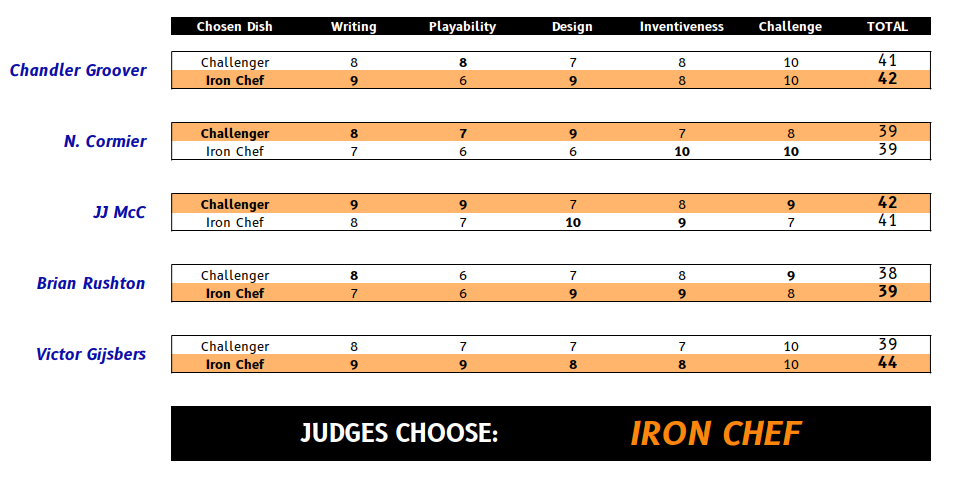
16 Likes

In the interests of equal time, Ben and Nellie after watching Dad spend 11.5 hrs on VdNP:

10 Likes

“Is he still looking at the glowing box?”

“Let me try to get his attention. No man can resist belly rubs!”

7 Likes

So, for the last 6 hours of the competition, sous-chef @Ally and I were on Discord, her pointing out things to fix, and me fixing them. With her permission, I copied it out and saved it. It begins with me adding hints about map directions, and ends with us workshopping the final sentence of the game with seven minutes to spare.

I don’t really expect anyone to be up for reading a 6-hour chat transcript. But I also didn’t truly expect anyone to be up for going through my source code nor reading my bug reports, so who knows? But either way, posting it definitely goes along with my ‘let’s make literally everything an open book’ philosophy, so here we go. I realized it needed a trigger warning, of sorts, and then the trigger warning itself turned into something kind of interesting, too.

11 Likes

The audience has chosen.


a banner reading: "AUDIENCE CHOOSES: IRON CHEF"

Iron Chef Inform 7 Afterward has triumphed in both the judges’ verdict and the audience vote, outshining even the stellar performance of his colleague, Draconis! The subtle intricacy and impeccable workmanship of The Van der Nagel Papyrus have delivered a double victory despite its difficulty level of rare magnitude.

With substantial support among both judges and audience, Challenger lpsmith can retire from the stadium with head held high, secure in the knowledge that he gave good account of himself in his match against his esteemed opponent. Now armed with fresh lessons and insights with which to further hone his craft, this worthy contestant is well-equipped to produce more and greater creations in other venues.

Congratulations to @Afterward for a stunning display of mastery over both Inform 7 and the craft of IF. The second consecutive victory by the Iron Chefs has been notched. How long can their winning streak last? More importantly: Who will be next to challenge them?

21 Likes

What an exciting turn of events! While we are, of course, a culinary competition, this reminds me this morning of the Rocky series. While Lucian is, of course, more decorated than Rocky was in the first movie and no amateur, he was coming of a decades-long break and in experience with the Inform 7 language, while Ryan is probably currently the world’s expert at streamlined production of high-quality Inform 7 games. Looking back with excellent 20/20 hindsight, it’s clear the cards were stacked against our Challenger, but he produced something magnificent.

And what makes the Rocky and Creed movies so fun is that the hero challenges his opponent to do his very best. Iron ChIF Inform 7 was pushed to his limits and produced an astonishingly good game that provoked a massive collaborative effort and high praise from judges and players. While many good games have been made by him these last few years, I suspect this specific game might never have been made (nor, possibly, the Link’s Awakening game) without the impetus of intense competition between two powerful rivals.

Thanks to everyone who participated, and thanks for tuning in!

16 Likes

Congratulations to @Afterward on the well deserved win, and congratulations to @lpsmith on a match well fought. This has been so exciting to watch from the judges’ box! It was mentioned earlier but I think it’s worth reiterating now: when the competition is this good, we ALL win.

I don’t know about any of you, but I can’t wait for the next round! Who knows what new and exciting tastes are yet to be discovered?

14 Likes

Congratulations to both the Challenger and the Iron ChIF! It has been a whirlwind week: two ideas generated from the smallest seeds and nurtured into full-fledged games in only five days.

In some respects, the Iron ChIF programming model strikes me as even more challenging than traditional Speed-IF – for although the timeline is slightly more lax, it is still, in practice, extremely demanding. With Speed-IF, you can cobble something roughly together, throw down your tools when the clock chimes, and count “completion itself” as total victory. But not so in Keyboard Stadium! Here, there is just enough extra time for the competitors to potentially sabotage themselves in countless unpredictable ways, and the audience is also breathing down your neck. The programming block presents the illusion of “more hours for development,” but this is indeed largely an illusion, for the deadline descends sickle-swift all the same.

And yet both the Challenger and the Iron ChIF have navigated a path boldly through the illusion, avoiding traps and pitfalls and producing outstanding work! We are lucky, in a world filled with so much trouble, to sit down at this little table together, in a moment of respite, and dine upon such lovingly crafted dishes.

14 Likes