Preamble
Everything here (except, of course, the Post-comp thoughts) was written before the comp’s results were out, so they’re my unaffected thoughts on my game. Apologies in advance for any rambling.
Origins
INPUT PROCESS was originally a short story written in 3rd person, which I then converted into a 2nd person interactive fiction game halfway through writing. The base concept remained the same throughout. I decided to switch because it just seemed thematically appropriate to have someone play through the story in real-time on their own screen.I technically started making this game in January this year, according to the details of the doc I made for it, but really most of the work (some of Act 1, and the entirety of Acts 2 & 3) was done in August. I’m a bit fuzzy on the details now but I believe I only got the confidence to continue working on it after I’d properly completed my first game in Twine for a Queer Vampire Jam game on itch.io. The game in question was somehow received quite well and made me think, yeah I want to continue getting better at this IF thing.
I got a bit too confident, though… I made my queer vampire game in about 1.5 weeks, during my university semester, both writing and coding included, so I thought INPUT PROCESS wouldn’t take that long. I was wrong.
To be fair to myself I was (am) also on my first internship, which ate (eats) up a lot of my time and energy, but still.
Story
I’m sure there were more, but these two pieces are what I can think of that specifically inspired or influenced the making of the game:- Lena, by qntm, and the implications of uploaded brain scans. One of my favourite pieces of short fiction ever (both the rough draft and the polished version) – highly recommend a read.
- This article in the New York Times, and the discourse around (artificial) digital intimacies under surveillance
I didn’t make a typical romance between Lance (the protagonist) and Squire (the AI) because 1. I wasn’t confident in making an AI x human love story that hadn’t already been done before and 2. the concept wasn’t super compelling to me anyway.
But I’ve always been a fan of not-quite-human not-quite-romance, if that makes sense. The in-betweens. So I decided to spin it in a way where it’s someone working through a human relationship using an AI instead.
Lance and Squire’s relationship isn’t totally unromantic – which I wanted to show through their relative levels of comfort with each other – but it’s also, as I hoped to portray, complicated by various power dynamics. I wanted to mirror the potentially exploitative nature of real-world AI’s relationship with its users, but I also threw in the bit about Lance technically having full ownership of Squire to spice things up.
Because a bunch of the problems with generative AI nowadays (at least, in my field of media studies, to my knowledge) are to do with the fact that the average user doesn’t really know what’s going on behind the veil, is unaware of what the model’s been trained on or how it gets to its answers, and is also not privy to such information even if they thought to find out, I wanted to explore the human-AI relationship with that particular issue taken out of the equation. Which I think I kind of did, peripherally? But it definitely could’ve been more fleshed out if I’d had more time to write.
So, in conclusion, while I don’t think I entirely failed in bringing my intended themes across, I think I was pretty clumsy in doing so and it could’ve been better.
(As an aside, I’m not sure if anyone who played INPUT PROCESS also played my entry to the Neo-Twiny Jam (20/20 hind/sight), but fun fact, the protagonists are alternate-universe versions of each other.)
Design
I will be the first to admit that I don’t think I wrote enough (in the objective sense) about the world in the game within the text, and my descriptions are pretty sparse. My rationale for writing is always that I write what I want to read, and to be honest I don’t like reading long swathes of environmental description, I like piecing the world together (both its function and aesthetic) via hints in other aspects of the writing. Unfortunately, I don’t think I polished the writing enough to succeed on that front.But anyway, in my mind, the world of INPUT PROCESS is retro-futuristic. I looked around on TVTropes for something to illustrate and the aesthetic I was going for is similar to Cassette Futurism. I didn’t want a regular cyberpunk setting (though it might’ve turned out that way anyway).
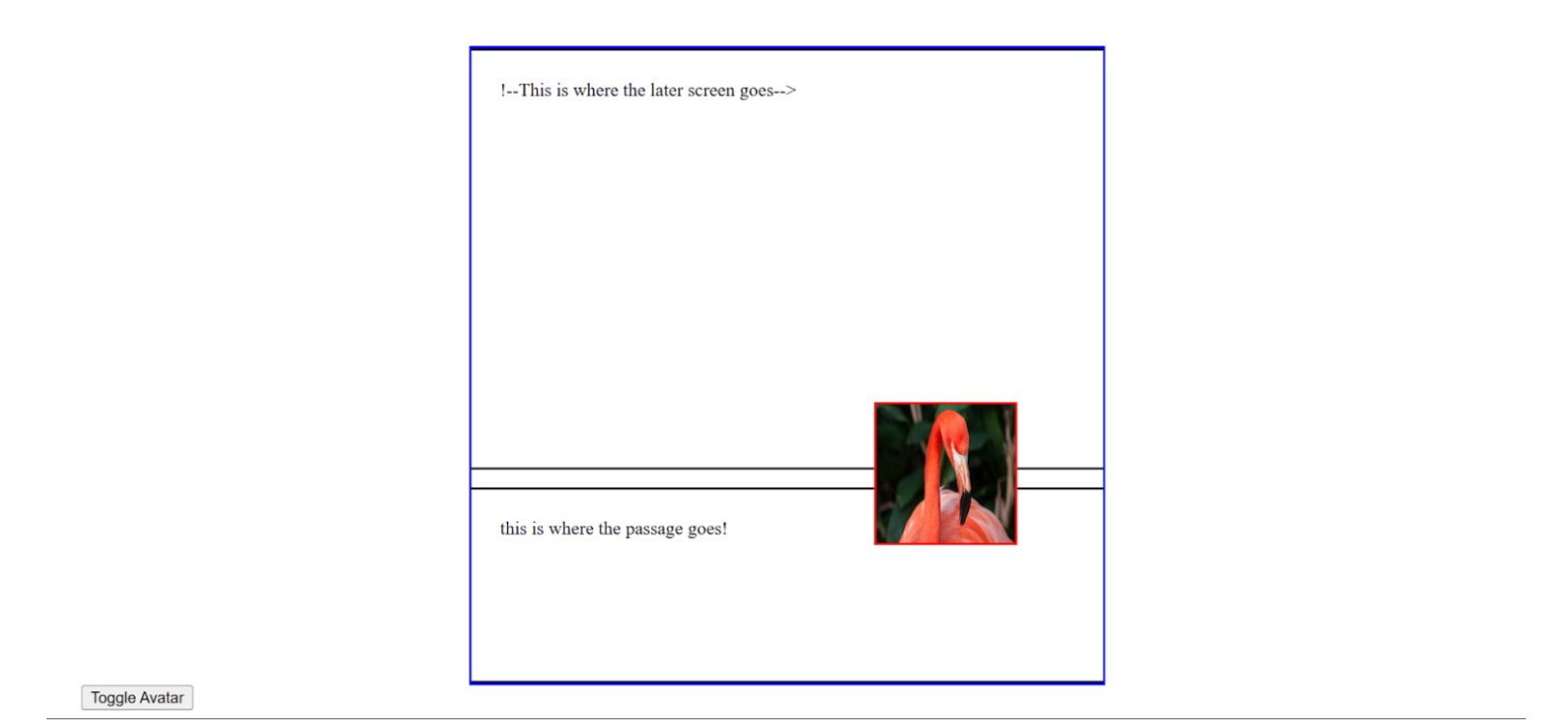
Early version of my intended layout for Act 2, featuring Squire on top and Lance’s comments on the bottom, the flamingo being a placeholder for the latter’s avatar.
I’d imagined the game with a lot more visual elements in mind to show this, like a proper background and drawings for certain objects, but of course, I didn’t plan enough time for those. I tried to make do with more simple design choices that I thought could still effectively contribute to the aesthetic, like the effect put on Squire’s display and text to resemble a CRT. (Thank you to this post for the heads-up that I should warn for flickering images! I thought about it beforehand but only put it in after the reminder.)
I am once again apologising for the timed text
The timed text for Squire’s dialogue was inspired by Ace Attorney, where they have scrolled text with pauses for each comma and full stop and other punctuation – this consistently makes the dialogue feel more alive to me despite there being no voice acting. And I wanted to make Squire feel more like a living entity, with each of her words transcribed as she spoke them.
It is clear from the reviews so far that this choice has hindered the reading experience. However, I also would not have wanted to release the game without at least some version of this effect, so the takeaway is I should have compromised somehow. I would have increased the speed during the comp if only I didn’t hard-code every pause in her dialogue… Hopefully I can improve my coding skills enough to implement things like this in a more user-friendly way next time, like with a click to skip to the end function.
Also I spent a stupid amount of time figuring out how to integrate JQuery with Twine just because I wanted Lance’s facecam to be draggable. I don’t know if it added much to everyone’s experience but it certainly did for mine. lol
Stats for fun (I used Tweego but imported into Twine to see this)

Things to note for my next project
- I should probably try writing a widget so I don’t have to have all non-main-passage text (like commentary) in a different file…
- When struggling with implementing something, it may be simpler to just make things in Sugarcube syntax (instead of pure Javascript).
- Sometimes artistic vision has to be compromised for the user experience.
- Be liberal with the content warnings.
Post-comp thoughts
First off, part of my would-have-been written remarks if I'd placed top 20, because they still apply:I’m new to this, so I’d like to thank the IF community for being so welcoming and inclusive. I hope everyone keeps making weird, funny, heartfelt, passionate, human art.
While I will say I hoped to place higher than 43rd, the disappointment dissipated once I read the anonymous feedback left on the ballot. Someone told me that despite usually finding Twine games a slog to go through, they hoped it would place at least top 5(!), which really hammers in the subjectivity of judge ratings. Someone else thanked me for the music recommendation in the in-game author’s note, available post-completion of all endings (always good to spread the word of 告五人 Accusefive). Most were from people who enjoyed the game, and all gave useful crit, so that was very heartening.
To conclude, my sincere eternal thanks to everyone who’s taken the time to play and/or review my game. I want to specially thank @Mathbrush for leaving the first review and, in doing so, indirectly reassuring me early on that the game wasn’t, like, absolute garbage – I’m really glad it connected with you.
I’m happy to have joined this time despite my initial apprehension, and to have shared space with so many great creatives. I wish I’d had the time to be a judge myself. Hopefully this won’t be my last time participating in IFComp!
Sincerely, HY :-]