Blind viewpoint characters... advice? Guidance? Sensitivity reading?

So, I want to do a short game in which the protagonist is blind. They’re at home, so they know their environment, and I’m trying to get the tone and so on correct. However, I also want to avoid explicitly stating to the player that the character is blind. And I guess… Part of what I’m looking for is more a social question than a technical question, which is roughly that, being sighted myself, I have no idea whether this is going to come across as offensive, or how people usually navigate their own space if they can’t see it, and so on. My impression, from the people I’ve known over the years, is that a person around their own house doing things normally would not really be actively thinking about whether or not they can see, but that there might be subtle differences in practices – for instance, they might habitually ensure that a knife is always put away in its correct location rather than just setting it down on the nearest flat surface the way I do.

I’d like to know more about this, but I’m not sure how to find out. I don’t want to be offensive, but I find the topic fascinating. I think what got me originally onto this was just thinking about how a room description could be full of things that sighted people would assume indicated sight, but which don’t, such as knowing that the blinds are open (sunlight is warm) or that the cat is nearby and bathing (you can hear this).

I actually originally had this idea probably twenty years ago, the reason I’m back to thinking about it is I saw an episode of an anime in which a blind-from-birth 7-year-old was being led around his own home by the hand because he could not possibly be able to move from one room to another without full-time help, and I’m pretty sure that’s just 100% wrong and sort of offensively so, and I got back to thinking about it.
2 Likes

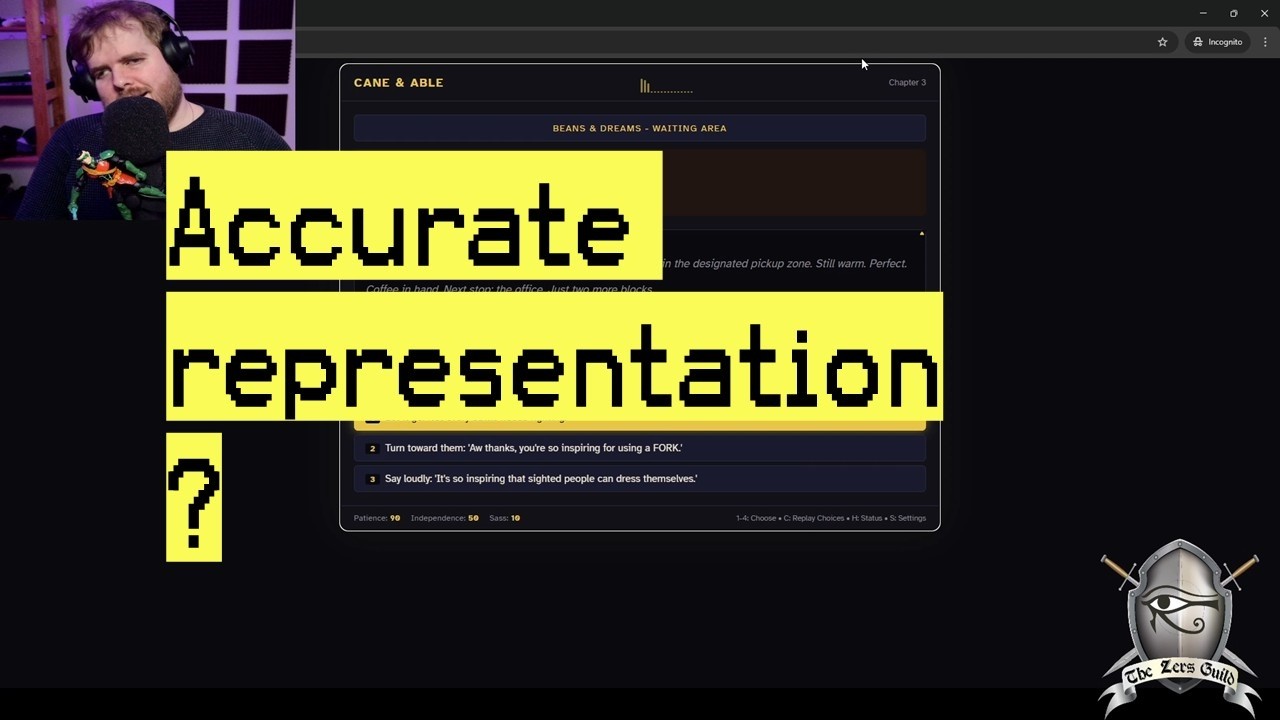
This was a good recent video on roughly that subject …I imagine you could dig up the other discussion he’s referring to, to see what other people objected to…

2 Likes

wow! that is an excellent video, thanks.

1 Like

As a sighted person who isn’t very well versed on the subject, I remember thinking that Perception was different, effective, and pretty awesome.

I remember a short IF game in which the protagonist was blind, and, well, all that it meant was that “examine” was replaced by “touch”. I’m not sure how accurate that was, but I seem to remember it was a short game, in which the PC had been kidnapped and was freeing themselves, so it’s a situation where exploration makes sense. It probably makes less sense to go around touching everything if your PC is going to the library to do some research.

A situation in which the game tell you “there is a knife on the counter”, and you type >TAKE KNIFE, and you get the response “You reach for the knife, but find nothing there. Crap, who’s been moving your stuff around?”, and possibly for the next turn the LOOK description might include a paragraph that says “There should be a knife on the counter. Le sigh.”… seems interesting.

You, and I, just put that knife down anywhere on the counter because we can see it when we’re looking for it. But what if it’s something you can’t easily see, like a tiny screw or something transparent? Or you want to make sure something doesn’t get mixed in with other things so you don’t overlook it (like, you choose not to put something black on a black surface, or if you do, you may immediately think “Erm, if I leave that there I’m going to forget about it and then I won’t know where it is”)? Without having much experience of what it is to be sightless (but catch me without contacts or spectacles and I’ll do a great impression of being sightless), I believe the general idea is the same: at some points, you simply take greater care now to avoid trouble later.

I know there are creators with various degrees of sight around here, though I don’t know how many of them create and how many of them, like me, just play (one of my favorite games, Crystal and Stone, Beetle and Bone, was written by a blind person. I use this term because this is the term they used in the “about” text so I assume is their preferred term). So I’m looking forward to see what responses you get, and learning from them as well.

Bearing in mind, that you can get away with quite a few things by allowing for an individual personality which may break from the “norm”, such as it is.

(aside: I find it interesting, sometimes, to try and do stuff around the house with my eyes closed, or to try and use my umbrella as though it were a cane, to try and get a glimpse of what that world is like, and understand how they do it. There’s professional interest as well, since I may have to play a blind character some day, and at any rate it’s often very useful on stage to use other cues than your sight to locate yourself and various items. At any rate, I do this sometimes. I rather recommend it. If nothing else, it will make you appreciate your sight a lot more - just one of many, many things we take for granted. And I’m sure the experience will enrich the game you will end up making)

1 Like

Yeah, this is set in the protagonist’s home. I do sort of like the feel of having the game tell you things that are wrong but you assumed, but it might be disruptive, and part of what I want to aim for, if I can pull it off, is that you can play the entire game without ever realizing that the character whose experiences and choices you’re interacting with isn’t seeing anything at any time. So I just want to have everything act completely normally, with just subtle things like refusing to leave a sharp object somewhere unexpected.

1 Like

Sounds pretty cool! I hope that when I get to play your game, I’ll have forgotten about that “twist”. :slight_smile:

Not a direct answer, but you could look at works tagged “blind protagonist” on IFDB for ideas/reviews/etc.
(There are only five, of which three are parser. One of them is from the currently-running Text Adventure Literacy Jam. I only created this tag a few days ago.)

This sounds like Blind (2011).

Yep, that’s the one. :wink:

Going to be tricky to maintain subtlety when the player types LOOK. Although redirecting L to LISTEN would probably last surprisingly long. I bet most players rarely type LOOK in full.

1 Like

This is such an interesting coincidence. Here’s part of a very recent post in What is everyone’s favourite thing to have on pizza?.

It sounds like exactly the sort of think that you were wanting to know, but it’s not likely to be something you can easily find out about. So bang, now you know your character should have the habit of sniffing open drink containers, and you don’t have to explain why until the end.

There is truly no substitute for finding someone to ask.

Well, there is. It’s awesome reference material. This might also be of some assistance, I guess.

There’s a bit of a leeway in there, I think. When “examining” stuff, people don’t really expect the result of a proper examination, just the same as “look at thing”.

But there are words which are part of one’s vocabulary and life which may not necessarily reflect their literal meaning. Easiest example, I am atheist but I still say “Oh my God” and “Jesus Christ” when shocked. It’s cultural.

This nice article specifically says,

EDIT - Thank you for asking your original question. I find myself fascinated by these articles I’m coming up with.

1 Like

Hi, just saw this now. Honestly as someone who has been blind since birth, the way we move around our home are very similar to the way sided people do. Imagine it’s late at night, and you need the loo or something like that. You probably still be able to find your way from your room to the toilet without too much incident, which is exactly the same for us.

4 Likes

@Seebs Wait. Are you saying Bruce Willis was a ghost this WHOLE TIME?!!!

Yeah, that was my assumption, that it would just be completely normal? And that was what I wanted to aim for.

I think my experience has been that I see a lot of blind people using “look” and “see” without apparently really thinking about it. Like, in that game reaction video, the guy doing the video says things like “I see what they’re doing” or whatever, and doesn’t think about it, so I think I’m just not even going to try to change “look”, because I think it’s just used idiomatically.

That said, I’m trying to make it so that objects are described only if you’d be aware of them or thinking about them. So for instance, there’s a cat, and if the cat is bathing, “look” will say the cat is here bathing, but if she’s napping, “look” doesn’t mention her.

ETA: i just noticed that Alyssia’s post started “just saw this now”. You see what I mean? Oh no, now I’m doing it.

1 Like

, A lot of us use Luke/C in everyday conversation a lot, even though we’re not actually looking in a lot of cases. For example, it’s just easier to say you’re going to watch a film rather than I’m going to listen to a film or hear a film.

I guess in the game you can use look sort of like a Meta command that just regenerates a room description, and what the character is aware of in their room and what they already know is there. For example, if they’re completely blind, they might not be able to see those sofa in the corner, but they’ll probably know if it’s a familiar environment.

1 Like

yeah, that’s roughly the plan. since the player is at home and doing things, i’m going to sort of gloss over things in descriptions that aren’t relevant/interesting, because like… if you ask me to look around in a room in my house, i probably won’t be conscious of most of the objects there?

1 Like

Yeah, sort of like examining I guess. Like I don’t think anyone actually picks up an object and gives it a thorough examination unless it’s something very odd LOL. I guess it’s just one of the quirks Yeah, sort of like examining I guess. Like I don’t think anyone actually picks up an object and gives it a thorough examination unless it’s something very odd LOL. I guess it’s just one of the quirks of IF.of

Sure, depending on the context. Personally I would feel misled in the case of a parser game. Similar if I spent the whole game typing LISTEN, not being told my character was inferring sounds they did not hear. Congrats, author, you sure tricked me by not clearly describing a situation about which you are my only source of information.

I’m not saying LOOK shouldn’t be accepted in a game with a blind character, but to both accept LOOK and carefully write the responses to disguise the fact that you were looking with your hearing/touch/memory is a bit much.

I’m not even sure the original idea is more effective when the player doesn’t know the character is blind. Especially if they never do figure it out. What’s the improvement over just telling them this, so they can marvel at your brilliantly mundane descriptions of everyday actions?

2 Likes

Speaking as someone who has been blind in his right eye since infancy and blind in the left since his mid-20s and attended a school for the blind and visually impaired for most of his k-12 education, I never realized how often we idiomatically use words related to sight to encompass all of the senses or as a synonym for understanding until after going blind in what use to be my good eye.

3 Likes

interesting question, but i think… like, given how baked-in those idioms are, i don’t really feel like it’s deceptive, and… hmm. like, for me as a writer, yes, i’m being careful about my descriptions. but the intent is that, to the viewpoint character, they’re just normal life. it doesn’t seem unusual or weird, and the impression i get from talking to people who do not in fact see anything is that this is approximately accurate. there’s not a ton of actively thinking “ahh, yes, in this situation, other people would be having different experiences” going on, usually, while going about daily business.

when i mentioned this to my kid, they pointed out the bit in photopia with the maze where there is a solution which would probably be intuitively obvious to a viewpoint character but isn’t to most players as being sort of a similar vibe.

2 Likes

Don’t good writers routinely mislead the readers to achieve twists? In such a manner that the reader is compelled to re-read to re-experience? 9:05 immediately comes to mind, “The Murder of Roger Ackroyd” as well, and there are certainly countless examples.

I dunno, I see it as skill.

2 Likes