Announcing Text Adventure Literacy Jam 2026

Write a text adventure that is suitable for beginners to this genre. The game must include an in-game tutorial.

Text Adventure Literacy Jam 2026 is now live!

This is the 6th annual competition where the entrants must write a text adventure (a.k.a. parser-based interactive fiction) suitable for beginners to the genre.

As per usual, the game must include a tutorial at the start of the game. This is one of the aspects that makes this competition unique and also one of the aspects that makes this sort of game extremely hard to write.

Schedule

Submissions open: 1 March 2026
Submissions close: 30 April 2026
Voting opens: 1 May 2026
Voting closes: 31 May 2026
Results announced: 1 June 2026

Rules

The rules are the same as last year. See the link above for all the rules. There are also extensive guidelines that try to explain the rules for new or inexperienced authors.

Theme

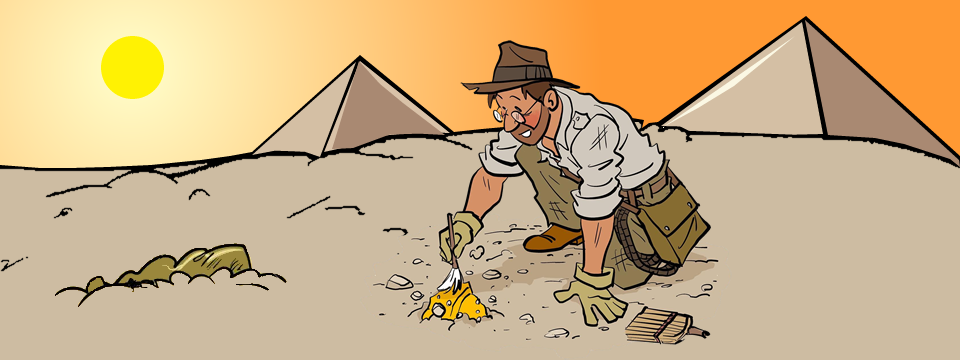
The optional theme this year is ā€˜Archaeology’. Whether it’s grave robbing, solving ancient mysteries or genuine research into Hittite culture, who doesn’t love a good game based around archaeology? Expect puzzles to solve, traps to avoid and ancient languages to decipher.

What’s new this year?

Er, nothing, apart from the theme. I’m still encouraging new authors to get a mentor, although no one took advantage of this last year.

Prizes

This competition is famous for its generous prizes. In fact, it’s more generous than anything on the planet, including IF Comp and Spring Thing. Last year, every entrant won a prize (except for the poor old host, who isn’t eligible for a prize).

I’ve started the ball rolling with a cash prize of US$100. Please, please, please donate prizes to encourage authors. It doesn’t have to be cash. Prizes may be T-shirts, books, computer games, vouchers or anything else that is likely to appeal to text adventure authors. Just keep in mind that physical prizes will entail postage costs. If you can donate something, please send me a personal message on here or the Text Adventure Literacy Jam Discord server.

Anything else?

Yes. Don’t leave it until the last minute. I know that a few people ran out of time last year, so it’s time to dust off those unfinished games, or start on something new. You have four months. Get those thinking caps on.

Ready, set, GO!

20 Likes

Gosh darn it, I already have two big WIPs to work on, plus maintaining the Dialog compiler…but I can’t resist a prompt like this! I saw it posted this morning, thought about it all day, and now I already have a concept I’m excited about.

One rules question:

Choice-based input should be avoided, but may be used sparingly, such as for a menu-based conversation system or hint system. If minimal choice-based input is used, the options should still be selectable by keyboard.

I’ve found it helpful to newcomers when suggested commands (like the tutorial saying you can TAKE THE ROCK, or a room description saying you can go NORTH or EAST) are hyperlinked, so they can click the commands instead of typing. It’s exactly equivalent to typing in the commands by hand, but I tend to use this quite liberally in games intended for new players.

Is this going against the spirit of the rules?

10 Likes

No, that’s fine, providing you can also type the commands. Think of it in terms of a visually-impaired player. Can they play the game using keyboard only?

7 Likes

I entered last year and it was rewarding. I noted I’d be glad to test prospective entries on the itch.io site and I want to do so again here. I’ve enjoyed TALJ very much over the years & hope to be able to review everything again.

5 Likes

Gosh darn it! In my current WIP I make reference to past experiences of my PC as a seasoned adventurer exploring ancient ruins and lost civilizations. I guess I have to start filling in some blanks now… Pulls off armored gauntlet and drops it on Garry’s left foot

Thx for confirming this, I want to give Bisquixe a whirl and this is the perfect opportunity!

4 Likes

You could write a prequel.to describe his/her exploration of those ancient ruins and lost civilisations.

4 Likes

You read my mind. That’s cheating!

3 Likes

I’d love to try this genre out, as a twine dev coming from MUDs. The tutorial concept in particular is quite interesting to me as I’ve written two different tutorials for MUDs (Aetolia: Evlasu zone, Carnifex guild)

How do I do this mentor thing? And which engine would be best for a dev focused heavier on twine?

6 Likes

Fantastic news. I was expecting the Text Adventure Literacy Jam, but not in the first quarter. Of course I’m interested in this competition and will place my game here instead of planned Spring Thing. I will try to fight for better placement, by putting big and more playable adventure game.

I will use ADL this time, and use its rich facilities for extended vocabulary.

I’m not quite sure why ADL isn’t listed in the proposed authoring-system list on the page. It’s mature and complete system - but not popular.

As of optional theme - it’s great and I’m going to use it. I’ll try to create the map and scenario of adventure game first, following the guides.

If I get into the first 5 places I will learn PunyInform. :slight_smile: I noted, that my game must be attractive enough to move on - to other authoring-systems. I’m pretty optimistic in that matter.
OK. let’s start it.

4 Likes

When Garry and I were working together on this, we agreed that we didn’t need an exhaustive list and settled on a shorter representative list of authoring systems. Ultimately, as long as you otherwise meet the requirements of the Comp, you could author it however you wish.

1 Like

I completely understand it. The list contains systems that are widely used by text-adventure (interactive-fiction) authors, mostly professional. There are tons of different tools, including those made by single developers. I like those made for Amiga computers.

ADL is multi-platform and in my opinion has all the important features. When I joined few years ago Facebook group dedicated to Text adventures I was surprised on what people use nowadays and back in the day - because I didn’t have contact with text-adventures on 8-bit platforms, which offers a variety of games and very popular systems.

Like I said to Garry, I write 1 or 2 more ADL games before learning new system. The game does not need to get high place, actually. :slight_smile: But I hope it will achieve from 1st to 5th place.

1 Like

For the mentoring thing, you’ll probably need to decide on an authoring system first, then request a mentor on the forum, the TALJ Community page or the TALJ Discord server. There’s a #teams-and-mentors channel specifically for this.

If you have the time, I’d suggest designing a little game with (say) two rooms and one puzzle and try to implement it in a few different authoring systems to see which one feels the more comfortable for you.

In my experience, most people adapt to Adventuron very quickly, as it’s all online, has a sophisticated coding environment, provides instant feedback if you have coding errors and can play your game in progress at the click of a button. You can save your progress in a text file and compile the finished game to an html file for quick upload to itch.io. It’s also relatively easy to include multi-media and custom fonts.

For minimal programming, try ADRIFT. It’s essentially just filling in forms with minimal ā€œprogrammingā€ in the conditional logic for actions and events.

For a more traditional programming language, you can’t go past Inform 6 using the PunyInform library. Others will argue that Dialog, TADS or ZIL are a better choice, but they’re all very different.

And for popularity, Inform 7 wins hands down.

All authoring languages have a fairly steep learning curve, which is why I suggest trying a few first.

I can mentor anyone that wants to use Adventuron Classroom or PunyInform, although I’m pretty rusty on Adventuron. Both of these languages have dedicated Discord servers that are pretty active.

I can steer you towards a mentor for most of the other popular languages. ADRIFT has an active forum. Dialog, Inform 7 and TADS support is available here. ZIL has a dedicated Facebook page.

3 Likes

Glad to have you onboard again. I couldn’t list every authoring system on the planet, as there are hundreds of them. I’ve highlighted the common ones that have an active community. I couldn’t find any links to AdvSys or ADL support pages. As far as I know, you’re the only one that uses them. But that’s okay.

You can use whatever authoring system you like, so long as the game is playable on modern platforms, and the more platforms, the merrier. Beginners to the genre aren’t likely to go looking for retro hardware or emulators just to play some game in a genre that they’ve never heard of. Nor are they going to use anything that requires complicated installation, as we’ve seen with some ParserComp games. This is intended as advice to everyone. Keep it simple.

2 Likes

I host my support page for ADL. It’s an old system from 1987, but I like it. The installation is very simple, requires just little knowledge of computers - just unpack the archive and run from the Shell. It doesn’t need complicated installation.

Moreover I also included (with the ā€œWizard’s Clubā€ game) icon for Windows with the script, that automatically opens the Shell and runs the interpreter.

ADL was written in C, and is easily adapted to any system without much work. I could make a Mac or Linux executable, but I don’t use these systems.

The idea behind links to ADL is to give people information about this system. I successfully adapted it to modern system using modern C compiler and have written two games in it recently ā€œWizard’s Clubā€ and ā€œPriceless Vaseā€. I have prepared the documentation in AmigaGuide and HTML format for it.

You’re right that beginners are looking for easy-to-use system with good support. Fortunately I didn’t receive any reports that my games are hard to run on particular systems.

ADL is Freeware as noted by its authors: Ross Cunniff and Tim Brengle, so I could adapt it further even with my modifications. But I consider its code as excellent work, still learn from it to this day. Maybe I can make completely own tool.

Learning Inform 6 shouldn’t be that hard, and I seriously think about it. But my games tend to receive last places, because of many flaws, thus it’s encouraging me to work harder. I hope my next game for TALJ will have more quality. As I mentioned the key is to create a draft scenario, a map, the puzzles, and play-test the game. Also thank you for earlier reviews, help and testing. I know that I go in the right direction with improvements. The playability is the most important here, the logical responses and proper vocabulary.

Also I take your games as a superb solid example. I start earlier with the mentioned order of game development. I’ll need to check the transcriptions from my last game as well.

2 Likes

I’m trying very hard not to let this game grow out of hand, and yet…

And a rope. Why did I include a rope??

4 Likes

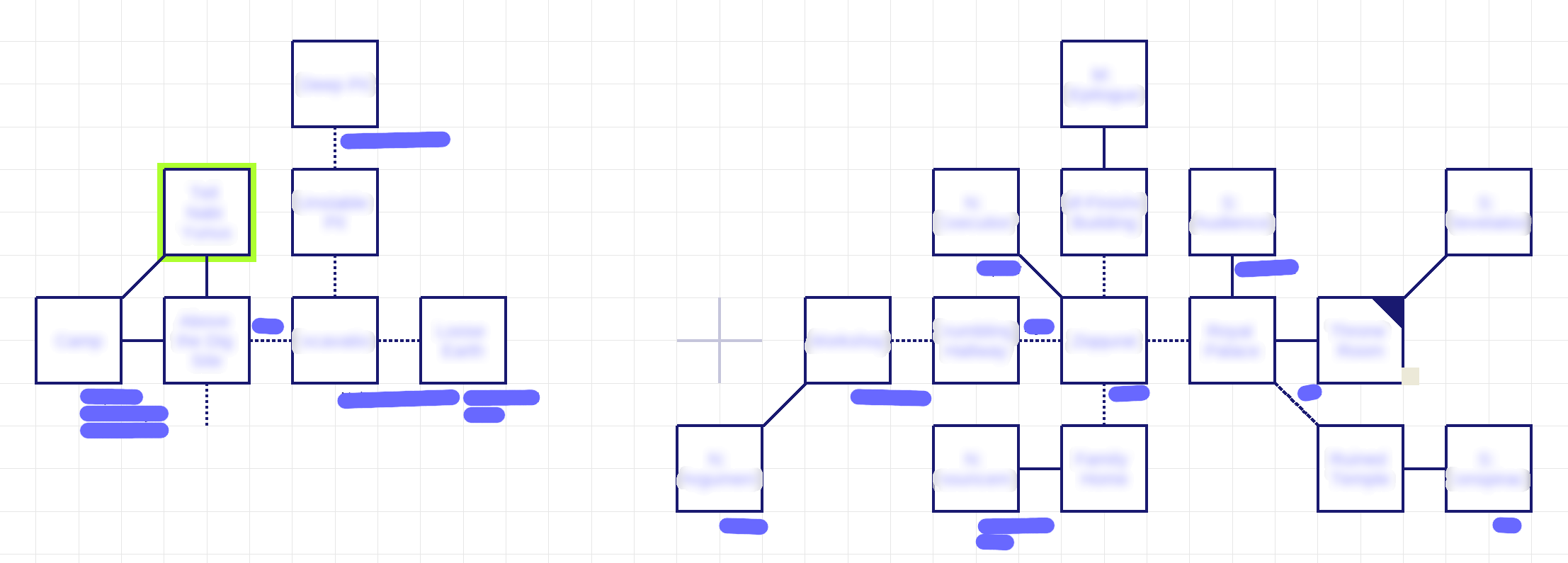
Could you please tell which program/software are you using to create such diagrams, maps and flowcharts?

1 Like

Sure!

For the flowcharts, I use Graphviz, which you can download and use on your own computer, or online. This one was made online. For flowcharts with a definite start and end, ā€œdotā€ is the best engine, and ā€œpngā€ is the format used here; ā€œneatoā€ is better for showing general networks that don’t have a definite start and end.

Here’s an excerpt of the code I used:

digraph G {
    START -> TeachMovement -> Camp -> Rope;
    TeachMovement -> Pit;
    Rope -> TeachItems -> Bones_N;
    Pit -> TeachItems;
}

(For the version posted here specifically, I did a bit of extra coding to make the labels disappear. Spoilers!)

The map was made in Trizbort, which you can also use online (though this one was made offline using the download version). All the blurring and redacting was done in an image editor.

I’m a very visual person, so I like having all sorts of charts and plots when I’m designing something. You can also export code directly from Trizbort once you’ve designed the map, but I generally just use it as a guide while writing the code by hand instead.

4 Likes

Thank you for links and info. These apps look very nice. Of course I create maps too when I’m designing the adventure. I mostly draw them on paper.

For diagrams (UML) I used free Diagram Designer so far, but it’s not very convenient. Also I used LaTeX package when creating diagrams in the documentation.

It’s very nice to know which program people use. I tend to miss some solutions, maybe I’m not searching long enough.

1 Like

Ha, ha, ha! Because you’re a masochist?

I can relate to this. Ropes are a common trope in text adventures, yet they are notoriously hard to implement (second only to liquids) and every rope seems to be different in some way. I’m currently working on an archaeology-themed game (not for this competition) where you have to create the rope in the first place, tie it to things, pull it or climb down it and climb back up again, and untie it to reuse it elsewhere.

3 Likes

For puzzle dependency charts, you might also like to try Puzzlon by @Adventuron author Chris Ainsley. It’s pretty easy to use once you get the hang of it. It requires minimal programming and formats the chart automatically. Ctrl+Space is all you need to let you know what you can do next.

For further info, see:

It’s all online, but you can copy your source code and paste into a text document to restore it later, or save the finished chart as an svg file to view in a browser.

3 Likes