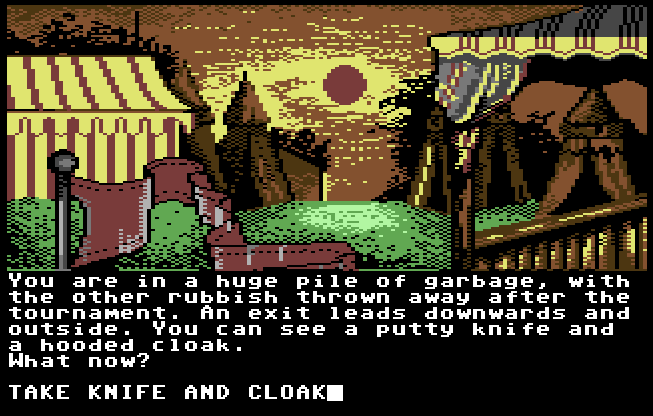
Hey Community, I hope you are doing well. I have an announcement to make that is too important to not break my current IF hiatus. Some of you that are closer to me might know that I’ve been in touch with Mike Austin from Level 9 since 2022 and we discussed about releasing the A-Code compiler, the game sources, specs and pretty much the complete Level 9 archive to the public.
And Mike started digitalizing the content from the Level 9 archive. A massive archive of around 1000 disks. From these, around 500 are now digitalized, so there is still work to do, but the essentials are now already preserved. Mike has decided to make everything he has done so far publicly available, while he continues to work on it. The sources of the A-Code compiler are there, sources of many Level 9 games, Knight Orc for example, Documentation and Specs, pretty much everything. You can access the Level 9 archive here: GitHub - MikeTheTechie/Level9-Public
Needless to say, another important part of interactive fiction history is finally preserved. And we are curious to see where you take this. Long live A-Code.
Yes, this is very exciting news! Thank you for your role in this.
Let me just slightly rephrase what I wrote on Mastodon: As far as I can see, these are almost all the games, with the exception of the non-adventure games (Champion of the Raj, Billy the Kid) and the choice games (Adrian Mole, The Archers). Other than those, I think only Emerald Isle and Erik the Viking are missing. For the missing games, I suspect that license issues are the main issue, so we might not see those games for a while.
The Level 9 archive is based on around 1000 floppy disks from various systems which were preserved from the late 1980s and early 1990s. Of these, about 500 were successfully read between 2021 and 2024, mainly using an Atari ST emulator running on a PC.
This GitHub repo is a work in progress. Here are some of the folders which I have processed so far.
So, I can’t honestly exclude that the missing IFs are in the ~500 out of ~1000 disks still to be read.
Let’s monitor the repo… (bookmarked here, of course )
Best regards from Italy,
dott. Piergiorgio.
ps. of course, I concur & second Zarf’s assessment. Digging into the mass of primary sources…
I suppose this will make it possible to play most Level 9 games legally using a free level 9 interpreter.
Hopefully, this will result in more reviews of these classic games, at least the later titles which had a more modern parser on par with Infocom. I suppose Knight Orc is an edge case and then the later titles had a strong parser.
Since I know that I know nothing about these tools…
What are the pieces here? There’s a README note about the “acode compiler, squasher and interpreters”. Is the “squasher” the tool that turns a compiled game into an Atari/whatever disk image?
Is “sys sources/PC huge” the compiler?
(I know that there’s a big pile of floppies under “floppy disk archive” which have not been sorted or organized.)
Finally! I’ve always been really curious about Level 9’s development tools. Maybe part of it was that I lived close to Wycombe when Level 9 were located there, so it was a local company. A big part of it was amazement at how much text Colossal crammed into a 32KiB home computer. Now decades later I get to peek at what was going on.
The fact that the descriptions and the parser dictionary are one and the same — that words are marked in the description to automatically make them recognizable by the parser — is a clever approach that must have saved literally dozens of bytes
While we wait for Mike’s answer (or more tools to be available), the manual under “docs/” gives some hints: the squasher is the program that compresses the texts into the “SQUASH.DAT” files contained in the folders for the different machines.
I think that the “PC huge” folder is not yet complete, or at least the PC process was structured differently from the Atari ST process. The manual talks about a “c” command on the ST, but there is no “c.asm”, “c.exe” or “c.bat” contained, so it’s possibly missing. But you might be right that “huge.exe” is the actual compiler for PC.
I’m certainly looking forward to more docs becoming available!
Roberto Colnaghi reminded me about the 2012 Digital Antiquarian post, which talked about the extremely efficient (for the era) string compression code. So that fits.
Also, someone comments on that post:
I worked at Mirrorsoft at the time when Level 9 had abandoned text adventures entirely and were trying to go on with graphical strategy games via their HUGE system (wHoley Universal Graphical Engine – or something like that!). Sadly, Champion of the Raj and the PC conversion of It Came From the Desert was about all it produced (along with Billy the Kid for Ocean)
Haha, right, I completely forgot about that, even though it’s in the Fact Sheet:
Finally, an animation control system named HUGE (The (w)Holy Universal Game Engine) was added, which was actually a new system on its own, but derived from A-code. HUGE drivers existed for the Amiga and Atari ST, and later the PC, only. It was never used for issued Level 9 games, but e.g. their conversion of It Came from the Desert was programmed using HUGE.
(I can’t remember where this info came from, so it could be incorrect in part, particularly concerning the “never used for Level 9” part.)
I am new here. I joined because I wanted to share with you something you might appreciate. The last couple of months I’ve been working on a recoding of the Level 9 development tools in C, to be compiled and used on Linux. I’ve been in contact with Mike over that period and this week I came to a point where I thought there is enough value to publish. Yesterday Mike approved the pull request. So you can find the l9dev project integrated as a folder in his repo.
It is work in progress. I am currently looking at the interpreter and I have HUGE dreams. This is great fun! The motivation for this project is also for the tools to feel more or less the same as they used to feel. I am sure from this reference implementation, people can create a much more efficient and modern IDE style environment if they so wish …
In the past I also worked on extending and correcting the existing L9 tools (e.g. l9cut, l9dis) also integrating my work on salvaging the MSX version of the games. You will find those on my GitHub page. MSX was my homecomputer when I was a teenager. I used to play mainly Lords of Time. But it was only in recent years that I completed all the games. I used walkthroughs in many instances, as I am not a hard core adventure gamer. I can enjoy also going through it like a good movie, not only as a challenge, exploring as I go along.
I also like reading the work you are all doing. I was fascinated by the work of Andy Barnes here, who is studying the games and creating a L9 interpreter in Python. I have a fork of his work where I completed support for the v2-v4 games (including pictures). My motivation was entirely different than Andy’s as I just liked the challenge of making it work. It prepared me for the work I am currently doing. Oh, are you all aware of the gem that was found in Mike’s archive? The unpublished game of Grange Murders? I also helped with the Atari ST support for that one. I can’t include a link as yet, but you can hopefully assemble it from this: Grange Murders (PC, Amiga, ST) - Cinemaware/Level 9
This sounds very cool. It’ll be interesting to see how it develops. I know that lots of people have dreamed about having some tools to enable them to write games powered by the Level 9 system. (I think I’m a little too old and set in my ways to learn something new myself!)
I’m just so pleased that Mike is making so much of the Level 9 archive available.
That’s fantastic, thanks for your incredible work! I’ve been watching your pull request for the past few days and didn’t really expect it to be integrated so soon.
Any chance you or someone else could explain the legal status of these games, perhaps simplified?
A few days ago I tried to read the license stuff on github but did not really understand the implications. I can imagine that being able to play these legally, could increase the number of reviews of Level 9 games on e.g. IFDB, as they currently have very few reviews compared to e.g. games by Magnetic Scrolls.