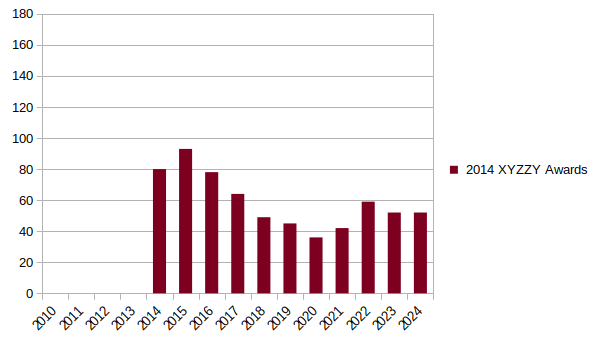
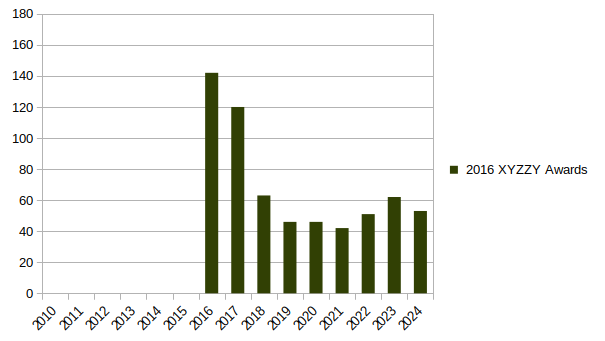
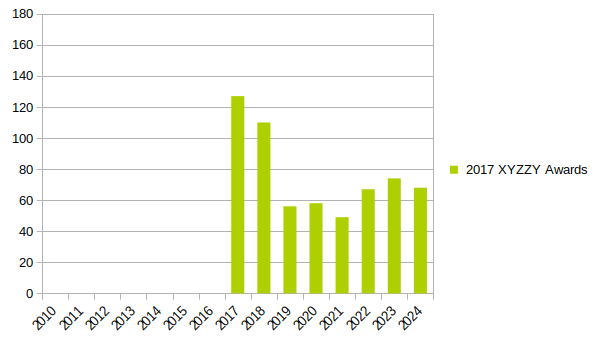
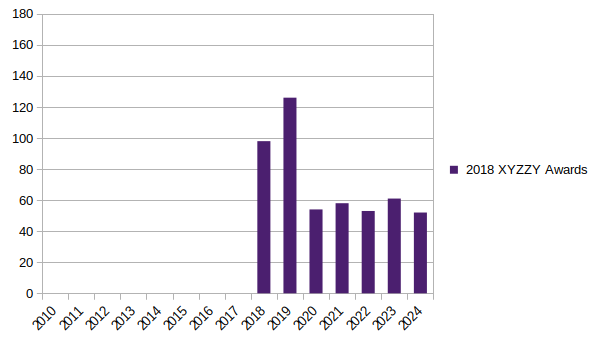
I was curious what kind of difference it made in a game’s longevity to win a XYZZY Award.
Since the timestamp on play data really means when someone logged their play on IFDB instead of when they interacted with the game, I started looking from 2010 on, after IFDB had been around a while and people were using it regularly. There’s almost certainly still some noise due to people signing up and immediately marking games that they’ve played in the past, but hopefully not too much.
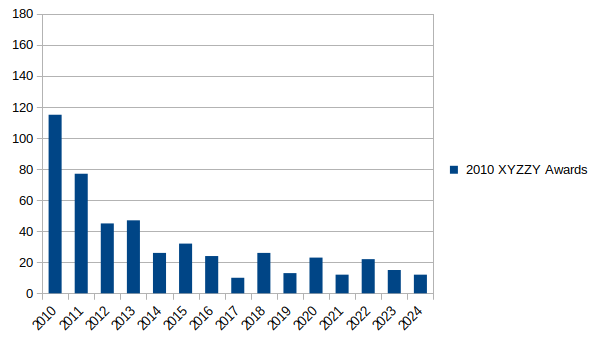
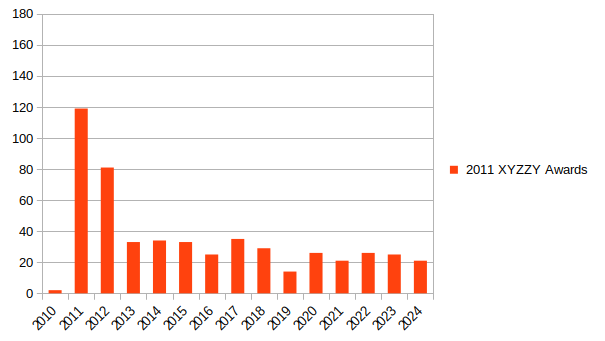
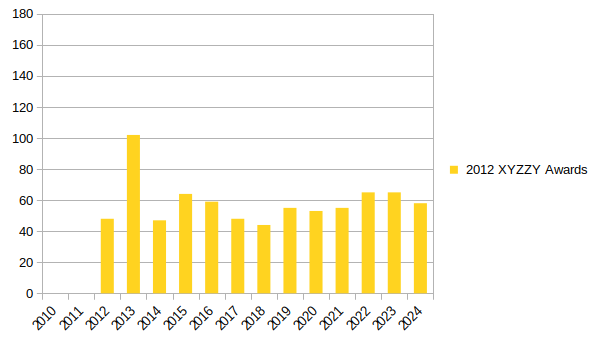
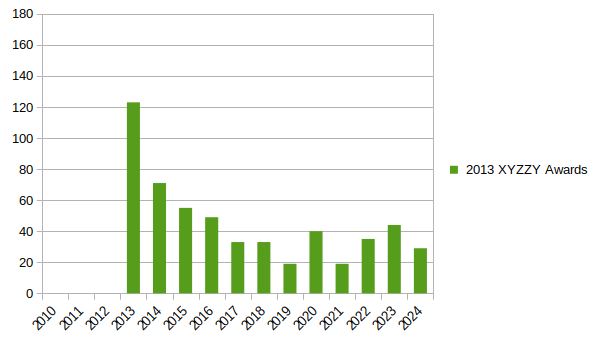
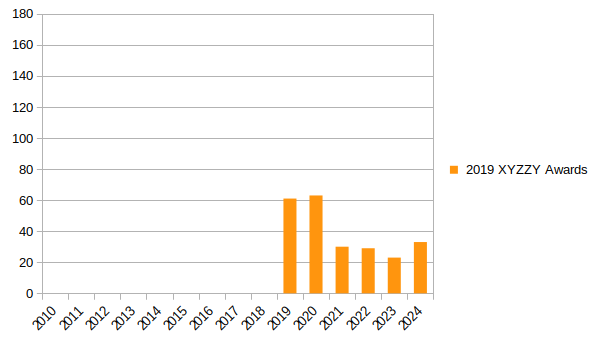
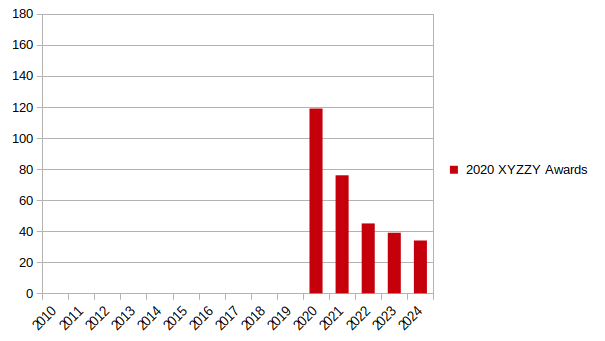
These graphs all show the total number plays for XYZZY Award winners in a given year, as they were registered over time. The graphs have all been homogenized to the same play years and same scale to make comparison easier. So, for example, the first graph shows plays of games that won XYZZY Awards in 2010, each year from 2010 (during which around 115 plays were logged across all of that year’s winners) through 2024 (during which around 10 plays were logged across all 2010 winners).
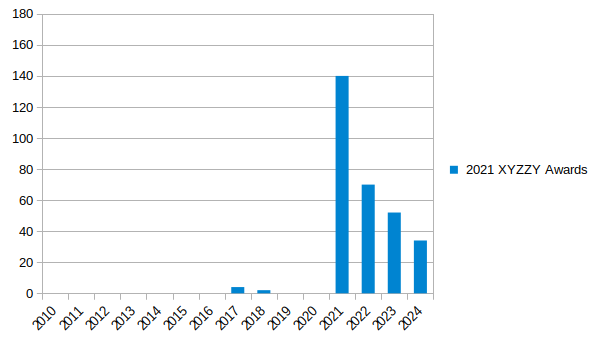
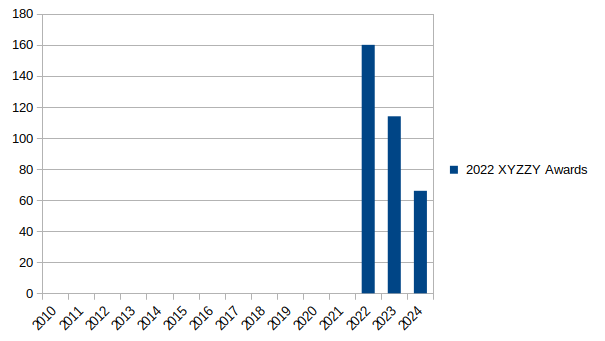
The peak year is usually, but not always, the year of publication. It’s interesting to me that the overall peak seems to have shifted generally upward over the years: from something in the range of 100 to 120 for 2010 and 2011, to something in the range of 120-140 for 2012 through 2020, to ~140 in 2021 and ~160 in 2022. (Note that years 2012, 2014, 2015, 2018 and 2019 all have peaks in the year following release. 2012 has the highest disparity between publication year and following peak year. 2014 and 2015 both show unusually low peaks for the era. 2019 shows a very abrupt drop in peak, to less than half the previous year’s.)
The uptrend in peaks from 2020 through 2022 (increasing about a third over that span) was surprising to me.
To a large extent the delay and abnormally large relative size of the 2012 peak is due to Counterfeit Monkey (winner of Best Game, Best Puzzles, Best Setting, Best Individual PC and Best Implementation that year) having been been released on Dec 30. There are no registered plays for that game in 2012.
FYI, those “time traveling” blips on the 2021 graph (i.e. the plays registered in 2017 and 2018) are for The Weight of a Soul, which won the 2021 XYZZY Awards for Best Setting and Best Individual PC, and also shared the award for Best Implementation with The Libonotus Cup.
The IFDB page (and associated game identifier) was initially set up for The Weight of a Soul’s IntroComp version.
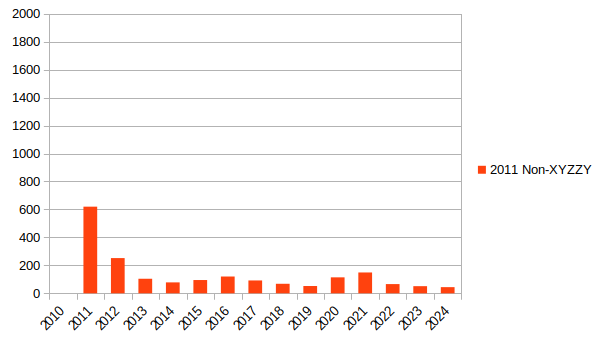
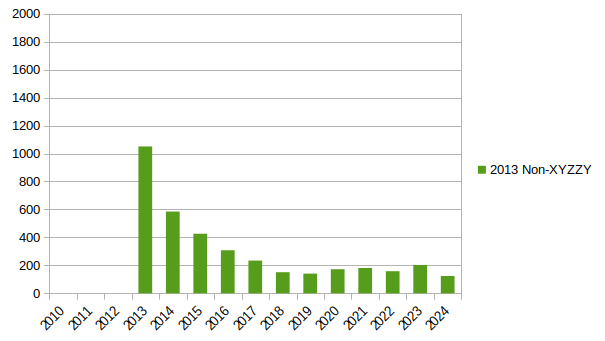
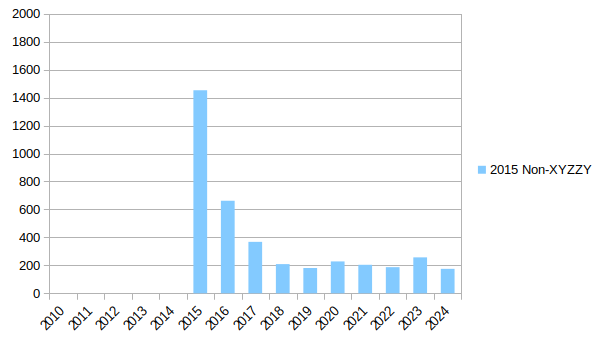
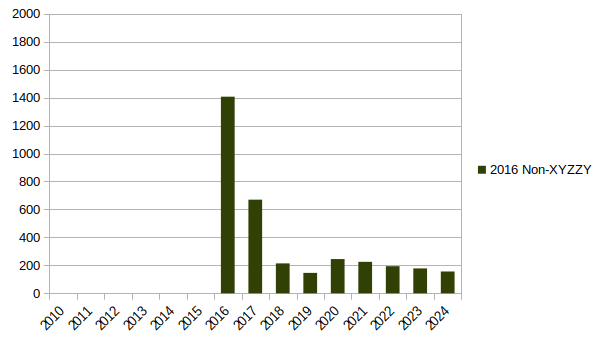
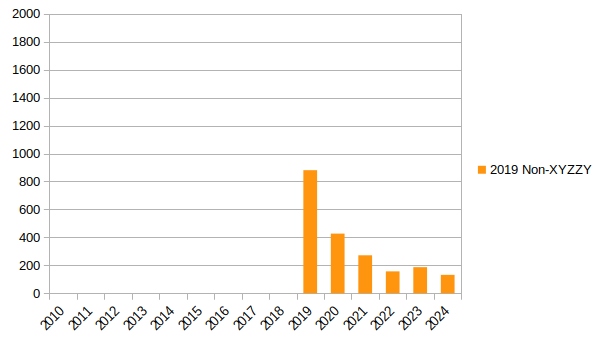
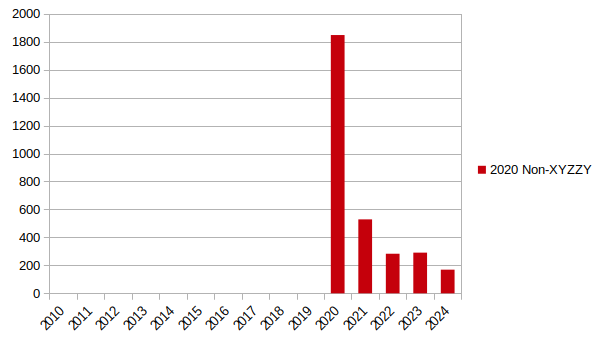
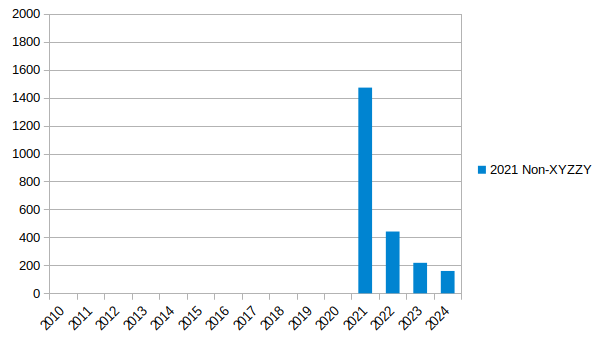
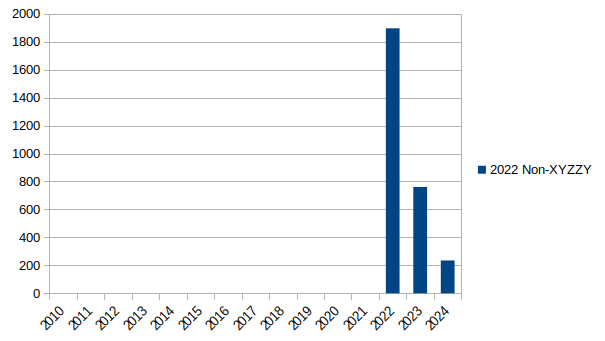
These are graphs showing the registered plays of games that did not win XYZZY Awards for the years 2010 through 2022. As with the series above, the scales have been homogenized for easier comparison, but note that the scale is more than 10x that of the previous series.
Obviously, there are many more games released in a given year that don’t win XYZZY Awards than games that do.
In this case, the peak number of plays is always the year of release. The peak is about 600 for years 2010 and 2011, but it starts climbing relatively rapidly after that, adding around 200 per year from 2012 through 2015. 2016 is slightly less than 2015, then there is a sharp drop (about 400) for 2017, and another drop of 200 or so for 2018. 2019 is a slight uptick, but 2020 is a massive increase, approximately doubling from around 900 to around 1850. 2021 falls back down to about 1500, but then 2022 is another jump up to around 1900.
I’m not including charts for 2023 or 2024 because there are no comparison graphs in the first series above, but the total plays takes another huge leap in 2023 to about 2900, which is off the scale for this series. (2024 is slightly less at around 2800.) Note that since no games have been awarded XYZZYs for those years, these numbers should be lower, i.e. plays of some games should move out of those totals and into graphs for XYZZY Award winners of 2023 and 2024. Nonetheless, the total plays (for both XYZZY Award and non-XYZZY games) has clearly seen a very large increase in recent years.
Weight of a Soul had its first chunk initially released in IntroComp, and I guess the full release wound up just updating that IFDB page rather than creating a new one - no causality inversion here, alas!