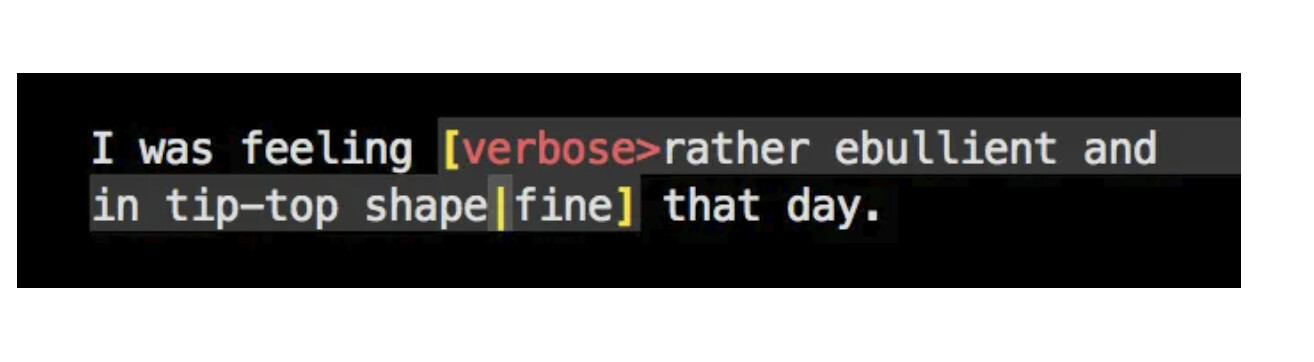
What to say… maybe the most honest expression could be… touche.
I really agree that Ink is one of the systems that gets very close to feeling like writing rather than programming.
Where my experiment differs is less about the syntax itself and more about the mental model of the workflow.
Ink still asks the author to think explicitly in terms of branches, diversions and structural constructs while writing. What I’m trying to explore is whether it’s possible to keep the narrative readable as continuous prose while a separate behavioural layer determines which fragments are revealed to the reader.
So the branching still exists, but the author doesn’t necessarily have to express it directly in the text while writing.
Regarding the interface friction that you mention: that’s good feedback. The current prototype is maybe a bit rough from a UX perspective, and I’m learning a lot from comments like yours about where the workflow feels heavier than it should. I’ve got inspired from Googledocs, and Ms word.
My goal isn’t really to compete with Ink’s writing experience (I wish I could even dream with playing that league), but to explore whether a different separation between prose and structure might open the door for writers who naturally think in scenes rather than in branching logic, maybe opening the community that is afraid of not being able to get an interactive work done.
If an interactive story branches, but the reader doesn’t interact, is it really interactive?
Seriously. I get the whole “you don’t play the story, the story plays you!” sort of Silent Hill:Shattered Memories thing, and I know the “your play through is canon” play-style if you don’t go back for a replay to see how it changes. But my takeaway with this was mainly frustration. “PC, you just spent the entire first half of your day exploring your home, a flea market, discovered all sorts of interesting things without my input, and now you need me to choose whether you go right or left in a hallway junction?”
I played on a computer, so “swiping” I guess equates to click-drag, which isn’t a common desktop browsing gesture for “continue” when you have a mouse button. I was hammering on the icon in different ways - I guess when It finally progressed I must have moved the mouse while holding the button. A simple [continue] button or “swipe to continue” prompt would probably help. Unless you plan this only for mobile touch devices.
Well… that is a good question and I think you’ve identified the main tension in what I’m trying to experiment with.
Decadence intentionally places a lot of the player’s influence in earlier moments (character creation, reading behaviour, restart patterns, etc.), so by the time some scenes unfold the story may already be diverging in ways that aren’t immediately visible.
What you feel about perceived agency is an important one. Even if the system is adapting behind the scenes, the reader still needs to feel that their presence matters in the moment… that is a decision for Decadence, the way I chose to write it. Maybe to much disruptive.
is something I’m still actively learning while writing the story.
So feedback like yours is perfectly useful for figuring out where that balance is currently failing.
Maybe if I add more exploratory agency, that change that feeling…
I guess I just really don’t understand how your system, which still expects the reader to explicitly think about adding “choices” and “scenes” and “alternate text,” actually offers a mental model that differs substantially from Ink. It seems like a more cumbersome interface for a conceptual structure that, under the hood, is almost exactly the same.
I think the confusion may come from the fact that the current prototype exposes some of the same concepts (choices, alternate text, etc.) that exist in systems like Ink
My point: In Ink the author expresses the branching structure directly while writing: the text itself contains the diversions, nested branches and structural logic.
What I’m exploring is whether the narrative can exist primarily as continuous prose, while a separate behavioural layer determines which fragments are revealed based on state, reader behaviour, or earlier choices.
So the branching still exists, but the author doesn’t necessarily express it directly in the text as they write.
The current UI definitely still exposes too much of the underlying mechanics — which is something I’m actively trying to simplify.
At the moment the tool is more of a laboratory for that idea than a finished writing environment. Not sure if I am explaining it correctly
It kinda seems to me like you have a high-level idea about “continuous prose” and a “separate behavioural layer,” but you do not yet actually have a concrete vision of what that would look like in practice, or at least not enough of a concrete idea to actually embody it in software. And the consequence is that there is a disconnect between what you keep saying you’re trying to do and what the current experimental tool actually does.
That was hard to listen, probably fair, and for sure honest. I appreciate it.
You are probably right, but I would like to make a bit of defense here.
I know what I want, and I thought that I was achieving it, probably because I am developing the tool for the kind of book I am trying to write, and that way always seems to be a perfect fit. It is quite difficult to figure out how it looks like in practice without other opinions and experiences. The closest I can be of that is opinions like yours, and other users feedback I have collected. The perfect situation would be having both, a pure IF writer writing a book with my tool, and giving continuous feedback, and requesting for changes, an a “normal” writer doing the same. That would be the inflection point for quick growth of variant.
As I am a single man for thinking, writing, testing, developing and back to the beginning I am probably contaminated by myself.
So discussions, opinions, suggestions like what we are sharing in this post about structure and ways of understanding what IF is or not, plus feedback from users is the best way I have to learn and evolve.
Many years ago, I had some working sessions (experiments, really) with various writers – some established (including multiple published novels), others new on the scene (a few self-published works) – and I had them working with Inform 6, Inform 7, and TADS 3. Primarily, however, it was Inform 7. And what you’re saying here is exactly what the vast majority told me as well. They could never really get behind the current crop of IF systems.
I should note this included screenwriters and others of that ilk (we did a lot of moral premise work), including one well-known director who was potentially curious about the idea of a new “Zork” game in the context of his “Mystery Box” philosophy and who tried to buy the Infocom brand.
At the time, the general consensus was (and I’m putting most of this in my own words, but I believe accurately conveying the sentiment) that the difficulty lies in the fact that most interactive fiction systems demand that a writer also be a cartographer and a physicist before they are allowed to be a storyteller. When an author sits down at a blank page, they are usually chasing a sequence of emotional beats, like the way a character’s realization mirrors the dimming light in a room. This is as opposed to the specific containment logic of whether a brass lantern is a member of the class of portable objects.
For the writers I worked with, the friction was almost entirely structural. Most of these systems require the world to be “compiled” into existence before the narrative can inhabit it. They felt it’s a process of building the house, plumbing and all, before you’re permitted to describe the conversation happening in the kitchen. But a novelist or a screenwriter, as was pointed out to me numerous times, typically works by following the heat of a scene. They want to capture the dialogue and tension first, and only later, once the narrative trajectory is clear, do they care whether the door to the north is locked or whether the player needs a silver key to proceed.
What I found is that this created a fundamental cognitive dissonance. So, I agree with you, at least based on these experiences: the natural flow of storytelling is often a straight line that only sprouts branches once the trunk is strong enough to support them. When you force a writer to define the branching conditions at the same time they are trying to find the character’s voice, you effectively split their brain between the creative and the systemic.
The director I mentioned found this particularly frustrating. His “Mystery Box” approach relies on the power of the unknown and the evocative nature of the unseen, yet most development environments require every “box” to be explicitly defined, coded, and bounded from the very first line of text. It was described to me as like trying to paint a masterpiece while simultaneously being asked to explain the chemical composition of the pigment and the exact tension of the canvas. For those used to the fluidity of the prose or the screen, the rigid, object-oriented (and even rule–oriented) nature of traditional interactive tools felt less like a medium and more like a cage.
Anyway, my post is a distraction from the thread, and I apologize, but all of this is bringing back memories! And I’m very intrigued by the solution you are working on and trying to determine if this would have worked better in the context I was in.
Wow… Jeff, this is a really insightful comment.
What you describe is very close to the friction that originally made me to experiment with this idea.
I was feeling that I needed the whole model to be built first, and only after that, let the narrative to fill it.
What I’m trying to explore is almost the opposite direction: letting the author follow the energy of the scene first — writing in a continuous way — and then allowing a structural layer to determine applying conditions, effects, and different mechanisms to modify/adapt the narrative experience.
So the branching, conditions, choices and structure still exists, but it doesn’t necessarily have to be defined at the same moment the author is discovering the voice of the scene.
PD: let me add that if you are interested and would like to investigate the tool or approach I will be really happy to give you answers, support,and questions
Huh, that’s interesting! I do sort of wonder if that attitude is part of the reason why it’s such common knowledge in gamedev that most novel writers, screenwriters, directors etc. write and design fairly terrible games until they learn to let go of some of their rules and ideas and ways of working from other media though…
Also, @oldskultxo, I wonder if you might find Aaron A. Reed’s articles about his process for Subcutanean, a procedurally-generated novel. He talks both about creating a simple syntax that doesn’t get in the way of the flow of writing, and the tooling he built to verify the transitions between generated pieces, and so on. But he ALSO talks a bunch about the limitations he imposed on the project; the ways in which this approach partly worked because it was a novel and NOT a game. I’m thinking specifically of the following three articles from the whole index post that I linked above:
Interactive fiction appears simple on the surface, but is surprisingly complex underneath. I think this is why writers approach IF with much enthusiasm and then hit a wall quickly. And why many programmers approach IF head first and then soon realize that writing is a harsh mistress.
Interactive fiction authoring is trial by fire, I swear! The people here that carry the torch are a hardy, stubborn breed.
This is an extremely good point. The authorial muscles for interactive fiction are different from standard linear fiction specifically because the moment you introduce interactivity and choice you give up a lot of control over pacing. Screenwriters especially have pacing hammered in because you don’t want an audience to be distracted from what’s going on by minor details, but much of the enjoyment of interactive fiction is exactly that - having the opportunity to examine everything and soak up details that a movie or a book doesn’t have time for.
This is why a lot of classic IF (and many other types of interactive games) excel at narratives involving piecing together a story that already happened or working in the periphery of other major plot points. Games like PLANETFALL don’t occur during the inciting catastrophe with action set pieces; they’re set in the aftermath with the player quietly sorting through wreckage and clues to figure out what happened and how to fix it.
In a game with an action scene where an NPC threatens to kill the player, the author needs to figure out a reason the NPC can’t immediately act on their threat if the player decides they’re going to ignore the threat and continue rifling through drawers or crafting healing spells, or the author has to pull the dreaded “you have one turn to do something or you die” gambit that usually results in multiple reloads and trial and error that kills any momentum or tension the scene is trying to convey.
Action and pacing is a little easier to handle in choice since an author has direct control over what the player can choose to do at any given moment, but for high-stakes action choices, choosing wrong is less of a dramatic moment or an effective loss than it is “well, I need to restore and do the other thing, I guess.”
If you’re making an interactive video-story, the writing comes first to plan it out. Then making the videos, building the node-graph, defining the variables, playing through it, refinements, etc. - that’s not writing, that’s development and testing, or “implementation”.
If you wrote a speech then presented it, the two stages are clear, but if you stood up and made a speech off the cuff, well you wouldn’t call that writing. The tools don’t take anything away from getting some writing done, but if you sit down with a tool, start building something with no plan or writing to put into it, then it’s hardly fair to complain that the tool is at fault for getting in the way of writing.
That’s the space I’m aiming for: the point where everyone who wants to write IF converges, both writers with little or no programming knowledge and programmers who want to venture into writing.
Finding that balance is certainly difficult, but I think the “write first, shape later” approach is a good starting point.
On the other hand, what I am building is probably still quite rough when it comes to reducing the initial tension for both groups, but I believe I have a very positive evolution in mind that could move it closer to that goal and attract the attention of both worlds.
I will read not only those 3 articles, but the whole list! Super inspiring!
I have started reading A Minimal Syntax for Quantum Text, and it is absolutely awesome!
The problem I have been struggling with, is quite similar to the one he describes in the article. He wanted just writing, being creative, without thinking about structure or conditions…
On the other hand I still find this way of writing too difficult for people outside IF world…
I will go on reading all his articles, thank you so much @JoshGrams
He designed a format for the kind of writing he wanted to perform, and somehow I have done the same, but I couldn’t stop there and moved forward to build a tool that ensambles it while the format itself shapes the way files, and texts are generated.
when I started with the .iepub format I had something really clear, I wanted all logic rules outside the prose files.
I did it, and It ended up being imposible to manage the book…. and that is start of the story of the editor I am building.
Those articles have made my day! Thank you so much!
I find the complaint about plumbing rather strange. How do you even begin to write static fiction until you’ve done some worldbuilding? Sometimes a lot of it. Some writers make worldbuilding the whole point, and I’m not even talking about tabletop RPGs. Tolkien’s famous adage about drawing the map first still haunts the craft of writing.
Sure, interactive fiction is code, so you have to be a little more formal about it. But… y’all ever look at a movie script? Heck, in some ways it’s as rigid as Inform 7 source.
As a humourist I’m highly resistant to premeditated world building, especially as a starting point to crafting a story. I wasn’t aware of Tolkien’s quote, so I’ll put it here in case anyone else has missed it:
“I wisely started with a map and made the story fit.” — Tolkien
Compare and contrast Terry Pratchett:
"There are no maps. You can’t map a sense of humour.” — Terry Pratchett
Eventually, Pratchett did bow to pressure and collaborated on several Discworld maps with Stephen Briggs, but for a long time he resisted, because ”what if I suddenly had an idea for a new continent?” (paraphrasing his rationale).
A story tends to come to me as a vibe, a sort of colourful blob of possibilities with a particular “flavour”. Writing one is a lot like exploring an uncharted territory. I don’t want to know what’s around the next corner, I want to be surprised, and if I’m surprised, hopefully my readers will be, too.
I love the different ways of understanding the creative process that are emerging in this thread.
I don’t think there is a correct or an incorrect one — they simply represent the different ways a writer can create.
From my point of view, as a software engineer I naturally tend to mix both worlds.
Before I even open an editor, I sit down, think, sketch some diagrams by hand… In other words, I do a minimal design of the system I want to create — what we usually call an MVP (Minimum Viable Product).
Once that is designed, I start writing it, implementing it, testing it… until I reach a result that convinces me.
Applied to an IF work, and looking at it from the write first, shape later perspective, this would be equivalent to writing a scene in a happy path, mostly static (or almost static).
Once I have this MVP, I begin the iterations and start shaping it.
In the comparison I’m trying to make, this is the point where I would begin introducing user choices, alternative text, conditions, and so on.
At this point, after writing and after giving it structure with logic, it would no longer be an MVP — it would have evolved.
If during this process I get an idea or inspiration, the initial design does not bind me to anything, because I never defined a strong and rigid structure.
I can shape it as I go and modify it freely.
However, if I had locked down the entire structural design from the beginning, I would in some way be self-limiting my creativity.
This is definitely the territory I want to explore further.