Ingenuity: the quality of being clever, original, and inventive.
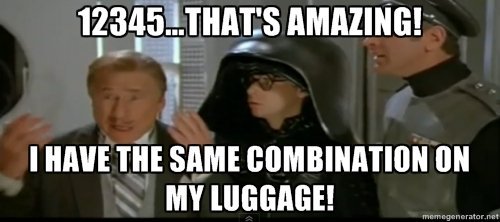
I think assuming 12345 as a probable combination requires some level of critical thinking. It’s also a culturally learned thing, like “sometimes the simplest answer is the right one”.
Ingenuity: the quality of being clever, original, and inventive.
I think assuming 12345 as a probable combination requires some level of critical thinking. It’s also a culturally learned thing, like “sometimes the simplest answer is the right one”.
@Mike_G
I think I understand where you’re coming from though. Is a Rubik’s cube a puzzle?
It’s a non-abelian group. If groups are puzzles, then physics is a puzzle.
If physics is a puzzle, a physics exam isn’t a puzzle. It’s a minigame.
See also: Like a Dragon: Infinite Wealth [RGG Studio, 2024].
So basically a question can either require logic or ingenuity to answer. When the author’s intent is for ingenuity to be used to answer it, it’s a puzzle.
Is that a good way of looking at things?
Worst. mini-game. ever.
Absolutely.
Hmm, I still feel sudoku is a puzzle, but doesn’t require ingenuity. I do think there is a requirement for a puzzle to be solvable via knowledge, logic, or other means without exhaustively trying each possible answer. Note, some puzzles may require trial and error in order to acquire knowledge to solve, without requiring a completely exhaustive search. That still doesn’t sound like it is enough to disqualify a quiz from being a puzzle.
How is a puzzle not like a quiz?
It comes down to the solving process. A puzzle isn’t just a problem and an answer, it’s a problem, an answer, and a (cognitive and sometimes physical) path to get to the answer. The specifics of the path give it its puzzlehood. The form of the question (sudoku, a Rubik’s cube, an arcade game, a quiz) does not.
I agree not all obstacles are puzzles and will go a step further and say not all puzzles are obstacles(e.g. consider a puzzle that is completely optional and all you get for solving it is the satisfaction of solving it, it doesn’t unlock any bonus areas, open any shortcuts, or provide any optional equipment that makes other parts of the game easier).
Whether walking is an obstacle, I think we have a paradox of the heap situation. Taking a single, unobstructed step is no obstacle, but walking a thousand miles along an unobstructed, unbranching path is an obstacle, and it’s hard to say where the boundary lies. Granted, this is a real world notion of obstacle, if we were trying to axiomatize Interactive Fiction or computer games in general, perhaps taking a single step or some other atomic action would be treated as a trivial case of an obstacle.
And while I do think brute force is a valid solution strategy for a puzzle, I do think a puzzle that could realistically be brute forced by a human player without computer assistance is rather weak and that it’s generally poor game design to include a puzzle where brute force is the intended solution.
Not sure quizzes and puzzles are non-overlapping sets, though I’ll admit it’s hard to say where the boundary of puzzle lies. A question where you’re just stating some fact of the game world that any casual player would know or where you mechanically solve a math equation provided doesn’t feel very puzzly, but a question where you have to make a logical deduction based on several facts or have to figure out what you’re being asked to calculate and how to setup the equations does feel puzzly. And while multiple choice certainly drops the challenge and opens up a potential brute force path if there aren’t many questions and little cost to failure, I don’t think that automatically renders a question not a puzzle, especially if several of the wrong choices are the result you’d get from a faulty train of logic.
And yeah, semantic arguments can be a total pain in the anatomy… and I suspect we might have several notions of puzzle that are so intertwined that it’s hard to pull a “If a tree falls in the woods and no one is around to hear it, it still generates vibrations that travel through the air, but those vibrations don’t encounter an ear to turn them into hte perception of sound”.
I’m sympathetic to but skeptical of this approach, as it seems reduce the definition of a puzzle to be “merely” a thing that obfuscates its mechanics.
Basically the problem, for any formal taxonomy relying on the structure of the solution to categorize things, is that (non-trivial) puzzles that are solvable at all are (with a few minor quibbles, like maybe riddles, bar bets, brain teasers, and other things that rely on wordplay or rule lawyering for their “solution”) solvable algorithmically. And most (and perhaps all) non-trivial problems that are solvable algorithmically are isomorphisms of each other, mod at most a polynomial time reduction.
Exactly. That’s why I didn’t say, “A puzzle is a problem and an answer, between which at least one path exists.” I said a puzzle is a triple of problem, answer, and a particular (cognitive, not specifically logical) path to that answer. (And I did not say that all such triples are puzzles.) My main point is that it’s the properties of the path that will have the most bearing on its puzzlehood, or at least that trying to characterize puzzles by the properties of the “problem” portion is leading mostly to counterexamples.
I was trying to follow the train of logic from @jbg, but they’re using big words and my brain melted a bit. 
I guess I’d say a puzzle is not like a quiz in that the puzzle aims to confuse it’s audience.
I think you either have to accept that either a) the “cognitive” path collapses to the “logical” path or b) the thing that one might externally believe to be a puzzle is in fact a potentially arbitrarily large number of puzzles, dependent entirely on the number of people trying to solve it.
The latter has a sort of Deleuze and Guattari air of whimsy about it, but it strikes me as basically a concession that the taxonomy problem is intractable.
Or you have to accept that puzzles have authors, or at least curators.
That’s a bit like saying there’s a potentially arbitrary number of platonic solids depending on the number of people trying to roll for damage. Depending on the properties needed to satisfy the definition of a puzzle, the number of puzzles for a
a given problem and solution might be non-whimsical.
That’s roughly equivalent to what I said: Picking a solution from a set of choices, where there must be a way of making the correct choice without an exhaustive search of all possibilities.
Ah, but what are the specifics that lead to puzzlehood above and beyond the barebones definition above?
I’m not sure that I understand what distinction you’re trying to make here. In this rubric is, for example, Tower of Hanoi in a Professor Layton game and Tower of Hanoi in Knights of the Old Republic two different puzzles? So the “cognitive path” that’s different between them is because they represent two distinct instances of a the same general class (or whatever word you’d want to use here) of puzzle? That is, in one case you’re moving pancakes and another you’re moving energy…well I’m not sure exactly what they were supposed to be but they’re definitely energy widgets of some sort…and that’s enough to make it a different “puzzle”?
No it’s not. The obstacle is the desert.
Puzzles <—> Quizzes
It’s a spectrum.
Problem solving, pattern recognition, deduction, and memory can be parts of both quizzes and puzzles.
Pure puzzles are self-contained with regard to knowledge of the solver, e.g. sudoku.
Pure quizzes rely on pre-existing knowledge, e.g. history test.
Where on the spectrum something falls depends on how much prior knowledge the solver needs, e.g. crosswords are puzzles requiring outside knowledge, math quizzes can require problem solving, pattern recognition and deduction.
For a person who has solved a puzzle, the puzzle shifts to the quiz end of the spectrum by an amount determined by how much of the solution is memorized.
40 Replies
W h a t
I s p u z z l i n g, e v e n ?