We just passed the 30th anniversary of the final Calvin & Hobbes so I’ve been rereading all my C&H books
5 Likes
Really? That’s crazy! I love Calvin and Hobbes. I should reread them…
Yeah, the final strip ran on December 31, 1995. I remember it making the news at the time.
Perfect time to get out my Calvin & Hobbes collection and reread it front to back. Perfect weather too: rainy and foggy.
Demon in White. Book 3 of Christopher Ruocchio’s Suneater series. Space opera at its finest. Galaxy scale politics, all out war, a library at the edge of known space. And a reluctant hero in the midst of it all.
And man, Ruocchio knows how to steal.
-Lightsabers (“highmatter swords”) and AT Walkers → Star Wars
-Personal shields to stop high velocity slugs and high energy beams → Dune
-Flying allies lifting the heroes out of harms way → LOTR
-There’s even a giant armored crawling drill to burrow through the city wall ! → Avatar: The Last Airbender
And somehow it all fits instead of feeling like a rip-off!
Two young Cree Native Americans volunteer to go to the Great War together. From their homeland in Canada, where their culture is being torn apart by the growing influence of the white men, they travel to the battlefields of Flanders.
Deeply moving historical novel by Joseph Boyden:
3 Likes
I was just browsing at the Center for Fiction and found a Katherine Dunn novel I hadn’t heard of before: Toad. It’s very different from Geek Love, her masterpiece–Toad is a realistic, desultory novel about 1960s-70s burnouts in Portland, Oregon (U.S.). But the writing! I’m only 30 pages in, but her sentences already have the same magic that hers do in Geek Love: an inimitable mix of caustic succinctness and wild, extravagantly purple prose.
Anyway, I’m in. I bet some of you here will really enjoy it.
2 Likes
I’ve been reading the Leonidas and Cassia mysteries by Ashley Gardner. They’re about an ex-gladiator in Nero’s Rome. Some nice details about Roman life, and “will they, won’t they” tension with the main characters. I liked them enough to pay for the most recent entry in the series (the others I got from the library). They’re on the cozy-ish side.
2 Likes
I’ll have to check those out! Cozy(ish) mysteries and historical settings are two of my favorite things.
I ain’t a fan of too cozy books (though a little cozieness is nice for me). And I avoid “will they - won’t they”. But for this book I might make an exception because I like
- Historical novels
- Ancient Rome
- Criminal novels
And this book(s) seems to have some action, like fights (after all he’s a former gladiator and a bodyguard.)
I found more books which interest me, too, on the authors website. 
I read my first fanfic!
Embers by Vathara picks up the story of Avatar: The Last Airbender after the season 1 finale and progressively swings further and further away from the events of the cartoon. Most interesting is the exploration of the “real” consequences of the slaughter of the Fire Nation fleet by the Avatar at the end of the first season. It also delves deeper into the cultures, traditions, and history of the four nations.
I liked it a lot.
But I wouldn’t want to play a drinking game where one slams a shot each time someone says something “wryly”…
4 Likes
Used to be a voracious reader, not so much now and I usually look for lighter fare…
I did recently read, and thoroughly enjoy, Ella Minnow Pea.
As for C&H, obviously a timeless classic; and the recent anniversary also makes it relevant to check out Bill Watterson’s and John Kascht’s “The Mysteries”.
After, in twenty-five years or so, having read the complete works of Stephen King until the final Dark Tower volume; the complete Terry Pratchett, plus the Hitchhiker’s Guide collection; Frankenstein, Dracula, Jekyll and Hyde (the latter being one of my all time favourites); Moby Dick (THE all time favourite single book for me); a goodish number of Agatha Christie novels, plus a significant selection from Clive Barker (great horror writer, but even better fantasy writer); some Shakespeare plays; after all of that, I kinda shut down on reading, and these days I’m enjoying translated manga and light novels. I occasionally might reread my Sandman collection or Maus, or some oldies French/Belgian comics like Asterix, Lucky Luke, Gaston LaGaffe, and my absolute favourite: Achille Tallon. In their original french, there is an energy and vitality to these series that I just adore.
One wonders whether, reminiscent of Benjamin Button, I might have gone through age-appropriate reading backwards.
There were tons of great books in my “to-read” list that look like they’ll never be read now. I’m cool with that. I’m enjoying what I’m having at this time of my life. Currently getting in touch with my inner geek by reading “Goblin Slayer”, and “Gunslinger Girl” will follow after.
Oh, I mentioned Moby Dick was my all time favourite? Put it side-by-side with Nausicaä. Which I bought, read from cover to cover, then immediately reread again from the first page, which is something I’d never ever done. I may actually reread it soon. I’ve been getting that itch.
EDIT - For professional reasons, I’ll occasionally read an opera’s libretto. Not quite the same, but a not entirely unrelated experience. The most recent one was a translation of Tannhäuser.
5 Likes
Don’t know if you read back in the thread at all, but I just finished Frankenstein and Dracula (also read Jekyll when I was young)…
1 Like
I did, it prompted me to write my post. Like others, I found Frankenstein not to be at all what I expected, and Dracula to be much more in line with expectations (being surprised by the epistolary format, the whole “male camaraderie” thing which is so pervasive (the female characters, from my recollection, are almost as underdeveloped as Dracula himself!), and the fact that Dracula himself was essentially just a demon, a malevolent force; I had been conditioned by more modern writers to expect something a bit more interesting. But I suppose one must first create the great evil before others can think of giving him traces of humanity and/or relatability).
I knew the story of Jekyll & Hyde from numerous adaptations, and after reading the book, I just went “all those adaptations are wrong, grab the low-hanging fruit, and are overly-simplistic! This thin book is a treasure trove!”
BTW, I remember starting Dorian Gray; I don’t remember finishing it. It must not have resonated.
EDIT - The thread inspired me. I’m picking up Nausicaä again right now.
1 Like
I was never a big reader, but I managed to find an author, in Isaac Asimov, that speaks my language. I really enjoy going to thrift stores to find old copies of his books. Got quite the collection going now (3 years in the making) and I love completing a series with different print editions, and mixed hardcover and paperbacks (very eclectic looking). The old sci-fi art style for the covers gets you into the mindset of reading a vision of the future from a 1950s perspective.
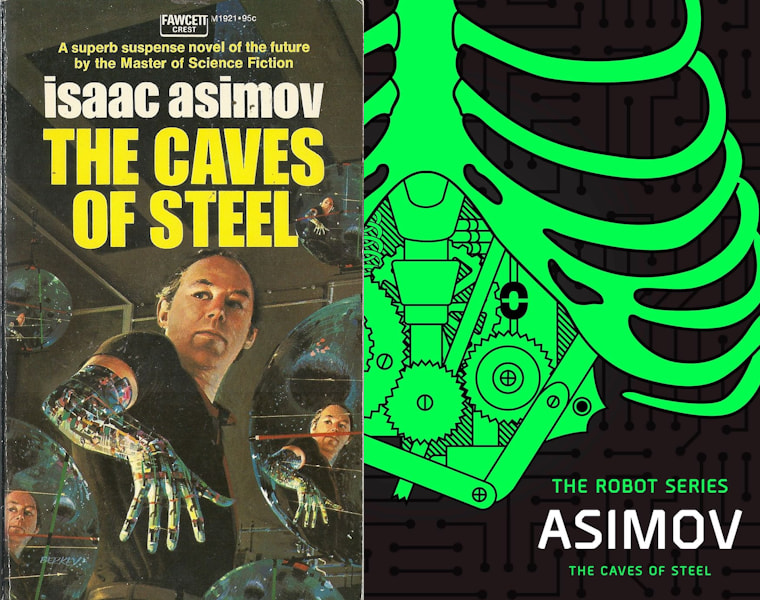
The newer print covers are sterile and criminally boring.
I recently read Nightfall by Asimov and Silverberg and I thoroughly enjoyed how it blended psychology, archeology, journalism, religion and academia with a world altering event. I won’t get into the plot, but I honestly think it would make for a wonderful movie. It has a similar energy to the movie The Island (2005). The first half is thoughtful, mysterious and fascinating, then the shit hits the fan in the second half.
I really enjoy Asimov’s writing style in how he avoids relationship drama and focuses on intriguing ideas. I feel like I’m reading Star Trek, while most authors seem to be writing Star Wars.
3 Likes
Strangely my local library has no book by Clive Barker. But I’ve heard or read about him in reviews. Didn’t know he wrote Fantasy, too.
I can’t stand the Gaston comics, the chaos he causes… 
I like Spirou and sometimes a bit of Marsupilami.
In my youth I’ve read nearly everything from Edgar Wallace (Exciting but not very great art) and Agatha Christie (She is a legend).
That’s very important for me
1 Like
Imajica, Weaveworld… and Galilee is a bit of an epic. I prefer these to his Coldheart Canyons and Hellbound Hearts.
1 Like
Can I get a direct link to Embers? TV Tropes anti-adblock prevents me from accessing their site even though I don’t have an adblocker installed.
Honestly, I’ve been curious about Agatha Christi, Terry Pratchet, and Isaac Asimov for quite some time, but have absolutely no idea where to start and understand all three are best known for universes that span many, if not dozens of books.
Asimov wrote a tremendous number of short stories, so a collection of those could be a good place to start. Personally I don’t think of him as a “universe” author primarily, even if the Foundation series, for instance, technically takes place in the same universe.
1 Like
For Pratchett, the obvious answer “read the Discworld novels in order” is… not at all what I recommend to a newcomer. The first two books, but even more so the first one, is only an inkling of what the series would become. In fact, the first one was meant to stand alone as a fantasy parody. It just then took on a life of its own.
But there are many early books that you can start from - and in fact, I think pretty much all of the books are stand-alone. Well, well later in the series it does become important to know about the Ankh Morpork Watch, and about the three witches, and other characters, and the various continents and races and… well, it’s a world. But it’s never overwhelming. Instead, it just gets more and more familiar. Anyway, it’s based on our world, so it’ll be familiar from the start…
Lemme see. I started by playing the Discworld game, personally. Some standalone books I would recommend would be Small Gods (my favourite), Monstruous Regiment (a later one), The Last Continent is quite enjoyable but you have to at least know about Rincewind and the Luggage and the wizards of the Unseen University (again, I got that knowledge from the games). Guards! Guards!, Mort, Equal Rites, Wyrd Sisters… that’s probably enough to get going. There’s plenty more stuff that’s good standalone, and I could just go on and name almost all of the books. But if you pick up any of these, or indeed any of the others, and go “Gee, I like this!”, then, my good sir, it will be time to dive - to DIVE, I say, headfirst - into the first book of the Discworld universe and then keep going from there (just be prepared for a slightly different experience. The first one is like that. The second one is a sort of transition. By the third one, though - Equal Rites - you can well and truly say it’s Discworld territory).
EDIT - The series matures as it goes on - not unexpectedly. For a taste of the direction it eventually starts to go, I would recommend “Night Watch”. To get the most out of it, it’s best to already be acquainted with the City Watch characters, but… I mean, I read it before reading Guards! Guards! (the first City Watch / Vimes book), and I loved it all the same. I had a vague idea of whom some of the characters were from the games.
Which is another point. If you jump around the timeline, it won’t really matter. There may be less or more characters around that you recognise, that’s all. The stories are all self-contained. Some characters get promoted, some characters get added to a roster, some characters you may recognise in cameos - yes, you will probably get the greatest enjoyment if you read in order, but it really doesn’t matter much. Like, you will probably enjoy “Maskerade” more if you already know who Granny Weatherwax, Nanny Ogg and Magrat are… but even if you don’t, you’ll get to know them soon enough, and the -Phantom of the Opera- setting is so familiar that it’s easy to get into.
2 Likes
For Agatha Christie, the connections between the different books are fairly minimal. Occasionally one story will refer back to another, but usually the only connection is that she has a handful of particular detectives who each solve a lot of different cases. Apart from that, each book is meant to stand alone, so you can really start anywhere you like.
Her two most famous books are Murder on the Orient Express and And Then There Were None. Both of them are excellent, but the former is more her usual style, the latter is a bit different in structure. I’d recommend starting there.
For Isaac Asimov, he only has a couple of big connected series; most of his books and short stories are disconnected, or only connected loosely to a couple others. Since I’m a big fan of the whodunit genre, I’d recommend starting with his mysteries; I’m especially fond of the Wendell Urth ones for building a fair-play mystery in a science-fiction setting. But probably my favorite of his books is The Gods Themselves, which is built around the premise of “what if aliens came from a dimension with fundamentally different laws of physics?”