I read the original Frankenstein this year too. Shelley was a skilled writer and I found a lot to enjoy/admire here: the nested narrative frame, the tragic-hero protagonist, the morally-ambiguous antagonist, and the settings that mirrored emotional states of the characters.
3 Likes
One of the most interesting things about Frankenstein, to me, is the fact that Mary Shelley started writing it when she was 18, and published it at 20. She wasn’t the average 18-year-old for sure. I’m looking at info online and it says her dad was a famous author who pushed her into writing and literature from a young age, and his connections helped get it published. She lived to be 53, but that one novel she wrote at 18 is the only thing most people know her for, and most people haven’t heard of her dad William Godwin at all. I hadn’t, at least, and I also haven’t read anything else she wrote.
1 Like
If you like original Dracula and original Frankenstein you’ll probably like “Strange Case of Dr Jekyll and Mister Hide” but iirc it’s short. Poe might also fit loosely into this kind of stories. And in this category of original horror stories one should not forget about Lovecraft.
I’m currently reading the German translation of Ruth Rendell’s Lake of Darkness, a crime novel from 1980. It is placed (and timed) in England of that year. One of the main characters is a man who struggles with himself because he detects homosexual feelings. In 1980 a more “controversial” topic than today. A further characters (which I consider funny) is man who does all the little work for a landlord, you know, like fixing the lightbulbs, repearing other stuff, murdering tenant (lol)
2 Likes
Interesting, thanks for this…
I believe I read Jekyll and Hyde as an adolescent, but I recall virtually nothing and it was probably mostly lost on me then.
I’m not strictly pursuing horror, either; Frankenstein was brought to my attention from a couple sources and reading it triggered a desire to know the classic origins of Dracula as well, because all I know/knew is the cheesy stereotypes of both. But I have to confess I’ve never read any Lovecraft, though I am now interested in doing so.
Overall, my life has undergone a years-long reading drought, and I’m ready to be reading again 
If I pick one Lovecraft title to read before moving out of my horror season, who wants to tell me what it should be?
A lot of his work is short stories, so you could read one or two of those quite quickly, but novella-wise I’ll put in my vote for At the Mountains of Madness. Set in Antarctica, so it’s very wintery, if it’s winter where you are!
4 Likes
Seconding the suggestion of At The Mountains of Madness. It’s my favourite Lovecraft story. Some years ago I read through the lot.
Two other shorter ones that I liked a lot are “The Doom that Came to Sarnath” (Dunsanian fantasy) and “The Outsider” (Poe like).
But yes, the Antarctic one is really strong, and a good representative.
3 Likes
Yeah, AtMoM is my favorite too - it is a novella though, so if you want something a bit shorter Call of Cthulhu is another classic with a lot of typical Lovecraftian tropes (but not too much racism, which is sadly also one of the typical Lovecraftian tropes. AtMoM barely has any though, which is among the reasons it’s good).
2 Likes
I haven’t read Lovecraft in a while, but I have fond memories of first experiencing his writing in middle school via Gregory Avery-Weir’s game, Silent Conversation, which was a bizarre little Flash game on Kongregate. It was a platformer where the platforms were the text of a specific story or poem, and you could jump on the words. All the background art and particle effects were also made of words, so if there was a passage about ominous howling wind, you’d hear the wind and see the words “howling” and “wind” blowing across the screen. The atmosphere and horror in reading Lovecraft that way was unmatched. But I was a dumb kid back then, so maybe today I’d just find it tedious.
The story was “The Nameless City”, not “At the Mountains of Madness”, though I think they’re vaguely similar in concept.
1 Like
Two history books, one fiction, one non.
→ Hope and Destiny by Niklas Natt och Dag is a historical fiction novel set in the year 1434 in Sweden. The Kalmar Union is falling apart due to internal frictions and external threats. Population numbers are still very low, not having recovered from the plague epidemic half a century before. Fields are bare of crops, watermills stand deserted along the river.
The Danish and German castle lords appointed by King Erik (and Queen Margaretha before him) rob the people of their livelihood with extremely high taxes. Those taxes are spent in the wars to the south, never benefitting Sweden in any way.
A miner’s uprising in the north gains support among the general population, and even among the nobility who are gambling whose side to take. The protagonist of Hope and Destiny is a young nobleman who befriends the leader of the miners to gain an advantage for his family in the struggle for power.
This protagonist, Måns Bengtsson, is the forefather of Niklas Natt och Dag. The author relies heavily on the actual historical and genealogical research by his wife into male and female lineages of the family tree as the scaffolding for his fictional tale.
Very intruiging mixture of history and adventure.
-Niklas Natt och Dag - Wikipedia
-Engelbrekt rebellion - Wikipedia
→ Wendy Wauters’ Geuren van de kathedraal (lit. translation: Scents of the Cathedral; I couldn’t find an English version).
Starting from the actual smells (wet dog, myrrh, badly covered graves stinking of decaying bodies under the church floor, juniper rushes and other fragrant floor coverings, your neighbour’s bad breath,…) that would have pervaded the cathedral in the late middle ages (15th-16th cent.), Wauters broadens the scope of her history to encompass the vivid, corporeal, sensuous religious experience in the life of the inhabitants of Antwerp. Wide overarching theme supported by many small anecdotes, some funny, some gruesome. A fascinating read.
3 Likes
Thanks for the overview! I too have read Robin Hobb for the first time this year (the Liveship Traders trilogy), and wondered how she stayed off my fantasy radar for so long. Fantastic books!
As usual, your list has given me some ideas for books to read, and you definitely nudged me into reading V.E. Schwabb as soon as possible.
Thanks again, and happy reading in 2026!
1 Like
The Yellow House by Mieko Kawamaki.
Tokio 1998-2000. A teenage girl leaves her mother to live with an unknown woman. They open a bar together. When they’re out of money, the girl turns to criminal activities. The ending twists the perception of what came before.
This is what happens in the book on the surface. The richness of the story is in what lies beneath the text. The reader has these few clues to construct an image of the characters’ inner lives, their history and how it has affected them.
Very strong.
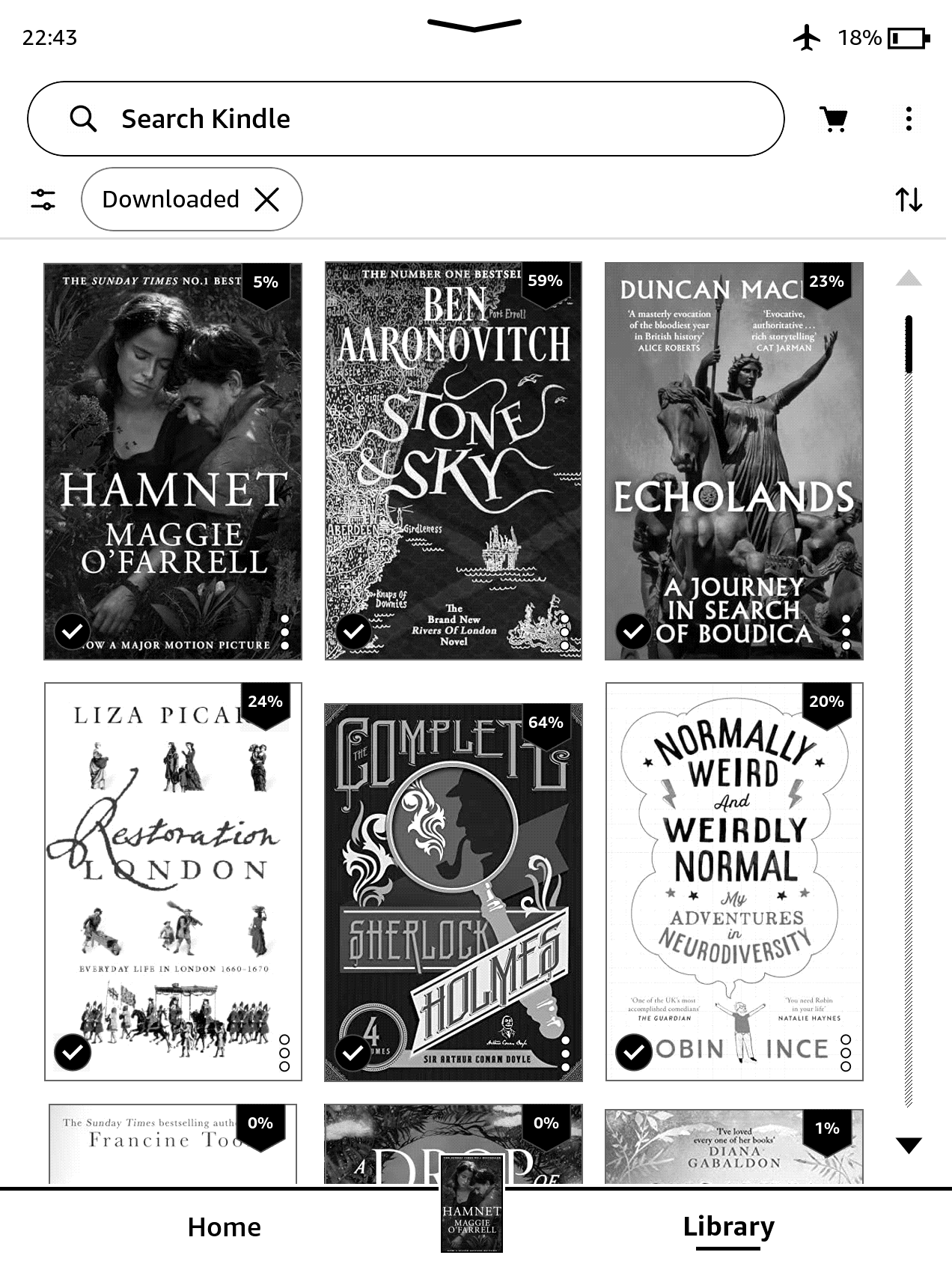
My current main reading, on my Kindle as usual, so I can have the gargantuan font (think old Ladybird learning to read books for the very youngest!) to counteract my neurological illness reading problems. Note I am reading all these books at the same time. I am flighty!
Alt text for the above picture
Screenshot of a Kindle Paperwhite, black and white / greyscale. A number of book covers are visible, showing books currently being read. On the top row are 3 book covers: “Hamnet” by Maggie O’Farrell (showing a scene from the film version with Jessie Buckley and Paul Mescal), “Stone & Sky” by Ben Aaronovitch (featuring a map of the area around Aberdeen, Scotland) and “Echolands: A Journey in Search of Boudica” by Duncan Mackay (featuring a statue of the legendary Icenean queen). On the row below that are “Restoration London” by Liza Picard, a “Complete Sherlock Holmes” collection by Arthur Conan Doyle, and “Normally Weird and Weirdly Normal: My Adventures in Neurodiversity” by Robin Ince.
2 Likes
I just discovered https://www.shedunnitshow.com/ so I’ve been on a classic detective novel kick this week:
- Agatha Christie: The Murder of Roger Ackroyd
- Christianna Brand: Green for Danger
- Ngaio Marsh: Vintage Murder
- Ngaio Marsh: Spinsters in Jeopardy
- Joan Cockin: Curiosity Killed the Cat
Just started Anthony Rolls’s Family Matters and then I’m probably going to (re)read A.A. Milne’s The Red House Mystery.
Dunno. Having fun.
5 Likes
First book of the year was Inventing the Renaissance by Ada Palmer. Explores the Renaissance through the lives of 15 people, and also about historiography, how the concept of a Renaissance golden age (as opposed to a previous dark age) came about and has been co-opted throughout history, how people’s ideas about modernity influence how they view the past.
Very engaging writing style, made me laugh several times, and the audiobook is phenomenal
1 Like
I spent some time in Victorian England.
First, I read James Wilson’s The Dark Clue. A dark and brooding mystery about a drawing teacher and aspiring painter who is asked to compose a biography of the greatest Artistic Genius of England: William Turner. The research for this work exposes the protagonist to the secretive scheming of London’s high society, and drags him down through the dredges of London’s darkest pauper alleys. His mind too is dragged into darkness during his investigations.
Most vivid and engaging novel. But very soon I got a feeling of familiarity I couldn’t shake. After some chapters it clicked: the atmosphere, the mood of The Dark Clue are very similar to those of Dan Simmons’ Drood. Some more research showed that both authors had drunk from adjacent sources of inspiration: Just as Simmons draws inspiration from Charles Dicken’s last stages of life, and the novel The Mystery of Edwin Drood that he was writing at the time, so Wilson adopts the main characters of Wilkie Collins’ The Woman in White to drop them in a sequel set a dozen years later.
So I decided to read Wilkie Collins book immediately after The Dark Clue.
The Woman in White appears on lists of “Best Books in the English Literary Tradition”. And I get it. The language is delicious, the plot is intricate and engaging, the sense of time and place is splendid.
But it does put a lot of strain on the modern reader. (based on carefully sampling the opinion of 1 reader, myself).
Not because of its overly elaborate prose, mind, I quickly adapted to reading a bit slower and tasting every bit of that archaic twist. No, it was because of how strongly people were bound by deeply engrained standards of propriety, norms, and etiquette. Oftentimes, I would almost shout at the second main character, the protagonist’s sister in law. “Get on with it! Never mind your manners, just kick him in the shins and run away!”
So yes… While I enjoyed it very much, a serious case of values dissonance sometimes made me read it as a historical document about cultural oddities of the past, rather than as the believable thriller I assume it must have been in its day. (Although I wouldn’t be surprised if Collins leaned a bit heavy on the mores of his own day to produce precisely this effect, akin to how girls in modern horror movies still like to go to the dark attic on their own.)
3 Likes
I’m listening to the German audiobook of "The Pirate - a Francis Drake Novel” by Mac P. Lorne. Not bad. Good story telling/arrangement (I mean the plot etc. not the voice.). I’m normally not an audiobook fan.
Also rereading Harry Potter. When I did read it the first time I was always wondering “Why?” And now it’s fun to understand this time what’s going on.
2 Likes
After finishing Frankenstein I went on to Dracula. Where Frankenstein was nothing like what I had expected (in a good way), Dracula was more so in the “expected” range in that there seems to be more purposeful focus upon the horror and suspense. The whole story is told without an author/narrator, but is rather presented as a series of either diary entries made by some of the characters involved, or written communications between some of the characters, or newspaper extracts of events that impact or make up part of the story. I enjoyed going through it, but it’s not up in the top tier of my recommendations.
Following that was The Picture of Dorian Gray by Oscar Wilde. Interesting and thought-provoking and mostly sad; again no regrets taking the ride even if it’s not on the all-time favorites list.
Now nearly finished with The Man Who Was Thursday by G. K. Chesterton; can’t speak as to the ending, but I think I’ll walk away with the same sensations as Dorian Gray: interesting, and the writer does some things that are neat/clever or out of the ordinary, but overall falling short of high impact.
5 Likes
I shied always away from this because I understand the moral of it very well right from the beginning. So I assume the story will bore me. Like “I get it. Enough!”
1 Like