This is question might be related to Switch-style condition list causes error - bug or not? although that problem appears to be related more to using properties.
But my intentions are the same here: ascertaining if this is a bug or not.
The following code compiles and works as expected:
Lab is a room.

To display it:
	if current action is fooing:
		say "You tried the fooing action.";
	else if current action is barring:
		say "You tried the barring action.";
	else:
		say "You did not try fooing or barring.".

Instead of display-action:
	display it.

Fooing is an action applying to nothing.
Fooing is a display-action.
Understand "foo" as fooing.

Barring is an action applying to nothing.
Barring is a display-action.
Understand "bar" as barring.

Bazzing is an action applying to nothing.
Bazzing is a display-action.
Understand "baz" as bazzing.
But this code:
Lab is a room.

To display it:
	if current action is:
		-- fooing:
			say "You tried the fooing action.";
		-- barring:
			say "You tried the barring action.";
		-- otherwise:
			say "You did not try fooing or barring.".

Instead of display-action:
	display it.

Fooing is an action applying to nothing.
Fooing is a display-action.
Understand "foo" as fooing.

Barring is an action applying to nothing.
Barring is a display-action.
Understand "bar" as barring.

Bazzing is an action applying to nothing.
Bazzing is a display-action.
Understand "baz" as bazzing.
Results in the following compile error:
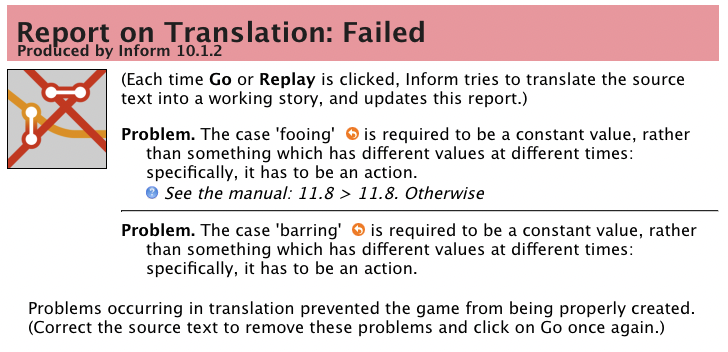
It seems odd that one works and one doesn’t. Especially when the error has the text “specifically, it has to be an action”, since both fooing and barring are actions.
Am I missing something?