Not a very important comment from me here, but since I live in one of the European countries that’s not among the 27 EU member states (Norway), I feel obliged to point out that we also exist and that there are quite a few of us. (I have no idea what our threshold for sales tax is.)
3 Likes
I just checked, it looks like Norway has a threshold of 50,000 NOK (about $5,000) in sales. Much more reasonable!
…did I not also ask that?
Sorry, perils of skimming the thread, it didn’t seem to get answered, which is presumably why I though it hadn’t been asked…
This seems a bit of an odd choice, to say the least—even on, say, Webnovel you don’t need to login to view free chapters, and this seems like it could be a bit of a sticking point when it comes to attracting readers from that sort of sector, if that’s what your aiming for. And IF readers do not seem likely to bite for this either—even CoG fans don’t need to login to anything to view the free demo of one of their games online.
This is more of a current limitation than a choice, I had built the character and variable tracking system with a dependency on some user data being stored in my database, but it sounds like it’s worth refactoring that to allow guest play throughs.
Is the opposite question—What does Twine, etc. make hard but this make impossible?—not also relevant here?
Sorry, I do plan to answer all questions, just got a bit overwhelmed with the response! I’ve only used Twine briefly and I’m not as familiar with it as with ChoiceScript, so I’m actually not sure! Keep in mind that I’m actively developing Storyfall so if people find limitations I can always make changes and improvements to the editor.
And even among the hypothetical demographic who do, one can imagine more easily their thoughts would be “I wish I could monetise my existing Twine games more easily” than “I wish I had to deal with a whole new incompatible platform just to monetise my choice-based writing”
Fair points. If there’s interest, and if it’s allowed (not sure what Twine’s license says about this as I haven’t looked into it yet), I could add an “Import from Twine” feature.
As far as monetization, Storyfall for me isn’t just a way to make money. I genuinely wanted to build a modern and easy to use editor and marketplace where writers could publish their stories. If all that ever happens is a few stories sell, enough to cover hosting fees, that’ll be fine with me. It’s as much a passion project for me as writing stories that never monetize is for writers.
So I am completely fine with people just using the platform and having their stories out there for free if that’s what folks want to do.
2 Likes
(Disclaimer: I am not a lawyer)
At least in the US, you can’t copyright a programming language—you can copyright a compiler, and the exact wording of a specification, but the actual syntax is not eligible for copyright. (It’s also usually not innovative enough to be eligible for a patent.)
Which means you always have the legal right to make a program that take Twine source code (or Ink or ChoiceScript or…) and converts it to your format. And if someone did try to prevent that in some way, the result would be IF authors abandoning that platform in droves; as a community, we’re quite fond of having the rights to our writing, and that includes the right to take it somewhere else!
(This is especially important when so many promising IF platforms have died or disappeared in the past. If Choice of Games got hit by a meteor tomorrow, obliterating the whole platform and everyone and everything involved with it, it would be a lot of work for authors to rewrite their ChoiceScript projects in a new system—but it is legally and practically possible, and that’s reassuring!)
That’s not to say writing a converter would be easy by any means. But you still have the right to do it.
6 Likes
The Twine software itself is open source, free software, under GPL. The specifications for the file formats don’t have a license (they could’ve been released under a CC license, maybe), but they’re openly available on GitHub, and like Daniel says they should be free to implement.
3 Likes
For all of these new platforms, I always have the same question - who is the audience? If you’re just building something because you love it then go for it. If you have no idea who the audience will be and are expecting to make any money at all, then that’s more hope than a plan. Is your audience the current IF audience? Why do they want or need another platform, and will this audience even be enough to make your platform successful? Is it someone else? What makes your platform so different from current IF platforms that it is going to attract new people who aren’t attracted to the current platforms? This is why so many platforms and tools and language emerge from games - a game becomes popular and finds an audience, and this generates an ecosystem around them. I feel like people look at something like tiktok and think they can translate its success into some other field, but I’m skeptical.
5 Likes
Yeah so it looks like you’re right about Twine, but I think with ChoiceScript it’s different. I believe they have a license that requires you to only use what you produce for non-commercial purposes, i.e. if you created something with ChoiceScript you can’t then go and monetize it somewhere else.
I’m going to add building a Twine import tool to my list!
I hear what you’re saying - I actually considered pivoting to a subscription model where readers either subscribe to Storyfall as a platform or buy some kind of “Storyfall credits” to overcome some of those fixed processing fees.
But ultimately this really isn’t what I wanted to build. I wanted writers to be able to build a proper writer-to-reader relationship, with all the tools (newsletters, subscriptions, forums) they could want, in a marketplace model; so I decided to stick to my original plan and just deal with the payment fees for now. Stripe does have custom pricing models that larger businesses are able to negotiate with them, so if I had some actual volume I might be in a position to lower those fixed fees and enable micro-payments.
There’s also the option of crypto, which has incredibly low-cost transfer fees for some kinds of on-chain payments, but even as popular as crypto is, I think there’s probably not much overlap between IF readers and crypto users, and it’s still largely a pain to use for most people.
2 Likes
I could imagine that there might be some demand for it as a secondary option considering relatively recent events—VISA/MC and game distribution platforms—but I suppose it would still be marginal.
Not quite: the license is for the ChoiceScript interpreter, the code that actually executes the ChoiceScript code. You can’t use Choice of Games’s interpreter to sell your game independently without giving them a cut, but if someone wanted to take their ChoiceScript story, rewrite it in Twine or Ink or Storyfall, and then monetize it on their own, they can do that—the author still holds all the rights to the actual story they wrote.
Now, they usually won’t do that, because if you want to sell your IF outside of Choice of Games, you’ll probably just write it in something like Twine instead of ChoiceScript in the first place. But it’s important that authors keep that right, in case of the aforementioned meteor strike! Platforms that don’t let you take your writing and go somewhere else with it don’t tend to be looked upon favorably here, because if they go under (as so many have unfortunately done), all that writing then goes with them. That’s not likely to happen with the IF world’s biggest commercial publisher, but, well, it didn’t seem likely for StoryNexus either.
Since the interpreter has these restrictions, of course, you have to abide by them if you want to consult the interpreter’s code to make your importing tool. But that’s standard fare for any sort of open-source project; if you build something with GPL-licensed code, you need to GPL-license the result, and so on. I imagine you’re already very familiar with that.
(That interpreter license claims it also applies to “code written for use with the ChoiceScript interpreter”, but if that’s meant to apply to the source code of games written in ChoiceScript, I’m pretty sure (again, not a lawyer) that’s not actually valid. In both the US and the EU, you can hold copyright to a compiler, an interpreter, or a specification, but not a programming language or a file format—these are considered ideas, not expressions of ideas, and ideas aren’t eligible for copyright. And thus, you can’t stop people from making derivative works of them. That’s why Microsoft can’t prevent people from writing open-source tools that convert .DOC files into other formats, much as they’d like to!)
5 Likes
I’ve figured out how to do proper quotes! Sorry for all my previous replies that weren’t properly quoting.
Can you tell me more about the editable templates you’d want? Right now Storyfall is automatically styling the reader interface based on the genre picked (out of 11 genres), and the readers can disable this if they just want plain styling. I was thinking I could let the writer pick which style they wanted for their story, and maybe even add more or add theming.
Storyfall already supports being able to skip the typewriter effect or change its speed, and already has dark and light mode throughout the entire site. These settings also persist for readers across different stories.
Okay this is interesting - I originally had an inventory system in the first iteration of Storyfall, together with findable items, a drag and drop grid, etc. but ended up scrapping that feature. What I have now is custom variables, NPCs, and factions.
Would variables be a reasonable substitute for inventories or would you want something specific to that? The map feature is interesting, I think having some image or set of images they can reference while playing the game would be cool.
Would the map be fixed or have some kind of pointer on it indicating location?
Right now there’s a very easy-to-reach export button which just downloads a file to your local machine. There’s no automation here though. I could build out a feature like this but I think it might be non-trivial, so I’d want to make sure it would get a reasonable amount of use.
So, you can kind of do this. You can export your story, modify it, then re-import it, though doing so would create a duplicate (rather than overwriting anything you already have). I hadn’t considered that people would actually want to do this, I could probably make this editable within Storyfall directly, but I think this opens up the risk of messing up your story. There’s a lot of validation that happens in my editor logic whenever things change.
I think my approach here would be that if you’re trying to do something not supported by the GUI editor, then I need to improve the GUI editor. If it’s supported but too complicated, I need to make it simpler. I think letting people edit the underlying source is kind of a cop-out for me as a developer, lol.
Modules and plugins is definitely one of those things I’d want to support, but would be pretty low down the feature list. I would need to have a decent user base of writers before I work on this because it would likely involve a lot of work and if nobody uses it, it would be a waste of time.
I appreciate the feedback and ideas, this is exactly what I was hoping to get!
As far as target audience, Storyfall isn’t just for writers trying to monetize, it’s for anyone who wants to write and publish IF. If it’s free that’s fine, I’ll just foot the hosting bill. Obviously the hope is that one day there’s enough monetized stories that I can quit my day job and focus all my attention on Storyfall, instead of doing this on evenings and weekends, but that’s okay if that doesn’t happen. I built this in part for myself as a writer too - I got pretty frustrated with the editors out there.
I’m a software engineer by trade and I still don’t really want to be writing code when I write a story. It breaks my flow. Maybe other folks aren’t like that, I dunno.
2 Likes
I’m not a lawyer either. I saw that the license seemed to apply to code written with ChoiceScript and assumed that was ironclad. I’m not sure if it holds legal validity. I also don’t particularly want to find out in court. My budget is basically $0 since this is a side project right now, so I can’t really afford lawyer fees.
I think I’d start with Twine as the safe one to add an import feature from and re-visit the legalese for ChoiceScript at a later date.
2 Likes
That’s fair! I imagine the number of people who want to convert ChoiceScript code to another language is fairly small, also, since the market for games via CoG is much larger than pretty much anything else will be.
Exactly - if you already have a game built in ChoiceScript, you might as well use Choice of Games to distribute and monetize it, they already have a huge audience.
Twine, which doesn’t provide any kind of distribution or monetization rails, would make more sense for me to target importing from first.
I’m still optimistic than over time, as writers hopefully create stories on Storyfall and publish them, the audience there grows, and keeping 60% of your revenue instead of 20% becomes a more attractive proposition. But we’ll see, that’s a tall mountain to climb still.
FWIW, i think you’re mistaken about being a "Marketplace Facilitator”. Firstly there’s a threshold and then there’s the definition itself. The concept is similar to the EU notion of a “platform”. A “platform” has a specific tax definition that’s not necessarily the same as you might think. You might think anything that sells digital goods is a “platform” or a “marketplace facilitator”, but it isn’t.
As i understand the US definition, it requires you to be a “facilitator of sales”. Which is defined to be taking the money and remitting the balance to the seller.
The platform collects the payment from the customer (e.g., processes their credit card) and then, after taking its fees, transmits the remainder of the money to the seller.
(see Marketplace Facilitator: The Ultimate Guide to Online Sales Tax Laws [US Law Explained] )
In the case of Itch, it does not do this if you opt for the direct sales. What happens is the money goes to the seller and a charge made back to itch. Note the word “after” in the above definition.
Someone else might know the US situation better than me.
1 Like
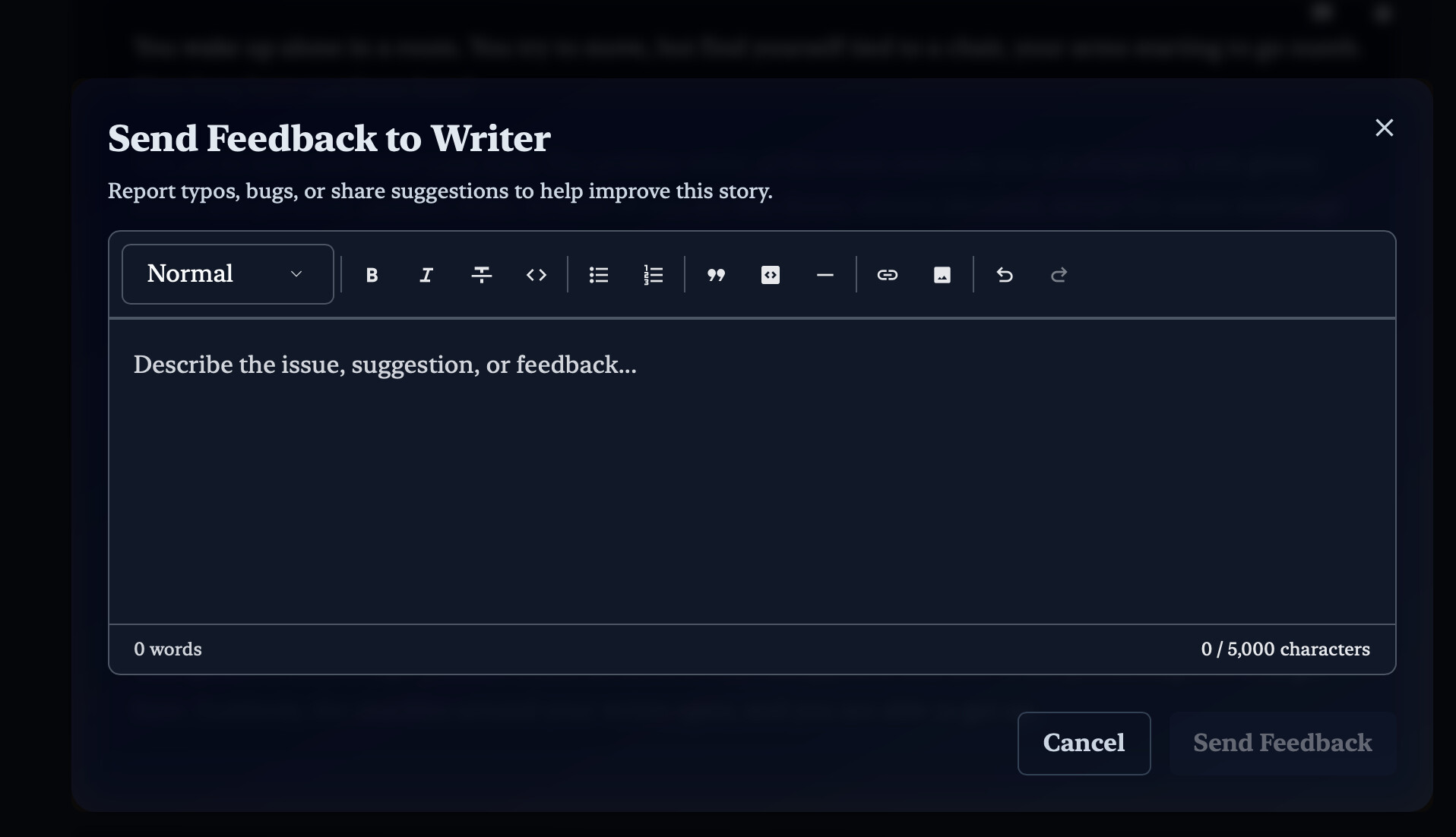
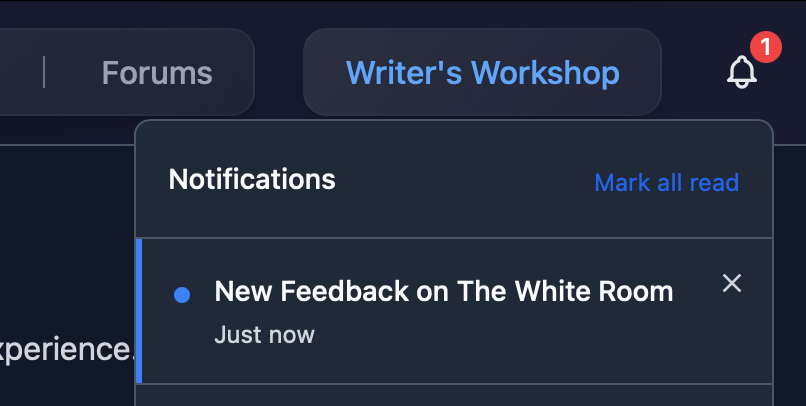
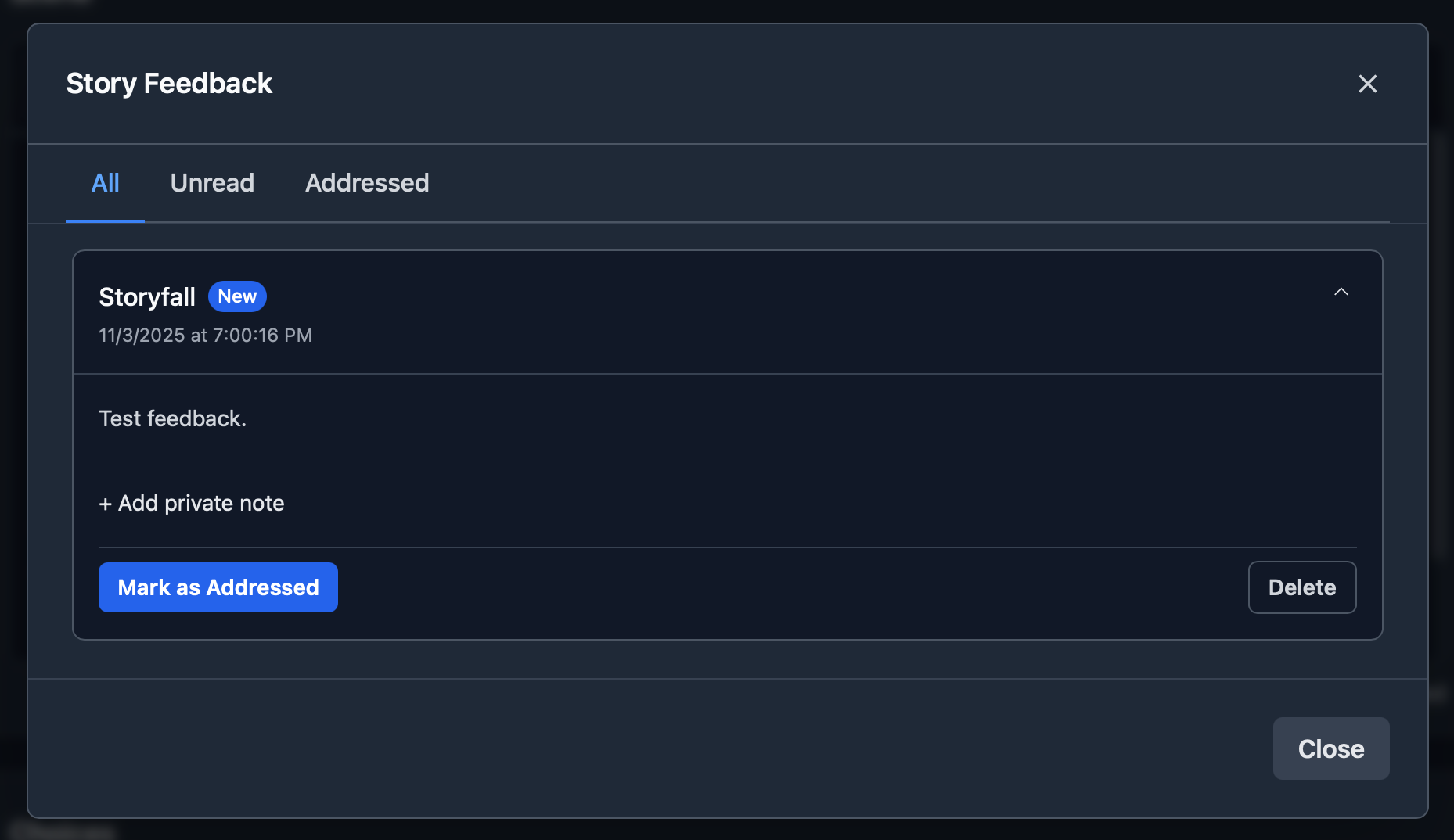
I just added a feedback system. Readers can now submit feedback directly from the game page and writers can see it in their editor. They’ll also get a notification and an email (unless they’ve disabled those in their notification settings).
Today’s updates also:
- Fixed the restart modal text to be a lot clearer (thanks for that feedback!)
- Added the “Export” story button to the settings modal too, so it’s hopefully easier to find now. It’s still in its old place as well.
- I realized a gap in my NPC and Faction logic and added a way to set those as discovered by default.
- Cleaned up the NPCs and Factions UIs a bit in the stats page.
To send feedback, click the little message icon in the top right.
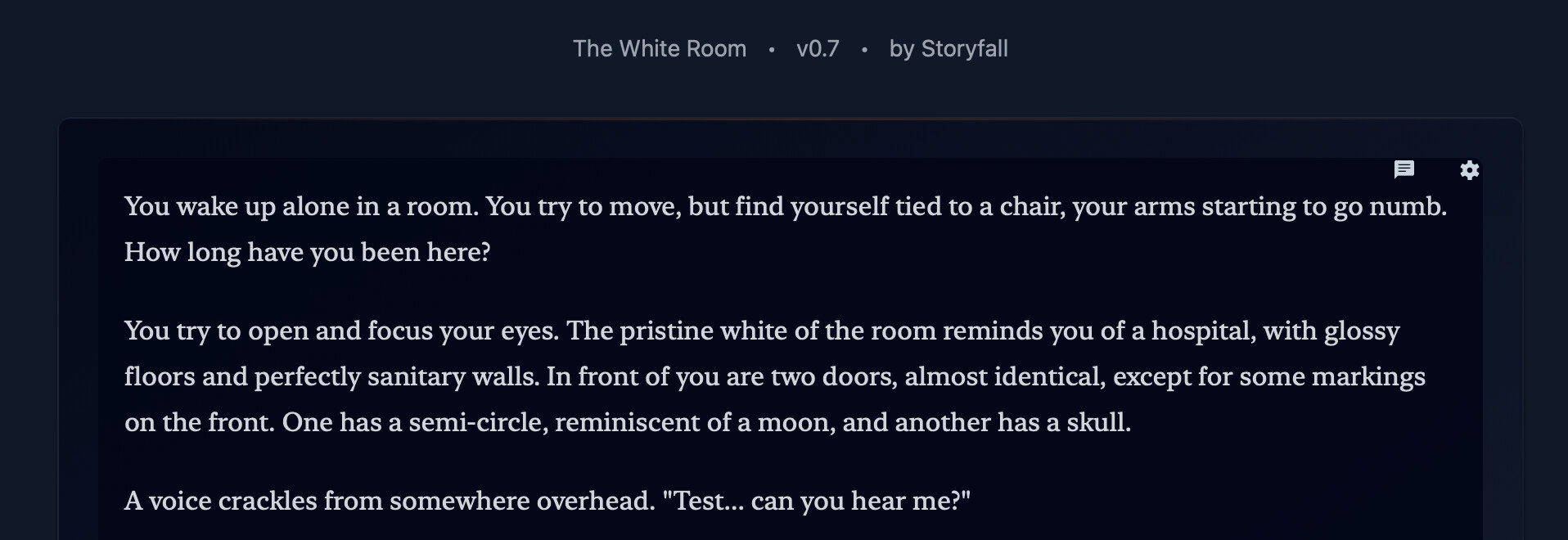
You can even attach screenshots if you want.
Writers get a notification
And can acknowledge or save notes on the feedback (or delete it) in a new modal in the editor.
Let me know what you think!
If Storyfall gets a Twine import feature and full functionality as an IF hosting (and discovery?) platform, that would make it a lot more useful and interesting to me. I don’t care at all about monetization or learning yet another IF authoring tool, but a hosting and discovery platform for IF, like textadventures.co.uk, would be really nice. I can tolerate monetization as long as it’s not in-your-face. IF had philome.la a while ago, but it’s no longer supporting new games since, I believe, the dev got overwhelmed with the amount of stuff people were adding to it. Especially because they never had any monetization plans and it would’ve been a major cash drain to keep letting people adding their games. Right now, it looks like people who don’t want to bother with Itch’s rating and commenting features just use Neocities or their personal websites.
Feedback brings the site closer to an itch.io kind of deal, which isn’t awful either. Itch.io is infamous for its awful feedback system where comments and ratings/reviews are two completely separate things, and it’s not clear at all who can see what, if you’re new to Itch.
If some kind of tag or search system was developed that lets people find the games they want to play, that would be awesome. IFDB and Itch both have tagging, but there are so many untagged games on there.
2 Likes
My monetization plan doesn’t involve anything being in-your-face, in the sense that it’s optional if you monetize, and there will never be any ads. I have a deep, powerful disdain for ads.
I do have a tag and search system already 