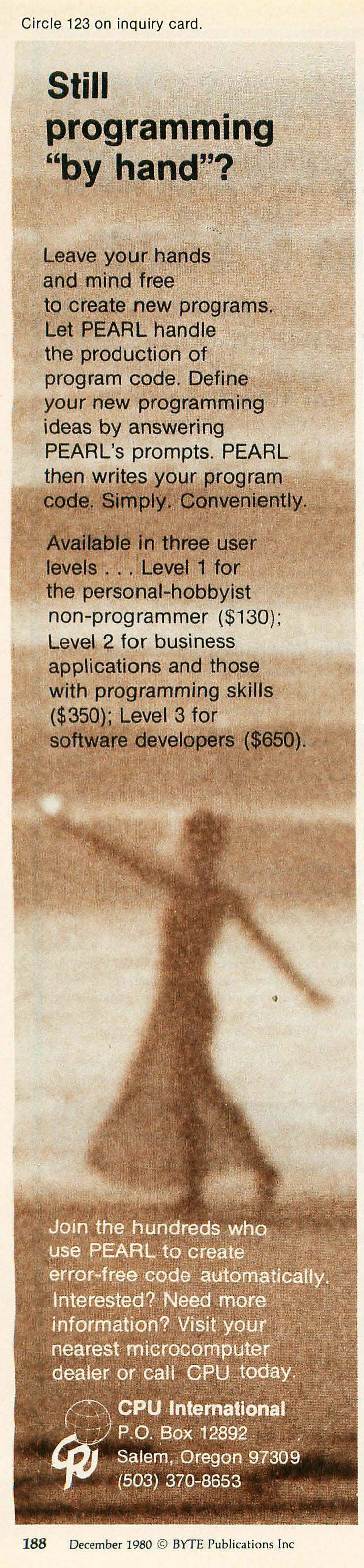
Submitted without additional comment, an ad that I found in the December 1980 issue of Byte:
I was unable to find anything more about this software online.
Submitted without additional comment, an ad that I found in the December 1980 issue of Byte:
I was unable to find anything more about this software online.
Awesome! Do you or anyone have; dunkin doughnuts say no to code?
Nothing actually changes!
I’ve found a few things from Byte Magazine:
CPU International is the former name of Relational Systems International. PEARL (Producing Error-Free Automatic Rapid Logic)
THIS AD MARKED THE BEGINNING OF A NEW ERA
IN MICROCOMPUTER PROGRAMMINGIt announced PEARL"
PEARL ushered in the era where programmers could free themselves
boring, routine and repetitive tasks. Because PEARL handles 60-70% of
programming details, which permits programmers to spend their time more creatively,
and more productively.But that was two years ago.
Today, there’s Personal PEARL - to be introduced at the West Coast
Computer Fair. And it goes a giant step further. Personal PEARL makes the
capabilities of the computer available to virtually anyone.For its $295 price, even people without technical backgrounds can use
it to visually create their own applications and reports on any computer.So the ad you’re reading now is announcing an even more important
breakthrough in computer and personal productivity.Just think about the RELATIONAL SYSTEMS INTERNATIONAL
possibilities. 1 hen Contact OUr rq Box 12892/Salem, Oregon 97309/(503) 363-8929
text corrupted in the original: Full text of "Byte Magazine Volume 07 Number 04 - Human Factors Engineering"
The Smithsonian has an article on Personal Pearl, which — judging by the Byte text, was a successor?
I think doing stuff on the computer with “no code” or “easy code” has always been the point.
BASIC made it so teenage me could print “MY STEPBROTHER IS A DORK” 1000 times without needing to know machine language.
Windows made it so the computing environment was visual and nobody need to to remember typed commands.
Inform 7 made it so you could describe rooms and game elements in (essentially) readable English so you didn’t need to learn obscure code commands.
AI makes it possible to request a cup of tea, and be provided with a cupful of liquid that is almost, but not quite, entirely unlike tea.[1]
Hitchhiker’s Guide to the Galaxy - which predicted AI and the Wiki format in the 1970s. https://medium.com/creative-analytics/hitchhikers-guide-to-analytics-tea-c4990e55b799 ↩︎
I wonder if it’s related to this? https://en.wikipedia.org/wiki/PEARL\_(programming_language)
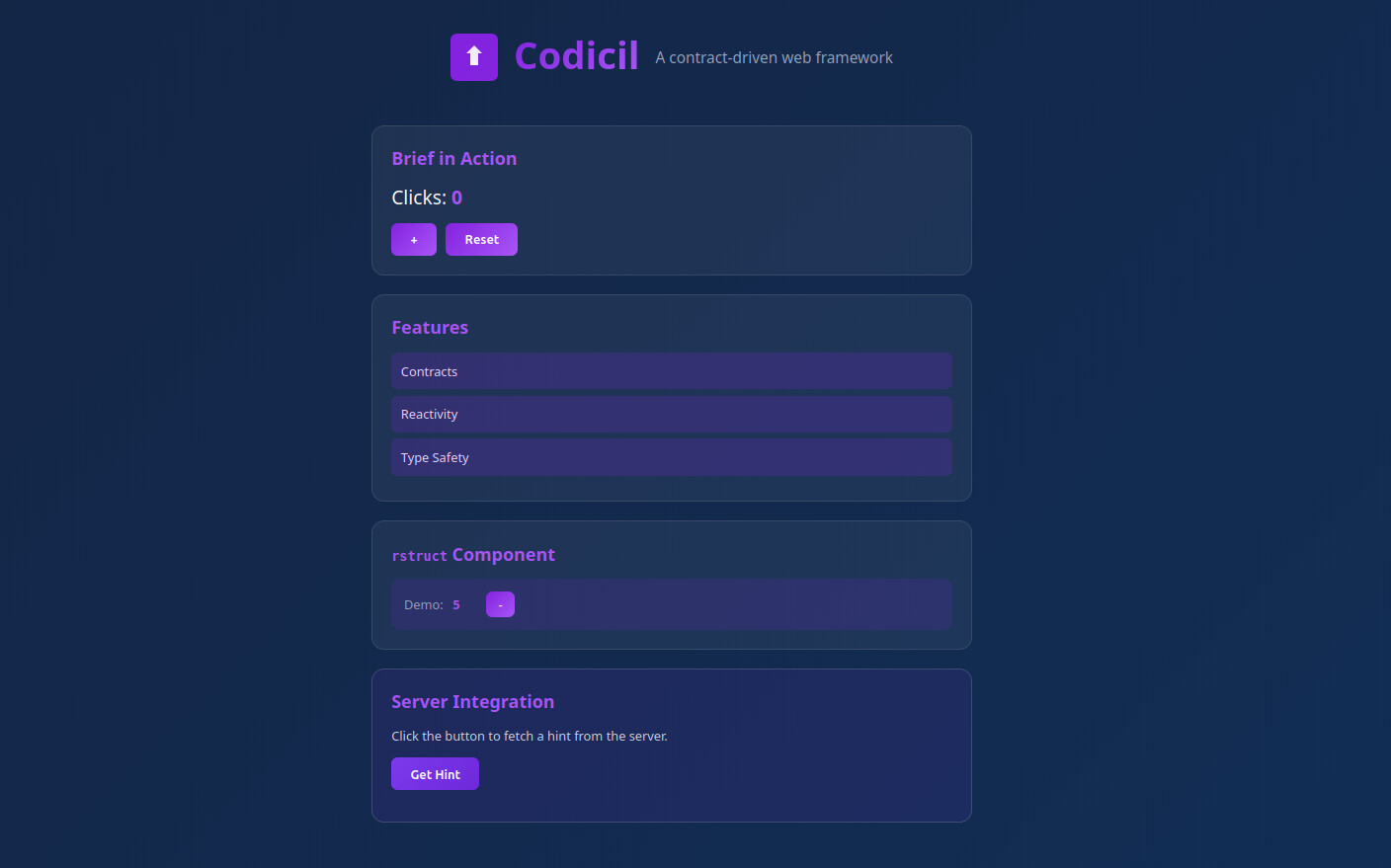
And Brief makes it so your entire code is verifiable before it ever runs
At this point, what am I even doing?
It works though
The history of programming languages really keeps being an evolution of feldspar
That was my first thought, but I think it’s entirely unrelated. PEARL (the programming language) is exactly the opposite of a thing non programmers can use.
Reading between the lines, when the original ad said “programming”, it meant “setting up a database”. (And the reports and forms that let a user work with the database.) For a certain slice of the 1980 software industry, that’s what serious programming meant.
The “Personal Pearl” update makes this more obvious. “Applications and reports” are the same thing – database screens.
IF relevance: this is exactly the same pitch as Cornerstone.
Also, let’s not forget that 1980 was long before the modern era of everyone and their grandmother having a supercomputer in their pocket. Those were the days when assembly code was a common tool in a programmer’s toolkit, a megabyte was a huge amount of data, and if you had access to a computer, it was probably in an office or university setting and what personal computers existed were barely capable of graphics and very much the domain of nerds. The non-technical user of those days might be more tech savvy than the typical power user of today.
But yeah, pretty much every major language that took off was in some regard an attempt to make it easier to tell a computer how to do what you want it to do.
Also, laughed out loud at the Hitchhiker’s Guide to the Galaxy reference above.
Seven years later, in 1987 David Betz presented the article about his AdvSys adventure-authoring system, published in Byte Magazine.
I was a huge fan of BASIC interpreted language back in the day, in my child-hood. I like to define things explicitly, as you have more control. There are several attempts to make programming easier. The classes, the inheritance. Still each language provides basic statements, loops and variables (C++, PHP, JavaScript) in similar manner, often duplicating these things.
The specialized languages like the ADL, AdvSys and also Inform or Alan exist and in my opinion they simplify things a lot. There’s a difference between specializing and generalizing. The former often is required to simplify the creation of given application or game.
There’s a difference between low-level and high-level languages. The latter has less control over creation process. Each of them finds its purpose and there’s ability to mix them like C and SQL for example.
In my studies I learnt such new to me languages like Haskell and Prolog where they find yet another use.
The GUI-toolkits are very nice addition to the classic programming, but still scripts, batch processing help a lot.
There are approachable books about programming for many people. I’ve heard about the new AI-driven tools, but as of searching the solutions, they miss a lot and do many mistakes. I still consider SQL as a more precise access to the computer’s database.
So, automation, high-level programming, GUI-toolkits are OK, but to some extent. Just my two cents.
A quote from Adams’s less popular Dirk Gently’s Holistic Detective Agency:
“Well,” he said, “It’s to do with the project which first made the software incarnation of the company profitable. It was called Reason, and in its own way it was sensational.”
“What was it?”
“Well, it was a kind of back-to-front program. It’s funny how many of the best ideas are just an old idea back-to-front. You see, there have already been several programs written that help you to arrive at decisions by properly ordering and analyzing all the relevant facts so that they then point naturally toward the right decision. The drawback with these is that the decision which all the properly ordered and analyzed facts point to is not necessarily the one you want.”
“Yeeeess…” said Reg’s voice from the kitchen.
"Well, Gordon’s great insight was to design a program which allowed you to specify in advance what decision you wished it to reach, and only then to give it all the facts. The program’s task, which it was able to accomplish with consummate ease, was simply to construct a plausible series of logical-sounding steps to connect the premises with the conclusion.
“And I have to say that it worked brilliantly. Gorden was able to buy himself a Porsche almost immediately despite being completely broke and a hopeless driver. Even his bank manager was unable to find fault with his reasoning. Even when Gordon wrote it off three weeks later.”