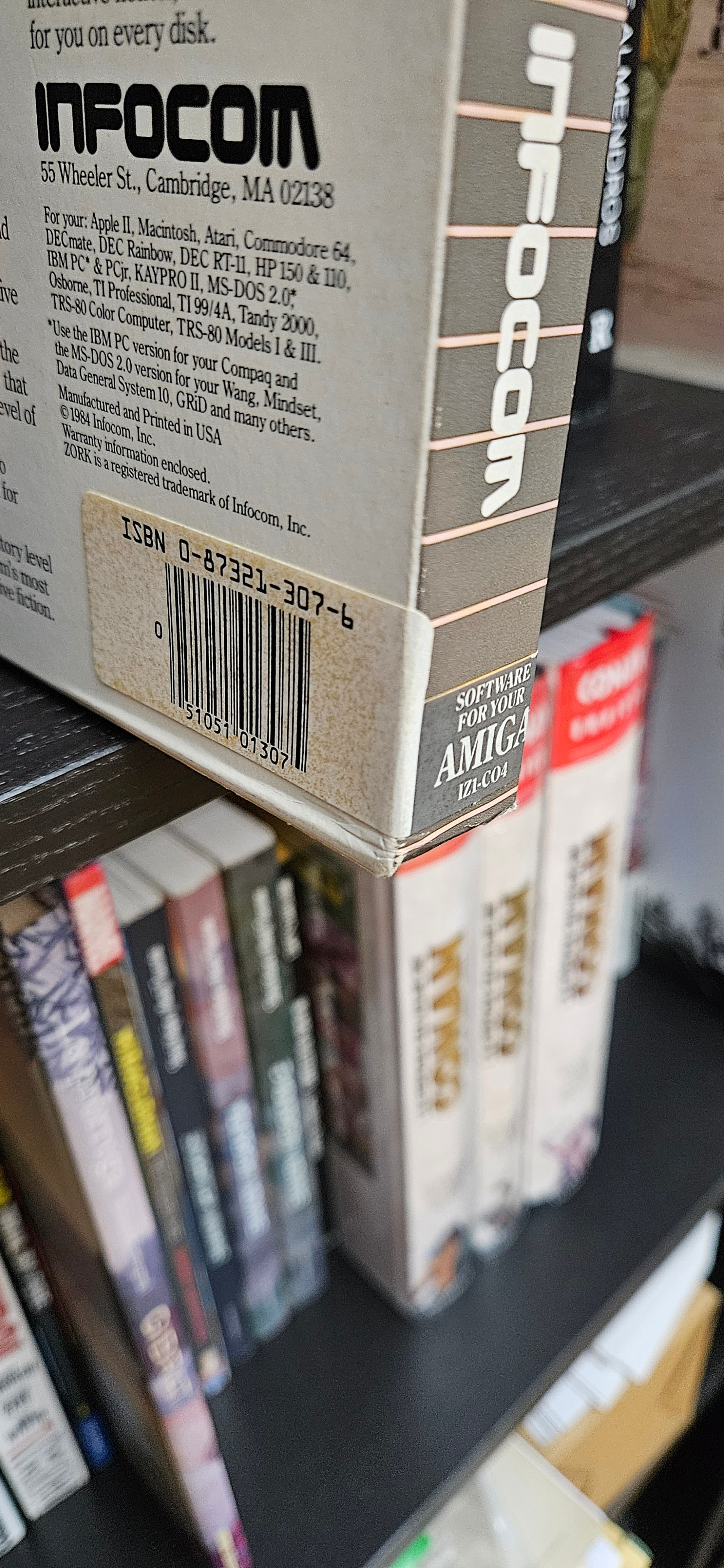
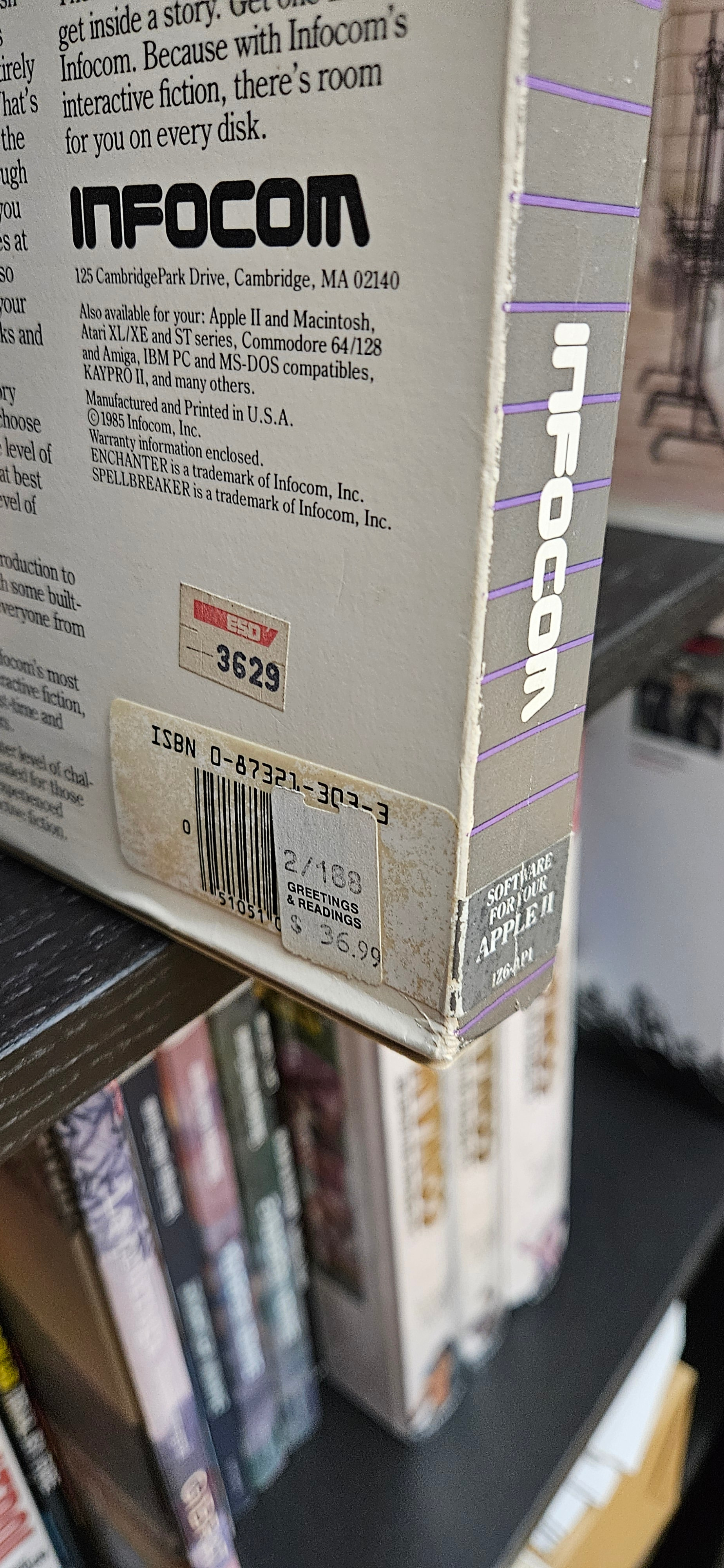
Most Infocom standard grey-box releases, probably untill the Activision aquisition, showed an ISBN code right upon their bar-codes. The ISBN agency actually never considered including video-games in their system and no ISBN searcher would recognise any of them as a valid number. So my best guess is they are just… fake!
A very well elaborated fake, I would say, as the bit corresponding to the publisher ID is consistent among them (87321). Was this sort of an in-joke related to that marketing statement about IF being the stuff you would get at bookshops in the future?
Yeah, and books-by-ISBN doesn’t list anything ever published under that prefix. It jumps from 0-87319 (Halberg Pub Corp) to 0-87322 (Human Kinetics) so I bet Infocom bought a chunk of ISBNs and then assigned them but didn’t register them since they’re videogames? And then ownership got transferred when Activision bought them? The numbers look reasonable otherwise - the check digit checks out.
Infocom games (and other computer games) were 100% sold in bookstores.
What is your source for words like “never” and “no”?
A lot of things which were Data Used In Business Computing in the 1980s didn’t make the leap to the Internet age, particularly for products with a fairly limited retail sale life… like computer games.
Board games and music and other things that don’t get ISBNs have also 100% been sold in bookstores…
I tried a bunch of ISBN-search websites; they all seem to be using the same database (cite the same rough number of titles included, etc.). None of them turned up results for the “ISBNs” that I could find for Infocom games. They DO turn up plenty of books from similar timeframes, and AFAIK a lot of the point of ISBNs has always been that the publishing data gets centrally catalogued, so I doubt this is a “data didn’t make the leap to digital” thing?
Bowker’s ISBN Eligibility FAQ says that video games aren’t eligible now. Looking through various revisions of the ISO standard, I don’t see explicit historical mention of them, but it looks like software is generally ruled out unless it was a digital form of a physical book?
It could have been a “data didn’t make the leap from Activision to the central database”, because the book publishing companies were the ones with the well-established pipeline.
(The paperwork might well still have moved on on actual paper at that point. If you didn’t know who to send the paperwork to…?)
Oh, that’s fascinating. They’re under Addison-Wesley’s publisher prefix, not the Activision (Infocom?) publisher prefix that rockersuke has, and that’s on the Deadline box photo here.
Yup, excluding previously well-known ISBN numbers as noveliztions, CYOA books, etc… all the ISBN code that refers to proper games in Jon’s search consistently point to Addison-Wesley.
Book publishing company Addison-Wesley has been known to publish a handful of games during the 80’s, see:
It looks like the Addison-Wesley ISBNs were originated in 1984 but do not seem to include the later games. I’ve got a complete set of the Infocom gray box editions in storage so I’ll dig these out to see whether any of the early games are using the Addison-Wesley ISBNs.
ISBNs are never removed so it’s an interesting anomaly that the games were published quoting an ISBN that never seems to have been registered. I wonder there is any reference to this anomaly in the New Zork Times newsletters from that period.
I think I may have got to the bottom of the Infocom ISBN mystery.
In the early 1980s, Infocom realised that interactive fiction, by it’s nature, had as much in common with books as video games and could theoretically be sold more broadly in book shops. However, Infocom was only known as a software company so needed a partner to get their products into book shops. Hence, the short-lived relationship with Addison-Wesley as a publisher for Infocom titles in 1984.
The longer term strategy was for Infocom to be registered as a book publisher so that they no longer needed a partner. ISBN publisher code “87321” was subsequently allocated to Infocom and this gave them the right to use ISBNs on their products.
Infocom doesn’t appear to have registered their products with Bowker (US ISBN agency) so the ISBNs now appear to be invalid but were actually perfectly valid for Infocom to include on their products.
So, for example, ISBN “0-87321-248-7” is made up of four parts:
The first part “0” means English language.
The second part “87321” refers to Infocom as publisher.
The third part “248” is the item code that Infocom allocated for the Atari ST version of Wishbringer. Infocom had the right to allocate any item code between “000” and “999” to uniquely identify each game and platform combination.
The fourth part “7” is a check digit for validation.
Well sure, “Infocom bought the publisher code 87321 and the right to allocate the thousand ISBNs under it” has been the working assumption since I made my first post in this thread. That’s not the mystery.
The mystery is why they never registered their products, and what good it did them if they didn’t? If bookstores had to manually enter products for the Infocom ISBNs themselves instead of getting them from the central registry, what good did it do Infocom to have bought the right to a thousand of them?
Or DID they register their products and the data was lost somewhere, and why did that happen when data from other products from the time wasn’t?
I don’t think stores purchased by ISBNs. (I don’t think they do today.) Purchasing would use some kind of publisher-specific SKU in a publisher catalog.
The question of what ISBNs are good for is a little bit fraught, considering that the system is run as a for-profit monopoly by Bowker!
They were used when selling the book. That is stock-keeping at the cash register, scanning barcodes, rather than when ordering titles. The barcodes on books were new, though. I see them on my paperbacks starting right around 1980.
I poked at my CD shelf and noticed a package of Planescape Torment / Soulbringer, published by Interplay, with an ISBN: 1-57629-679-2. Of course that’s a decade later.
(It also has a barcode, but unlike the Infocom photos above, the barcode does not contain a subset of the ISBN.)