I absolutely love this question. When building something new or unconventional, we really should question everything; even the basics.
Are they necessary? No. But I feel like they are preferred for the same reason Paul @paul-donnelly mentioned. I absolutely hate when a puzzle is unexpectedly solved. Of course, that can never be fully avoided with choices, but the more direct (involved) you make the command, the more the intent is established, and hopefully the more satisfying the result becomes.
Though I like Hannon’s idea of clicking on nouns and getting the actionable verb list on them, I feel it will present the answers too easily. Like, when you mentioned pulling a handle, maybe it’s even those “duh!” solutions that players initially struggle with and yet that simple command executed gets them one more step further in the story/adventure. I used to feel those little “aha” moments of triumph in the original Monkey Island. I found it to be satisfying, at least.
In another thread that talked about puzzles, I got the third-degree for championing a parser-like experience in choice based IF. But what came out of it was the concept of narrative puzzles versus object puzzles. The less precise (easier/convenient) you make the navigation and manipulation of the story’s world, the more you should lean on a solid narrative purpose and hinting of a puzzle’s solution. I think I had mentioned that parsers don’t really need a story to have puzzles be functional, but the more stream-lined your choice engine becomes, the stronger your writing needs to be when constructing puzzles. One of my favourite adventure games is Shadow Gate. It relies heavily on object orientated puzzles to drive the narrative… instead of the narrative driving the puzzles.
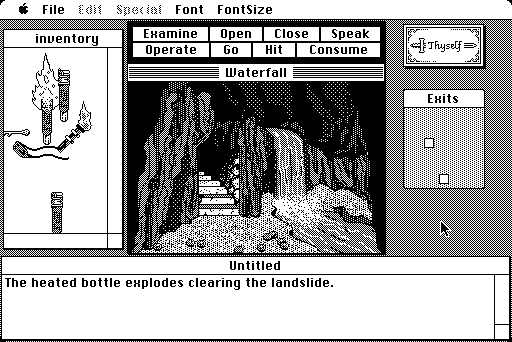
I never got to play the Macintosh version, but the NES cartidge game was superb and the new remake on Steam and GOG is so beautifully done and the painterly art style is to die for.