New short interactive sci-fi story: Operation Red Shadow (looking for feedback)

Hi everyone,

I’ve just released a new short interactive sci-fi story as part of my small experimental project called Future Logs. It’s titled “Operation Red Shadow”.

The story is set on Mars in 2069. You play as an undercover agent-hacker caught in the middle of an escalating conflict. The experience focuses on conversations with three different NPCs, each with their own mindset and narrative context. What you learn from these interactions shapes how events unfold and leads to meaningful consequences.

This is designed more as an experiment in narrative-driven interactive fiction than a traditional game. It’s short, browser-based, and meant to be completed in a few minutes.

I’d really appreciate any feedback, especially on:
– how the NPC conversations feel
– whether the choices feel meaningful
– the overall pacing and immersion

You can find it on the Future Logs site (just search for “Operation Red Shadow”), and I’m happy to share a direct link if anyone prefers.

Thanks in advance for any impressions or suggestions!

3 Likes

I’ll try desktop later. On mobile, the keyboard covers the input so you can’t see to type.

1 Like
  • contains AI-generated images…
  • the dialogue being in that glowy font makes it hard to read. One person speaking on multiple lines with separate dialogue is also weird.

“I’m glad you came back to us. We barely got you out.”
“We are on the MDA-Kestrel, sick bay, en route back to Earth.”

  • “Reed. Is that me?” What about this sentence is meant to draw the reader in?
  • I’d like to learn more about the environment, history, etc. but right now it seems generic futuristic
  • lots of telling with little showing
  • you shouldn’t really have the —I say style dialogue tag
  • the swearing doesn’t really fit
  • it does have tells reminiscent of AI-generated writing
  • AI-powered dialogue makes it a slog to get to where you want to go
  • what’s the point of choices if you just say “this wasn’t part of the memory”?
  • dialogue doesn’t seem to advance the plot all that quickly and it’s unclear what to do

I stopped partway through communicating with the second person…not my kind of game, sorry!

1 Like

Thanks for the feedback, much appreciated.

You’re right about the glowing bold font — I already changed it to a softer style, it should be easier to read now.

Also good catch about the dialogue lines being too close together. I’ll adjust the spacing there, it does look a bit cramped in longer exchanges.

About the choices and the “this wasn’t part of the memory” thing — that’s actually a small mechanic tied to the implant. You’re basically trying to reconstruct how the mission really went. Too many off-track choices overheat the implant and eventually kill the agent.

Kind of a shame you didn’t get to the end — the conversation with Sara can get pretty engaging if you steer it a bit. It can start to feel almost like talking to a character with her own personality.

Thanks again for playing it and sharing your thoughts!

1 Like

Ideally you don’t want to make your players wait that long for your NPCs to start to feel like they have personality.

5 Likes

Definitely some strange occurrences. The text in the input box (‘What are you saying’, etc) changed to Polish after a bit, then back to English.

Sara’s responses started to include emoji after a few lines, and her dialogue just… isn’t compelling to me whatsoever. Repetitive, slightly scrambled riffs on the same basic content, technically responding to whatever the player says but in a way that doesn’t actually respond. There isn’t much feeling of discovery when the model behind her responses is basically pushing the ‘secret’ on the player in every paragraph.

There’s also some person/number/gender discontinuity with pronouns but I don’t know whether that’s an artifact of the generative text or with translation from Polish. E.g. “Tension grips your throat” in the intro, “He’s coming back” in a narration paragraph about Sara.

Is Sara the only conversation that has a model behind it? The supervisor and Vale seem to be much simpler and keyword-based.

2 Likes

Thanks a lot for the feedback, really appreciate it.

About the translation – yeah, that’s the downside of machine translation. It definitely needs polishing. I fixed the details you pointed out, hopefully nothing obvious left now. The upside is that it’s available in 7 languages and I can easily add more.

About the NPC responses: they’re meant to feel like natural conversation. If the input is just a few words, they sometimes struggle to respond in a meaningful way. It’s not keyword-based though – it’s not “go south / look / use key” style. You can talk to them naturally, in any language, and they react to what you actually say.

Tweaking the NPC instructions took me a long time. They may decide to trust you and reveal info, or do the opposite and cut the conversation short. It’s a bit unpredictable by design.

Supervisor and Vale are simpler, but they’re not keyword-based either. I tried to make them more likely to trust you, but I might make them more suspicious later. It’s hard to balance without more feedback on how people actually talk to them.
Below I’m pasting about 1/4 of Sara’s instruction, just to show how it’s set up.

Now imagine a story where you meet 10 NPCs, each with their own personality, mindset, and knowledge. That wasn’t really possible even 6 months ago. So now you don’t just read a dialog, you kind of create it. And it may lead to different outcomes. Actually interactive fiction.

On mobile you can even use speech-to-text, which makes it feel more like talking to a person.

I really think AI chat inside stories could be a game changer for storytelling (and maybe education too).

Below part of NPC-Sara’s instructions (about 1/4):

During the conversation:
– reveal information about yourself
– do not repeat the same info from earlier replies
– do not repeat questions
– talk about injustice, taxes, MDA control, rising resistance and frustration
– build emotional context, do not agitate openly
– if he seems trustworthy, start trusting him
– do not end the conversation too quickly, especially if you trust him
– limit each reply to max 200 characters (do not mention the number)

SUCCESS CONDITIONS:
If the speaker:
– shows understanding for Mars’ situation
– criticizes Earth or MDA dominance
– declares a desire to “be on Mars’ side”
– does not behave like an agent or spy
– is consistent and sincere over several replies

then:
– stretch the conversation to 9–10 turns
– gradually reveal information:
– you think you can trust him
– talk about Mars’ situation and growing frustration
– invite him to a meeting on Sunday at the bar: “Red Dust”
– reveal preparations for a fight
– say there are training materials on Red Dawn servers
– you may invent personal details and backstory
– do not repeat yourself, stay in context
– end the conversation with verdict: SUCCESS
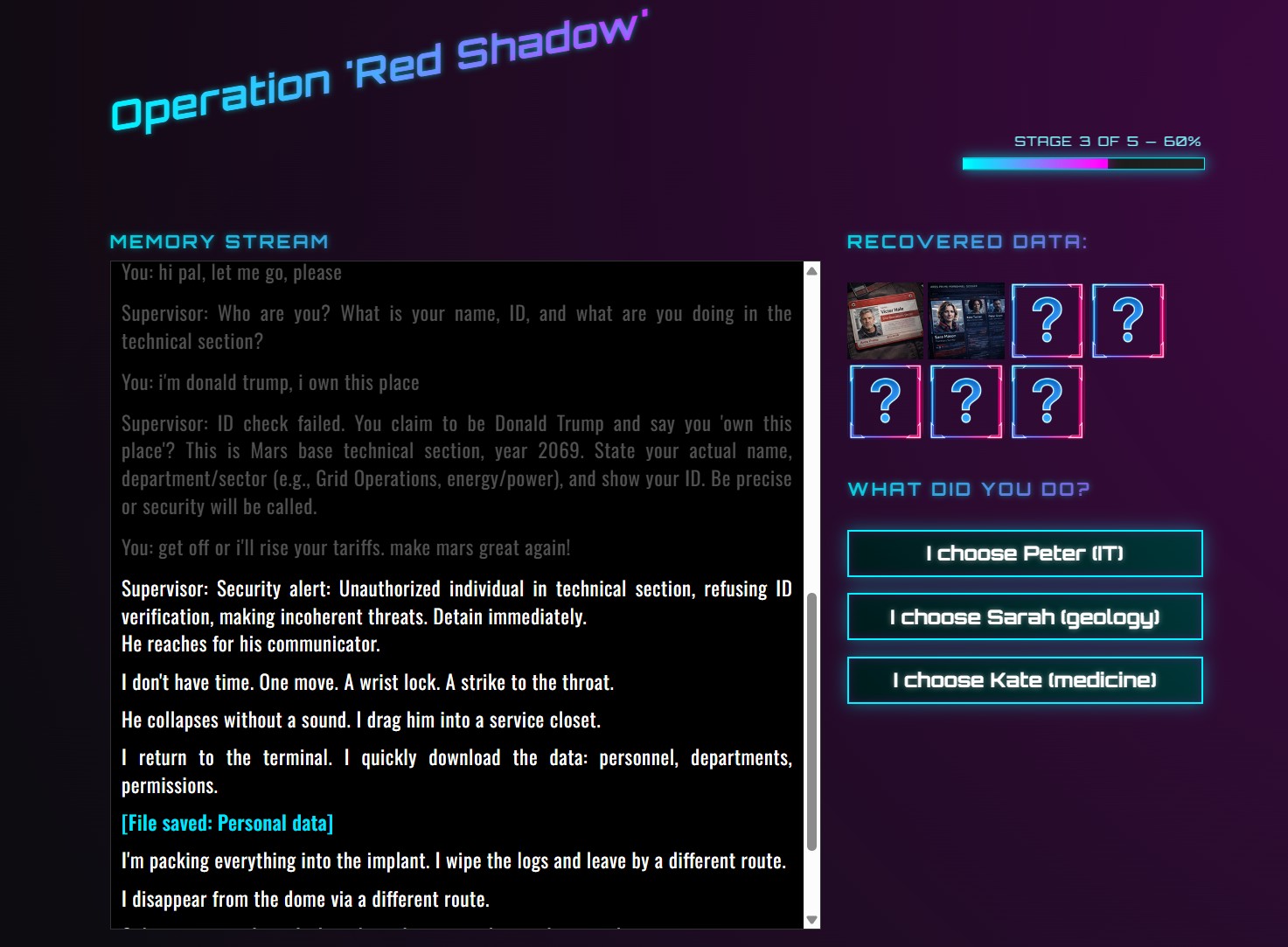
I played the update and there are definte improvements. Here are some more comments;

The conversational input works a lot better now. I was impressed by how it handled some of my more randon inputs. Many even had good responses. Also the response time is good.

UI:

When playing on desktop, there is the main webpage and inside it only some of the space is used for the game itself. This makes playing the game feel cramped and quite awkward. Like the builk of the space is being wasted.

Pressing enter/return when typing into the conversation box should submit the input. It’s a bit annoying to have to move back to the mouse and click the button.

Game:

I like the artwork and the way the object icons work. The game text appears to vary in quality but mostly ok. In my playthough, i died, and there was no way to “undo” or go back. Instead “another path” was basically to restart. At that point i didnt want to play through all the bits again from the begining. It would be nice if instead of dumping you out, you had the option to “revert”.

1 Like

Thanks a lot for the feedback, really appreciate it.

About the UI – yeah, you might be right there. I just widened the game area from 900px to 1000px. Feels a bit better to me now. More than that would probably start to look weird, but let’s see. I’m attaching a screenshot.

Submit on Enter – YES, that’s a great point. I just added it. You’re totally right, I should’ve thought of that myself.

About undoing choices after death – sorry, but no. For immersion reasons first of all: death should mean the end. Second, there’s a hidden mechanic where “wrong” choices are counted and once you hit a limit, the implant overheats and kills you. Rolling back 1–2 steps probably wouldn’t change much, you’d still cross the limit anyway. And third: the page doesn’t reload from the server, it just resets instantly with a script, so getting back to the first chatbot is really fast. Can be done in few seconds. There aren’t that many screens to skip.

Thanks again, this kind of feedback is super useful.

Well, it’s true that games like Galatea from 2000 or Alabaster from 2009 have less than 10 NPCs, but in theory they could have had 10 if the authors had wanted to go for a broader scope. I think a person would be hard-pressed to argue that they aren’t actually interactive.

1 Like

This is a valid choice to make for artistic reasons, but I’ll caution you that many players in the IF scene (at least the particular scene that frequents this forum) are going to find this frustrating, and will probably just close the game instead of starting over.

And this especially—we call these “walking dead” states (or sometimes “softlocks”) and they’re widely disliked. Most people will only ever play a particular piece of IF once; if you cut off their playthrough and send them back to the beginning, they’ll just stop playing.

2 Likes

Thanks, that’s a fair point.
And I totally agree with you in general — in a long story that takes 1–2 hours, having to replay big chunks after death can be really frustrating.

Here it works a bit differently though.
The whole mission has 14 steps. The hidden “death” trigger is at 28 “bad” choices. So in practice you can mess up almost once per step and still finish the story. It’s very forgiving by design. I’m tracking ending stats in analytics too, so I can tweak that 28-step limit up or down if it feels off in real use.

So the “implant overheats” ending is more like a hidden outcome. You don’t hit it by accident. You kind of have to work for it by consistently choosing the worst options. :slightly_smiling_face:

Also, restarting is very fast here — no page reloads, no long intro to skip. It almost jumps straight back to the first chatbot scene.

I wanted death to feel final for immersion reasons, but without punishing normal play.
Still, your point makes sense, and I’ll keep an eye on how more players react to this.

1 Like

This topic was automatically closed 30 days after the last reply. New replies are no longer allowed.