Need help identifying an old 70s-80s castle adventure - tourist castle, spells, coloured fluids

First time poster. I hope this is in the right category. Please move as needed.

I am trying to identify this old game (likely mainframe) that Claude seems unable to find any trace of, and Jason Dyer (Renga in Blue blog) and his friends don’t recognize it either. I have a completely detailed to-scale PDF map of the entire castle, but since I can’t attach it as a new user, it will be hard to describe since it is a 5-storey castle with over 60 rooms plus quite a few staircases. There are also manipulable objects, room states, doorways in various states (open, closed, locked, bolted, hidden), teleportation via drinking coloured fluids, and various spells among other elements.

My backstory on this is that probably in the 70s, I hand-copied a map of this complex 5-level castle layout of an exploration game. I have no recollection of playing this game but the map was written in my handwriting on graph paper with precise room measurements and numerous objects and doorways of all kinds. To make it easier to ID, I had Claude convert my hand-drawn map to an exact PDF replica, which I would like to share with you.

The Game’s backstory - as best as I can reconstruct it – is as follows: The setting is a medieval castle that has long since been abandoned and turned into a tourist attraction for visitors. After paying admission in the Entry Hall to the “girl” there, you start exploring and eventually manage to get access to a part of the castle that is not open to the public. You soon discover that there is magic still active in the castle and that there are valuable and interesting objects to be found there. Beyond that, I don’t recall what the goal of the game is.

When I asked Claude to try to ID the game, it replied: “The combination of (a) a mainframe-era possibility, (b) British vocabulary, (c) an idiosyncratic room set (Exhibition room with a showcase, Gambling room, “turn3times”), and (d) no hits on any of its distinctive phrases suggests it may be a university or in-house mainframe game that never had a commercial release — exactly the kind of thing the Phoenix (Cambridge) games were before Topologika ported them. Those are catalogued now; yours isn’t, which points to something more obscure, possibly circulated only on one system.”

Claude also helpfully suggested that Phoenix/Topologika veterans inhabit this forum and that this might be a good place to post about this mysterious game.

Some of the many other room names are: Soldier’s room(s), Armoury, Magic workshop, Chapel, Lumber room, Torture room, Lookout, Eagle’s nest, Bell tower, Bewitched room, Laboratory (with a special Cupboard), Dungeon, and Cellar vault. British wording/spelling throughout: rubbish instead of trash, coloured fluid, armoury, etc.

If there is any way for me to let you see the 5-page PDF of the castle map, that would help a great deal, I’m sure. But given what I’ve mentioned so far, I was wondering if you had any idea of the provenance of this game and what it is called?

Thanks very much in advance for any help you can provide. I’d love to pin this one down. It looks like a fun game.

Best, Dennis

2 Likes

That sounds very much like The Secret of Arendarvon Castle to me.

I haven’t played the game much yet, so I can’t be 100% sure. (I probably should, one day.)

1 Like

Don’t know the game myself, but for your convenience, here’s the link to the IFDB entry for the game to which @Timmy is referring: The Secret of Arendarvon Castle. There is also a link to a scanned copy of the book which contained it.

I’d suggest taking a look at the entry for The Secret of Arendarvon Castle at CASA. This includes a very nice map by Alex Dijkstra. You can compare this map to yours and this will allow you to confirm or reject the suggestion proposed by @Timmy.

1 Like

You can also play the game online, here - The Secret Of Arendarvon Castle

(I really love the book that goes with the game. So much time and care has been taking up on that. I’m surprised this game hasn’t been the target of a fan remake.)

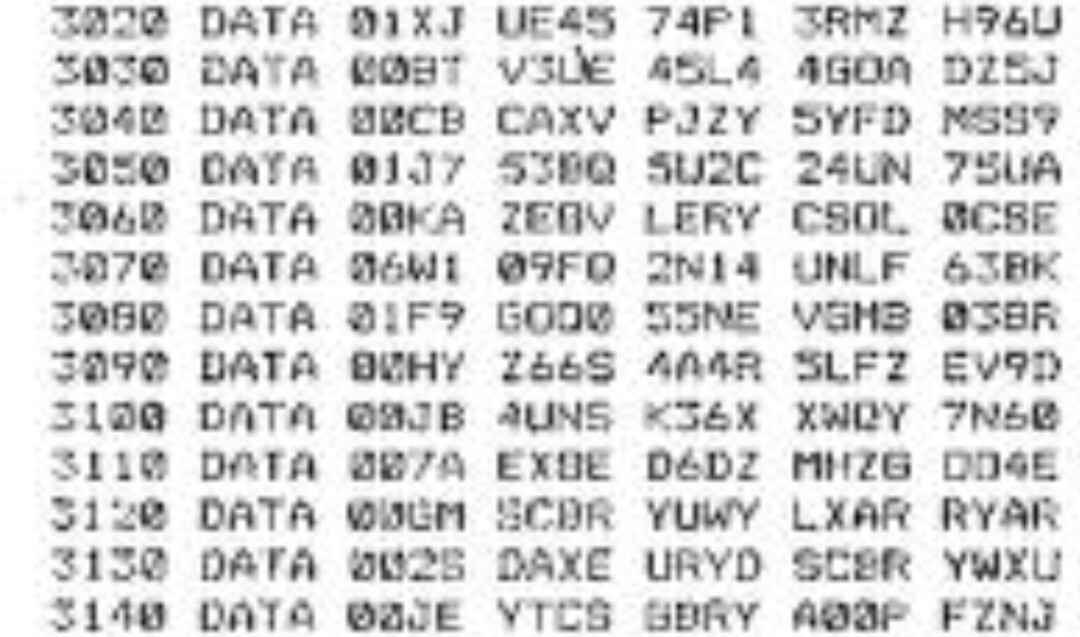
I haven’t seen this game before but I took a look at the book (on the internet archive) and wow, the type-in job they were expecting would-be players to do was … quite something.

It’s from the same publisher/imprint as The Antagonists, and Aaron Reed has talked about how well this worked out as an approach.

helpfully dividing the process into seven chunks each estimated to take an hour and a half to type

:scream:

At least only about seven of those ten and a half hours consist of typing in incomprehensible chunks of alphanumeric characters …

4 Likes

I remember spending many hours typing in similar listings from magazines and books, back then. It wasn’t too bad. At least this one has the text broken up into blocks of four and I think it also includes a built in checker (although that didn’t work properly for the sequel).

2 Likes

Yes, that’s it! Absolutely. There are a few differences between my map and Alex Dijkstra’s, some of which may be due to my map being a physical plan layout rather than a connection map like Alex’s. But that’s definitely it.

Thanks so much to all of you who recognized it. The title sounds familiar, and I can imagine myself 40 years ago typing in all the compressed BASIC. LoL

I’ll get BeebEm for Windows, the SSD, and the book and give it a shot. Should be fun!

4 Likes

Wow, that book is amazing. I have only the vaguest memories of a few games distributed this way through magazines, and this one goes far beyond anything I remember.

2 Likes

Yes, both books (this and The Antagonists) were very amazingly looking books.

It was also the way back in the day to add more content into games that were small.

There were many, many books that had “listings” inside them or background information and people can “read” these instead of something on screen.

As for these 2 books, it’s coincidental but we just had an event this week where several of these books was shown, so I could identify them immediately.

Also, if you didn’t wanted to type in for a week, these 2 games were also available on “cassette tapes”, and I was lucky to able to borrow them from my library back then.

If you want to know more about those days then just ask, perhaps in another thread.

*) Also The Antagonists was a really nice game too, I did finish that one, it felt easier without all those measurement actions.

1 Like

Thanks to everyone for their tips on finding resources about The Secret of Arendarvon Castle.

I am a retired programmer and found myself very curious about the design and complexity of this very interesting game that I played long ago; and thanks to bbcmicro.co.uk, I was able to download the game disc. Over the past weeks I have worked with Claude Code, Anthropic’s coding agent, to take the game apart and rebuild it. I set the goals, made the design decisions, desk-checked the code, and played the result as an additional validation; Claude Code did the disassembly, wrote the code, and built and ran the test harness.

What came of it is this. The ALADIN virtual machine and its bytecode were disassembled, and the game’s 1,420 bytecode instructions were refactored into structured, commented JavaScript, with every statement carrying the bytecode offset it came from. It plays in any browser or in a terminal, with no BASIC and no VM.

A port is only worth having if it is faithful, so the JavaScript version was validated by comparing its outputs to those of the original code rather than against anyone’s reading of it. A handful of small bugs turned up as well (e.g., the test after STRIKE TORCH is inverted), and each fix was validated by writing it into the original bytecode and running the comparison again.

The JavaScript version is now on GitHub, and you can play it in a browser without installing anything; a bonus is that the text word-wraps to any size window, the parser will take lower case input, and the game prints normal bi-case output.

The game: https://dmcr45.github.io/arendarvon-castle

The map: https://dmcr45.github.io/arendarvon-castle/maps

The code: https://github.com/dmcr45/arendarvon-castle

The map was drawn from the game’s own data: every room at the size MEASURE reports, every door in the state it starts in, and every object and character where the game puts them at the start.

I have published it as preservation and as a way of bringing to light its clever design, with full credit to Arend Rensink, Kasper Boon and Alex Pelsmaeker (aka Hal Renko and Sam Edwards).

Dennis

3 Likes