Some of us survived the 80s. We were emotionally scarred for life of course.
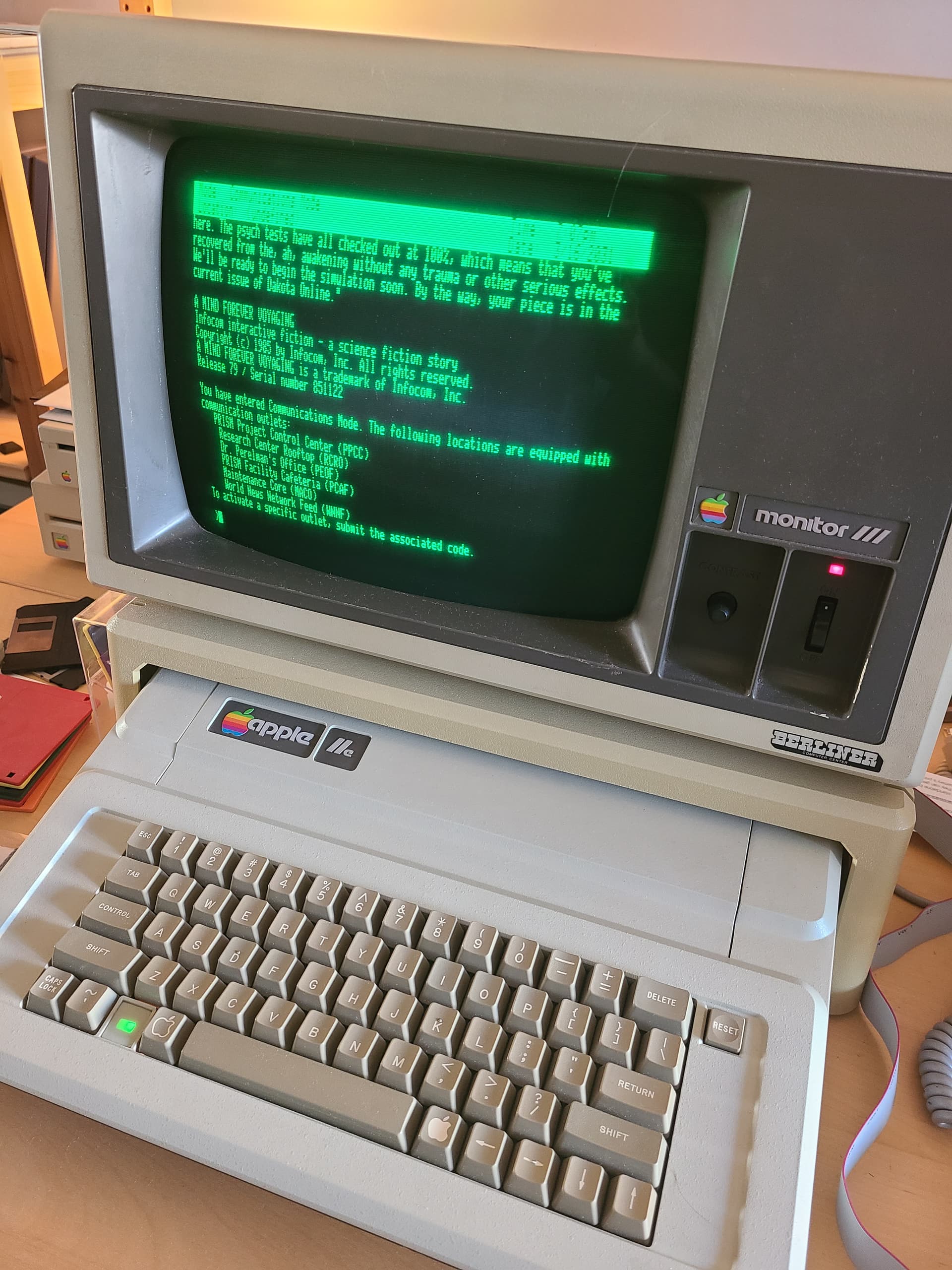
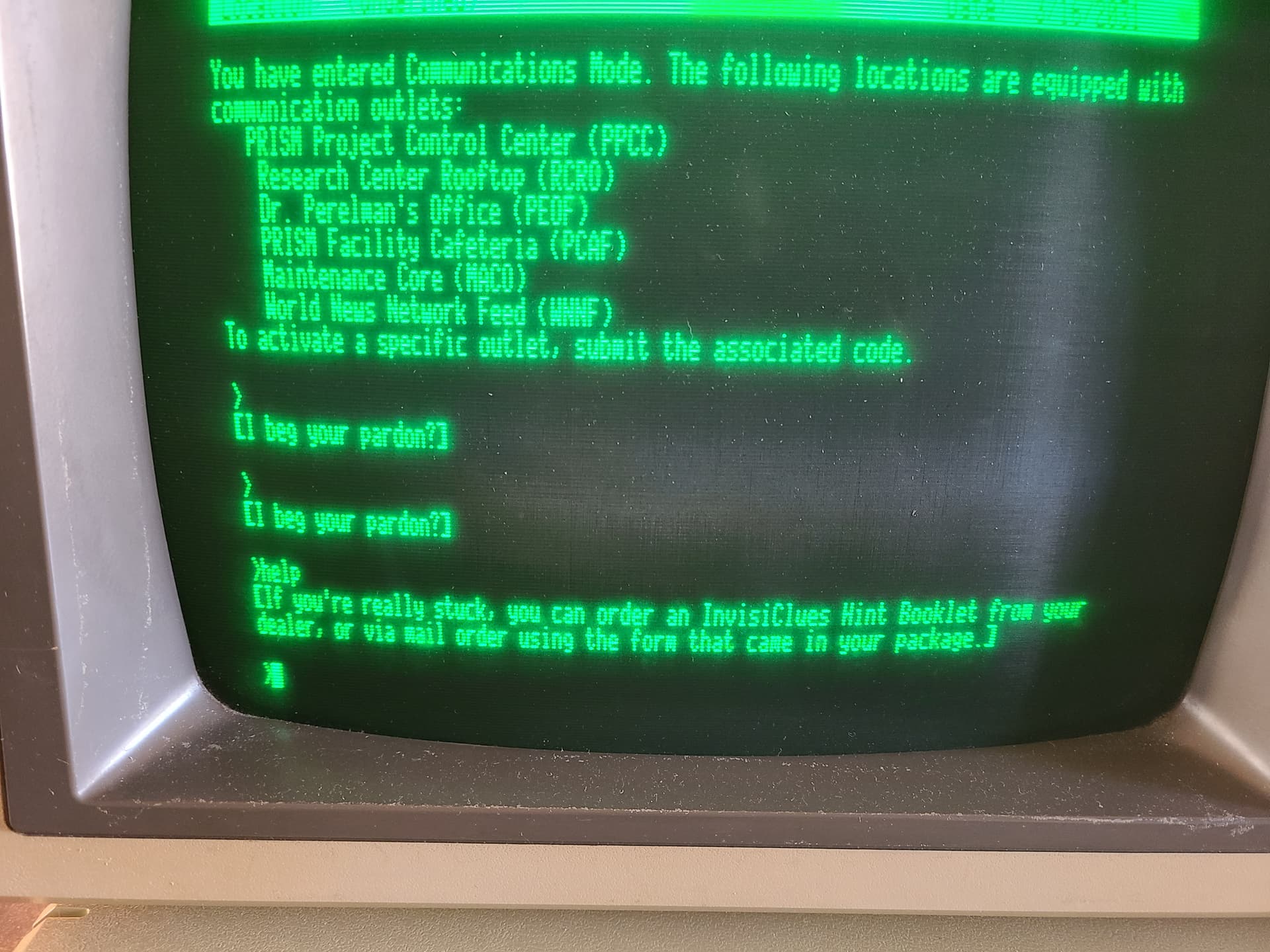
I still have my old Apple II+. I booted it up for the first time in years just the other day. I used the opportunity to briefly revisit HGTTG, a game that originally took me weeks to get through without hints. They were deeply traumatic times.
Text adventures in the 80s were cruel, but they were like mother’s milk. If you were weaned on mother’s milk, you grew up to be fit and healthy and ready to handle anything.
You’ve got to remember that everyone was faced with a cryptic prompt and a cursor back in those days. Computer users were like hackers. There was no instructions, no windows, no mouse, no copy and paste, no drag and drop, no undo, no colour, no hard drives, no multi-tasking, no visual filing system, no internet. Even navigating the operating system was like playing an adventure.
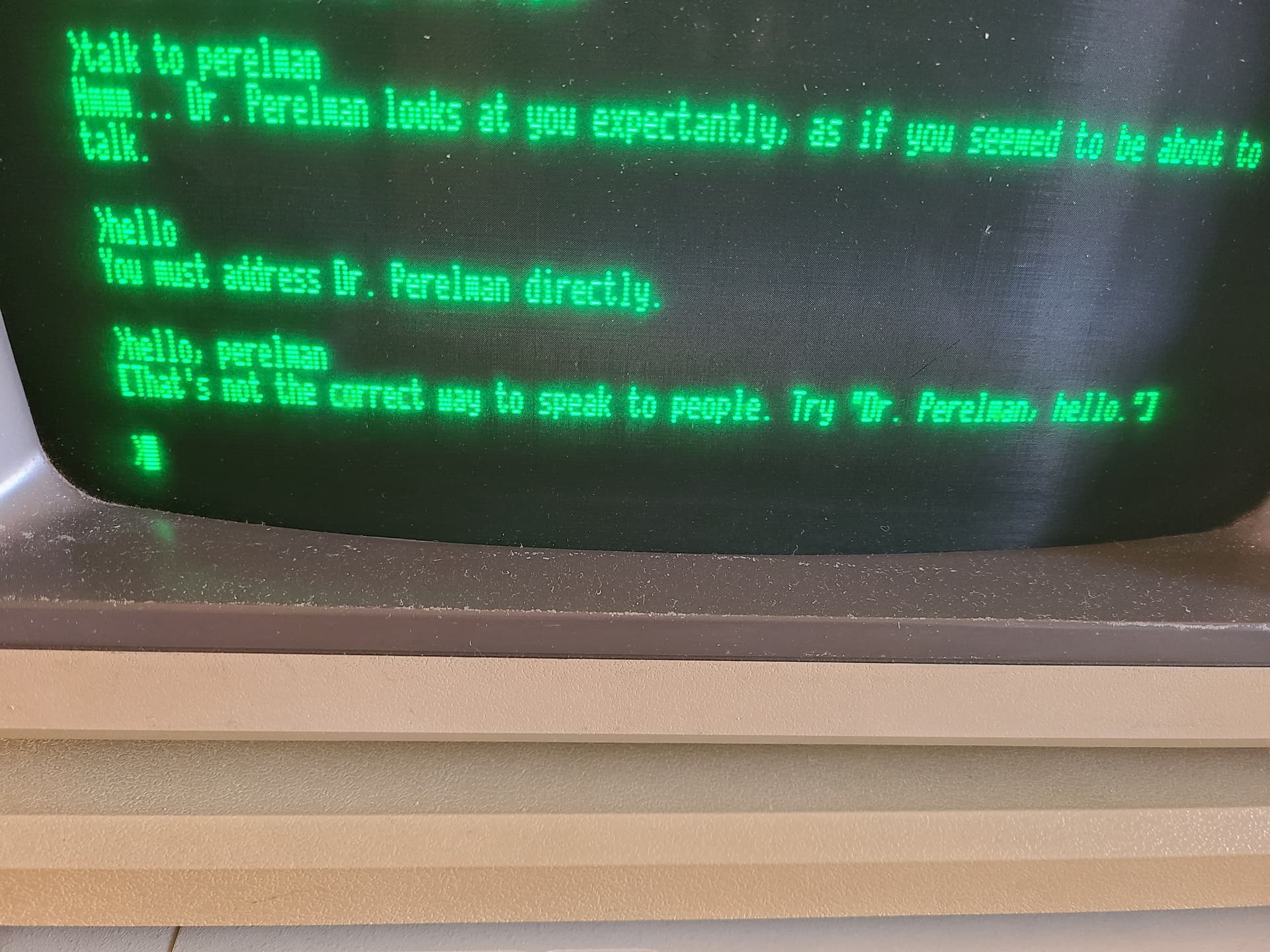
If you started with Infocom, you had already skipped one or two generations of text adventures. Players of modern games are spoiled beyond belief. Multi-word parsers. No sudden death. No guess-the-verb. No unwinnable situations. No moon logic. You can undo your last move and even save your progress. Wow!
My first computer was C64, and there was instructions, which I followed. The C64 greets us with a Basic prompt. Thus I learned the important commands like Load, List and Run, and therefore basic programming constructions, like Print, Input, If and Gosub. The instructions also noted how to achieve different text colors just by keyboard combination. I also turned on and off the computer, monitor/TV, peripherals in a specified order.
As of mouse and windows, they became natural GUI element very early. Amiga has window-based environment, where there can be Shell window as well. I started interesting in Text Adventures on Amiga CDTV. On C64 I only played graphics-games, platformers. On Amiga point-and-click adventures like Gobliiins were just fun and superb - for me as young person.
Text Adventures like Aardvark Museum brought me lots of fun, because I loved the way these games stimulate imagination. I also learned some English language. I like the descriptions, the puzzles, however I agree that some can be tricky. ADL (and AdvSys) were 1986-1987, but I discovered them in about year 1993 on CD-ROM software. They offer game-states. I began to create own adventures much later, and my debut adventure (in EAC) Space Station was not bad.
Kids these days worrying about memory limitations…
This is why you have the output sent to a printer as you play! RAM is expensive, paper is cheap. And if you use a good old-fashioned teletype, the way things used to be done, that happens automatically for you.
But no, people these days need their fancy terminals with their cursors and their escape codes and their curses…
I miss alot of the noises that came a bit later. The CD-Rom spinning up, or the sound of the CD tray popping out, or the crunching of old disc drives. Bios beeps.
The Apple II disk drives were much the same. I used to run a thing called “RobotWar” (the original, by Silas Warner, released commercially for the Apple in 1981) with programmed robots fighting, and I’d leave it running in my room overnight. Every 10 minutes or so a match would finish and then the drive crunching would start. I still hear those disk drive sounds in my dreams sometimes.
As to the other noises the Apple II would make, after initially just unplugging the internal speaker so I could play games at night when my flatmates were sleeping, I ended up drilling a hole in the case and installing a trimpot to give me some sort of control over the volume, beyond “on” or “off”.
Exactly, load “myfile”,8 would load the file on the floppy diskette.
There was a command to list diskette contents: load “?”,8 from what I remember.
Then the contents were listed by list command, which was also used to list current program in Basic.
The * used as a file name would load the first file on disk.
As of Tape, I got it later (my father bought C64 with disk drive), and loaded games from casettes using C64 cartridge extensions (fast loader). But I know that load itself would print press play on tape and search for a nearest game.
In my opinion tapes had one nice property - unless described, the contents were unknown. So it was like digging the treasures.
I also recall “mysterious” print # and input # commands used to print or input from given channels. C64 basic was nice, later I got AMOS basic with sound, graphics on Amiga.
Later I learned C and I consider it very important. They teach C (or Pascal) on first year of studies, to understand algorithms and mathematical notation. As of text-adventures, they can be written of course in Basic, C, specialized languages. And from what I learned recently, on C64, ZX Spectrum and other platforms they can be created using programs like PAWS and Quill with menu designed to insert adventure game definition. I remember such menus, but in different kind of utilities for C64.