Mathbrush reviews IFComp 2026

Verb Noun Adjective

This game is described as being by ‘Rybread’, and ABOUT text starts with: “Rybread returns. Funemployment has let me tackle Inform 7 or at least try.”

That suggests to me that this is Rybread Celsius, who was a well-known author many years ago and contributed to the IF theory reader. The previous Rybread Celsius games that I played were often buggy but had a creativity and a surreal quality that was enjoyable, like in Acid Whiplash.

Writing for Sub-Q magazine, Anya DeNiro wrote:

When I first became involved in the interactive fiction community online, back in 2001, my head was blown open by the possibilities afforded by parser-based games. I dutifully tracked down a copy of Lost Treasures of Infocom to find my footing with the “canon” that most others were building from. But there was someone else who seemed to be working on the fringes of the community, who some people considered an Ed Wood-type figure making monumentally bad game after game. Many considered him the worst writer of interactive fiction on the contemporary scene. Still others, fewer in number, considered him one of the experimental geniuses of interactive fiction. His name is Ryan Stevens, but he wrote under the name Rybread Celsius.

This game is both similar and dissimilar to those older games. It contains a giant carpet you can search/enter for candy, like his game Candy. Room directions often don’t match what’s actually available. There are numerous bugs; for instance, there’s a coin in a well that you can’t pick up unless you are in the well. So if you drop it anywhere else or put it on a supporter, you can never pick it up again (unless you can put the supporter in the wall). There is a dead adventurer that you cannot refer to by that name. I got around this by using ‘it’ immediately after entering a room, but found later on it responds to ‘corpse’.

Dissimilar is the tone. His earlier games were somehow more frightening and unsettling to me, almost as if designed to subtly corrupt the human soul. This game feels more gentle and fun, almost whimsical, and is inspired by counterfeit monkey.

With the walkthrough, decompiling, and an eternal wellspring of hope, I got to 13 points. One point can only be obtained by taking a certain action on turn 127, so missing that locks you out, but I swear the turn counter jumps around from time to time. I never solved the grue puzzle, found the clock room, or the false coin.

Overall, I found it fun. While it’s not polished, there’s always something to do, and it’s nice to see a long-retired author come out again to surprise the world. I liked the use of glulx’s text styling, and the counterfeit monkey-inspired machine puzzle was cool.
18 Likes

I did some internet sleuthing and I do believe this really is the original Rybread Celsius. I was pretty flabbergasted to see his nom de plume after all these years.

6 Likes

If it is, I think he now has the record for longest time (27 years, 1999 to 2026) between IFComp entries, eclipsing @BrettW who had the previous record of 18.

This record is impressive, though Leon Lin, if he wants to, could probably put together something cool–as he’s still active and writing good stuff!

I’m wondering how long Rybread (assuming it’s him) planned a return in advance.

10 Likes

The Count and the Communist

The original French version of this game was one of my favorite games of 2025 when it originally released. Alas, mine is the only review on IFDB. Hopefully the English version will meet a broader audience.

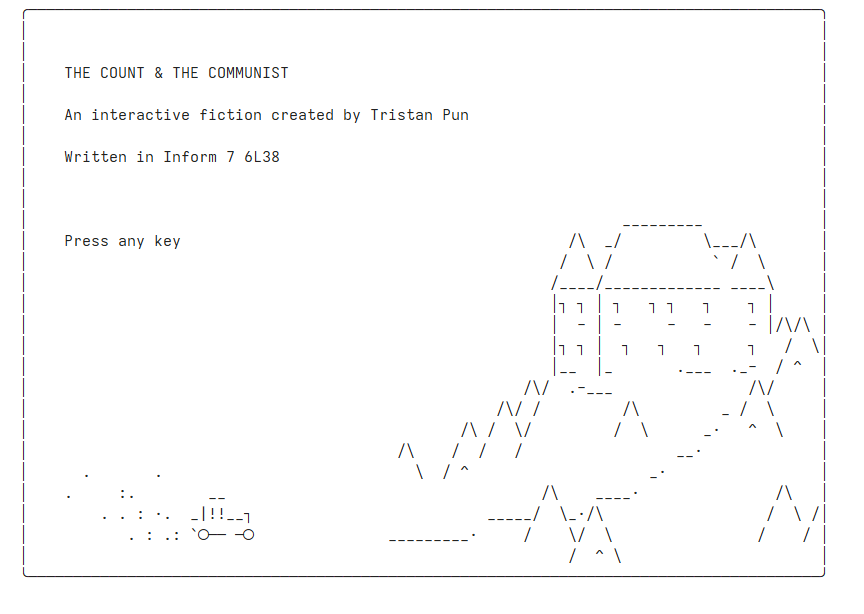
The design is daring. Every page has ASCII art, either of people, a map, or something else. These drawings adapt to different circumstances, changing clothing and items carried.

More daring is the command input structure. Like Superluminal Vagrant Twin or Skybreak!, it’s a menu-based parser system. It also has many parts that require typing a period followed by enter to get to the next page, which slows down things a bit. In French, it was perfect, as my slow reading speed benefitted from a slow input system. In English, I found it annoying, until by the end (5 or so hours later) I was quickly double tapping the keys.

Everything is accessed through menus, including saving and looking around. Again, some shortcuts were very annoying at first. EXAMINING and USING items that are carried requires an entirely different menu than objects in the area around you. Yet the game is long enough that, by the end, these menus can be mastered.

The game is very long, taking place over about a week. You are a communist spy supporting the Red faction after the Russian revolution, and you are sent to a count’s household in France to support him as a laundress. The game tackles themes of communism, misogyny and homophobia in the early 1900s.

As a spy, your main job is to gather information. At first you are strictly limited to a small set of rooms, and you quickly learn your duties as a laundress. SAVING often is good as UNDO doesn’t work here (due to the complex structure producing the images).

Over time, you gain access to many more areas. This game is huge; the wordcount is higher than Never Gives Up Her Dead, though much of it is from the ascii images. But over and over more areas and events unlock in the game, including complicated devices (some requiring pdfs of old French war manuals) and code transcribing.

The attached hints are absolutely useful, especially later on. It is possible to beat the game without doing everything; I didn’t bother doing the last 3 optional puzzles as I had played the game all night for 2 nights and was reaching midnight and wished to finish.

The characters are well-developed, including the beautiful spy Marceline who leads you and the complex housekeeper whose young dreams of fame and success have been subverted by the cold Count.

The communism propaganda is huge here; our character spends every night trying to teach herself communist theory. Tons of conversations and lessons on communism are had. It is essentially like playing a religious crusades game with heavily Christian themes, except the all-consuming religion driving one to violence has been replaced with communism.

Overall, I think this is a fantastic game. It is clunky, sure. Some puzzles are not fair without hints, true. It is probably too long and too hard for IFComp. Fine. But I think it’s a fantastic game, and my time playing it was worth it.

12 Likes

Maximilien

This is an interesting game. I’ve decided to write my views based on a games individual merits rather than investigating them for potential AI use.

Maximilien is a highly polished game, and is destined for a future Steam release according to the author and website. The author’s name on the IFComp page links to a page about the game, and that includes a page about the author and the creation process.

That polish includes several pictures, many of which are morphed or animated with various techniques, giving distortion or fire effects. The opening screen includes a particularly detailed-looking demon embryo thing, made in the author’s style (who has been doing digital art for years).

The story is that you are living in Boston in the 1800s and have horrific and surreal nightmares that end with you waking up covered in blood. You have to investigate what’s happening to you. Investigations increase your progress on 4 tracks of knowledge and hints, with each track giving different ending possibilities. I got the bad/possession ending, but I thought it was good.

You investigate through a map where you can choose where to go and spend action points on each of 4 days. You also have an inventory you can read, and there are several text-box entry ‘tests’.

The original was in French, and the translation is extremely ornate and rich. Combined with the necessarily non-linear nature of the investigation and the surreal jumps in location and space, it was often difficult to keep track of the story. Here is an example of the ornate text:

After a moment of eternity, I finally rise with a soft hiss. A sweep of my gaze lets me take in some twenty yards, where I make out a tangle of tombstones merged into the night. I curse myself for not having made use of one of the two fellows’ lanterns ; and despite a careful look, I cannot see them. A curtain of trees a little farther off, its shadowed rim standing out against the sky, seems to mark the cemetery’s boundary. A little path of pale gravel stretches before me, in one direction toward the tree line, in the other toward the thickening mist at the heart of this resting ground.

or another:

The spectacle unfolding before my eyes defies even the oldest myths, whose obsolescence could not withstand the apprehension of the world through the prism of the most enlightened minds. Even the most unbridled imagination could not have engendered such a syncretism of credibility, belief, dreams, and nightmares, in this vision my senses transcribe with a pernicious exactitude, as only madness can produce.

Writing styles and preferences differ from person to person and culture to culture. For me, I like precision of language, where simpler words are preferred and complex phrases are only used if the provide clarity. All of the sentences make sense, and the meaning, once deciphered, is interesting, but like I said, combined with the jumping around and the surreal environment (and the distortion and warping of the text as play progresses), it can be difficult to follow the story thread.

The story that I did perceive is interesting. It reminds me of the Cognomen of Edgar Allen Poe game from a few years ago with its city investigation or aesthetic. This game includes a lot of details about Judaism, Boston and I think Ukraine.

Overall, I had a polished experience. I didn’t feel compelled to replay, but I admire the effort put into the game and found the villain compelling.

6 Likes

Postgrad

This game will, eventually, be a live-time game, like Lifeline once was, where you have to wait in real-time to unlock new events and things.

You play as Bel, a young graduate student who is part of a startup for medicinal drugs. She also is involved with investigations into drugs and dead cats.

The game is played on a map of the world, with events placed at different times of day (in this Beta version, you can click to advance time at any time). All events in-game are in one part of, I believe, New Zealand.

The game is unfinished. It is also long. The game ends at the end of Ch. 1. Some plot threads are well-developed by then, but almost all of the climaxes and so on are missing. I have been planning on not playing any of the unfinished games this competition, but I somehow walked past the glaring ‘Chapter One’ and ‘Beta’ in the title.

The presentation is professional. The images consistently have a nice-looking black finished image with a blue sketch layer under or over or something; it looks like a talented professional artist worked extensively on the game. The writing is professional, with real-sounding dialogue.

Plot-wise, if this game is meant to be played over an extended period of time, I’d strongly suggest adding a journal or recollection feature. I got confused as it was with all the plots running. Some, like the status of our theater we’re working/squatting in, were easy to follow and gripping. Others were less so; I honestly could not remember who the person was that we were trying so hard to stalk with Paige. Looking back, was it the CEO of the company charging her $2000? Or something? I genuinely don’t know. A recall feature would help with stuff like that.

I’m not sure if choices have an effect here. You often have the choice of which storylet to play, but most that I skipped came up again later. Is it mostly just picking the order you read it in? The quality of the dialogue and graphics mean that the game can kind of coast on that alone, but it would be good to know if we can adjust the story.

The game has frequent strong profanity, which I personally didn’t enjoy but which is very clearly laid out in the intro. Our protagonist has a kind of crappy life. I’ve seen people go through almost all of these things (mostly relatives); trying to hide a non-certified or otherwise illegal business from others; hiding a drug farm; living in a building not intended to be lived in and keeping it from others; having funding pulled from a company and being muscled out; trying to move biohazards around without it getting flagged; etc. Bel seems to have the opposite of a charmed life. It makes the story more interesting; how boring would it be to have the main character just exit the business, stop committing crimes and focus on grad school? Watching everything fall apart is definitely the right choice for telling this story.

Take the content warning on disturbing animal imagery seriously; this is not a good game for those who dislike text-based animal abuse.

7 Likes

Caribbean Nightmare

I originally tried the German version of this, then gave up and waited for the English release.

I’ve played several games by this author. They tend to have gigantic maps with a ton of puzzles and allow play by dropdown menu or by parser entry. They also tend to be a little underhinted and a tad undercoded, but with enough hints to help out.

This game was better than usual. I liked its 4 chapter structure. I did end with only 2600 points instead of the full 3130, so I must have missed something, but I found the storyline more engaging and the puzzles more interesting than before. It just felt like things were mostly thought through well. I did find the pseudo-jungle maze a bit annoying, though each part of it eventually gained another exit, making it easier to distinguish them.

There were a few unfair-feeling puzzles, but many of the puzzles were very fair. Maybe using the flashlight is a bit unfair since there are so many places you can check (and using the rag or even knowing it exists), but for the flashlight there is a bit of a hint for part of it. There’s a lot of dialogue in the game, which I think significantly improves it.

The idea is that you have amnesia on an island and have to explore it, finding shipwrecks, a parrot and a monkey, zombies, dancing skeletons, and, of course, treasure. There’s a giant plot twist in the middle that changes things significantly.

Overall, I found myself enjoying the game. There is still some strangeness; UNDOing at one point instead reloaded the entire game and then ran through all my previous commands, but left me in a completely different place with a completely different score. Tying the string to a tree and then taking the string made things weird (as I didn’t use ‘UNTIE’). So it wasn’t perfect, but it was fun.

7 Likes

Wait-Our-Way Tower

For those who haven’t played Andrew Schultz’s games, he typically chooses a mechanic to center the game, often about wordplay but in other circumstances involving chess or complex movement. The wordplay games typically involve you typing words as solutions to the wordplay and navigating NESW. The storyline is generally centered around a series of surreal events, with dialogue often being discussed in general rather than reported directly and with topics like self improvement and confidence.

There are some types of Andrew Schultz games I look forward to and some I don’t look forward to, and this game combines three of the positive ones. It is in Adventuron with pixel art, which I think really improves these games a lot by grounding some of the more surreal objects with easily-readable pixel art. It is long and polished. And its central wordplay system is hard enough to be non-trivial but easy enough that gameplay doesn’t come to a halt as you run to a pencil and paper or online solver.

It also has people that follow you around that are also illustrated, which I don’t recall happening before (I remember people following you and illustrated people but not both).

Overall, I’ve conditioned myself to enjoy his games by playing so many of them (I’ve played 31 out of 44 total). And I like this one more than most of the others.

11 Likes

Hello Mathbrush, thanks a lot for your review!

It would be great to get the transcript. It sounds as if there are some things I should look into.

BTW: I think you didn’t miss something. But the score decreases if you receive spoilers or solutions from the help system.

1 Like

TOITŪ

This is a work made as part of a PhD project. Some college project IF games are real stinkers, while others (like Blue Lacuna) can be impressive. This one is complex and literary, and should, I believe, serve well as a PhD-level material.

I do have some complaining to do to contrast with later praising. When I saw ‘2 hours’ and the term ‘detective poem’, then tried the opening page and saw the text was being slowly typed out, I was possessed with terror and flashbacks of other poetic games like Succor that used slow text for hours at a time. I even started downloading the code and opening it up to remove the timed text, when I saw it wasn’t that much. Reader, I pushed onwards.

The first scene was difficult to parse, I kind of wandering through nature and establishing your physical identity. I thought at first that nothing was being tracked, but quite a bit was, and there were callbacks later on. I genuinely didn’t understand much of the intro, except that there was water there.

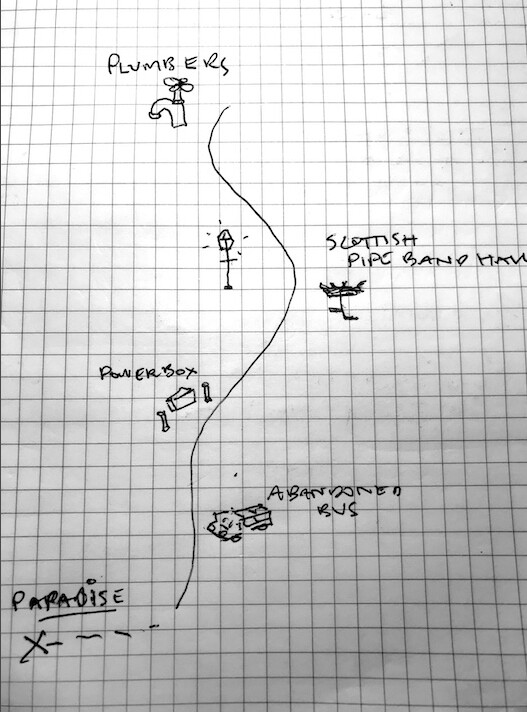
Then we break into a more story-focused segment that was cool. You are in New Zealand in Dunedin and have to climb up a street with a map and clear out several drains to help a plumber/concrete company owner. Everything is mystical, and at first I wasn’t sure if it was realism, ADHD causing us to over-fixate on every detail, or that our character was under the influence of perception-enhancing/changing drugs, but after playing later parts I think it was more magical realism. We do find a talking animal or two.

Once I had unclogged everything, in the evening light, I felt very satisfied with the game, which had felt lengthy. To my surprise, I saw ‘End of Part 1’, and was troubled. Wasn’t this a good place to end the game already?

But the next part was interesting in a different way. Like @alyshkalia’s Blossom, NY, this part of the twine game features real landmarks from a city (in this case, Dunedin) and gives info on them, but combines it with story. This part of the game has you exploring an underground tunnel in the city with a strange mechanical contraption equipped with periscope and walkie talkie. By rolling up and down the tunnel, you encounter different things (like a urinal that knows your name) and objects that you can acquire and use elsewhere. Meanwhile, you encounter the plumber more and more. Eventually, you can leave the tunnel and explore more of the places you passed. This final segment was bewildering with its number of possible choices but I believe it was actually funneling you all along, as I made it to an ending safely.

There was a small bug, I think, with the magnifying glass. There’s a variable called $magnify that can be set to two different things, and the code checks for that, but in one part the code checks if $magnify is set to “yes” which never occurs. I’m not going to include this bug report in my ifdb copy of this review.

The best character in the game is the river Toitū itself, which is extremely prominent in all 3 parts, serving as a linear organizer of locations and as a source of refreshment and even holy water at one point.

Overall, I found the grate-unplugging to be the strongest portion, but the overall effect was good. I tend to be less open to poetic works, and have found that my reaction to such things as the games of B-Minus or furkle/mother or the poetry game Portrait with Wolf tend to be less enthusiastic than those games deserve, and the same is likely true here; others may find the first opening area to be more enlightening than it was to me.

Finally, I loved the hand-drawn maps, very cool.

PS Oh, I forgot to mention! The game also contains a dozen or mor images of pages from the works of Janet Frame, a NZ poet who was saved from lobotomy by winning an award for her works. This game shows an alternate history.

7 Likes

Without Corporation

I beta-tested this game, but I never got very far. I did complete it this time! (Possibly through exploits).

This is a difficult game to play. It combines in one several features at the start that make it extraordinarily hard to get use to.

  1. The online version has no way to scroll back. The game now suggests using a transcript which is good. I downloaded it and made 6 transcripts which I’ll upload to the hint thread.
  2. Compounding the above, the game frequently prints several pages of text at once and clears the screen.
  3. You do not control the main character of the game; instead, they perform random inputs while you observe and help.
  4. You cannot WAIT for the main character to do things, since the game will yell at you and disable WAIT. So you have to come up with different actions each turn.
  5. The game can randomly crash; I had 4 different crashes on Gargoyle, so saving often is useful.
  6. The game still progresses if you save, and at the beginning there are several help menus to navigate that are required to progress that also move the game forward, and
  7. The game yells at you if you are too slow and calls you stupid.
  8. The game is a surreal game-within-a-game with multiple voices and POVs, and the game-within-the-game is intentionally buggy and underdescribed.

So, the average experience of a new player may very well be trying out different commands, missing chunks of text, having the game yell at you, and being booted out to try again.

If they are able to push past that and continue, they can find some amazing concepts.

The idea of the game is that Max Fog is dead and an AI trained on his consciousness has finished a game based on his notes. Years later, you and an in-game AI have to work together to make the game run for a real-life player. So, you move objects around, queue up routines, etc. in order to get the game running. Meanwhile, the in-game AI is annoyed with how buggy the game is.

More happens, but I’d rather not spoil it. It has much in common with the ending of A Mind Forever Voyaging.

I’m in the game! A neat trick is that whenever the game crashes/reboots you read a review by Me, Mike Russo, or JJMcC, with various scores depending on how well you did running it. I laughed at mine because it was extremely similar to what I’d write, down to a typo in the first paragraph.

The game talks a lot about AI, and is set in a future where AI has caused lasting damage to the earth.

I did find the ending hopeful.

The game is very ambitious, with using Inform menus and keystrokes and regular text to progress, random commands, writing to external files (I think; I never triggered the text that I think does that), and text animations which I’ve rarely if every seen in Gargoyle. It doesn’t 100% pull it off, since it crashed a few times, but it 90% pulls it off, which is great. I did decompile it, which is funny as the fake me in the fake review also decompiled the game (good thinking, future fake me).

I’ll post my transcripts and a general guideline of how to get through in the hints thread for the game.

6 Likes

Thanks so much for the review!! I’m very glad you… well, maybe “enjoyed” is not the right word, but neither is it the word I hoped youd’d say, lol. I will try and fix the repeatedly typing UNDO though, that seems to be an issue…

It happens every turn, but gargoyle stores them in a different location…

1 Like

I think the right word for my feelings are that I admire it!

What is the intended path on completing the game without abusing the UNDO trick?

1 Like

Honestly, the AP should type QUIT once an ending is reached, which I will try to fix. I’ve spent two months working on it so hopefully soon…

1 Like

that makes perfect sense. Are you sure there’s not a brainscan of a long-dead author haunting your game and causing it to disobey? j/k I’m sure you’ll figure it out. I felt really proud of finishing and loved the text effects!

1 Like

Thanks so much!! Lmao, perhaps…

There is a series of conneected easter eggs you may or may not have noticed, but they were definitely there. But don’t worry about them if you didn’t!

1 Like

I only found 3/4!

Triangle for Two

I was surprised to see this one unreviewed so far, since Naarel tends to have strong prose and games that are easy to finish, which usually means lots of IFComp reviews. I suspect that it comes from not having the game length field filled out (I’d put it in the 15 minutes or less category, though I took longer as I thought through it and reread chunks). Also, it ends without THE END or something similar at the end, so people may think they didn’t finish it. I’m not as familiar with the co-author, though I suspect the text itself may elucidate that matter.

This is a short, polished twine game with literary text that deals with a social/personal facet of life. That’s a fairly large field, but this reminds me more of Ann Hugo and Glassrat than any other authors (I enjoyed both of their games a lot).

The main topic of this game is that someone who has two people in the same body has to announce their mutual coexistence to a friend. This is complicated by the several differences in the two’s personality. One sees the friend as a close friend, possibly even more. The other is hesitant, protective, tense.

There are three kinds of links: progressing links, ‘aside’ links that go to another passage and return, and replacement links. One page uses a lot of replacement links in a clever way.

It was interesting to read in the literal sense (by that I mean I wanted to know more and went back and forth and read it a few times to gather more information). I have family members with similar situations; my brother’s wife has several alters (using her language here rather than the game’s) including one that likes group video games when we do voice calls together.

What strikes me about the character in this story is the combination of ‘>1 people in =1 body’ with body dysmorphia. The woman in the pair sees the male body as ‘other’. I was also struck by the lack of other people; the few people I’ve met in life with similar situations typically have several different alters, some steering in groups. Having exactly two, one man and a woman, makes for a really compelling relationship, well, ‘triangle’, with others, as the name of the game reveals.

The writing was good as always, with multiple references to places and things in Poland.

9 Likes

Bloodrust

I was playing on not playing this game due to its strong language warning, but I decided to try it, and I found that the language was intense and moving but not offensive.

This game uses stark black and white graphics. I had to resize my window, as at first the text overlapped the ‘monitor’ that envelops it.

This is a futuristic game, set a thousand years from now when all life besides humanity has died. You play as Harlan, someone who is all alone. Your mother figure is now all but forgotten, and you have to inspect things for the government. In order to feel something, you play an underground blackjack game where the wagers are your body parts. The game deals with the complicated relationship you have with yourself, the world, and the mysterious blackjack dealer. The game also contains very discreetly implied sexual scenes.

The writing is solid, the design is hardcore. The worldbuilding reminds me of a couple of Fujimoto works (though of course Fujimoto borrows from others) and of an X-files episode about an organ-harvesting lottery.

Overall, I think the author set out to make an evocative work of art combining text, graphics and audio and succeeded (though I did have my console open most of the time, because having it open fixed the window size, and a couple audio files did fail to load.) Beyond those minor hiccups, this was great.

7 Likes