I was quite active in the IF community in the very early days (how many of you remember Volker Blasius and the FTP based archives?) but have been out of the community a good 30 years. Now, older and retired, I’ve been looking around, and I notice that many games, and most notably games that win or place high in the IF contests, are choice-based. I find this interesting and am wondering about the reasons.
Are they easier to create? Somehow I doubt it … maybe on a technical level but certainly not at the level of creativity.
Are they received better, as they seem to require less effort to play (subjective of course)?
I had been so used to parser based games that it’s a bit of an adaptation for me.
Yes, I remember GMD archives maintained by Volker Blasius.
Back then there was no choice-based IF afaik. But choice IF is a gain for gamers (and authors), of course it’s a matter of taste. I personally am more into the old-school parser IF.
I don’t think you can say one sort of IF is easier to develop. It depends on the game one wants to write, its features (edit: its complexity).
Also note that for both choice IF and parser IF there are authoring systems with clickable UIs and systems where you write code (or definitions). Again, a matter of taste.
I’m sure this has been discussed to death, but might as well throw in my thoughts.
For me personally, the most obvious factor is that choice-based IF exists not just as its own phenomenon, but as an accepted component of the modern video game landscape, in a way that parser-based games simply don’t. Mainstream games in a wide variety of genres use multiple-choice branching dialogue trees, for example, whereas switching to a parser-based ASK/TELL interface in the middle of a conventional RPG is basically unheard of. And the entire visual novel genre is basically just choice-based IF with the addition of graphics.
This has the following implications:
As a player, choice-based games are already familiar and intuitive, whereas getting into parser games requires deliberately investing time to familiarize myself with the conventions of a historic input modality.
As a developer, I feel that the design/writing skills that I can practice by writing choice-based IF are directly transferable to modern game development.
The previous point even extends to technical tools. Ink is designed to be directly integrated with modern game engines like Unity or Godot, and I believe Twine is also widely used for prototyping in the conventional games industry.
In some cases, entire choice-based IF games can fairly easily be “upgraded” to a mainstream game through the addition of graphics and other UI or gameplay elements.
Modern games like 80 Days, Reigns, and Sunless Sea made me realize the value of heavy use of text in games, and the IF community is an interesting place to focus in on that particular aspect of gaming. But I’m not ultimately interested in IF as its own isolated little universe, and choice-based IF fits into the broader “games” world in a way that parser doesn’t.
I think the technical level is a big factor; it is a lot easier to learn the basics of Twine and make your first complete, playable game with it than it is do the same with Inform. So “choice-based systems tend to be more accessible to new authors” is a fair statement. And I think the “less effort to play” is a factor as well, because with choice-based games it’s immediately clear how to interact with the work; you don’t have the learning curve that parser games require. So the advent of choice-based authoring systems has opened the IF field to both new authors and new players!
I’d go so far as to say they’re easier to make, AND easier to play. Most folks on encountering a twine game for the first time can more or less figure it out just by clicking on stuff. Parser games require you to know a subset of English commands that the game understands; advanced parser use involves a bunch of single letter abbreviated commands like X LAMP that look a bit like gibberish to a new player.
A while back zarf made a pretty nice little card for new IF players, but it’s still not easy to get a friend to sit down in front of a computer with that little blinking cursor.
It can be good to note that while you were gone two separate movements happened. One is that choice based games appeared and became quite complex. There are choice based games with puzzles and inventory and movement. For instance, you may enjoy the game Detritus from last year.
On the other hand, some parser authors moved towards simplified command sets (called limited parser games) and more story-focused games. So there are parser games that play a lot like choice-based games. An example is Out by Viktor Sobol.
So it may be worth not worrying too much about the distinction in parser bs choice and more look into what style of game you like to play in terms of puzzle or story.
There is also a strong retro parser group that makes traditional games. Garry Francis releases several such games a year.
I too returned to the IF community after a gap of 17 years. I’m not into choice games so my perspective is necessarily biased, but it seems to me like they are an evolution of parser games, in a couple of senses…
In an age when AAA games are made by hundreds of people, IF remains one of the only game art forms that can be built by a single creator. The only cost of entry is the time it takes to create and develop. Choice games have an even lower cost of entry than parser games, as choice systems generally have a shallower learning curve. The learning curve argument also goes for players - parser games have a higher barrier to enter.
Secondarily, considering a balance of puzzles vs narrative delivery, I think choice games place more emphasis squarely on the writing over puzzle design, which puts the player closer to the author’s thoughts, so that it’s more akin to a novel or a play. I can see the appeal of wanting to reach an audience that way.
Personally, I don’t play choice games because if I want prose I’d rather read a book, and my favorite element of parser games has always been the exploration. But I can see why choice games are the growing art form while us parser guys are dinosaurs. It’s like the difference between a terminal app and a GUI. Who wants to type into a terminal when they can click buttons? Well, obviously, some of us, but fewer and fewer for sure.
I would actually add a third movement to this set, based on what I’ve seen in the year or so since I started hanging out here. It seems to me that a very large contingent of the choice based game makers and players are folks in the LGBTQ+ community who can’t find representation in the mainstream. The low barrier to entry for making/playing these games seems to give a lot of these folks an opportunity to express themselves, that aren’t available through mainstream channels. (To be clear, I’m CIS, but an ally, and fully in support of this.) I don’t think any of this was true in the early days of IF when developers were primarily focused on trolls and treasures.
This is largely but not entirely the case, as there are some very puzzle- and gameplay-forward choice games! Mathbrush already brought up Detritus but there’s also 4x4 Archipelago, Social Democracy: An Alternate History, and Master of the Land for other choice games that are very puzzle or gameplay-forward.
The double edged sword of the ease of entry to Twine is that the easiest games to make with it are prose-forward and puzzle-light, so that’s the majority of what gets made (and there’s nothing wrong with disliking that kind of game, to be clear!). But occasionally people have a misperception that those are the only kinds of choice games so I like to push back a bit when it comes up.
As a side note, there’s also puzzle-light parser games like Portrait with Wolf, The Spectators, or The Little Four. Do those still have the certain je ne sais quois that makes a parser game fun for you? (As a side note to the side note, I love the creativity of this community that means I can have so many examples to hand when I want to talk about something!)
I write choice-based interactive fiction that is not game-like or really trying to be game-like. In general I call my own work things like an “interactive story” or “interactive novella.” People still usually call them “games,” which is fine. Even I do that sometimes out of habit, but personally I try not to when discussing my own work because I want to create the expectation that someone picking up my work will be reading a story rather than playing a game.
But the choices, links, hypertext elements, randomization, time-based components, and digital visual presentation are all essential parts of the story that could not be altered/removed without fundamentally changing it into something else. It is not the equivalent of reading a printed book, even if it is (probably?) closer to that experience than playing a parser-based text adventure game.
A lot of work goes into crafting all those elements, even if for me, the coding itself isn’t as intensive as other types of IF. I have found Twine pretty accessible overall, as someone without any programming background. I spend most of my work time writing and editing the story scenes, relative to the time spent implementing them in Twine. It can be challenging and labor-intensive to write high quality prose regardless of its context, so I don’t know if you could really say what’s harder, vs. what requires a different set of skills or specialized knowledge.
It’s sort of weird and interesting that something like what I make coexists in a creative space that also hosts so many other types of media (like parser puzzlefests, old school text adventures, really simulation-intensive Twine games, choicescript-style narratives with deep main-character customization, all kinds of other hybrid formats and riffs off of “interactive fiction,” etc. Not trying to leave anyone out.). Personally I think the cross-pollination is kind of cool and part of what makes this a unique community. I feel like I learn a lot from reading/playing all these different kinds of projects.
It’s actually amazing that parser games were ever the dominant form of text-based game. I guess people were just really used to command lines, and of course Adventure’s influence was colossal. I’m not sure when choice-based games exploded. Maybe around 2009, with Twine, Fallen London, and Choice of Games? Probably display technology had a lot to do with it. A parser game can’t be put in print, even if print or some other kind of physical medium would look a lot nicer, drawing writers down that path where possible.
To add here, I’d say that the Choicer folk have been much more outgoing with their tools, games and community than Parser folk have, atleast on the mainstream. When you search up “Interactive Fiction” on YouTube you’ll mostly get tutorials on Choicers like Twine or Ink. These videos are also mostly more wellmade than videos on Parsers. So, anyone new and on the mainstream will leave with a wrong understanding of Interactive Fiction being only Choicers.To be fair though, this is also for that Choicers are more widespread.
I’ve no doubt that’s due at least in some part to generational gap between old parser fans and young choice fans. I’m an old and I would never make or consume an instructional video, because I prefer to read.
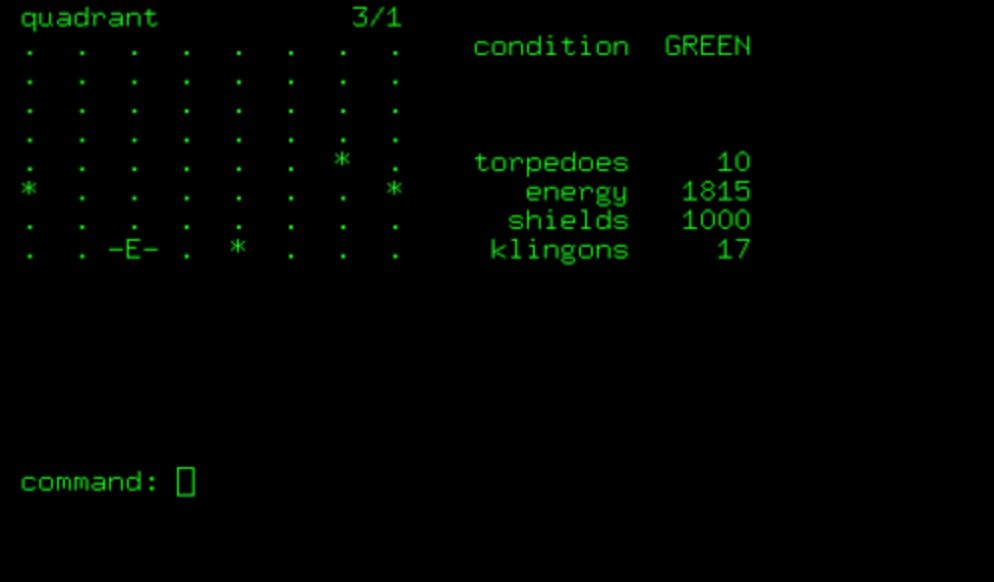
There was though! Lots of programs, including games, prompted the user to make a selection from a small set of choices. Yes/no prompts, or entering a number to choose from a list, were very common UI techniques. I’d guess most programs did not implement an actual command line (not that I’ve counted them all), much less attempt to parse English (Star Trek didn’t).
I started out playing and making parser-based games, too. But didn’t really get anywhere until moving on to choice-based. My most popular Twine games aren’t even interactive fiction as such, but randomized text-based RPGs. My best-received IF is also choice-based: one in Twine, the other made with Texture. The writing is on the wall far as I’m concerned.
Technological limitations (RAM size, etc) are probably part of this. The Scott Adams games, for example, clearly provided many, many hours of gameplay for some people despite containing a vanishingly small amount of text. A CYOA-type game running on the same systems would presumably have been limited to a handful of passages.
There’s also a gap where some techniques and design ideas just didn’t get invented for a while.
The model of choice-based gameplay in the 80s was gamebooks, and gamebooks were extremely simple. Even the ones that told the reader to manage state or RPG stats weren’t doing that much, narratively speaking. When choice-based games appeared in this community (which they did, occasionally) that’s how they were conceived and how they were judged.
(From 1996-2010, IFComp got zero-to-two choice-based games per year. Desert Heat may be the highest-rated on IFDB.)
That’s something that changed over time, and I don’t think it was computer tech. (1980 machines were cramped, but for text games, the limitations were essentially all gone by the mid-90s.) It was new ideas that took hold and spread.
Choice of Games got started in 2009 with the idea of long-form choice-based games where the language of play was accumulating many choices into a story arc, rather than looking at one simple choice at a time. (Or you could say it was the idea of visual novels but dropping the “visual” and focusing entirely on text.)
Twine went big around 2011-2012, like Ivan said, with the creativity of a community that suddenly realizing that games were an expressive medium that anybody could get into. That was a lot of experimentation and (more importantly) a positive feedback loop of people playing each others’ work and building off of it..
(The same feedback loop that we experienced in the 90s with parser IF and IFComp! And which we are now seeing again with “deduction” games like Golden Idol and Roottrees. I could go off on a whole tangent about Type Help, a Twine game, which could have been written in 1995 or 2012 but the concepts behind it weren’t in circulation.)