Linear vs. Open World games (Which do you prefer and why ?)

I’ve been thinking about this a lot lately. I just finished a tightly-paced, story-driven linear game, and then jumped into a massive, “go anywhere” open-world title. The whiplash has me wondering where the community stands on this classic debate.

For me, it often comes down to a trade-off. Linear Games: I love them for their focus. The pacing is usually decent, the set-pieces are incredible, and the narrative hits hard because there are no distractions. You’re along for a curated, often unforgettable ride. Think games like the modern God of War ( semi linear) trilogy, The Last of Us ( completely linear and more like an interactive film), or the Uncharted series ( completely linear) , life is strange , The wolf among us , life and suffering of sir brante, suzerain , disco Elysium . I prefer narrative rich story driven games . Yes these games have branching based off choices but it’s extremely limited and in some cases no matter what you choose the outcome is predetermined . The bad thing about linear based games is if I’m not into the story it’s telling them by default the game is bad open world games don’t have this problem.

Open-World Games: I used to love open-world games for their freedom, but lately, the downsides are really killing the genre for me. The worlds have become bloated with repetitive checklist tasks that feel like a chore, which completely kills the pacing and urgency of the main story. It often feels like I’m just following a predictable, uninspired formula of clearing map icons, and the sheer number of them leads to directionless overwhelm. The worst part is that these massive worlds are often a mile wide and an inch deep—they’re visually stunning but lack meaningful interactivity, making the journey feel empty and unfocused. It’s a classic case of quantity over quality.”

So, where do you all stand

Do you have a clear preference?

What are your favorite examples of each and why did they work for you?

Do you think the industry favors one over the other, or have we reached a good balance?

Are there any games that you think perfectly blend the two styles, offering a strong narrative within a vast world?

Let’s talk about it! I’m genuinely curious what everyone thinks.
2 Likes

Because I actually have a major WIP, I feel that a gradual opening of the world allows a gradual immersion in the narrative (cfr. The Portrait and A taste of Isekai for the two major openings in my WIP) and the most interesting experiment is in progress (a “Virgil” alongside the open world… But I think only an Italian can fully appreciate the experiment)

Best regards from Italy,
dott. Piergiorgio.

2 Likes

Speaking as someone who likes good narrative games first and foremost, I like open world games because I enjoy exploration, and in my experience, I’ve almost always found “open world” and “narrative” to be at cross purposes. I’ve enjoyed some Assassin’s Creed games, because I really enjoyed the exploration (oh, and the pirating, and the pirate shanties), while I totally ignored (and sometimes hated) whatever narrative they were layering in, and even found the narrative an irritating obstacle to getting on with the exploration. Ditto for Zelda BotW. Really enjoyed the exploration, could not care less about the narrative. Various Grand Theft Autos were fun, but my favorite part was riding a motorcycle up the coast. Hogwarts Legacy: flying a broom up the coast. (Actually some of the companion storylines in Hogwarts were pretty decent.)

About the only game I can think of with an open world that fully supported its narrative hook was Shadow of the Colossus. I’ve never thought about it in those terms, so I can’t say why, but maybe it’s because the story was simple and focused and emotionally resonant, and the tasks few and far between and always in clear support of the narrative. For that matter, the music was always in support of the story, too. Probably the best game soundtrack ever. (If only the controls had been better!)

I suspect that the reason why most games don’t work for both purposes is the time and distance that all the exploration and fetch quests and grinding and leveling put between chapters of the story, for the same reason that it wouldn’t be very satisfying to read a book and wait a year between each chapter.

2 Likes

What is the plot of your two games and are they fully text based or will you have pictures ??

Fully text based, of course. In a questionable english, but as I have just pointed elsewhere, please avoid reigniting embers looming in this forum…

on the general plot, sure that you want this spoiler ??

Perplexed regards from Italy,
dott. Piergiorgio.

1 Like

I enjoy some open-world games like Elden Ring, but I steer toward linear games more often.

Sometimes “open world” can roughly overlap with “sandbox.” The appeal is that the player can go anywhere, do anything, at any time. You’re not bound (as tightly) by someone else’s framework. You have the freedom to shape your own experience.

But if I want to shape my own experience, I’ll sit down in front of a blank page and write my own story or design my own game.

If I’m playing someone else’s game, it’s usually because I want to experience their story. So box me into a predetermined framework! Lead me down a linear path! If it’s done well, I’ll go along for the ride.

(This is also why I don’t care too much about character customization, and why I’m not drawn to games like The Sims.)

7 Likes

The biggest drawback of a linear, story-rich game is that if its narrative fails to engage you, the entire experience falls flat. Open-world games can compensate for a weak plot with exploration and player freedom, but a narrative-driven game has no such safety net. For me, the primary issue with open-world titles is repetitive mission design and grinding just to progress through the game . As you noted with Assassin’s Creed, the story and missions often feel at odds—a problem Cyberpunk 2077 also exemplifies. Developers seem to want both a vast, player-driven world and a tightly crafted narrative, but these goals frequently conflict, undermining the very freedom that defines the genre.

This message was written with the assistance of [Chat-GPT]

Yeah Im sure the whole concept of an isekai interactive game intrigues me .

1 Like

Most of the epic graphic games I’ve played are quite old now; Legend of Zelda link to the past, Ocarina of Time, some others in the Zelda series, Some games in the Baldur’s Gate series, and some games in the Ultima series.

What I liked about all the games I’ve just mentioned is that they look like open world games but have enough of an internal structure and story line that there is some directionality to the play.

Baldur’s Gate had some grinding for advancement (not as much as Ultima or some of the early Final Fantasy). “Zelda-link to the past” has almost no grinding, because the important “leveling up” opportunities occur at the end of dungeons, not through accumulation astronomical body counts. Grinding isn’t fun.

2 Likes

I like to finish a game. Open world games either take an eternity to finish or have no end… is what I hear. I can’t say I’ve started playing any since, uh, I dunno, the western Gun? On the Gamecube. Which I did finish, but at least it’s a semi-relevant example. Still a contained one game to today’s enormities.

With the limited time and energy I have for console gaming, I put it towards my backlog of survival horror games. They’re all of manageable duration, and aesthetically I’m more into an intimate scale in general than a literal world which includes all the inbetween bits of that world.

I read, back in the time of the original Resident Evils, that Japanese gamers preferred shorter games, and there was some tension between Western expectations of game size and the games they were producing. I’m with the Japanese.

-Wade

3 Likes

I like a game I can put a hundred hours into, but only around the holidays. Otherwise, there’s a lot to be said for a game that can be played in an afternoon, like To the Moon or Journey or The Beginner’s Guide or Gris to name just a few.

1 Like

Feels like I played more open world games when I was younger, I mean so many people under a certain age had a huge Minecraft/Terraria phase at some point, but now with less time under my belt I prefer shorter concise games that have something interesting to say and don’t waste the player’s time in saying it. I don’t play as many commercial video games as I used to. I feel like brutally long or difficult games end up getting played by mostly younger kids since they’re the main demographic with the free time for that stuff, so the fanbases for those games tend to be largely younger kids too.

It’s a spectrum, though, since plenty of games with a linear story let you go really off the beaten path and there are some open world exploration games that are short and not bloated AAA behemoths. A Short Hike is one.

The worst part is that these massive worlds are often a mile wide and an inch deep—they’re visually stunning but lack meaningful interactivity

This is also my biggest gripe about modern open world games.

For me it’s less about bland side missions — these are often optional, and the main mission sequence is not that different from a linear game.

For me, the problem is the far too open landscapes. Pretty soon the games allow you to traverse the landscape faster to the point of being overpowered (often walking → vehicle → flight). Combined with fast travel, the games lack a sense of place and it doesn’t feel like you’re going there.

Even old games did this, like Final Fantasy 7 graduating you to an airship and the Zelda series giving you fast travel songs … but the overworld was meant to be a side thing rather than the core of the game.

One recent open world game that I enjoyed all of despite this is Death Stranding. It still has extremely open natural geography, and that’s really all there is to the game, but all movement demands reasonable attention whether you’re on foot or a vehicle. Very engaging IMO.

There are also Metroidvanias, which are non-linear but mostly “closed” rather than open. You still gain powers that help you travel, but you have to think about how to use those powers to find shortcuts — even in your most powerful state. That’s also very engaging.

1 Like

I also find it interesting that Shenmue is considered a precursor to open world games given how small each map is, and given that you’re sometimes restricted to just one part of said map — not to mention strict day-night cycles.

Admittedly there’s a better case for Shenmue II being open world because of its larger city maps and greater number of side missions.

But the series is far closer to life sims that any other genre IMO.

I’ve found it useful to think of a spectrum of “openness”. (With the caveat that I think about this mostly with IF, and specifically with puzzle IF, but it can also apply to some other genres.)

The “openness” of a game, at any given point, is how many things you can go do, that will actually be productive. Solving puzzles, grinding for resources, even just “test this ability on every wall and mark off the ones where it doesn’t work” can count, as long as it’s something that engages the player and gives a sense of progress.

If a game is too narrow, there’s only one or two things to do at a time. If you get stuck, there’s no way to progress. This often gets frustrating. If someone is trying to beat an IFComp game within two hours, they’re probably not going to want to put the game down and go do something else while they think about it; they’re either going to go do something else within the game while they think, or they’re going to stare at it in frustration.

If a game is too open, on the other hand, there’s choice paralysis. Players presented with a wide open world can easily get overwhelmed and not know what to interact with. Even if “anything!” is a valid answer, it can feel overwhelming having so many possibilities available. And often that “anything!” comes with an asterisk: only some things will feel like they’re accomplishing something useful. In a narrow game, opening up a new area or some new puzzles feels like a breakthrough; in an open game, it can feel like you have the same amount of surface area to explore before and after, so you haven’t accomplished anything at all.

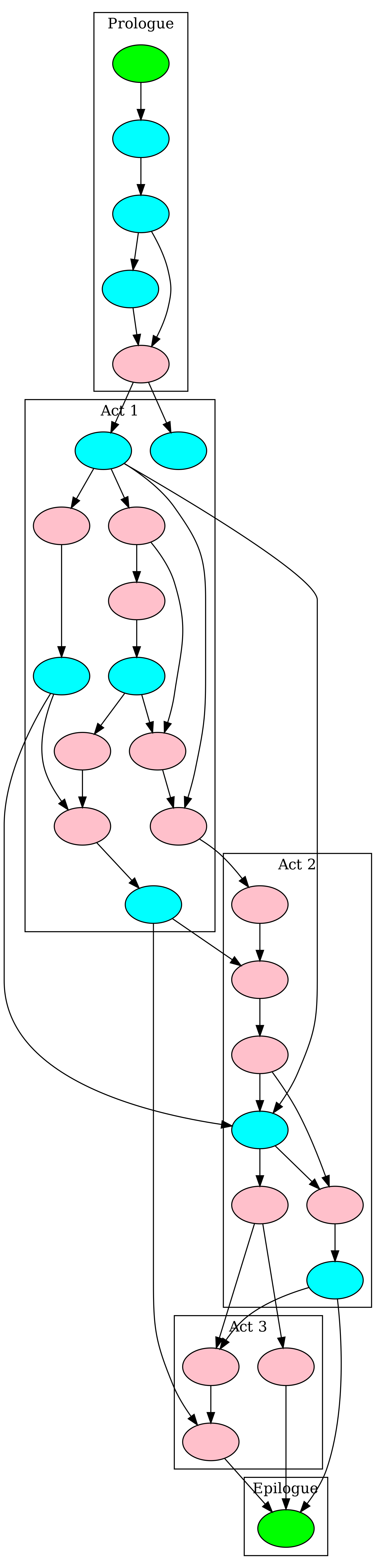
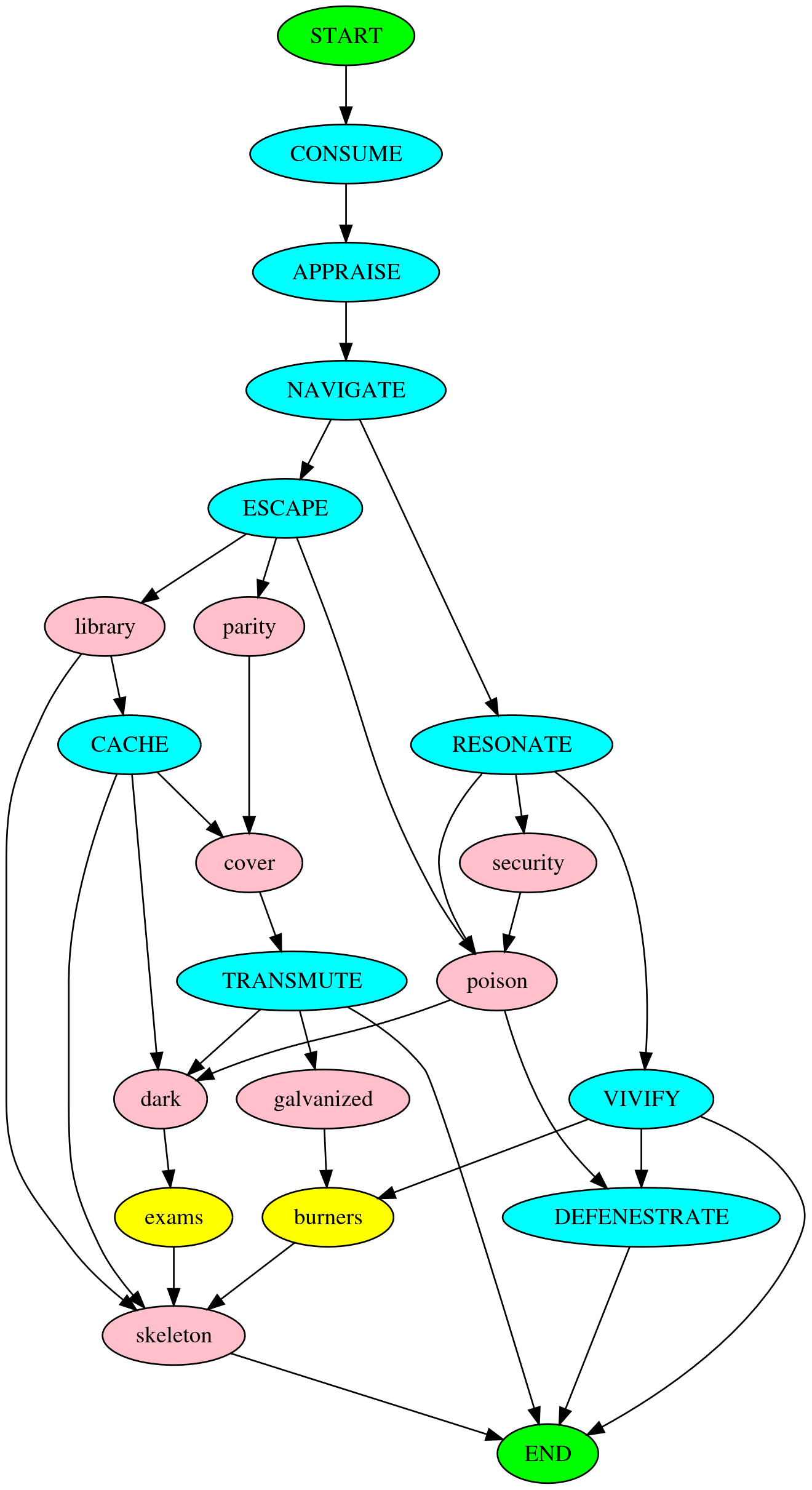
So whenever I’m designing a game, I try to plot it out with flowcharts like this.

This is Familiar Problems, last year’s ECTOCOMP winner. Generally, the width of the flowchart at any given point is a decent measure of openness. So the opening tutorial is very linear as it teaches you the game mechanics, then everything opens up, and there should generally be an average of three things available to work on at any point after that. Quantitatively, we can call this an average openness of 3.

This is this year’s upcoming entry, which is noticeably more linear, since it has a plot and overall progression to it. Now the average openness is about 2; there are generally approximately 2 things you can do at a time.

Will players like an openness of 2 or 3 better? No idea! But that’s about the level I usually aim for. High enough that you don’t get stuck on a single bottleneck puzzle; low enough that you don’t get overwhelmed with decision paralysis.

(The Wise-Woman’s Dog took a different approach—unlike these games, it only required you to solve 70% of the puzzles in each section to move on to the next one. So it’s more open in general, but also doesn’t require you to hunt down every puzzle to progress.)

7 Likes

I prefer linear games which I feel as the more intimate ones, but I also like big open world games becouse I feel these more challenging ones.

Outside the IF sphere, I’ve been spending much of the past month playing Hollow Knight: Silksong, which I think strikes a perfect balance between openness and linearity. Much better than the original Hollow Knight did! There are very few bottlenecks, and even when a particular boss fight is absolutely required to progress in the game, there are still options to go seek out more upgrades first.

2 Likes

I prefer open-world or sandbox style exploration, but a good story is enjoyable too.
One thing I can not stand are time or move limits. They directly oppose freeform exploration and are stressful.

2 Likes

I enjoy being able to decide the current challenge is too tough and being able to go do something else… Super Mario World might be my favorite of classic Mario games because it lets you freely replay most levels and gives you the freedom to pick between many different routes through its world even if it still fits within the classic notion of a game divided into distinct levels… SMB3 also has some branching, but you can’t freely replay levels, are stuck on the current world until you clear it or use a warp whistle, and the branching paths are far more limited… I also prefer the way Super Mario 64 and Banjo-Kazooie let you collect their macguffins in almost any order over Super Mario Sunshine forcing a strict order per world… and I like how the original Jak and Daxter kept that collect in any order while removing the world boundaries others of their genre had.

Granted, I’ve never played a modern triple-A open world game, and I don’t think I’d like something that. goes so far as to make it hard to find the main quest. Give me enough openness that one tough spot doesn’t render progress impossible(I’m looking at you, Twilight Princess bridge joust and Wind Waker leaf glide to the Lost Woods), but give me enough structure I’m not wandering for hours with no idea what to do.

3 Likes