“Isaid, I really want us to get that new stove.”
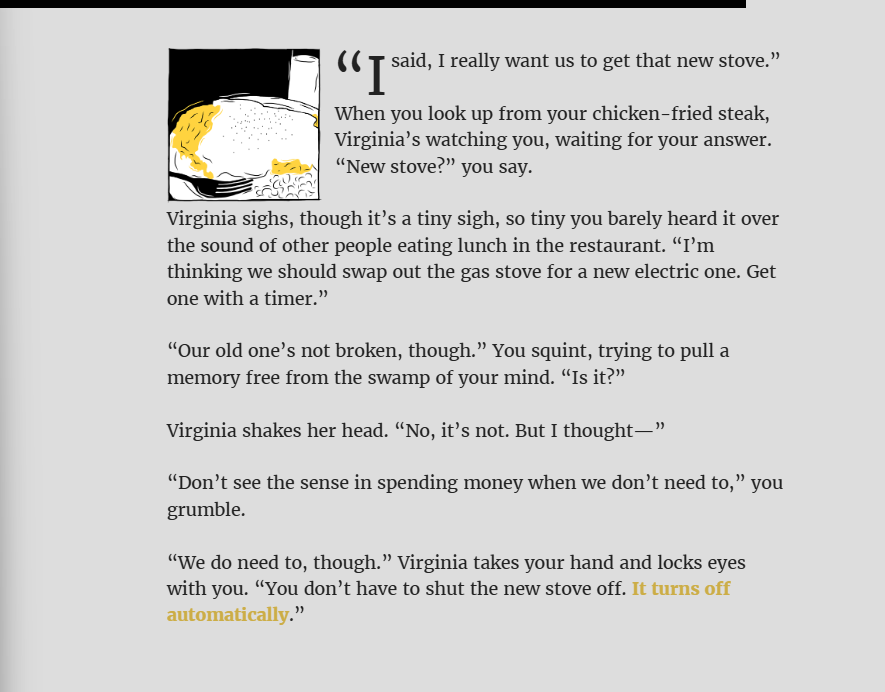
When you look up from your chicken-fried steak, Virginia’s watching you, waiting for your answer. “New stove?” you say.
Virginia sighs, though it’s a tiny sigh, so tiny you barely heard it over the sound of other people eating lunch in the restaurant. “I’m thinking we should swap out the gas stove for a new electric one. Get one with a timer.”
“Our old one’s not broken, though.” You squint, trying to pull a memory free from the swamp of your mind. “Is it?”
Virginia shakes her head. “No, it’s not. But I thought—”
“Don’t see the sense in spending money when we don’t need to,” you grumble.
“We do need to, though.” Virginia takes your hand and locks eyes with you. “You don’t have to shut the new stove off. It turns off automatically.”
Hmm, sounds like it’s a ‘me’ problem.
She’s babying you. Like you can’t take care of yourself. You jerk your hand away from her, accidentally hitting your water. The glass wobbles and almost tumps over. “I know enough to turn off the stove. Don’t need to flush money away because you’re nervous.”
Virginia takes back your hand and holds it tight. She glances around at the other tables in the restaurant, then says, “You’re right. I am nervous. But with reason.” Her thumb massages the back of your hand, tracing small circles over your skin. “We wouldn’t be wasting the money, and it’s not too expensive anyway.”
She knows how tight money is right now. And when they have to place you in a home, you’ll burn through money like it was gas-soaked hay. It makes it hard to give in.
I chose ‘how tight money is’.
You don’t respond, and after a minute, Virginia stops rubbing your hand. You tell her, “We’ve got to live on what I socked away before I
I socked away before I retired. That money’s not growing. I don’t want it to shrink any faster than it has to.”
“Fred, I’ve been tracking our expenses, and we’ve got plenty of cushion, even with—”
“I was the accountant, so I think I know our money situation. We’re not spending more on…
not spending more on…we’re not spending more money, and that’s final.” You cross your arms. “I don’t want to talk about it any more.”
Virginia has a look on her face that means that she’s going to do what she damn well pleases, and never mind what you want. “You said that the last two times, too.”
You don’t remember those earlier discussions. Stung, you snap, “Well, I’ll write it down so I won’t forget.” You pull out your folded stack of index cards and a pen. When you unfold the cards you’re brought up short. The top card reads, “IT’S NOT YOUR FAULT”.
Oh man. Also, I wonder if I wrote that, or if she did.
You’d written the card back when
Ah.
You’d written the card back when—well, hell, you don’t really remember when you wrote it, but it’s a reminder to be easy on yourself.
“Fred?”
You shake your head, your thoughts flying off. Someone’s cleared Virginia’s plates away. A waitress, you guess.
“Fred? Where’d you go just now?”
“Nowhere.”
You take a deep breath. Apologizing hasn’t gotten any easier as you’ve gotten worse. “Virginia, listen, I’m sorry.”
“It’s all right.”
“No, no, it’s not. I’m just not myself today.”
“No, no, it’s not. I’m just out of sorts today.”
“So we can get the stove?”
You nod, glad she reminded you what you’d argued over. “I really am sorry.”
“It’s already forgotten,” she says, with a tilt of her mouth that tells you she knows the joke she just made. It’s how you two deal with your condition, these sideways acknowledgements.
You reply in kind: “Easier done than said,” and you’re rewarded with the brief flicker of Virginia’s smile, like a bird darting fast across your sight.
Virginia’s plate may be gone, but you’ve still got more lunch to work on. You’re not hungry, but you don’t feel right letting it go to waste. You carve off a corner of the chicken-fried steak. It’s a little bland. “Pass me the…
“Pass me the…it’s like sand.
“Pass me the…it’s like sand. Black.
“Pass me the…it’s like sand. Black.” You’re reduced to gesturing at the two shakers over by Virginia. “Black sand.”
Virginia slides a shaker to you, the light over the table catching the grooved parts of the glass and making it sparkle. “Pepper.”
“I know,” you say, and immediately feel bad all over again, but you don’t say anything more for fear of making things worse. You just shake the sand over your lunch. You fork another bite into your mouth, careful to scoop up some gravy from the steak. Much better.
You work on the steak, you and Virginia quiet while you eat. As you get into the steak you realize you’re hungry after all. Probably helps explain why you’ve been so mean.
You’ve near finished your steak when the waitress delivers the check. You hold up a hand and she pauses while you pull out your wallet. But it’s not your wallet. It’s your index cards. You pat your back pockets, but your wallet’s not there.
To buy time to think, you fan out the index cards. “Miss, do you take plain paper?”
“Here,” Virginia says, handing the waitress a $20. “Keep the change.”
As the waitress walks away, you whisper to Virginia, “My wallet. I can’t find it.” You check under your napkin, then on the table before glancing at the floor. No sign of it.
“You didn’t bring your wallet,” Virginia reminds you. “After the last time you lost it, we agreed I’d bring the money when we went out.”
Your anger’s back. It’s the one thing your mind reliably serves up, like a chef’s favorite dish he can’t help but make. The cards are still in your hand. You run one finger along the edge of the topmost card and breathe deep. It’s not your fault. It’s not your fault. It’s not your fault.
“Thanks,” you say. Your tone’s almost civil, hard as it is to be polite instead of mad.
Virginia lifts her napkin from her lap, folds it neatly and places it beside her plate. “You ready to go?”
“Ready as I’ll ever be.”
Again, not commenting on this as much because it’s engrossing. And that’s interesting about the anger again (as was linked above).
It’s warm outside, though a gusting breeze makes you glad you brought your windbreaker. Now where did y’all park? The thought reminds you to pull out your keys, which reminds you that you don’t have any keys, which reminds you not to worry because Virginia drives now.
“Where’d we park—” you start to ask, but you’re interrupted by a black woman calling, “Ginny!” from the parking lot. She dodges around a car creeping past the café and waves one arm as if she’s cleaning a window. “Ginny!”
Virginia adjusts her glasses. “Alma? Alma James, as I live and breathe! How you do?”
“Right fine, Ginny.” She’s no one you recognize, which doesn’t mean much these days.
As if reading your mind, Virginia tells you, “Fred, this is Alma James. We used to teach English together.” She’s gotten real good at spoon-feeding you information like how you’d feed a baby bird.
“Still teaching it, in fact,” Alma says.
“Good for you! I miss teaching sometimes, but it was for the best that I retire.” She deliberately doesn’t look over at you. “How’s Kevin?”
“Fair to middlin’,” she says.
“And your boys? What’s Cordell up to these days?”
“He majored in English down at Texas Tech.”
“Oh?” She tilts her head. You used to claim she looked like
“Oh?” She tilts her head. You used to claim she looked like the RCA dog when she did that. “He was a right hellion in my class, you remember.”
The woman sighs, half exasperated, half amused. “Don’t I know it. But he righted his ship. He’s a technical writer now.”
“Well. As I live and breathe.”
“What about his…brother?” Virginia says.
Alma nods. “Lamar. He’s at UT Austin. Graduates this year, God willing.”
Virginia laughs. “Must be interesting for you, having two sons at two different UT schools.”
“I couldn’t convince him to go to Arlington. He wanted to be a lot further away from home.”
You shift around a bit, leaning more heavily on your cane as you half-listen to Virginia and Alma. Small talk never interested you much even when you were whole. There’s no place to sit out here, and it’s going to be murder on your feet if you keep standing for a while. You might could hint that it’s time to go, or interrupt outright.
Virginia doesn’t really seem to have any memory issues at all, though she had the other ailments earlier. Seems we all get something as we age.
I’ll interrupt outright.
“Virginia, time to go,” you say, a lot more snappish than you meant to be.
“Sorry, Alma, Fred and I’d better…” Virginia says. Regret fills her voice.
“No problem,” Alma says. She looks sad for Virginia, or maybe you. Or maybe you’re imagining it. “It was real good to catch up with you, Ginny.”
“You, too,” Virginia says. “Fred, are you okay to wait here while I get the car?” When you nod, she takes off in one direction and the woman in another. “Nice to see you, Fred,” the woman says as she goes.
You shift your weight some more, trying to get comfortable, or at least as near to it as you can while standing. Your mind drifts off. Left on its own it likes to float further and further away these days. It makes waiting a lot easier than when you were younger. Back then you always carried a book to pass the time while you waited.
A touch on your shoulder brings you back to the here-and-now. A woman’s snuck up next to you. The waitress. Didn’t Virginia pay? Maybe she forgot, or you told her you’d take care of it and then you forgot. That seems more likely. But you don’t have any cash on you. A while back you stopped carrying it when eating out with Virginia.
“Hold on a moment, please, miss. My wife will be right back with the car.”
“Fred?” the waitress says. She sounds as confused as you feel.
“With the money. She’s got our cash. She can pay for our lunch.”
“Fred, it’s me. It’s Nipper.”
Memory sparks. That was the RCA dog’s name! “Did you know, that’s my wife’s nickname! Gave it to her…
Uggh.
Memory sparks. That was the RCA dog’s name! “Did you know, that’s my wife’s nickname! Gave it to her…oh, ages ago.” Funny to think someone actually named their daughter “Nipper.” It takes all kinds.
“How about I take you to your wife,” the waitress says, pointing to a car idling by the curb. It’s an old powder-blue Buick, a lot like the one you used to drive back when you drove.
You’re not sure. Shouldn’t you wait for Virginia instead of going off with this stranger? Then again, more and more people are strangers to you lately.
Really reminds me of the fiction podcast ‘The Truth’, the episode ‘Can You Help Me Find My Mom?’
I’ll go with the nice lady.
“You’ll take me to Virginia?” you ask the waitress. “You’ll have to help me in the car since my legs don’t quite work right. Virginia normally does that.” Virginia always lets you lean on her a bit as you get in, though you try not to put too much weight on her. She’s a slight thing. Can’t hold you up forever.
“I’ll help.” And she does, making sure you get in the passenger seat okay and buckling your seatbelt for you before she gets in the driver’s seat.
“Is she far? Virginia, I mean?”
“She’s close, Fred. It’s all fine.”
“She’s close, Fred. It’s all fine.”
Her voice is what brings you out of your episode. “I’m so sorry, Virginia, I just…went away for a minute.”
She just sits there, staring out the windshield, before she slaps the steering wheel once with her hands, hard, and then again, and again and again. She bows her head and clutches the wheel so tight her knuckles turn white. Her chest rises and falls as she breathes deeply. “It’s all good,” she whispers. “I’m fine.”
“You’re not fine,” you say. “Believe me, I know neither of us is fine.”
“I’m just so angry now. Bone-deep angry.” She won’t turn her face to you. Her voice is level and she doesn’t look mad, which is how you know she’s truly angry. “It’s never-ending. It’s never-ending and there’s nothing I can do and it won’t get better. It just won’t.”
“I know.”
“Do you?” She faces you now. “Every day there’s less of you to take care of yourself, and more of you for me to take care of. There’s no break and no way out. We’re in a dark tunnel and the tunnel keeps getting narrower as we go through it. I try not to dump this on you, I do, I swear I do, but there’s only so much bitterness I can swallow before I have to spit some back up.
“If you do know, here in a while you won’t any more. You’ll be gone, even while you’re still here.”
The silence fills the car, thick and oppressive, a fog of misery you’re both lost in. You pull out your index cards again and riffle through them as if to blow the fog away. You peel the top one off the stack and wordlessly hand it to Virginia.
“I thought this message was for you,” Virginia says.
“It’s for us both. Listen, why don’t you call Rebecca? See if she can take a few days off and watch me while you take a break. What use are kids if you don’t make them do stuff for you every now and again?”
She holds the card in her lap and chews on her bottom lip the way she does when she’s worrying at a problem. “That might be nice.”
“Call Leigh and the others. Been a ■■■■’s age since you played bridge with them.”
The silence returns for a minute, though it’s less heavy than before. “I can do that,” she finally says. “Let’s get home and maybe take a nap.”
“Then put it in drive. It’s like I always say: If you’re not moving forward, you’re backing up.”
She laughs a short, sad laugh, hands you your card, and drops the car into gear. You put the card back on top. The words “IT’S NOT YOUR FAULT” have run just a bit, now sprinkled with drops of water.
This section has been very heavy on dialogue and material between choices. I feel like the author has chosen this as the climax section, putting the hardest-hitting stuff.
The screen pauses for a moment, but I don’t believe the progress bar has shifted. Is the color a tinge darker? hard to tell.
Tom drums on the passenger-side car dash. It’s just arrythmic enough to annoy you. The man never could sit still. “I don’t understand why Tuberville’s team is flaming out like it’s been doing,” he says.
“Too much passing,” you say, squinting at the road. You should reach the street to Waffle House soon. “Can’t get anything going on offense.”
“Bet you’re glad not to be there watching them lose all the time,” Tom says.
You shrug. “I’m an Ole Miss fan even when they’re terrible.”
“That’s good, I guess, because this year they’re really terrible,” Tom says. “By the way, you’ll want to take a left at the next cross-street.”
I know so many older men who get really mad at people giving them directions while driving.
“I know how to get there,” you snap.
“Sure, but like you told me, you don’t always know what you know. We missed Spring Creek, so we’ve got to double back around.”
You start to say something mean, but pull up short at the last second. He’s right, of course. Thankfully, since you made up with Tom, you’ve been better at catching your words before they escape. “Sorry,” you say.
“No problem, Fred,” Tom says.
“You know, this reminds me of when I got us lost in the wilds of downtown Houston on that sales call. I’ll never forget
I’ll never get over how you looked when you realized I’d made us late for the meeting.”
You glance over at Tom. He’s frowning. “What?” you say. You realize what’s wrong. “That was Dick who made you late, not me, wasn’t it?” You sigh. “That’s the problem with having a patchwork brain. Sometimes you patch it with other people’s memories.”
Huh, didn’t know that was part of it.
“Don’t get all fussed,” Tom says, “it was you on that sales call, not Dick.”
You feel a mix of relief and annoyance. “Well, hell, Tom, then why the frown?”
“That was a potential million-dollar client.” He makes a thoughtful sound. “Tell you what, keep going straight. We’ll take a road trip back to Houston, win the guy over.”
“It’s a bit late for that, don’t you think,” you say.
“It’ll be great. Think of how excited Paul will be when we show up, contract in hand.” Tom would try it, too, just on the off-hand chance it worked.
God, it’s great to be back in a car with Tom.
The cross street’s coming up. You slow down and make the left turn. “Direct me from here?”
“Like always,” Tom says.
The screen has gotten very dark now, and it looks like we’re going to be in the final segment.