I’ll admit, I’m being a bit intentionally obtuse on this puzzle, because it’s one I know the answer to. (Just this puzzle, though—not knowing you could go east in the Hangar or find the box under the hat was entirely my own ignorance.) It’s a bizarre one, so if nobody gets it by mid-day tomorrow I’ll provide some more nudges.
2 Likes
Orville Wright’s mandolin…
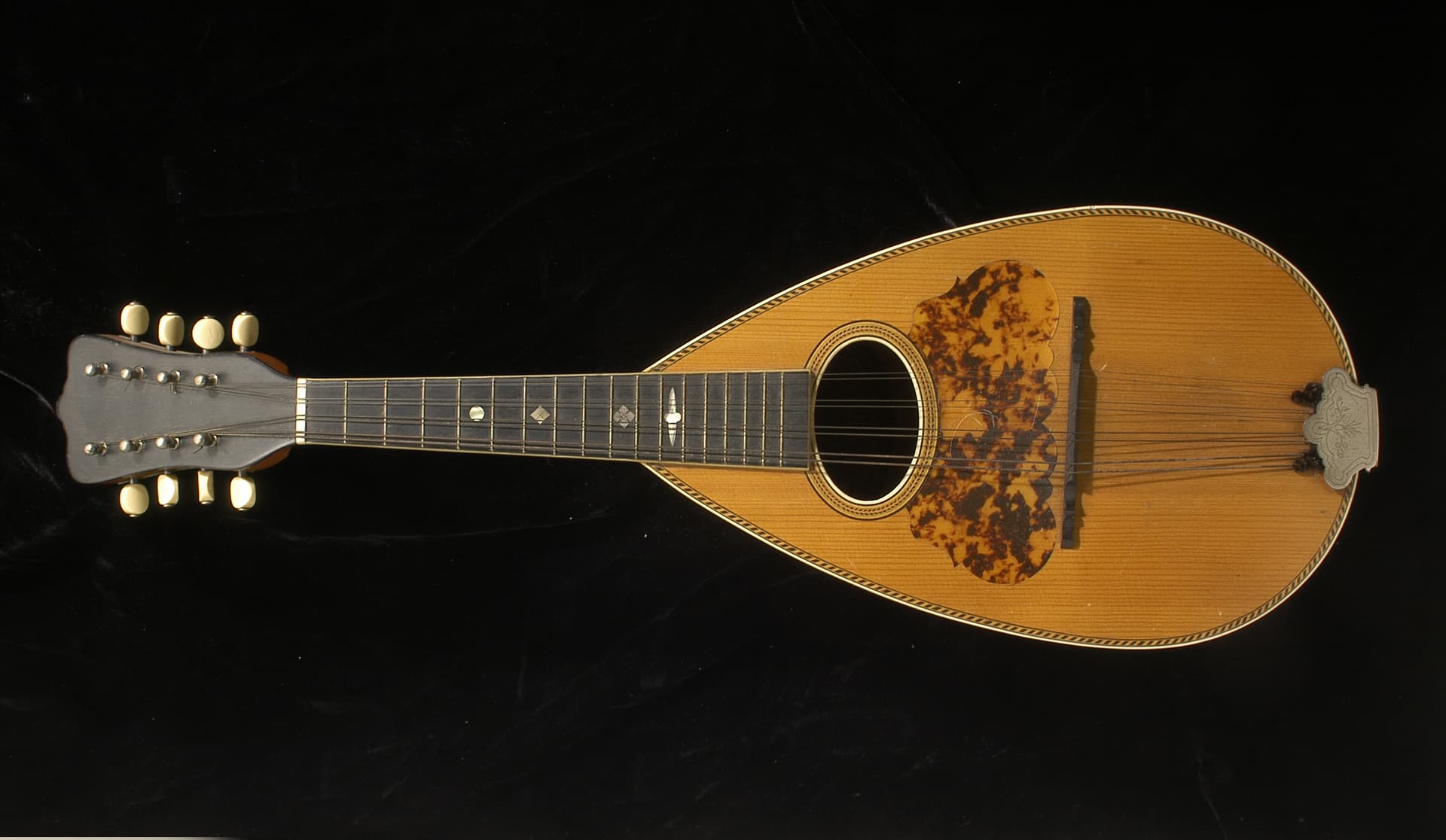
“Orv has begun lessons on his mandolin and we are getting even with the neighborhood for the noise they have made on pianos. He sits around and picks that thing until I can hardly stay in the house.”
– Katherine Wright, 1900
I guess you’ll need a bit of practise to master this instrument.
1 Like
You’re right, we shouldn’t expect to master the mandolin on our first try, surely?
>play mandolin
You pluck at a few strings, making discordant twangs at best. The mouse scurries by, glances at you pityingly and disappears back into the wainscot.>play mandolin
Rather badly, you pluck out “Home on the Range”. The mouse scurries by, glances at you pityingly and disappears back into the wainscot.>play mandolin
Really rather well, you launch into “Muleskinner Blues”. The benefits of practice are amazing. The mouse scurries by, glances at you pityingly and disappears back into the wainscot.>play mandolin
With stately aplomb, you pick out the slow movement of Vivaldi’s Concerto RV 532 in G Major. The mouse scurries by, glances at you pityingly and disappears back into the wainscot.
It’s an instrument that takes at least five minutes to master. Maybe even six!
This is the puzzle I was being cagey about last time. I’d originally thought that we just couldn’t play the mandolin at all, but no—you just need to play it five times to get good. This is another one that I would consider distinctly unfair by modern standards, because there’s no indication that trying again would give a different result. (If I were doing this nowadays, I would change the description of the first failure: say that it sounds awful but you feel like you’ve almost got recognizable notes, for example.)
Now, we can’t take the mandolin directly out to the west, because Wilbur makes us put it back.
>w
“Hey,” Wilbur says, “You leave Orville’s mandolin alone!” And you are obliged to return it to the hangar before proceeding.
I tried playing it out in the dunes, but Wilbur grabs it as soon as he lands.
>play mandolin
With stately aplomb, you pick out the slow movement of Vivaldi’s Concerto RV 532 in G Major. Wilbur has to listen to quite enough of his brother’s caterwauling without any of yours as well, and angrily grabs Orville’s mandolin away from you.
So maybe we’re not quite as good as we thought. But this seems like it should be a good distraction, right? Wilbur specifically takes it away from us, while Orville yells at us to put it back.
There seems to be a 10-turn-long cycle of actions here:
- Orville gets into the plane
- Wilbur runs it downhill
- Wilbur says the headwind speed is too low
- Wilbur drags it back uphill
- Both of them inspect the plane
- Wilbur gets into the plane
- Orville runs it downhill
- Orville says the headwind speed is too low
- Orville drags it back uphill
- Both of them inspect the plane
Which means there might be a two-turn window when Orville isn’t around to object: the second and third of these. Going to retrieve the mandolin takes five turns (E. E. GET MANDOLIN. W. W.), so if I leave as soon as Orville runs it downhill…I think that will put us at the right moment.
>w
“Hey,” Orville says, “You leave my mandolin alone!” And you are obliged to return it to the hangar before proceeding.
[…]
The brothers shake hands as Orville climbs into the “Flyer”, lying flat on his face on the bottom wing.
One turn too early. So let’s wait until after it launches to do our actions…
>w
“Hey,” Wilbur says, “You leave Orville’s mandolin alone!” And you are obliged to return it to the hangar before proceeding.
Or not. Okay, maybe if we go distract them when they land?
>z
Time passes.From above, the “Flyer” is launched along the rail, and the engine carries it just stable above the sand dunes. But after ten seconds or so, Orville grazes the ground with a wingtip and comes to rest not far from where you’re standing.
>play mandolin
With stately aplomb, you pick out the slow movement of Vivaldi’s Concerto RV 532 in G Major. Orville is impressed by your bravura performance. “Hey, Wilbur, this is good!” he calls out to his brother uphill (who is less pleased but fortunately possessed of iron patience).
Okay! So if we wait for Orville to land (the music appreciator of the two), we can distract him down here! I’ve played three turns of music, and now let’s see what happens next time.
>z
Time passes.Orville shakes his head. “Not enough lift, that’s the trouble.”
>z
Time passes.Wilbur and the spectators arrive from up-hill to help drag the “Flyer” back to the rail.
>z
Time passes.Up on the hill, the brothers are checking out the “Flyer”.
>z
Time passes.Up on the hill, one of the brothers gets into the “Flyer”.
>z
Time passes.You watch, amazed, as Wilbur soars over your head in the “Flyer” and heads north, finally coming to rest on Little Hill. He gets out, jubilant, and rushes past you to join the others up at the launch rail.
[Your score has just gone up by one point.]
Success! We got the cycles aligned!
Let’s go celebrate!
>s
“Hey,” Orville says, “You leave my mandolin alone!” And you are obliged to return it to the hangar before proceeding.By the Railing
On the shallower northern slopes of Big Kill Devil Hill, thirty yards or so to the west of a wooden hut.The brothers are jubilantly celebrating their first powered, controlled flight.
The spectators are shouting and cheering.
Spoilsport.
But, they didn’t bring the Flyer with them! Which means we can go over to North Hill and steal its control surface!
The “Flyer” rests unattended on the windy dune, after its first successful powered flight.
>get control
Just as jubilant as the Wrights, you manage to pull away the loose aileron and are rewarded with another jigsaw piece. But Fate intervenes as the wind blows up, catching the untethered glider, blowing it hard down onto the beach in a twisted mangle of wires and canvas, nearly strangling you in the wreckage…The Wrights and the spectators manage to extricate you and drag away the mess for inspection (surprisingly cheerily, as they lose gliders all the time). You succeed in being left behind when the others rush away to the Kitty Hawk post office to send a telegram to the world.
Atlantic Beach
Down at sea level, the sand is wet and an effort to wade through. The slope rises to the west, where a path winds up to a wooden hut. The vast ocean is choppy and boatless. Regular gusts of wind blow up great waves.[Your score has just gone up by one point.]
We wrecked the “Flyer”, but not history! And that’s what matters!
And now that they’ve left, let’s go blow up their hut!
Remember how the towel didn’t fit over the air holes? Some experimentation reveals that the corn bread does: we can plug the holes with it. (Though I’m not entirely sure how, because the corn bread I’m familiar with would just disintegrate if you tried to stop something up with it: it doesn’t have the gluten holding it together like wheat bread does. Maybe this old-timey stuff is more cohesive.)
>put bread in holes
Breaking off some of the corn bread, you plug the air holes tight. Black smoke begins to emerge from the top of the heater as the fire splutters. Before much can happen the mouse runs in from the kitchen, seizes the corn bread and makes off with it. The fire recovers cheerfully.
>:(
>shake powder
You give the box a good shake, sneezing as the horrid powder scatters into the air.>put bread in holes
Breaking off some of the corn bread, you plug the air holes tight. Black smoke begins to emerge from the top of the heater as the fire splutters. The mouse runs in to look at the corn bread but is repelled by the vile smell. Foul black smoke begins to gush out of the hut, filling the air while you cough and weep. And then the heater explodes, not very dramatically, just falling to bits on the floor of the hangar. While you stamp the fire out, the smoke clears.[Your score has just gone up by one point.]
This gets us a “creased edge piece”: oh no, did we damage it? Examining it doesn’t tell us anything special, and unfortunately that turn spent examining means we just barely miss the time window, which opened off to the west. We’ll have to visit the Land some other time.
For now, though, we have two new pieces and two new animals sketched! Back to the Monument we go!
>turn on alarm
The latch on the clock is now on.>set clock to 1
You shorten the time left on the clock.Suddenly you are wrenched out into the time vortex once more, and find yourself back…
We have a center piece and an edge piece, and there’s only one possible place for the center piece to go: B2, where it lights up with “a silver USAF-marked plane”. (United States Air Force, right?)
The edge piece (“perhaps depicting the side of a plover’s egg”—that’s a new one!) has a few more options. For once, we don’t get it on our first try, so our lucky streak is broken. But it fits at d3, showing “fields of cabbages”.
And last but not least, our footnote:
[ Footnote b2: ]
Wilbur and Orville never repaired “Kitty Hawk Flyer”, after one of the spectators was nearly strangled by the wreckage blown onto the beach, but built other planes. They did so in secret from the press, which tormented them with exaggerated or wholly made-up stories: they wasted years patenting the many technical breakthroughs they’d made, refusing to show their design to anyone until then. Few believed their claims of powered flight, and by 1908 the French papers were calling them “les bluffeurs”: but after a demonstration they became the heroes of Europe. (The craze swept France: Proust, writing at the time, killed one of his characters in an aeronautical accident.) Eventually the brothers did make money, winning a dozen protracted lawsuits, but their fame was always greater.
(Orville grew fond of the mouse he failed to trap, and started to feed it instead. It’s true about the mandolin, too.)
Wilbur died of typhoid in 1912, but Orville lived to 1948, long enough to fly a four-engine airliner and see the first rockets.
In about 1930 a granite boulder was planted marking the first launch site, and now the area has been restored and called the Wright Brothers National Memorial.
The remains of the original “Flyer” came to the Smithsonian in 1949, after a stay in the Science Museum, London (because of the Smithsonian’s fraudulent attempt to claim that Langley’s plane had been first after all, by faking the evidence: it later apologised). They have all but one square of canvas, which Neil Armstrong laid on the Sea of Tranquillity after the landing of Apollo 11.
Huh, so we ended up in the historical record, as the spectator who almost got strangled! That’s a very nice little detail: giving the player character a reason to play a minor but documented role in history. And we sketched not just any mouse, but a historically-important one!
Despite the underclued puzzles (and the mild frustration of going back and forth for the mandolin every time), this may be my favorite section yet. You never need to save and restore, there’s a nice hint to the overall puzzle (the bottle in the ocean floats in and out on a three-turn cycle), and that puzzle is based on historical details about the people involved. Very nice.
Here’s our grid:
          1            2            3            4
   +----------------------------------------------------+
   |.............                          ooooooooooooo|
 a |.   Mould                                  Park    o|
   |......o......                   o      oooooo.oooooo|
   |ooooooooooooo...... ......ooooooooooooo.............|
 b |o  Invalid  ..   Dunes   ..   Plane   oo   Snow    .|
   |oooooo.oooooo.............oooooo.oooooo...... ......|
   |.............oooooo.oooooo.............             |
 c |.   Glass   .. Carriage  oo   Train   ..            |
   |.............ooooooooooooo.............             |
   |      .            o      oooooo.oooooo             |
 d |                         oo  Fields   oo            |
   |                          ooooooooooooo             |
   +----------------------------------------------------+
10.txt (41.8 KB)
10.sav (2.1 KB)
(No changes to the map this time. I think I finally got all the rooms, and most of the connections!)
3 Likes
The unsolved tiles are b3 (“a silver USAF-marked plane”, 1954), b4 (“white folds of snow”, 1975), c3 (“a racing steam train”, 1917), and d3 (“fields of cabbages”, 1941). When shall we go next?
- Air Force plane
- Snow
- Steam train
- Cabbage fields
0 voters
1 Like
----MY CABBAGES!----
2 Likes
Wow, I would never have guessed to use the mandolin. But it’s a neat solution!
3 Likes
As a side note, I’m going to be breaking any ties in favor of the steam train, because we got that piece a while ago and I want to see what it’s about. But for the most part the order of the vignettes doesn’t matter in this game (there are just a few where it does) so I don’t think we’ll break anything if we do something else first.
3 Likes
Nice job solving this – it is a neat puzzle and I can see how there are enough cues to prompt you to the solution, but it’s still a tricky one even if you know you need to practice to get good enough on the mandolin (what happens if you try to regale Orville before you know what you’re doing?)
Yeah I think there was a 19th Century version of cornbread that was a bit more like a biscuit/hardtack; there’s also a modern northern/southern cornbread divide, so you might be imagining the northern stuff which is substantially crumblier than the southern version (if Dr. Nelson’s research got to this level of granularity, I have to say I’m very impressed!)
I like this stove puzzle too – multiple steps, but they each make sense and build on each other so I’m guessing it feels satisfying to work through.
Ugh, sure feels like there’s only one thing this can be – definitely a tempting target to try to do something differently.
This must be the mid-80s Cabbage Patch Kids craze, right?
3 Likes
I’m definitely thinking of the northern style; as a proud northern-Illinoisan I refuse to acknowledge that barbarous southern-Illinoisan food. (Or perhaps there’s just not as much of it around here. Take your pick.)
My best guess is Hiroshima—is that where your mind went too, or is there something else? I actually predict we won’t be dealing with nuclear weapons because Trinity put so much focus on it and this game is very much structured as an homage to that one.
2 Likes
Yeah, or Nagasaki (as the second target there’s probably a stronger case that stopping its bombing wouldn’t change history that much and would prevent an incredible amount of suffering). But as you say I thought given this is ground Trinity’s already plowed we might be steering clear.
3 Likes
Since I’m planning to do another session later today, I’m going to give you all (and myself) another hint: the year of each place.
The USAF plane is 1954, the snow is 1975, the steam train is 1917, and the cabbage fields are 1941.
None of these years actually mean anything to me, but those better-versed in history may notice something!
2 Likes
Oh, that shifts things substantially!
Not Hiroshima or Nagasaki then – '54 was the Bikini Atoll H-Bomb test though.
Huh, that feels pretty late for polar exploration to be the turning point.
That’s a big year in U.S. politics (Watergate fallout, the end of the Vietnam War) but I’m not thinking of anything this could be.
I’d flagged the Russian Revolution above as a key turning point and this is the year – I’m not sure of any particular link to a train though (some White Russians fleeing?) And of course there’s a lot of WWI stuff still happening.
Well that’s WWII – Pearl Harbor is at the end of the year, and the Brits had been in it for a while (the Blitz was ongoing). 1941 is also when the Nazis launched Barbarossa, which was definitely of historic significance and they do grow a lot of cabbages in Russia from my dim understanding of their cuisine so that could be it?
All of these are once again biased towards politics and war since that’s the stuff I know best, of course!
4 Likes
The steam train is winning 3-2-2-1, so that’s our next destination! The status line in the monument is currently at 46/10/733 (points/pieces/moves), and our full score comes from:
16 points for opening the monument, revealing the board, lighting the board, entering the time vortex, meeting Black, triggering off World War One, rearranging the deckchairs on the Titanic, sending a distress signal, passing on a secret diplomatic letter, ensuring safe passage of the letter, entering the Land, bringing mould to attention, dancing with Black, regaining “Le Temps Retrouve”, scheduling aviation and plugging the heater;
10 points for recovering jigsaw pieces;
10 points for playing jigsaw pieces;
5 points for finding sundry items;
5 points for visiting various places
And we’re off!
>set clock to 59
The clock starts, silently and slowly, and the jigsaw board pulses with a flickering amber light, warm and erratic as though from an oil lamp.>press c3
The piece at c3 presses in smoothly, like a button, then releases. You are sucked up once again into the time vortex. As you slow down, you briefly make out John Steinbeck’s novel “The Grapes of Wrath” being printed and then everything begins to change…[Press SPACE to continue.]
Off to…
Chapter Six - No Compromise
Corridor of a Steam Train
Before you have a chance to look around, a stooped man with a worker’s cap stamps towards you from the north, hurls a newspaper to the ground with disgust, tramples it with new boots and wanders back where he came.This is the corridor of a steam train rattling its way south through icy wastelands. To the north and south are carriages, and there are compartments east and west.
Pravda lies crumpled on the floor.
Always convenient to have a periodical to tell us exactly when we are! (And also vaguely where we are—I wouldn’t expect Pravda outside Russia.)
This is the April 15th, 1917, edition of the Bolshevik newspaper “Pravda”.
Although the editors, chief among them Stalin, are full of historic language about events since the Army mutiny and the Tsar’s abdication last month, they come down on the side of Alexander Kerensky’s moderate Provisional Government. If only all men are reasonable, then Socialism will advance peacefully.
Hopefully all men will be reasonable, and things won’t have to get violent. That would be nice.
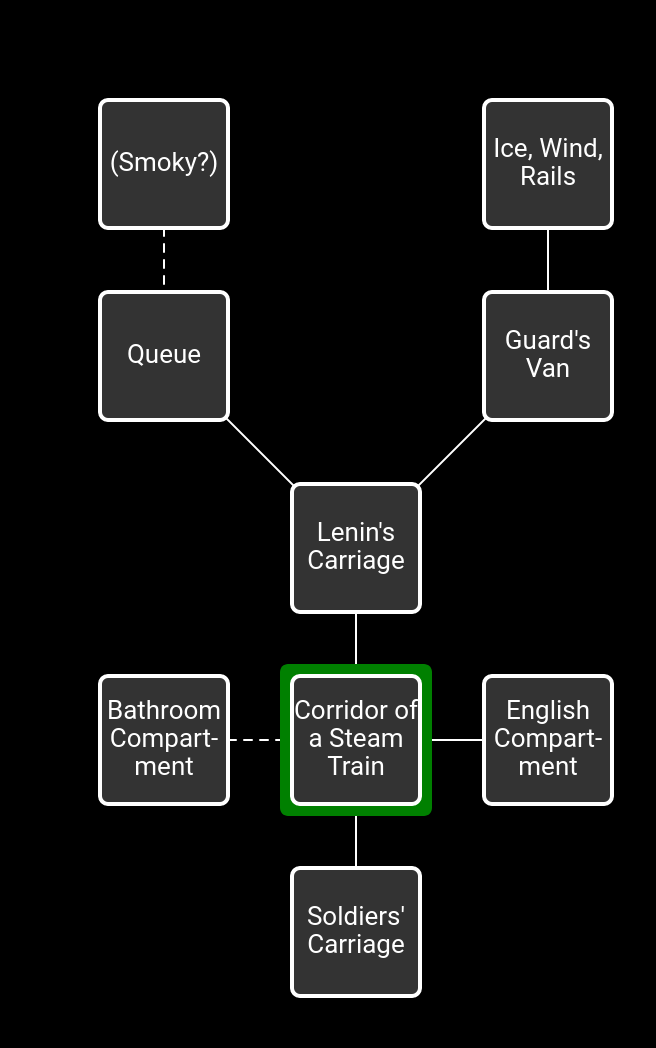
I’m going to spend this first session exploring and making a map, and then we can figure out what we’re actually doing here. From the sounds of it the Russian Revolution is already in full swing, but I don’t know enough about the details to say what’s supposed to happen in April. Would this be Lenin coming back onto the scene?
(The short version, to my understanding: the revolution started with riots against the Tsar. The Romanovs utterly failed to handle this and he was forced to abdicate; this “Provisional Government” is what replaced him. Then Lenin came in and under his leadership the Soviets (workers’ councils) overthrew the Provincial Government—and in the process set off a civil war. Do I have that generally right? I am very much not a historian.)
>e
English Compartment
The compartment of an English gentleman, incongruously enough. There is no sign of the gentleman, though.An Army uniform is laid out on the narrow bed.
There’s a heavy black Army trunk in one corner.
Ooh, a disguise! An English army officer will definitely blend in in 1917 Russia.
>wear it
Over the top of the Sixth Officer’s jacket?
Fair. That would look a bit ridiculous. Gotta take that off first.
You disguise yourself as an officer in the British Army. The effect will pass, if nobody looks too closely.
Searching the trunk gets us “a little stick of a key”, and more keys are always good. Let’s try the other direction.
>w
You can’t, since the west compartment door is in the way.>open west door
It seems to be locked.>unlock west door with stick
You unlock the west compartment door.>w
You can’t, since the west compartment door is in the way.>open west door
You open the west compartment door.>w
Bathroom Compartment
An old-fashioned, tight, enamelled bathroom, consisting little more than a sink and a mirror.A man is bound and gagged, wriggling on the floor. He looks extremely angry at the sight of you.
[Your score has just gone up by one point.]
Oh!
>x man
Tanned, British, angry, helpless.
So someone tied up this officer and threw him in the bathroom…why?
It’s very convenient for us, but I have to wonder what their plan was. Maybe this is Black’s meddling.
>search him
You submit the officer to this further indignity, and are rewarded with the discovery of some kind of travel permit or visa.
A visa?
>x visa
A third-class ticket and some kind of visa:“Depart Bern, 1100 8 Apr
Zurich, 1510 9 Apr
Halle – Berlin –
(passengers must not leave car)
Sassnitz–Trelleborg overnight ferry
Stockholm 2100 14 Apr
(cross River Torniojoki by sledge to Finland)
Depart Tornio for Byelo-Ostrov border post
Arrive Petrograd, 2310 16 Apr”These details are counter-signed by the German minister Count Ulrich von und zu Brockdorff-Rantzau.
Google tells me this was the Foreign Minister of the Weimar Republic, but I have no idea how they felt about the Russian Revolution.
Anyway, I’m sorry, but this is all for a good cause. You’ll thank me later. Just think of it as a sacrifice for the eternal glory of the British Empire or whatever.
>hug man
That’s it, kick a man when he’s down.
Yeah, that might not come off well when we’re wearing his stolen uniform. Fair point.
Let’s check out the other carriages.
>n
Lenin’s Carriage
About thirty people travel in this carriage, grouped into fours. Most of them stare out at the icy Baltic wastes, nostalgic for their homeland, or sing the Internationale softly to themselves.At the north end, there are two passageways, northeast and northwest.
The Bolsheviks’ leader is clearly the short man, proudly wearing a worker’s cap, who sits making notes and hardly glances at the windows: Vladimir Ilyich Ulyanov, or Lenin as he will some day be known.
The man himself!
Familiar from old USSR postage stamps and bronze statues.
I’m quite sure he’s not supposed to be assassinated yet, but he’s probably the key to whatever is happening here. (While going through the inventory I also realize we stole Orville’s mandolin from history. Oops. Hopefully that doesn’t ruin anything—maybe he just gets a new one to celebrate his success?)
Anyway, more exploring!
>ne
Guard’s Van
An empty, rattling cage of a compartment: the guard’s van. To the north is a door leading out to the train’s rear end, to south are the carriages.A little boy, with Dmitri embroidered on his jump-suit, sits playing here.
You can also see a blank piece of paper here.
That’s probably important.
>get paper
(the blank piece of paper)
Dmitri sits on the paper, protectively.>dmitri, privjet
Dmitri smiles and sings on.
Now, if I remember this right…
>dmitri, dajte mne eto
Dmitri smiles and sings on.
We probably pronounced it wrong. How do you say “it’s for the good of the fatherland” in Russian?
>n
Ice, Wind, Rails
You stand on a kind of wrought iron balcony on the back of the train, in the open Baltic air, white wind rushing past, the silvery rails disappearing among drifts of snow in the distance. It is breath-taking, and fearfully cold.
I gotta say, that’s a great room name. Very evocative in very few words.
I don’t see anything we can do here, so back to exploring!
>nw
You join a queue of ten passengers, which blocks the passage-way here.In Queue
You stand in a long, patient queue to one corner of the carriage. The passengers stand clutching slips of paper signed by Lenin.
A queue, eh? As a good British citizen we know what to do here!
>z
The queue shuffles forward, and there are now nine passengers in front of you.
Jolly good.
>z
The queue shuffles forward, and there are now eight passengers in front of you.
As it should be.
>z
The queue shuffles forward, and there are now seven passengers in front of you.
Okay, I won’t actually make you read all of this. Eventually:
>z
You’re now at the front of the queue, next to the door which should open soon.>z
The door opens as a passenger leaves and files south past the queue into the carriage.Inside, you catch a brief glimpse of… a very smoky compartment, but before you can enter the passengers see you have no signed chit and push you back.
So we need to get something signed by Lenin.
There’s another carriage to the south, which we can check out using our disguise:
>s
Showing your travel papers to the Russian soldiers who fill the southern compartment, you pass down the train to…Soldiers’ Carriage
This shabby old third-class carriage, at the front of the old steam train, is packed with soldiers of the Russian Empire.The soldiers are tired out and slumped lazily over their packs, but they’re used to billeting wherever they can.
One of the soldiers has left a piece of paskha, or cheesecake, on one side.
Ooh, paskha!
>get paskha
Don’t you think it rather rude, and dangerous, to take the last piece of cheesecake, uninvited and all, from an entire carriage full of battle-scarred soldiers?
Fair point. Thanks, narrator.
I haven’t found any other directions I can go in, so I think this is our map. Any idea for what we should be doing? There’s one piece and no animals to be found here.
2 Likes
Hey, finally one I got sorta right! Also not an era I know too much about, but yes, this is Lenin returning from foreign exile during the period between the February revolution - which led to a “moderate” provisional government - and the more famous October one (immortalized as Red October).
Hmm, I also don’t know the full context here - the “tanned” detail makes me think this is based on a real person - but big picture, in the complex web of WWI alliances Russia was fighting Germany and thus de facto on the same side as Britain. Lenin’s return would of course be seen as a destabilizing event, thus Germany (where he’d been hanging out iirc) would be happy to export him so he could cause chaos, while a British spy would likely be trying to undermine him (likely not stooping to assassination but perhaps feeding information on his actions to the government). So likely he got those travel papers under false circumstances.
As to what Black’s up to - if you were trying to change history you’d presumably want to make life harder for Lenin rather than easier at this stage. So maybe Black’s trying to maintain the status quo and this British agent’s intervention is ahistorical. Or perhaps the idea is to somehow strengthen Lenin’s position vis a vis Stalin to prevent the latter from coming to power; that’s be tricky though since that won’t happen for a number of years and Lenin’s declining health is a major cause (Lenin wasn’t assassinated).
Hmm, presumably get the cheesecake, swap it to Mitya, get that paper signed by Lenin, and make it to the head of the queue? We might need to do some forgery to turn the autograph into something official-looking, I suppose - perhaps we can untie the spy and enlist his help?
As to how to get the cheesecake in the first place, I dunno - maybe ask nicely? Or maybe that warning is a paper tiger and we can just try to take it again.
EDIT: maybe we can go UP from the Ice, Wind, Rain location? I feel like getting on the roof of a train is always helpful, albeit a bit dangerous given the conditions.
2 Likes
> ask soldier for cheesecake
“Go on, tovarisch, take a slice. Happy Easter!”You thank them.
…I was definitely overthinking this.
2 Likes
x boy
Presumably, he’s the young son of one of the Bolsheviks: whose, you couldn’t say, though a tag on his jumpsuit reads DSCH. He sings softly, and you can hardly make out the words.
I think the boy is supposed to be Dmitri Shostakovich, born 1906 and 11 at the time. DSCH was his musical signature and motif.
What he is doing on the train, sitting on a blank paper, eludes me.
2 Likes
“Years ago, my mother used to say to me, she’d say “In this world, White, you can be oh so so smart, or oh so pleasant.” Well, for years I was smart… I recommend pleasant.”
2 Likes
Haha, I was just looking up that clip yesterday. What a fun movie.
2 Likes
We are now in possession of a wedge of paskha, which we can eat if we want to:
Smooth, creamy, delicious. The best thing you’ve eaten since Century Park.
But this consumes the entire thing, which is probably not the correct course of action. Instead:
Let’s give this a shot!
Untying the British officer isn’t the answer:
> untie man
Quickly you loosen the bonds of the officer. Then, even more quickly, he grabs you, ties you up, frog-marches you to the Russian soldiers and you are imprisoned all the way to Petrograd… where you spend the great year of 1917 in a police cell, until you’re shot in a chaotic misunderstanding at the height of the October revolution.*** You have died ***
So it seems we’ll need to keep up this impersonation a bit longer. I also don’t know much about how British military officers are supposed to act, so I might have to hit up my ex. Back in college she was an English major.
(Ba-dum tsss.)
If we give the cake to Dmitri he immediately eats it. If we show it to him, he seems interested, but still doesn’t respond to a request for the paper. Maybe he doesn’t speak English. (I wondered if there was some translation convention going on here, but we are impersonating a British military officer after all.)
But, there is the area to the back of the train. Maybe we can lure him there?
Sadly not. So we’ll have to find some other use for this place.
I tried dropping the paskha here to lure Shostakovich away from the paper, but he doesn’t notice. Dropping it in his location also doesn’t get his attention. Amusingly, we nod politely to our hosts every time we take the paskha, even if there’s nobody around (like in the back of the train).
After a bit of trial and error, it turns out Dmitri actually does get off the paper if you feed him the cake, so now we’ve got a blank sheet of paper.
Now all we need is a signature—
> lenin, sign paper
Lenin insists on no conversation in the carriage, and he’s a man of extraordinary will-power.
Well, who needs conversation?
>show paper to lenin
Hardly looking up, Lenin signs the paper. You are now the proud possessor of a chit.
Now we can see what’s so exciting to the northwest!
After ten turns of waiting in the queue:
> z
The door opens as a passenger leaves and files south past the queue into the carriage.Smoky Compartment
Your eyes swim in this fog of cigarette smoke. The last tiny berth of the train has been converted into a smoking car, but there’s only room for one at a time, half-sitting on the bunk.Ash is heaped up in an old grey ash-tray.
Your eyes swim.
[Your score has just gone up by one point.]
Grey, you say?
The ash tray is wide, square and grey.
Well that was easy.
>get tray
(putting the lump of corn bread into the canvas rucksack to make room)
You shake the ash out of the tray, and pick it up - a jigsaw piece!There’s a knocking at the door from the next passenger.
[Your score has just gone up by one point.]
That was easy! Now we just have to…
>out
But you aren’t in anything at the moment.The knocking gets louder and more irritable.
>s
Fresh air! What a relief.The passengers, annoyed, search you to find the ash tray, and relieve you of it. You’re pushed back south, still protesting the loss of your jigsaw piece.
Dammit.
I haven’t found anything else in the room we can interact with, and even putting the piece in the rucksack doesn’t help: their search is very thorough. Which makes me think we need some way to hide it. But how?
It seems like that balcony at the back of the train should be relevant, but there’s no window in the smoking room, and I can’t find anything on the outside either. Though there is another amusing death:
>jump
You leap out into the wind and ice…(Of course, writers of adventure stories like Dornford Yates and John Buchan will be rather popular soon, with their heroes punching smugglers, foiling spy rings, unmasking Bolsheviks and (as need arises) leaping from speeding trains.)
…and you ricochet into the vicious permafrost, smashed by the force of the ground, without even the time to freeze or bleed to death.
*** You have died ***
What to try next?
New map and transcript:
11b.txt (17.7 KB)
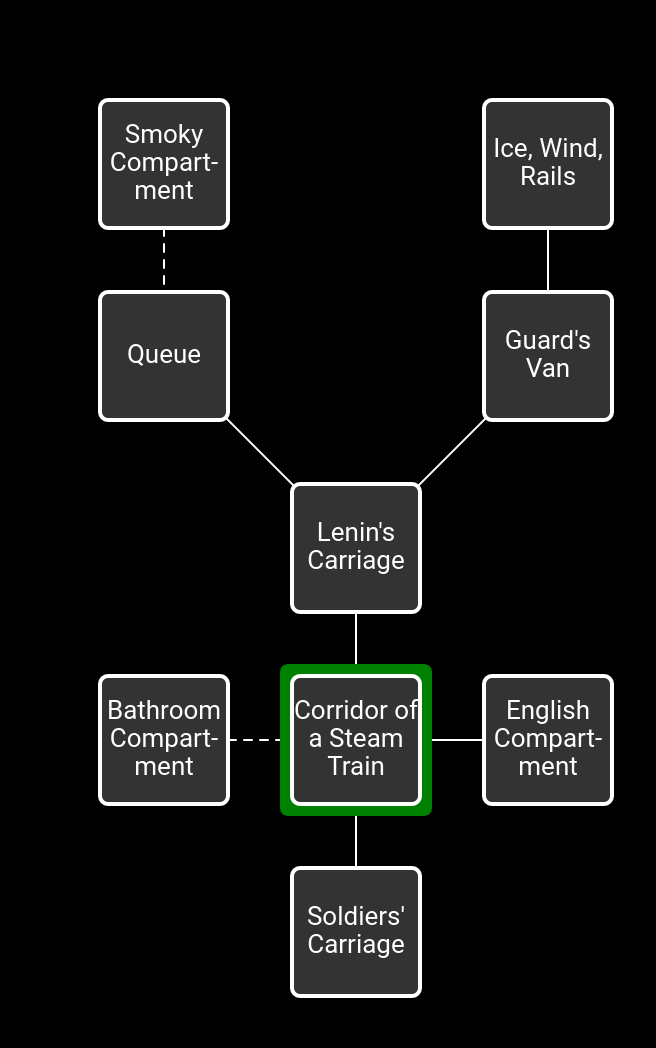
2 Likes
Can you just leave after getting it? With the clock?
3 Likes