Let's Play: Jigsaw

On further thought, the dodecahedron is a bit odd. There are five “Platonic solids” in three dimensions: five ways to form a solid shape by gluing a bunch of identical regular polygons together at the edges. Nowadays they’re better known as the D&D dice (except the d10 which isn’t made of regular polygons).

Plato associated four of the five with the four classical elements: the tetrahedron (d4) was fire since it’s sharp and pointy, the cube (d6) was earth since it packs together solidly, the octahedron (d8) was air (not sure why), and the icosahedron (d20) was water since it’s smooth and rolls around.

The dodecahedron (d12) was the odd one out, with no element associated with it. So if there are only four corners to the Land, I’d be inclined to make each one represent an element, and leave out the dodecahedron. But here, something else has been left out instead.

I’m curious which one it’ll be. The pyramid at the center could be taking the place of the tetrahedron, but the descriptions made me think it has four sides (nw, ne, sw, se) plus the base. Maybe the final puzzle will involve bringing the fifth element to the pyramid and restoring balance forever?

2 Likes

I mean we laugh, but who else did any significant practical or intellectual work with Platonic solids in the 20th Century? They could well be D&D dice!

On the pagoda, I’m wondering if there will be other buildings with a theme - this one for art, but maybe there’ll be one celebrating scientists, or activists and leaders? Things here do seem fairly allegorical - rather, er, Platonic when you get right down to it.

1 Like

Magnus J. Wenninger!

3 Likes

I’m enjoying this Let’s Play. Jigsaw was one of the first IF games I played, back in 1999. I didn’t get too far, but I did the whole thing with a walkthrough a few years ago and loved it.
All of the comments have been interesting as well as you lot know a load more about history than I do.
One of my favourite bits was the titanic section as I got a good idea of what the interior would’ve looked like. As it happens, the main reason why my IF D-pad has ship directions in it is because of the Titanic part in this game.
I can’t wait to see which section you play next. :slight_smile:

4 Likes

The sand dunes are currently winning, 4 to 2 to 2, which means it’s time for…

Chapter Five - 59 Seconds, 852 Feet

Big Kill Devil Hill
You stand on the brow of the largest of the four Kill Devil Hills, sand dunes on the North Carolina coastline. A few miles due north is the tiny village of Kitty Hawk, and just below you down the slope is some kind of wooden railing.

It’s a cold, windy day, and the great expanse of the Atlantic (to the east, of course) is combed by the waves swept back.

A paper dart lies nose down in the sand, ruffling in the wind.

It’s currently 11:42 am, and the year is 1903. And based on where we are, I suspect it’s specifically December 17th.

The paper dart (what we’d now call a “paper plane”, but of course they didn’t have planes yet) unfolds into a copy of the Cincinnati Herald:

The December 12th, 1903, edition, which is laceratingly cruel about the second hopeless failure of Dr Langley’s so-called flying machine “Aerodrome”, which crashed into a canal yards from take-off despite all the money the Smithsonian and the U.S. Government could put in. Dr Langley, it seems, blames his $50000 launching ramp and is confident the machine is sound. The “Herald” begs to differ.

I’m not sure which directions we can go, but the description mentions north, east, and down, so let’s try…east!

Atlantic Beach
Down at sea level, the sand is wet and an effort to wade through. The slope rises to the west, where a path winds up to a wooden hut. The vast ocean is choppy and boatless. Regular gusts of wind blow up great waves.

A bottle, containing a rolled-up message, bobs away out on the waves, not far from the shore.

Ooh, bottle!

>get bottle
The bottle is too far out to reach.

The bottle washes a little closer to you, but it’s still some way off.

I said

>get bottle
The bottle is too far out to reach.

The bottle eases closer yet, bobbing on the waves.

Come on now! I SAID…

>get bottle
You just manage to reach the bottle without falling in, and pull out the message:

“Couldn’t face putting troubles in their way - both such nice boys, trying so hard. Perfect weather conditions today and they still wouldn’t fly, because it was the Sabbath! Anyway, it’s too cold to hang around.”

A signature seems superfluous. You bury the Coke bottle, just in case, though it hardly seems much of an anachronism.

There we go! So Black stopped by…four days ago? December 17th, 1903 was a Thursday. And decided not to ruin their experiments. How nice of them!

This is another place where I’m not sure it would really change history all that much if they failed. All their previous attempts did, after all, and even if Black outright killed them, other people were working on powered flight at the time. I wonder what happens to the timeline if we sabotage them ourself?

>n

Little Hill
Looking north, there’s nothing but miles of sand-bank and bicycle tracks to Kitty Hawk. South, the ground falls to the valley, and east to the beach.

Oh, so we’re west of the beach now? Northwest?

>s

Dune Valley
A valley among the dunes. A bicycle track runs north for some way in the direction of Kitty Hawk, rising to the south. The hills are as lifeless as the moon; spars of old trees, broken by frequent storms, break surface here and there; pools of water have frozen in the sand; cold wind comes and goes in gusts.

Oh boy. I’m lost.

>s

By the Railing
On the shallower northern slopes of Big Kill Devil Hill, thirty yards or so to the west of a wooden hut.

A single wooden rail runs along the ground and slightly downhill to the north for some sixty feet or so.

Okay, so now we’re north of our starting position.

>s

Big Kill Devil Hill
You stand on the brow of the largest of the four Kill Devil Hills, sand dunes on the North Carolina coastline. A few miles due north is the tiny village of Kitty Hawk, and just below you down the slope is some kind of wooden railing.

It’s a cold, windy day, and the great expanse of the Atlantic (to the east, of course) is combed by the waves swept back.

>e

Atlantic Beach
Down at sea level, the sand is wet and an effort to wade through. The slope rises to the west, where a path winds up to a wooden hut. The vast ocean is choppy and boatless. Regular gusts of wind blow up great waves.

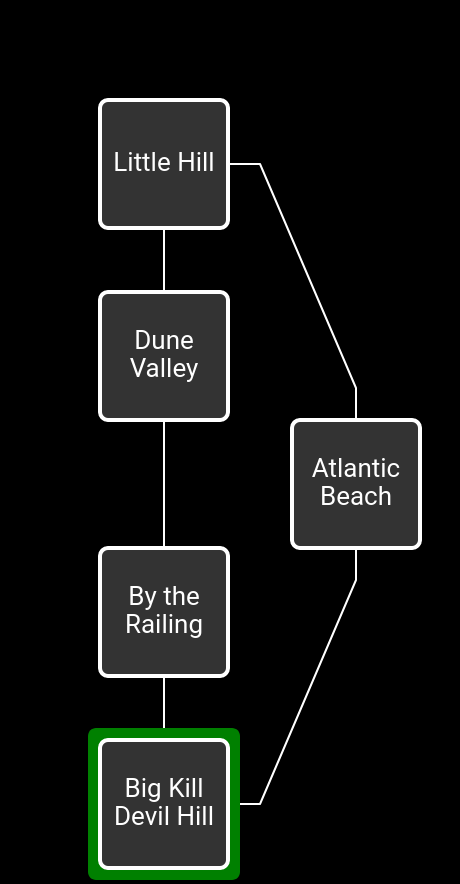
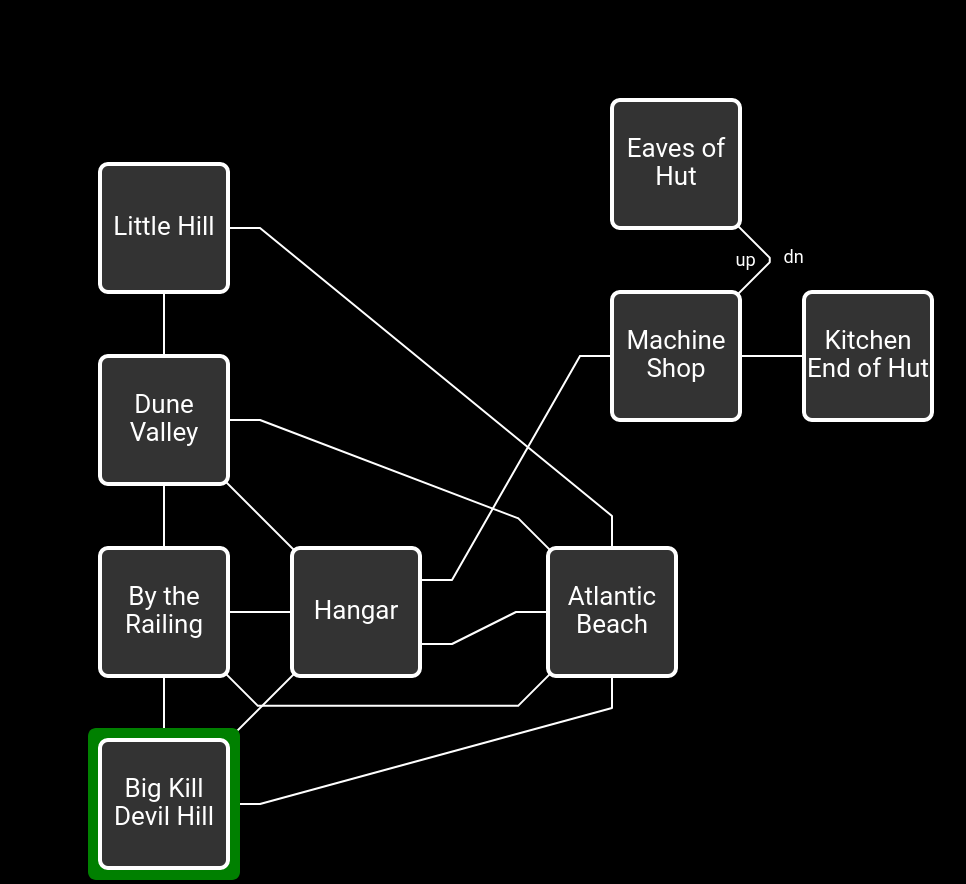
Right, okay. I think the map looks something like this.

So if we go west from here, we’ll end up…

>w
Just as you approach the hut, men heave an early biplane out of the hangar and towards the west. There seems to be quite some activity over there now, whereas it’s deserted here.

Hangar
A one-storey wooden hut, with a tacked-down tar pitched roof, about twelve yards by five, serves here as a hangar. The western wall has been opened up like a garage door and stands on three stilts. A bicycle track runs down the dune northwest, and footsteps in the sand trail away east to the beach, but the hangar really faces the rails to the west. A signal flag is flying.

A Richard’s anemometer lies among coffee mugs on a table on the “porch” of the hangar.

A lump of corn bread is all that remains of breakfast.

An anemometer is a device that tells us the wind speed, currently 7mph. From a Google Image search it seems Richard’s makes the kind with the little cups that spin around (rather than the ones that look like handheld fans). Looks very sciencey when you go around holding it up.

Grab everything, and keep exploring!

>w

By the Railing
On the shallower northern slopes of Big Kill Devil Hill, thirty yards or so to the west of a wooden hut.

Wilbur is tightening the wire-pulls to the wing warping.

Orville is adjusting the engine.

The “Flyer”, a flimsy but expertly-made biplane, is mounted on the rail.

A small crowd of spectators and witnesses from Kitty Hawk has gathered here and is looking on with some interest. They have no objection to your joining their number.

A single wooden rail runs along the ground and slightly downhill to the north for some sixty feet or so.

The brothers shake hands as Orville climbs into the “Flyer”, lying flat on his face on the bottom wing.

Ooh, this looks promising. But I’m going to undo to keep exploring first before anything serious happens.

>nw

Dune Valley
A valley among the dunes. A bicycle track runs north for some way in the direction of Kitty Hawk, rising to the south. The hills are as lifeless as the moon; spars of old trees, broken by frequent storms, break surface here and there; pools of water have frozen in the sand; cold wind comes and goes in gusts.

Up on the hill, the brothers are checking out the “Flyer”.

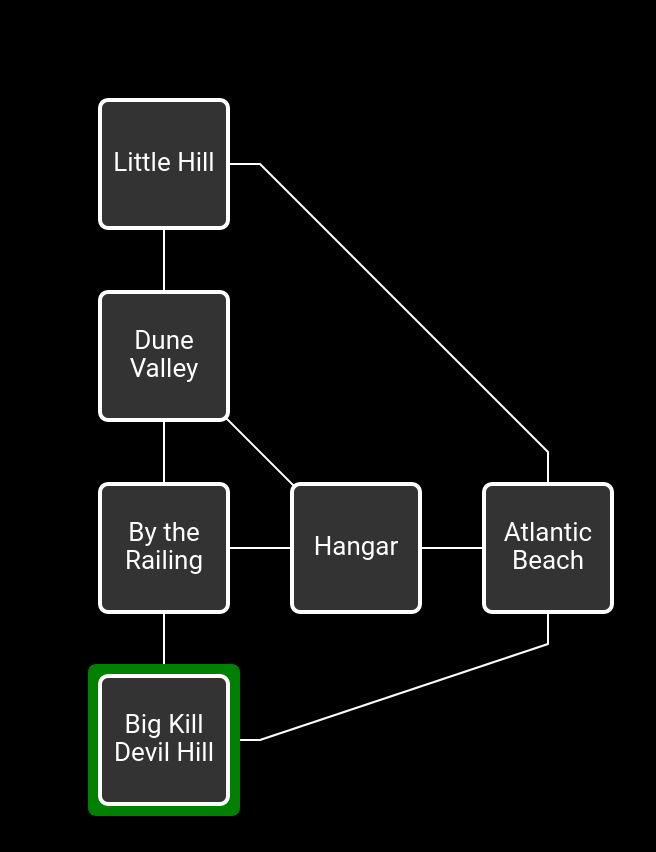
Okay, so the map is more like this.

Kinda looks like an airplane wing, doesn’t it? That’s a neat coincidence (or aesthetic decision).

>w
West Hill is not a very exciting place.

Up on the hill, one of the brothers gets into the “Flyer”.

So I think this is our map.

>z
Time passes.

From above, the “Flyer” is launched along the rail, and the engine carries it just stable above the sand dunes. But after ten seconds or so, Wilbur grazes the ground with a wingtip and comes to rest not far from where you’re standing.

>wilbur, hello
“Excuse me, but there’s work to do, and we’d get along a little quicker without your questions.”

Wilbur shakes his head. “Not enough lift, that’s the trouble.”

Well, how’s the wind speed today?

>x anemometer
The wind speed is now 23mph, if “Richard’s” are to be believed.

Orville and the spectators arrive from up-hill to help drag the “Flyer” back to the rail.

Oh, it’s picked up! Is it going to stay that way?

>x anemometer
The wind speed is now 29mph, if “Richard’s” are to be believed.

Up on the hill, the brothers are checking out the “Flyer”.

I think this is gonna be the one!

>x anemometer
The wind speed is now 28mph, if “Richard’s” are to be believed.

Up on the hill, one of the brothers gets into the “Flyer”.

Uh-oh…

>x anemometer
The wind speed is now 23mph, if “Richard’s” are to be believed.

From above, the “Flyer” is launched along the rail, and the engine carries it just stable above the sand dunes. But after ten seconds or so, Orville grazes the ground with a wingtip and comes to rest not far from where you’re standing.

>x anemometer
The wind speed is now 20mph, if “Richard’s” are to be believed.

Orville shakes his head. “Not enough lift, that’s the trouble.”

>x anemometer
The wind speed is now 24mph, if “Richard’s” are to be believed.

Wilbur and the spectators arrive from up-hill to help drag the “Flyer” back to the rail.

>x anemometer
The wind speed is now 28mph, if “Richard’s” are to be believed.

Up on the hill, the brothers are checking out the “Flyer”.

>x anemometer
The wind speed is now 28mph, if “Richard’s” are to be believed.

Up on the hill, one of the brothers gets into the “Flyer”.

>x anemometer
The wind speed is now 25mph, if “Richard’s” are to be believed.

From above, the “Flyer” is launched along the rail, and the engine carries it just stable above the sand dunes. But after ten seconds or so, Wilbur grazes the ground with a wingtip and comes to rest not far from where you’re standing.

>x anemometer
The wind speed is now 20mph, if “Richard’s” are to be believed.

Wilbur shakes his head. “Not enough lift, that’s the trouble.”

So it’s not quite a cycle, but the wind does get stronger and weaker. Is the problem that they’re launching when it’s strongest, but then it tapers off and they crash?

>show anemometer to wilbur
Wilbur is unimpressed.

You just said the problem is not enough lift!

Let’s go back south, and…

Orville shakes his head sadly. “Head-wind speed too low again,” he laments.

Yeah, here, look at this!

>show anemometer to orville
Orville is unimpressed.

I guess you already know about the wind speed.

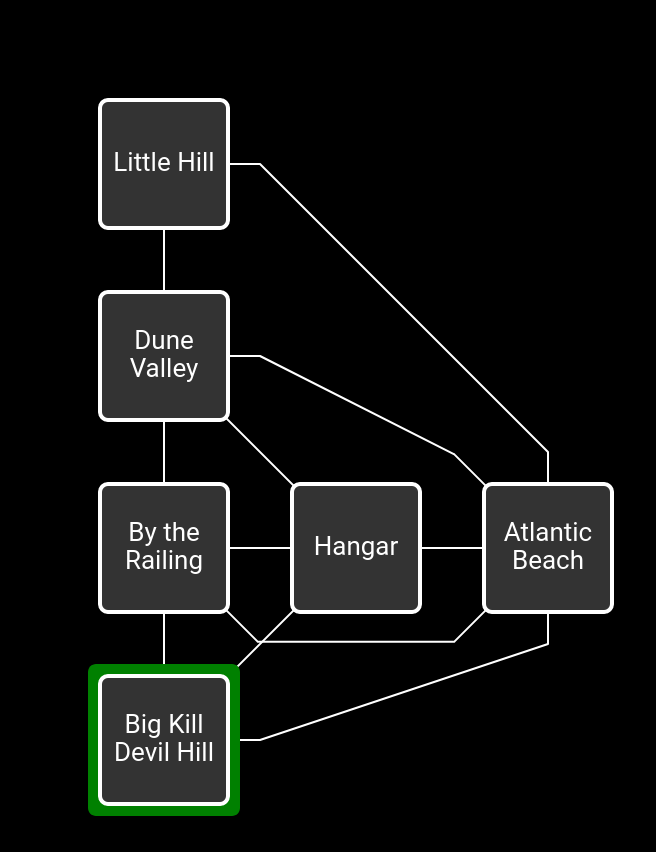
A bit more exploring, and I think this is the complete map. Some of these connections are one-way but I couldn’t find a way to show that without it becoming a mess.

What next? Anything obvious I’ve missed? Anywhere in particular we should go, or anything we should do? We need to draw two animals here, but I haven’t found any, and the KD tells us there are two puzzle pieces hidden in this area.

09.txt (19.5 KB)
b2.sav (2.0 KB)

2 Likes

Are you sure?

1 Like

Ah, have I missed something?

On the one hand, dammit, that means more time poking at every exit from every room.

On the other hand, good, because that means I’m not just missing something obvious in the rooms we’ve seen.

1 Like

Oh, for the love of…

Going west from the Beach takes you to the Hangar, but going east from the Hangar does not take you to the Beach. It takes you to a new location instead.

Hangar
A one-storey wooden hut, with a tacked-down tar pitched roof, about twelve yards by five, serves here as a hangar. The western wall has been opened up like a garage door and stands on three stilts. A bicycle track runs down the dune northwest, and footsteps in the sand trail away east to the beach, but the hangar really faces the rails to the west. A signal flag is flying.

>e

Machine Shop
Inside, the hangar is the machine shop of two highly competent amateur engineers, tidily kept but stacked with all manner of provisions: timber, canvas, saws and rasps, cement, small engine parts, chain, ropes. The walls are lined with pinned-up designs and calculations on the back of old brown wrapping paper. There’s a small kitchen area east, and a ladder leads up to a small loft.

A mandolin depends from a nail.

A fire burns in the improvised heater here, made from an old carbide can, so it’s actually quite pleasantly warm in here.

I think I’m justified in my indignation here; is there anything in that description that makes you think that “footsteps in the sand trail away east to the beach” don’t actually connect east to the beach, or that the “twelve yards” deserves not one room but two? Or, as we’re about to discover, four?

Taking the mandolin gets us a point, and the heater has a “square off-white metal lid” that may be our first puzzle piece. We can’t examine the designs or calculations on the walls.

From here we can go east or up:

>e

Kitchen End of Hut
The neatness extends to this very well-equipped kitchen area, where pans of all sizes hang from hooks, the whole wall shelved with long lines of cans and packets in perfect order. The hut runs west and then out onto the cold daylight.

A primed mousetrap, from which the bait has been stolen, lies in wait on the floorboards at one end.

A mouse might be one of our two animals, if we can trap it somehow! Taking the mousetrap gets us a new ending:

The spring snaps forward over your finger, making you howl with pain. Men rush in from the dunes, catch you going through their private things and march you off to the Kitty Hawk Life Guards’ Station. Before you know it you’re in the clink…

*** You have been stranded in the past ***

And that’s Jigsaw! What did you all think? What game should we try next?

In seriousness, this is the first ending that we can UNDO back out of. Wrecking history waits one turn after you come back from the past, deliberately putting you just out of UNDO range—Jigsaw prevents you from undoing twice in a row. This time, failure was immediate, so we can UNDO and keep going without redoing that whole section.

Baiting the trap with corn bread does attract a mouse, though it’s quite skilled at stealing the bait without setting off the trap. Sometimes it pauses for a turn while doing this (it seems to be a random chance) and lets us sketch it. I missed my opportunity the first time this happened and had to wait another fifteen turns to see it again.

(But hey, look on the bright side. If this were Trinity, we’d miss our one and only shot at the mouse and have to restore a save!)

This one is a “domestic mouse”, different from the “white mice”, which is important—street horses in Paris are the same as street horses in Sarajevo and don’t count twice.

>u

Eaves of Hut
There’s a crude second floor rigged up in the eaves of the hut, where a couple of camp-beds are laid out. A ladder runs back down.

A flat green cap hangs up among some boxes by the roof.

Bedtime reading for one of the inhabitants is a book called “Place Names of Carolina”.

The cap has a “rather odd odour”, and smelling it tells us it’s “faintly repellent”. The book gives us a bit of flavor:

The book opens naturally at the local pages, which tell that Kitty Hawk is a corruption by the early English settlers (one colony was founded as early as Sir Walter Raleigh, later died out) of “Killy Honk”, the coastal Indians’ seasonal killing of geese, which happens nearby. “Kill Devil Hills” is after a shipwreck in the early 1800s, when a guard rushed into town saying he’d “killed the devil” after a pillager tried to raid the wreck.

Wikipedia instead derives the name from “chickahawk”, meaning “a place to hunt geese”. It doesn’t mention which language that’s from but my guess at the standard spelling would be čikahak or čikahok. This may be a clue or may just be flavor.

And that’s about it for right now. Examining everything tells us there’s a dog in the crowd (sketched!), gets us one more quote:

And also reveals our remaining puzzle piece.

The biplane has an efficient little propellor motor, a forward pair of smaller wings, a curious rear rudder and many wire-pulled control surfaces, the secret of its success. One of the control surfaces looks awfully like… oh dear. That sinking feeling again.

So now we have a mandolin (which we can’t play very well: “discordant twangs at best”), a repellent-smelling cap, a puzzle piece that’s attached to a heater (“far too hot to touch”), and a puzzle piece attached to the Wright Flyer.

What now?

tmp.sav (2.1 KB)
09b.txt (20.0 KB)

2 Likes

You mentioned earlier trying to change the timing of the brothers to coincide with the wind. Is there any way to delay them? Start a fire with the hot heater? Shout or make a fuss?

2 Likes

You know what would really mess with their timing? Grabbing one of their control surfaces and running like hell!

3 Likes

Why is the cap repellent-smelling?

Good question! I recognize that this is a hint, but I legitimately don’t know:

> get cap
You lift the cap off the box it was hanging on and admire it. Green felt, the kind that only a true gentleman has the nerve to wear in public. Rather odd odour, though.

> x it
Who would guess these would become a fashionable craze across the World in just ten years’ time?

> smell it
Faintly repellent.

I’ve tried various standard verbs (including SEARCH and LOOK UNDER), but no dice. Looks nice enough when we’re wearing it, though.

I’ll also give the description of the heater, since I’m pretty sure that’s important (we need to get that piece somehow):

> x heater
To the brothers’ own ingenious design. The heater has air holes for ventilation, stove pipes and metal legs, with a square off-white metal lid on top. Inside, a fire burns away.

We can’t examine the pipes, legs, or fire, and the lid redirects to the stove, but the air holes are implemented separately:

The air holes are hand-drilled, and only about a half-inch in diameter.

I tried putting the towel from the Titanic over them, but it “won’t fit”. So maybe something else will?

Oh duh, we even had this on some of our lists, I think - dunes can be beaches, not just deserts!

Wowza that’s a lot of money – just using a naive CPI calculator, that $50k would be over $1.5 M today, which is some ramp!

…actually, having recourse to Wikipedia (the history of aeronautical engineering being slightly outside my wheelhouse) and looking at the picture, it looks like it was less a “ramp” than a mechanical catapult installed on a houseboat, sort of a prototype aircraft carrier I guess? Very interesting, though of course catastrophically unsuccessful.

[quote=“Daniel Stelzer, post:125, topic:59520, username:Draconis”]

Indeed – it would be interesting to analyze Jigsaw’s view of history once we get to the end to see whether it seems to hew closer to the Great Man theory, Marxist structural-factors stuff, or some kind of Tolstoyan synthesis.

…That’d probably be overthinking things, though.

I am deeply curious about the payoff here.

Are we sure this is a musical instrument, and not the slicing tool (in fairness, we’d probably be more concerned about the state of our fingers than the quality of the plucking if it were).

As to puzzles – we’ve shown the aerometer to the brothers, but can we GIVE it to one of them? And what happens if we wear the cap? Or (of course 'd suggest this) licking it?

3 Likes

On the back of this rather fine American guitar, the initial O. is inlaid.

So definitely the instrument. Which is good for our fingers, certainly!

Wearing the cap doesn’t seem to do anything special, though I suppose it might act as a disguise? Sadly, LICK is not a verb Jigsaw knows.

Giving gets the same result as showing: the person “doesn’t seem interested”, whether we’re wearing the cap or not.

3 Likes

Wait a sec. Wait a sec.

Box?

> look

Eaves of Hut
There’s a crude second floor rigged up in the eaves of the hut, where a couple of camp-beds are laid out. A ladder runs back down.

A shakeable box of mosquito powder sits on the shelf.

Box!

Taking this gets us a point, though examining it tells us nothing. Smelling it does:

How repellent. If that doesn’t deter a mosquito, nothing will.

We have a new inventory item to work with now!

I’m not sure what we can do with it, but we have it!

3 Likes

Everything I’ve tried has either been ignored or gotten me arrested (e.g. blowing up the hut). But I suspect you’re on the right track. That cycle of wind speeds has to be important for something.

2 Likes

Hmm, I’m not sure how big the box is, but can we put it on the holes in the stove in order to smother the flame so we can get the piece? Alternately, can we shake the powder into the stove to create a really bad smell and delay the launch?

It makes a bad smell, but doesn’t spread, unfortunately. (It does keep the mouse from interfering if we want to ruin the stove, but that just gets us arrested.)

1 Like

Does waving the cap do anything like in those movies where they’re waving at people in airplanes? Or maybe waving the stinky cap upwind scares them off from launching?

Good thought, but alas, no—we just “look ridiculous waving the green cap”, no matter where.

1 Like