(Chapter the Ninth, continued)
>ne
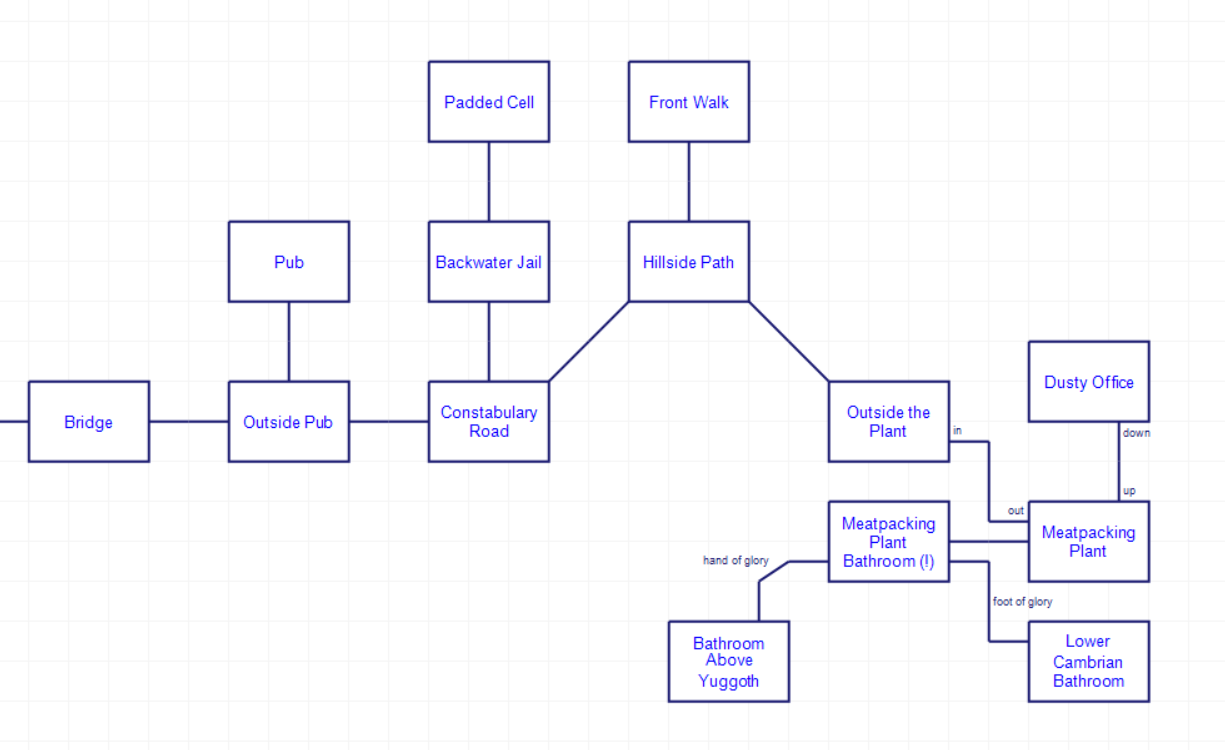
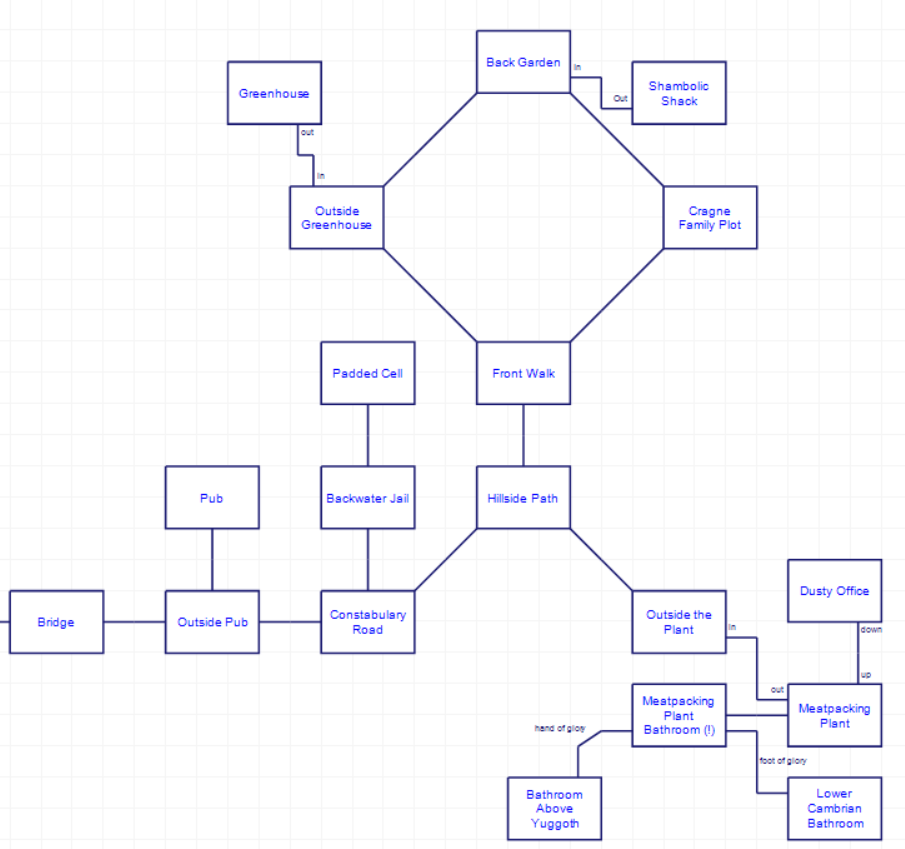
Cragne Family Plot (Mark Britton)
A cramped and neglected place on unwholesome yellow soil. Over the years the gravestones have shifted like teeth in an overcrowded mouth, collapsing one atop the other. Crabgrass pokes up limply between them, urine-yellow and parched-looking. The earth mounds up around the shabby crypt, as if it’s sunk over the years into the Vermont topsoil. You wonder who would want to be buried here–and who would willingly consign their ancestors to this brutal place. Perhaps that’s why it’s been so neglected.
Four squat columbariums stand north, east, south, and west of here. A winding and uncertain path leads southwest. By stepping over collapsed gravestones and bleached obelisks you can go northwest. Carefully. You could also enter the crypt from here, if you were able to open it.
Three graves nearby draw your eye. One headstone teeters drunkenly, half overrun by lichen. One headstone has collapsed entirely. An adjacent plot stands open, overlooked by a blank headstone. The grave within is flooded almost to the top with bubbling rainwater.
You can see some rotten flowers and a china urn here.
(A columbarium is a structure for holding urns of cremains. And yes, the technical term for the ashes of someone who’s been cremated is actually “cremains”).
Mark here appears to be another debut author, though as always I welcome corrections in the comments.
Okay, so a lot of potential places to go here, especially if the columbariums are their own sub-locations. Let’s check those out first:
>northern
The door is shut. The geometric shapes incised deep into the marble prick at your eyes. No explanatory plaque is affixed. You wonder whose name was obliterated.
>x eastern
The door is shut. Crude figures are incised into the white marble door. One is jackal-headed, cringing and skeletal. Another is fat and imbecilic as a maggot. The tarnished plaque’s name has been eaten away; in its place someone has scraped “O homines ad servitutem paratos!”
Hey, Latin! I’ll try to figure it out, then @Draconis can tell us how I did. Homines is men of course, nominative plural; servitutem is slavery, accusative singular (checks out since it goes with ad, the preposition meaning towards or for), and paratos is I think some participle of paratum, which I know because of the Coast Guard’s motto – semper paratum, always prepared. Put it together, and it’s something like “O men, prepare yourselves for servitude”. If the Cragnes have signed one of the standard my-soul-is-yours-after-death dealies with a dark power, this checks out.
>x southern
The southern columbarium’s front panel hangs ajar, as if ripped asunder. Battered by the wind, it swings; the sound drills into your skull. Your gums ache.
Into the granite wall, someone has carved “MEDIA VITA IN MORTE SUMUS” in long, ugly slashes.
Er, eyeballing this one I think it’s something like “in the middle of life, death is there”? Except “sumus” is first personal plural of to be, so like “we are”, and “morte” is ablative so it goes with the in, so perhaps it’s more like “we are in death while at middle of life”? I dunno, this one feels a bit fuzzier; “et in Arcadia ego” is a punchier way of getting the point across, if you ask me.
A shame for the departed that the door here is ajar:
>close southern
You swallow hard around the lump in your throat. It’s oddly pathetic. You fumble with the columbarium door, but for your trouble get only wet hands.
Umm, why is it wet?
>x western
The door is shut. The marble is blank. Mold has seeped into its pores, dyeing it a fungal yellow. You don’t want to touch it.
A bouquet of flowers, black with rot, lies at the foot of the columbarium.
More fungus, yay. Still, Nitocris interprets “you don’t want to touch it” as “you’re really going to have to touch it.”
>open it
You don’t want to touch it, but you grit your teeth. The mold leaves a fine yellow smooch on your hand. You see a copper urn here.
>x copper
The smell leaches through the metal, clinging to your skin, your hair. Your stomach rumbles. You’re almost hungry.
Well, I suppose Nitocris is a ghoul – an urn like this is basically takeout. Might as well grab it in case we need a snack later.
When we check our inventory, there’s a (closed) tag after the urn, so let’s check that out:
>open copper
The stench is thick enough to blind you. Gagging you fall to your knees, shapeless forms whirling behind your eyelids; colors flash, almost solid, as if they have physical presence. You see stars bursting, flesh sloughing off the delicate bones of something curled in a damp and pulsating womb, a face that is not human and not animal. You’ll have nightmares tonight, if you sleep tonight.
Yeah this seems like the good stuff.
There was another urn around, too:
>x china
The urn’s been half reduced to colorful powder, seeping into the mud.
>take it
As you scoop up the urn, it disintegrates into gritty powder. Chunks of bone crumble apart in your fingers and are swept away by the rain.
Oops. Well, this is going to be an awkward conversation with the in-laws. While we’re grabbing things:
>x flowers
A bouquet of half-liquefied flowers. The heavy stench of the rain blocks out the smell. You wonder who left them here, and why.
>take them
Taken.
>smell them
You smell nothing unexpected.
Ugh, that bad, huh?
Maybe we don’t need to be carrying these around right under our nose.
>put flowers in copper
You put the rotten flowers into the copper urn.
>close it
You close the copper urn.
>open it
Greasy red liquid flows out over your hands, itching like centipede legs. Something deep in the urn is just visible, adhered to the side. It is not ashes. Tiny hands, half-reduced to corpse-liquor, fold over a tiny blackened face.
Oh, that’s different (we can look in the urn and then see the flowers; trying to examine the face or the hands doesn’t get any result). After some experimentation it turns out that the two descriptions alternate every time we close and open the urn, and we can cram whatever we want into it, which may turn out to be useful?
More stuff here:
>x crypt
A sprawling and brutish monument with a skeleton incised into its metal door. You wonder who’d want to be interred somewhere so grim. You wonder if there’s a space inside for your husband.
>open it
You push and shove, putting your back into it, but the door remains locked. The skeleton grins stupidly down at you.
That’s probably a come-back-later type of thing – adding it to our list of stuff we need keys for.
Last major thing here are the gravestones:
>teetering
A perfectly round face gawps up at you, its eyes and mouth neatly drilled out. Deep gashes score the granite, the name obliterated. You wonder how long it took. You wonder how much hate it took.
Just readable beneath a carpet of lichen is the inscription: “In the sweat of thy face shalt thou eat-” Here the inscription has been pulverized. A line below it continues: “-till thou return unto the ground; for out of it was thou taken: for dust thou art, and unto-” The inscription crumbles away. An entire line has been scraped off.
The quotation’s almost familiar, but there’s something off-putting about the missing words. They draw the eye like wounds.
This the King James version of Genesis 3:19, the expulsion from Eden. The missing word is “bread” and then the omitted final line is “dust shalt thou return” – feels kinda general, not sure if there’s a clue there?
>x collapsed
The stone is pitted, perhaps acid-eaten. A litter of dead insects and blackened leaves leaks from every cranny. Almost unreadable is the inscription “Zadie Cragne, 1829.”
One date. You search in vain for a second, then glance round at the jostling tombstones and wonder how many infants lie beneath.
>x blank
It’s fresher than the others, not yet crusted with lichen. Search as you might, you can’t find a name.
It’s not mentioned in the description, but the grave under the blank stone is open:
>x grave
Mildewed and splintering boards cover the nearest grave. Beneath, gritty ocher water, thick as paint, laps the soil. The grave is open. A granite headstone looms over it, implacably blank.
So it’s maybe a bit damp, but sure seems cozy – it’s been a long time since we’ve gotten to curl up in a nice tomb!
>enter grave
You kneel by the grave, your gorge rising. The boards crumble, staining your hands yellow, as you push them aside. As you disturb the murky rainwater it bubbles, an acrid stink wafting up; your eyes itch and water.
It’s easily six feet deep. You imagine the water closing over your head with a soft slurp, soaking through at once to your skin. You could drown there, clawing at the melting earth walls, your feet never scraping bottom.
You sit back, gasping for air. Your skull fizzes. An earthy taste remains on your tongue, and the wind spattering your face as you get to your feet is an odd relief.
You’ll have to find another way down.
So this seems like it’s the puzzle here, let’s try messing with it:
>put copper in grave
You put the copper urn into the flooded grave.
As much fun as playing boats is, we probably shouldn’t leave this out.
>take copper
You imagine reaching into the murky rainwater to retrieve the copper urn, and nearly vomit.
Huh, shouldn’t it be floating?
>put all in grave
[snip]
All our inventory – well, everything we aren’t wearing – goes right in.
>take all
You imagine reaching into the murky rainwater to retrieve the cast iron spire, and nearly vomit [times like 37]
I’m sure there’ll be some way to get our junk back, seems fine.
>x coffee
The swirls in your cup form a mermaid. Images of strange hybrids mean that some challenges in your current environment can be defeated with what you already possess, while others will require outside assistance.
See, the coffee wouldn’t lie.
Maybe we can like dam up the grave?
>push blank
It’ll fall over on its own in time. Give it time.
We still have the flowers since we put those inside the urn, so maybe we need to honor the dead?
>put flowers on grave
Putting things on the flooded grave would achieve nothing.
We live in a harsh universe, far from the regard of an uncaring god, I guess.
It belatedly occurs to me that my exploration of the columbariums (columbaria?) was drawn short by finding the copper urn, so maybe there’s something there that can bail us out.
>open eastern
You mumble an apology that the rain drowns out. The door gives way easily. Inside, gleaming in the scant light, is a silver urn.
>x silver urn
The incised shapes nauseate you; they whirl and dance in a frenzy, contorting and bulging, spreading like a fungus. You blink once, twice, and they were never there.
Opening it just gets us one of the same messages we got from the copper one.
>take it
Taken.
>put it in grave
You put the silver urn into the flooded grave.
…you know, rereading this transcript I’m not 100% sure why I did this.
>open northern
The door is shut tight. You prod and pry, the marble panel squeaking on the granite. At last it gives way. Inside, just visible in the dark, is a bronze urn.
>x bronze
The metal seems to absorb all light. Unfamiliar colors dance iridescent on its surface. It’s greasy to the touch.
>take it
Taken.
>open it
You open the bronze urn, revealing a key from an urn.
Oh, that’s nice!
>take key
Which do you mean, the aluminum key, the brass winding key, the thin steel key or the key from an urn?
>key from urn
You can’t see any such thing.
Ugh, implementation could be a little smoother here.
We try it on the crypt door, but it doesn’t work.
Hrm, I think that’s all of them, though.
>x western
The marble is blank. Mold has seeped into its pores, dyeing it a fungal yellow. You don’t want to touch it.
A bouquet of flowers, black with rot, lies at the foot of the columbarium.
Wait, didn’t we grab those already? (Checking) yes, they’re in our inventory – I took them back after putting them on the grave.
>open western
You don’t want to touch it, but you grit your teeth. The mold leaves a fine yellow smooch on your hand. You see a copper urn here.
Wait, did it teleport back from the grave?
>take copper
You imagine reaching into the murky rainwater to retrieve the copper urn, and nearly vomit.
The implementation here is definitely feeling shakey.
Well, at least there’s one thing we know how to do:
>put bronze in grave
You put the bronze urn into the flooded grave.
Why do you keep doing this, Nitocris? Is this like a ghoul hoarding instinct?
>x coffee
The clouds in your cup form a keytar. Images of strange hybrids mean that some challenges in your current environment can be defeated with what you already possess, while others will require outside assistance.
…it occurs to me that I’ve been delegating a lot of my decision-making to a half-empty cup of coffee.
>take water
You can’t see any such thing.
>dig grave
You dig at the mud with the toe of your shoe. Lukewarm water seeps in around your toes, soaking your sock.
Progress?
>enter grave
Your throat closes up at the thought of touching the water.
You’ll have to find another way down.
>drink grave
There’s nothing suitable to drink here.
>empty grave
You can’t bring yourself to touch the water with your hands.
Maybe that’s promising?
At this point I take time out from my busy schedule of trying to get stuff out of the grave to put the new key (plus the flowers) back in.
…after a bunch more faffing about, it begins to dawn on my that I may have made a boo-boo. I figure this is an OK time to glance at the hint thread just to see if I’ve made anything unwinnable. Good news: someone else has asked this exact question. Bad news: @mathbrush replies “as long as you haven’t put [blurry text] in the grave, you should be fine.”
>i
You are carrying:
a trolley pass (being worn)
Ed’s coveralls (being worn)
a hovering spark (haunting you)
…I am pretty sure I have flubbed things. The hint suggests that there should be a failsafe popping up even if I have put too much stuff in the grave, but I’m sure not seeing it.
Fortunately, we haven’t actually accomplished very much yet, so it’s a quick matter to reload, zoom back to the library, and get back here, this time not chucking our entire inventory into a wet grave for reasons incomprehensible to the living.
The implication that there’s an object here that’s needed to solve the puzzle is enough for me to figure out the puzzle, though it seems a bit illogical to me:
>empty grave with urn
I only understood you as far as wanting to empty the flooded grave.
>empty grave
Minutes pass, punctuated only by the gentle splash of stinking water onto the soil. Your shoulders ache; your fingers go numb holding the urn. Yet you’ve made some progress, and the grave walls are showing.
Given that it’s apparently still raining and the ground is super muddy and wet, I have a hard time believing that this urn is going to make that much of a dent, but hey, I’m not going to second-guess it if it works.
>x grave
The water’s half gone now, the bare walls stained ocher-yellow. You can’t quite believe you scooped out that much water.
>empty grave
Minutes pass, punctuated only by the gentle splash of stinking water onto the soil. Your shoulders ache; your fingers go numb holding the urn. Yet you’ve made some progress, and the grave walls are showing.
Your legs are numb, your clothes soaked with reeking water. As you stare into the empty grave, it leers up. Beyond your reach rainwater sloshes round the bottom.
You think you could climb down now. Carefully.
Something seems to have gone weird here, but I think we’ve fully emptied it?
>empty grave
You lean down, shoulders protesting, and catch a whiff of sour air. You pull back, choking. The remaining water is beyond your reach.
You think you could climb down now. Carefully.
>enter grave
You clamber cautiously into the grave, gagging at the stench, and don’t relax until your feet touch the ground. Your footing is unsteady here; the walls seem to be dissolving before your eyes, slick with iridescent runoff that reminds you of gasoline. To the west is the grave of Zadie Cragne, you think, and to the east is the grave with the vandalized headstone; yet your sense of direction down here is limited at best.
The dirt to the west is dissolved more than the rest. Something pokes through the mud there.
>empty grave
You scoop up some scummy water from around your ankles, but let it drain out again. There’s no way you can bail from here.
The rain pounds your back and rattles your bones. Looking down, you realize you’re knee-deep in water already. Around you the mud groans ominously.
Seems like we’re on a timer here, but we’ve got something to grab:
>x mud
You can’t see any such thing.
>x something
You can’t see any such thing.
>x western
The marble is blank. Mold has seeped into its pores, dyeing it a fungal yellow. You don’t want to touch it.
A bouquet of flowers, black with rot, lies at the foot of the columbarium.
That’s annoying, how do we actually find this thing?
…but we have bigger problems:
You hear it before you see it: the whole grave groans, a low sepulchral note, and the walls squelch as they slump down. The smell is acrid, overwhelming. You cough, falling to your knees; soft mud hits your back, your head. Upward you dig, the weight bearing down and swallowing you up. The water is in your mouth, your nostrils, your eyes. Stars pop in the back of your skull. A red haze floats before you in the hungry darkness.
*** You will be buried here for a long, long time. ***
Oi. We undo, climb out, and bail again to reset the timer.
>search grave
The flooded grave is empty.
>>x grave
The grave stands empty, save for a few inches of foul water. Something is just visible through one of the half-melted walls to the west.
>dig
Which way do you want to dig?
>w
There’s no exit that way, and you are in the flooded grave anyway.
>dig west
The mud crumbles away. You hold your breath, expecting a whiff of rot, a crumbling coffin no longer than your arm. But there is nothing–nothing but a pewter box too small to be a coffin.
You hope, at least, it’s too small to be Zadie’s coffin.
Whew, a little guess-the-verb-y but here we go.
>take box
You scoop the box out of its crumbling niche. A whiff of stale air hits you, and you recoil. Yet the box remains safely cradled to your chest. Something inside it thumps, as if to the rhythm of your heartbeat.
You can see no further into the grave.
Now we’ve got what we came for, we clamber back out, just in time:
With a thunderous squelch the walls cave in and the grave floods again; an acrid stink mushrooms up. Your eyes water, your throat tightens. Anything you left in there is probably pretty drenched.
So what’d we get?
>x box
A dull pewter box, unaccountably heavy. Your gaze skids over the engravings. Damp and glistening, they look very nearly alive.
>open box
It seems to be locked.
>unlock it with key from an urn
You unlock the pewter box.
>open it
You open the pewter box, revealing The Lives of the Roman Emperors.
>x lives
It’s still wet from Zadie Cragne’s grave. You don’t recognize the publisher–some little New England college, you guess. The pages stick together, discolored and mildewing. Stamped on the cover is the insignia of the Backwater Public Library.
Ah, this was all worth it, one more from the book list. There was something I wanted to try:
show lives to spark
(first taking The Lives of the Roman Emperors)
You hold the book out to the spark, which hesitates, then plunges inside the pages. The book freezes, and tumbles from your hands. Once dropped, the spark re-emerges, frost recedes from the cover, and remains only in the library’s insignia.
Fun!
The Lives of the Roman Emperors – is this Seutonius?
>read it
(first taking The Lives of the Roman Emperors)
–Octavius Lucilius Saturninus, accused of turning Palatine Hill into his whorehouse. Few reliable reports exist from Saturninus’s contemporaries.
Fragments of satirical poetry now survive. Until the 17th century, the commentaries of Sextilius were rarely copied and often actively suppressed; they appear on several lists of books condemned by the Papacy. Sextilius’s depictions of Saturninus’s court are outrageous not for their sexuality, nor for their frank violence. Rape and incest were not unknown in the literary tradition of Imperial Rome, nor in the Imperial court (witness the accusations leveled against Saturninus’s predecessor Gaius Lucilius and his daughters, the survivors among whom were exiled by the Salvius family).
Rather, Saturninus was condemned primarily for his offenses against the Roman religious-political complex. The Eastern cult promoted in Saturninus’s court did not merely deny the existence of the Roman gods; nor did it “simply” elevate Saturninus and his family to the pantheon. Saturninus is believed to have struck at the very heart of Roman morality, depicting Rome herself in helpless thrall to the Eastern gods–
As you finish reading the passage, the spark moves through the book with an eerie hum, leaving frost behind on the library insignia.
…this is not Seutonius. These are Roman names, but none of these folks are historical: Otho was an emperor of the Salvian gens, but he was a three-month-wonder during the year of the Four Emperors, there was a Gaius Lucilius who was a Republic-era satirist, and as for Saturninus, there was a pretender who raised his standard in short-lived rebellion against the third-century Emperor Probus, but was assassinated by his own troops before anyone noticed. The model for worship of Asian gods as hostile to traditional Roman religion also feels quite at odds with the far more syncretic reality (Mithras, the patron god of soldiers, was a direct import from Persia, for example). But hey, there’s a lot of crappy ancient scholarship out there, so it goes.
Coffee confirms that we need something from elsewhere to complete our work – the key to the crypt, I assume – so we can move on. Gotta say, this wasn’t my favorite room; the basic idea was fun, and some of the writing was good, and getting stuck was less the author’s fault and more due to my pathological desire to bury all my worldly possessions in a muddy grave (look, Nitocris is used to pyramids, okay?), but still, there was enough implementation wonkiness and unclear situations to make things annoying.
As is traditional, I forgot to X ME, but here it is when I went back later and checked:
The cuffs of your jeans are soaked with greasy, pale-yellow mud. You stink of rot, and the sweat mingling with rain on your cheeks burns like vinegar.
(to be continued in a bit)