Yeah, the solid gold inner coffin of Tutankhamun is about 240 lbs or 110 kg. The game uses its size for a puzzle, but never really cares about the weight!
Huh, kind of surprised King Tut’s coffin only weighs that much, especially after googling weights of modern caskets. Granted, I understand people tend to be taller in modern times than they were in antiquity and that Egyptians favored a more body-shaped form factor instead of the boxier style of modern caskets, but still, Gold is ~2.5 times as dense as iron… granted, no idea how pure the gold the Egyptians were using is, and presumably, most choices for alloying gold reduce the density compared to pure gold… and I doubt the egyptians knew of platinum, iridium, or osmium.
I don’t know all the details, but I’d assume they also made it as thin as feasible, because even for a pharaoh, gold is expensive!
dunno for the others, but the debate reminds me of a certain demo picture done in mid-80s with the Commodore Amiga…
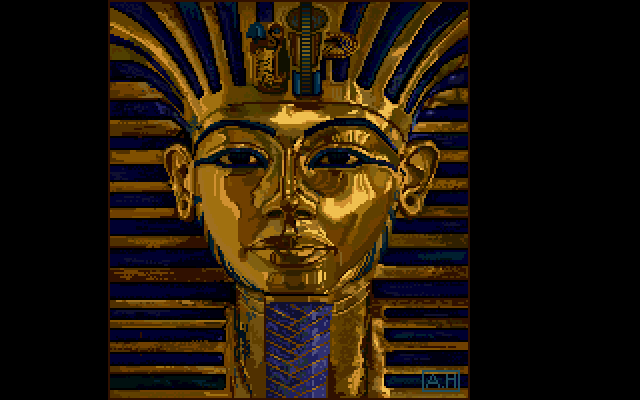
Best regards from Italy,
dott. Piergiorgio
2 Likes
During the New Kingdom, Egypt had gained control of Nubian mines and was possibly the pre-eminent source of gold at the time (“gold is as common in your country as dust,” was a formulaic complaint to Egyptian gift delegations). Gold was used in coffins not specifically to signify expense, although yes to signify expense, but because of its millennia-standing association with immortality and the divine. Silver and lapis would have been more generally connoted with exotic royal wealth, although the New Kingdom had more reliable access to all kinds of imports.
6 Likes
What I’ve read indicates that it was gilded wood, not solid gold. And the gold surface was stripped off in antiquity anyhow. What we have (in the Egyptian Museum in Cairo) is a nice wooden coffin.
110 kilograms of solid gold is a cube about seven inches across.
1 Like
I may have been misled! I found it here.
I missed that you said Tutankhamun, not Ramses the Second! My apologies. The wooden one I mentioned was Ramses. (See here.)
Yes, everybody says “solid gold coffin of Tutankhamun”. I haven’t seen a reference to how thick it is, though.
You know, I’m pretty sure I saw the gold death mask of King Tut when I was a kid. There was an international exhibition which came to the Smithsonian in 1976.
2 Likes
I’ve wondered about the whole “solid gold” thing. That much gold shaped into a roughly man-sized coffin would have a thickness probably not more than 2-3 mm. More like foil-wrapped than solid.
The official figure seems to be 2.5–3.0 mm thick, but that’s about the thickness of a heavy wedding ring, which seems reasonable for a freestanding gold coffin.
1 Like
I have the somewhat unpopular and controversial view that none of the exhibits are genuine and they are all fakes. Every time I see a Tut exhibition, there is somehow more stuff. In the last one, there were three more outer caskets (also gold) for the inner coffin. Where did these come from?
With 5,398 catalogued artifacts it would be surprising if a single exhibition showed them all.
(For those curious about provenance, Carter’s original three-volume publications (1, 2, 3) on the discovery are now public domain, and his inventory lists have been digitized.)
2 Likes
Well, that’s certainly a lot to >TAKE ALL.
5 Likes
Thanks for that. I hadn’t realised it had all been catalogued. Your inventory shows less than 2500 items, where are the others?
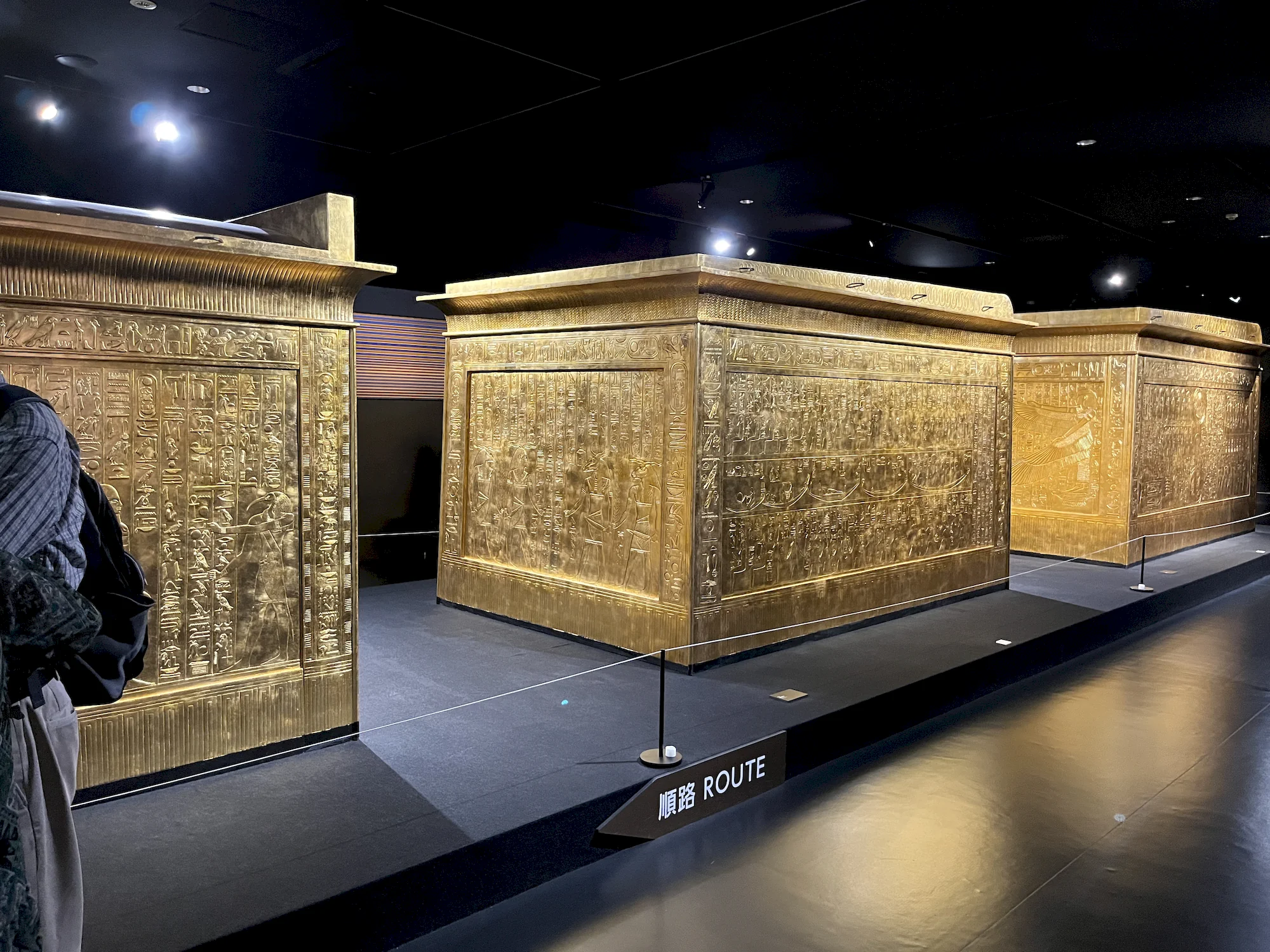
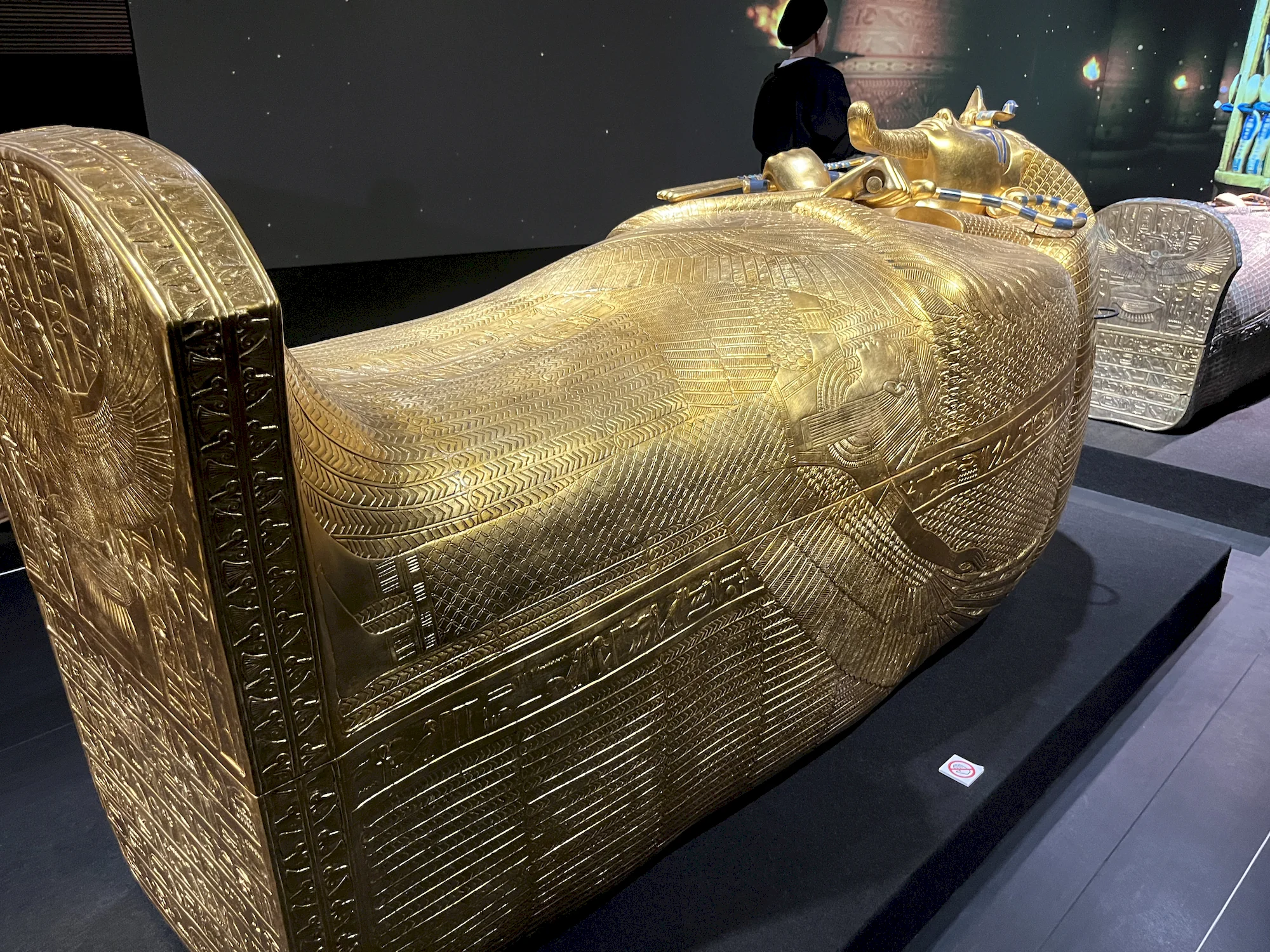
A museum i went to tried to claim there were 3 giant caskets containing the two other coffins and the whole lot nested like Russian dolls. You can see from the photos here, that’s not very likely.
These apparently nested:
And contained these.
1 Like
They do nest (tightly), the perspective in the photo is just confusing because the largest shrine is the furthest away (size comparison).

But it’s very possible you did see replicas. There are a lot of museums that have replicas, and I don’t think the larger pieces (such as the shrines) generally tour.
2 Likes
Thanks, jkj, the first picture thus confirm my idea on a certain Hebrew Artifact…
(Moshe was an Egyptian priest, so I think that the design of said Artifact descends to these rectangular caskets)
Best regards from Italy,
dott. Piergiorgio.
1 Like
Are you suggesting that the ancient Egyptians have an exclusive monopoly on the invention of a decorated rectangular box?
2 Likes
Clearly you meant > GET ALL.
2 Likes
A 7" cube could be flattened into a square 49" on an edge and 1/7 of an inch thick, which is about 3.6mm. Folded in half, that gives two rectangles of roughly 2"*4" for the top and bottom of a box… No idea how tall Tut was, but between people typically getting taller over time and Tut dying young enough he might not have been full grown, shaving a millimeter off that thickness does sound like we get into the right ball park.
2mm does sound rather thin for a coffin though… granted, the comparison was made to a wedding ring, but things that come to mind include:
-
Pure gold is notoriously soft.
-
A wedding ring is adecorative object under few stresses a coffin is a more functional object intended to protect its contents… plus, a bit of flexibility might actually be desirable in a ring while one might want more rigidity in a coffin… Granted, maybe this is a none issue because the gold coffin is the decorative inner lining of a multi-layer casket-vault system with the structural integrity provided by the outer shells.
-
Most modern jewelry is 18, 14, or 10 karat gold, the alloying metal often picked to improve durability. I’m not sure on the time line, but I’m pretty sure Tut still lived in the part of antiquity where ages are defined by what metals the smiths of a given civilization can smelt and work and I understand that one of Tut’s artifacts is a dagger made of meteoric iron that would have been more valueable than the gold in his life time because Egyptians of his time hadn’t yet figured out extracting terrestrial iron(that or Egypt was just so poor in Iron ore that iron rich meteorites were the most ready source of Iron… combined with gold’s tendency to be found in elemental form and its apparent abundance in that part of the world, and it wouldn’t surprise me if the ancient egyptians were using what could pass for 24k Gold in their jewelry where we’d probably use 18k or 14k or just gilding/plating/gold leaf instead of making it solid.
Ramses’s coffin being a gilding strip job doesn’t surprise me, though before the mix up was admitted, I was thinking, Wait, I thought the reason Tut was such a big deal was because his tomb was one of the few looted in modern times instead of in antiquity and so one of the few that give archeologists in-tact grave goods to study instead of having to reconstruct based on scraps left behind by ancient grave robbers… Which admittedly probably makes it one of the few someone showing off fake artifacts can use to trick anyone who knows anything about the state of Egyptian archeology… Though let’s be honest, even for non-charlatans, it makes a certain amount of sense for museums to display replicas instead of risking the originals getting lost in transit by doing a touring exhibit.
1 Like
Tut’s mummy was about 5’6" tall, which is notably tall for his time period.
1 Like