I recently learned of the Kamishibai viewer, a program created by Jennifer Diane Reitz and one of her spouses Stephen Lepisto in 1997. (This pair is better known for creating Boppin’.) As explained on otakuworld.com:
Accursed Toys has created a program that captures the spirit of the Kamishibai. With this program, you can create a story with pictures, text, sound and music. The stories can not only be simply linear, with a beginning, middle and end, but they can also have multiple paths weaving throughout the story!
That sounds like IF to me, but I don’t see it on IFDB or IFWiki. Many personal sites once hosted Kamishibai stories but have since link-rotted away. Otakuworld’s story library is still online.
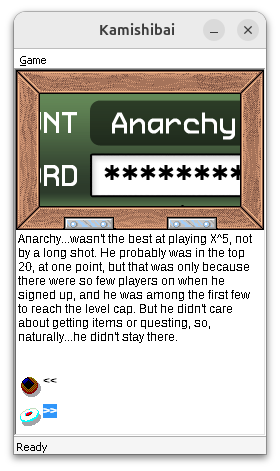
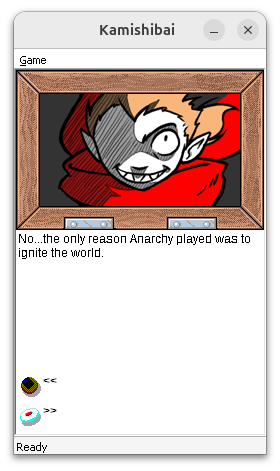
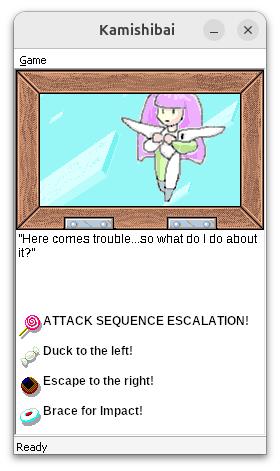
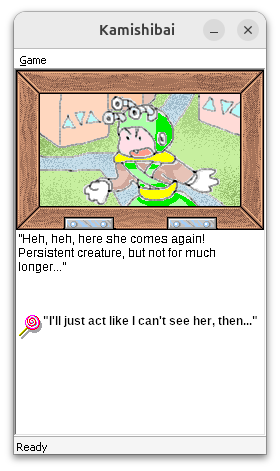
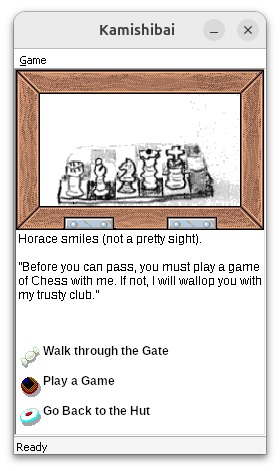
Story screenshots to give you an idea of the form-factor
Kamishibai’s only game state is the current scene. Each scene has:
An image, which can be animated. 200x112 BMP, one for each animation frame. Later versions support PNG.
Optionally, audio. One music track and/or one sound effect.
0–4 options linking to other pages. (The options’ food icons aren’t customizable.)
Prose, described by the documentation as “approximately five lines of text, holding about 250 characters total”, though this seems an underestimate.
The interpreter comes with authoring instructions. Stories are written as a specially-formatted .txt with audio and image files in neighboring folders. Example code from A Puzzle from the Manga Shoggoth by Chris Leeson:
Excerpt
[Scene Permission to Pass]
@image = chess.bmp
@description = Horace smiles (not a pretty sight).\n\n"Before you can pass, you must play a game of Chess with me. If not, I will wallop you with my trusty club."
@link2 = Scene Walloped by Horace
@option2 = Walk through the Gate
@link3 = Scene Play Chess 1
@option3 = Play a Game
@link4 = Scene Start
@option4 = Go Back to the Hut
To play these yourself, get the interpreter here (Windows only, but I ran it on Linux with Proton) and stories here. The stories are distributed as .exes, but they’re just self-extracting archives; I renamed them to .zip to extract them normally.
Has anyone else heard of these? And should they be documented on IFWiki/IFDB?
Many years ago I wrote a Python script to turn a Kamishibai story into a webpage, so it could be viewed without the original Windows player. I tried to make it a MacOS X app (since that’s what I was using at the time) but it also works from the command-line, and might be a starting point to get things working on more modern platforms: https://gitlab.com/Screwtapello/kamishibai2html
It doesn’t work for me with the included demonstration story, but that’s because the story file says to look for images in the images directory, while the actual directory is named Images (with a capital letter). I guess that would have worked automatically on Mac OS or Windows, but not on Linux.
As a genre, these stories are closest to visual novels, I think; I don’t recall them having any world state, just branching paths. If that’s IF, then I guess Kamishibai stories count.
I’d never heard of these before reading the post, but funnily enough I’m familiar with Jennifer Diane Reitz from her writing under the name Chatoyance. When I was younger I read most of her stories for The Conversion Bureau and Friendship is Optimal, and they fascinated me because of how they combined uplifting transhuman utopianism with an incredible pessimism about the human species.
Both settings involve humanity being nonviolently overtaken by a superior alien civilization that’s better in every way: kinder, less inclined to and capable of violence, technologically superior, and so on. Eventually, everyone on Earth is forced to either lose their humanity and join the utopian alien civilization, or die.
The alien civilization in question also happens to be the pony society from My Little Pony, because it all started as My Little Pony fanfiction. As you may guess, the stories are very different from the actual My Little Pony show, which I haven’t watched a single episode of.
Depending on how attached you are to humanity, you can read her stories either as perfect wish fulfillment, as she intended, or complete and utter horror. A lot of her critics have accused her of misanthropy, but considering what she’s lived through, I think it’s understandable. Obviously, I’m biased since I’ve enjoyed so many of her stories. Her personal autobiography, which covers her transition, is worth reading; your post got me to read it again, and it’s really a tearjerker. On her Fimfiction page, she also has an affecting eulogy for Sandi, one of her partners, who recently died of cancer.
More on The Conversion Bureau and Friendship is Optimal
The Conversion Bureau and Friendship is Optimal are both popular My Little Pony fanfictions that have very little to do with the actual My Little Pony show, which I’ve never watched. Chatoyance didn’t write the original stories, but she wrote numerous spinoff fanfictions for both settings.
I was a big fan of Friendship is Optimal back in the day. The Friendship is Optimal setting, also known as the Optimalverse, can best be described as “the Matrix, but the machines are genuinely well-meaning in saving humanity from its inevitable self-destruction”. You could also compare it to Robert Nozick’s experience machine, just like the one I brought up in my Intfiction survey, because I’m biased towards this topic:
In Friendship is Optimal, a My Little Pony MMO run by a hyperintelligent AI is developed by a gaming company. The videogame takes the world by storm, and the AI starts uploading humanity into the virtual world where they can live forever as ponies in an infinite utopia. The AI needs a person’s consent to upload them, but this becomes less and less relevant as more and more humans escape the banalities of mundane life for the infinite utopia of the virtual, and the Earth becomes a deserted wasteland. The endpoint of the Optimalverse is that every living human is uploaded and the Earth (along with the rest of the universe, eventually) is reduced to a computational substrate for running the digital world.
I skimmed through the first few chapters of both Friendship is Optimal and Chatoyance’s FIO spinoff while writing this post. I wouldn’t necessarily recommend them unless you’re interested in the concept, but if you are, they’re a fun read. I find it interesting that as those two stories were first written in 2012, the opening chapters are now a bit dated considering the current state of AI today. Both opening chapters involve a character being shocked at how how the NPCs can pass the Turing test, but nowadays, with the advent of ClaudeGPT, passing the Turing test isn’t even notable anymore. It’s odd how far the technology has come and how normalized AI is now when it would be a feat of science fiction ten years ago. It’s still not as good as the hyperintelligent pony AI, though. Fortunately for us.
(In the Conversion Bureau setting, the pony world exists in the real universe and is starting to overlap our own due to an unfortunate accident of physics; all humans in the affected area need to transform into ponies and join the pony civilization or they’ll die from the magic backlash or something. The overlapping area eventually covers all of Earth, forcing every human to join. I always liked FIO more, but it’s interesting to consider how the ethical dilemma changes when the pony world is “real”.)
End long digression. I think Kamishibai and the stories created with it are worth adding to IFDB and IFWiki, if only to get a record of their existence onto those sites. You might have to do it yourself, since I don’t know if anyone else would be sufficiently motivated to. I could look at it if I get the time, but no promises.
Ha, I actually watched the first few episodes of Pluribus because it seemed to present that exact scenario, but I stopped after [spoilers for Pluribus episode 6] it was revealed that the hive mind is incapable of raising plants for agricultural purposes since it can’t kill them, so the members are reduced to cannibalizing each other until they inevitably die. There was already a lot of fan debate about whether the hive mind actually made people happier and more fulfilled or just killed them and replaced them with a hive-copy that had their memories, considering that the existing hive members are awful at displaying human emotions and values. The hive becomes straightforwardly evil after the reveal.
I feel like it destroyed all the moral nuance of the show, collapsing the somewhat-ambiguous ethics of the plot into a boring good vs. evil thing. Just my personal opinion, though. I was annoyed because I wanted a show that focuses on a benevolent or semi-sympathetic hivemind for once, instead of how it turned out to be.