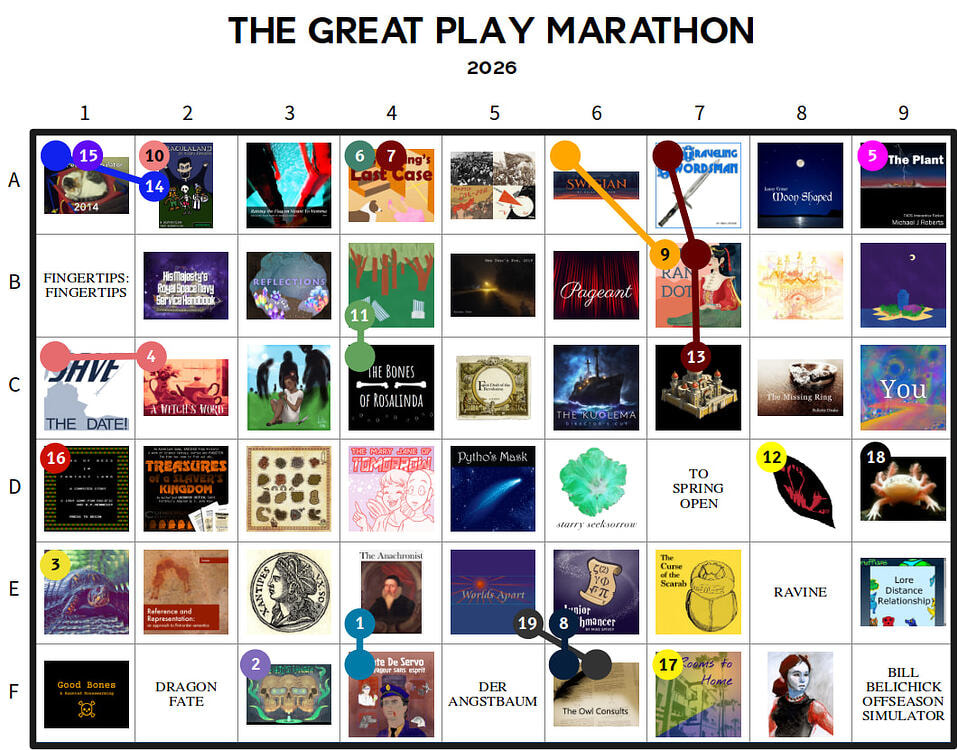
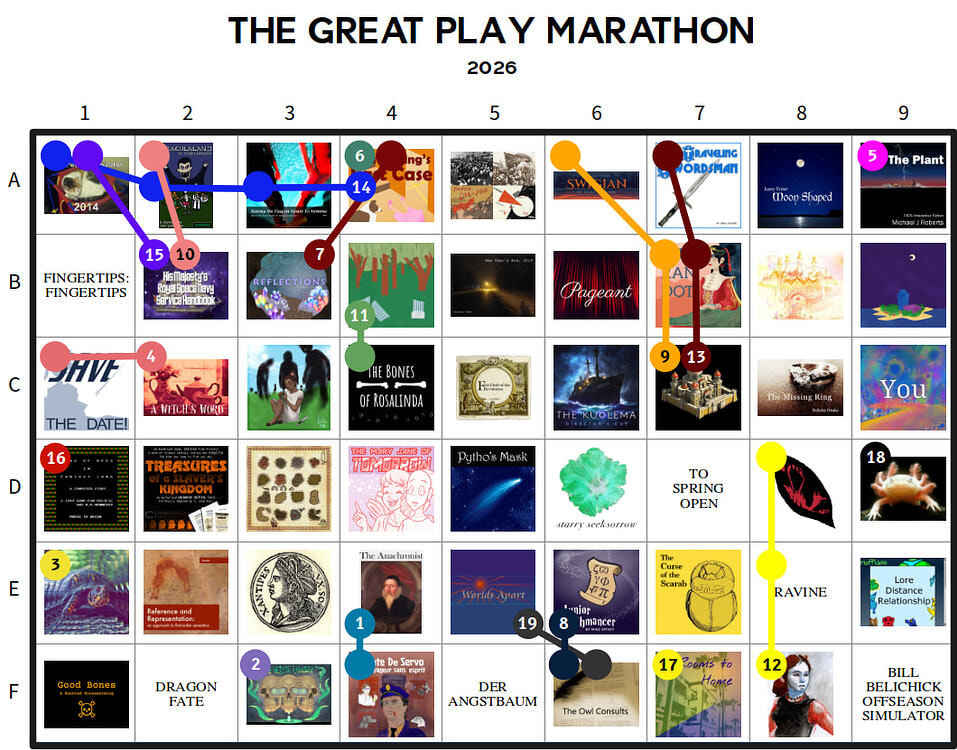
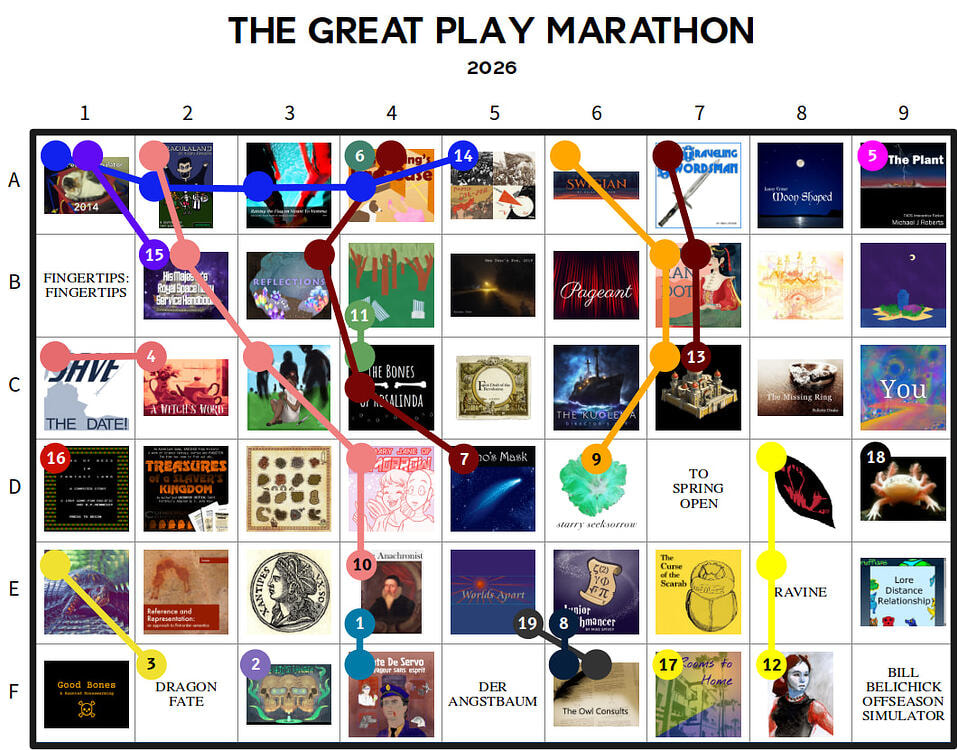
I’ve started a long marathon, back and forth across a grid of games. I exclusively chose games that I hadn’t finished, and mostly hadn’t started. My starting point is Swigian. I’m #9, at A6:
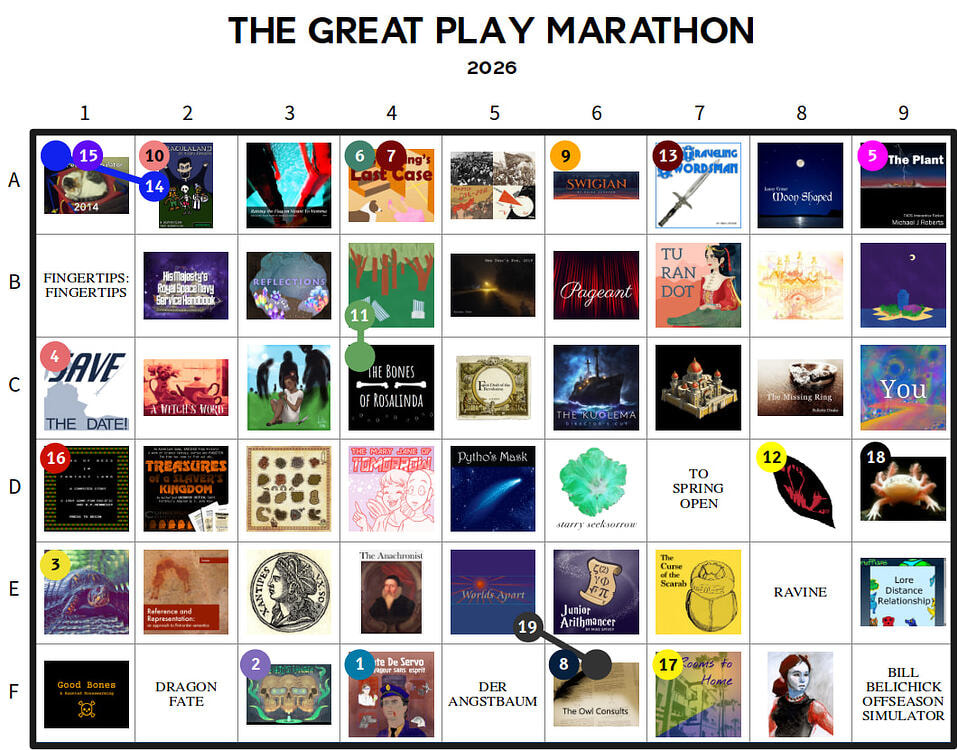
My goal is to play 12 games in a sequence down the grid and then back up.
Swigian
Swigian is a game inspired by Beowulf. It was written as an experiment by Brian Rushton (Mathbrush) to see if any moderately long well-implemented game with puzzles would do well in the IFComp regardless of any merit. He kept the prose minimalist, the puzzles rote and nose-leading, and didn’t care about any plot consistency. It was tied for 21st place in the comp that year, more than beaten out by Mathbrush’s Absence of Law in 5th place. As an experiment, people mostly found it had greater merit to it than Mathbrush intended, but its placing did at least show that having rich characters, prose and stories is still well rewarded. (There’s a great discussion of it in the postmortem thread.)
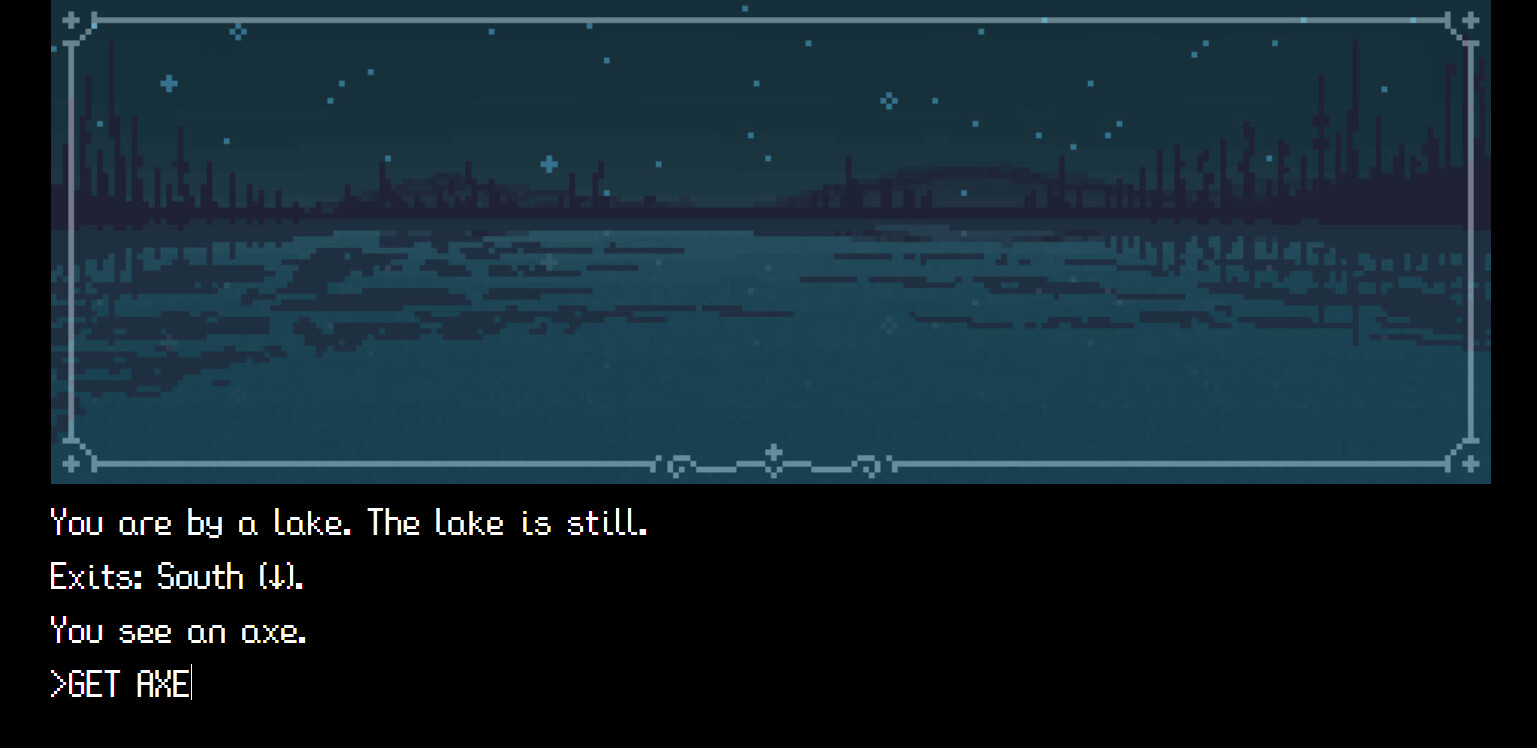
Before playing, I’d heard Swigian was a minimalist game and so I thought it would work well with Adventuron and so I went with the Aventuron port. Marco Innocenti’s art is enriching without distracting and helps give a greater unity to the sometimes confusing picaresque.
While I was playing, I was thinking about the role of minimalist prose in adventure games. In the very early days, minimalism was a necessity due to hardware constraints, but a virtue could be made of it by having the minimal prose reinforce a specific atmosphere or theme. Often early adventure games would squander this, committing crimes against mimesis with anachronisms and forced zaniness, all the while having flat prose. But sometimes they would rise to the challenge. Perhaps despite Mathbrush’s best intentions, Swigian manages to make the most of its minimalism, with the game pushing the player to take simple and direct action in a setting which rewards simple and direct action.
There might be a temptation to say that Swigian (which appropriately means “silent” in Old English) is matching the sparse style of early literature. But I think the functional prose of text-adventurese is very much its own thing. Beowulf, from which Swigian takes its inspiration, is not afraid of adjectives, let alone adverbs. It can interweave a history of its characters to layer on dread and awe in its monsters. Consider these two translations of the same description:
Grendel this monster grim was called,
march-riever mighty, in moorland living,
in fen and fastness; fief of the giants
the hapless wight a while had kept
since the Creator his exile doomed.
(trans. Francis Barton Gummere)
A foe in the hall-building: this horrible stranger
Was Grendel entitled, the march-stepper famous
Who dwelt in the moor-fens, the marsh and the fastness;
The wan-mooded being abode for a season
In the land of the giants, when the Lord and Creator
Had banned him and branded.
(trans. John Lesslie Hall)
And compare to Swigian:
The mead-hall is dark and dusty.
You see an opponent.
> FIGHT OPPONENT
You attack the opponent. He vanishes through a hole in the ground.
In sum: I recommend playing Swigian, especially if you’re familiar with Beowulf. As an experiment I am glad that it was a failure in its modest success: it is better than it hoped to be, but thankfully far from as good as it is possible to be.