I don’t really know how to start writing a postmortem for Demon Game for Sophie. I think that that’s mostly because it doesn’t feel like it’s died. Or perhaps more accurately, that it hasn’t really lived. For that reason, I’m going to discuss the game in terms that reveal some of what is going on, but don’t actually spoil the story. This is a game I’d love people to play, so if you’re on the fence about giving it your time, you can read this without it ruining it. If a section’s tagged, it’s got spoilers in it, but some are more mild than others.
Demon Game for Sophie is two stories in one game. It contains a game about a demon on a fantasy-style quest to murder a corrupt priest. It also contains a story of a man dealing with depression, existential meaninglessness, and the consequences of his actions. It is a story about demons both literal and figurative. It is a story about mental health, our place as individuals in western society, the value and responsibilities of art, the process of writing Interactive Fiction, the seductive allure of suicide, and the things we sacrifice.
Mostly, it is a game trying to ask the question: what is enough?
What is enough? (mild spoilers)
The central question I wanted readers to come away with is “when is enough enough?” The premise of the game is that the writer, or ‘the narrator’, was working on a piece of interactive fiction (Arisen) in order to show it to his friend Sophie. But, for reasons which are definitely spoilers, when he comes to ‘finish’ making the game, he finds himself feeling that the thing he has been working on is facile, pointless, and lacking in anything meaningful to say. In the process of recording the audio for the game (and at some points while finishing the text of the game) he veers off, using the audio level of the game to tell his own story in an attempt to insert something of greater meaning into the piece. At one point the Narrator speaks about Arisen, saying:
It means nothing to me. Almost nothing. There’s just this little fizz of resentment. You might have picked up on that earlier. I’m pre-emptively angry that people might like it. That there might be people out there who play through that whole story and kill the archpatriarch, and then come and listen to all of this, or vice-versa, and think that story was the better use of their time than this one.
How dare they. It’s an insult to art that Call of Duty sells better than Disco Elysium. And it’s an insult to reality that people will watch all the Marvel movies but not watch the news.
The question I hoped players would leave with was: “is the Narrator right? Does a piece of art need to have some kind of political message? Does something need to be deep to be of worth? Is ‘fun’ not enough?”, as well as “does everything we do and are have to be pointed towards some kind of greater meaning, or is it okay to just live? Is it okay to just be me or do I have to constantly strive for something more?” Or, in more general terms, is it okay to accept the way things are? Under what circumstances? The character of Sophie expresses the same dissatisfaction as the Narrator, except where he is passive and inward looking, she is violent, driven, and outward looking. They both refuse to accept the facts of their lives, but they express this in different ways. They both strive to ‘make things better’, but both are simultaneously deeply unhappy. Not to mention that the consequences of their actions may not be in line with the goals of those actions.
This question of ‘when is enough enough?’ is something I struggle with. Much of DGfS is autobiographical (if you’ve played I know what you’re thinking, I’ll get to that): I have had many of the same thoughts, held many of the same beliefs, as the Narrator. But I have done a lot of work on myself and, in many important ways, changed since I was the person this game is about. One of the key aspects of this was gaining an understanding of cosmic acceptance. For me that was a process of exploring Buddhist thought and cosmology, but when people talk about the Christian concept of grace that also now rings true. Buddhism argues that it is attachment (to things, to hopes, to ideals) which causes suffering; most major world religions argue for some form of temperance; and anti-consumerist, pro-environmental ideology urges us to accept and find the joy in the things we have. Enough is enough. You don’t need more. The best place to find joy is where you are.
It’s a radical, liberating and progressive philosophy and it is one which has, in part, helped me find a lot more joy in my own life. But it is also potentially damagingly conservative. “Enough is enough” has a double and almost opposite meaning. There is the literal ‘we have enough, and that is enough’, but there is the more idiomatic ‘we have had enough, and that is enough, we will take no more!” Both have their problems: “we have enough, and that is enough” can easily become “you have enough, and that is enough”. And we all know that university friend who ate nothing but pot noodles for a year in dorms and got scurvy (or is that just me?), so sometimes the enough in “we have had enough, and that is enough” is not, in fact, enough.
Which is all a very roundabout way of saying that sometimes accepting the way things are means not perpetuating wars of conquest, or runaway consumerism, or a miserable cycles of self doubt and ‘not good enough’s. But sometimes it allows for the tacit acceptance of state oppression, runaway consumerism, or a depressive slump into inactivity.
When do we accept, and when do we push? Is there a single rule? Demon Game for Sophie is an attempt to look at these questions. It has its own answers, but they’re messy and inconsistent. Is the Narrator right? Is Sophie? Is a “dark fantasy romp” enough, or does a game need more? Does a life need more? Is it okay to find it enough to just turn the sound off and enjoy the adventure, or do we have a responsibility to dive deeper?
A quick note on 'meaning' (major spoilers (and CW: suicidal ideation))
Related to this is the Narrator’s depressive existential philosophy.
The food I eat destroys habitats. The clothes I wear are either made by slave labour or, I don’t know, take jobs away from the countries that need them. The house I live in could go to someone else who needs a roof over their head. The shampoo I use was probably tested on rats or something, I don’t know, I haven’t checked. My existence causes pain.
There is a moment when he is arguing for why he feels he has a moral imperative to kill himself:
There are so many good reasons, like consumption of the earth’s resources, unavoidable participation in systems of exploitation … [hesitation noises] the space you take up, physically and societally, just, letting someone else, something else have that.
The part that I’ve marked as ‘hesitation noises’ is, for me, the most significant single moment of the game. That ‘umm, err’ is the chink in the philosophical armour which I had wrapped around my own suicidal ideation. The Narrator never questions it, but as the writer I thought it was important to show his thinking while still indicating that the philosophy was not as impenetrably ‘correct’ as he (and I) thought.
That’s a lot of philosophy, but there’s less esoteric things to talk about as well.
Looking at the results, I can’t help but feel like DGfS was a failure. Enough is not enough, I suppose. It’s my worst result at the comp so far, despite the fact that I feel it’s possibly my best ever game (although I remember A Chinese Room very fondly). It also seems to be one of the least played games of the comp, judging by the number of ratings. I knew, intellectually, that DGfS wouldn’t do well in the comp. It’s an intentionally arcane story, or rather, stories, it’s horror, it’s quite deeply personal, it’s potentially a fair bit over 2 hours long, and, of course, it’s heavily audio based. I think that the small number of plays was why I wanted to write this ‘postmortem’, in the hope that someone might see it and think ‘oh, that actually does sound like something I’d like to play’.
The other issue is the implied critical feelings towards the game. This is the part of the postmortem when I’d like to talk about the problems with the game, but I don’t really know what they are. I got 7 reviews, of which 5 were broadly positive one was mixed, and only one of which was broadly negative. I was hoping that the feedback I got through the IFComp website might be more constructive, but for the first time I didn’t receive any at all. So I can gather from the results that people were, generally, lukewarm on the game, but since the actual reviews I received were mostly positive, I don’t actually, for the main, know why.
But I’ll try to address what I think might be the issues:
Audio IF (no spoilers)
Almost every review, positive or negative, had reservations about the use of audio, although most acknowledged that for this game in particular it made sense. I personally think that this is a shame. @JoshGrams said in the thread specifically on this issue that audio didn’t really have a place in IFComp since IFComp is a celebration of games that tell their story through text. I can see that point, but I’ve been feeling that way about the use of visuals (both images and aesthetic UI) for a while now, which seems to be becoming a more and more niche view. Maybe before I entered the scene there was more pushback against visuals in IF games, but it seems that that battle is well and truly lost now. Would this year’s winner, SCAVS, have done so well without it’s snazy UI, changing map, and appropriately spacey soundtrack? And despite my grumblings, which, let’s be honest, come from a place of having absolutely no skills at all in making things look pretty, I do think that the games we’re getting now are better for their prettiness. [Sidebar: It’s a deep cut, but 2022’s Nosebleed is something I’d never have been able to make, but also something which I think only works, and works beautifully, because of it’s aesthetic layer.] So while I get the argument of ‘audio doesn’t belong here’, and I do have sympathy, I do feel like it’s a holdout in a war that was lost long ago. Having said that, I don’t intend to put out more audio based games. For whatever reason, there doesn’t seem to be an appetite for them (which I find odd, with the rise of audio books, but maybe that’s my dyslexia talking).
A more specific gripe is that of speed. I won’t strawman here like I did above. This is a problem. Most people read faster than they listen, and most people who listen to a lot of audio books have trained themselves to expect faster reading speeds. I know the first thing I do when I start a new book is to put the speed up, usually before I’ve even heard what the narrator sounds like. This is a real problem, and one I foresaw, but one which I just didn’t know how to fix. If there is anyone out there who understands enough to write the code required to add a playback speed slider to DGfS, I would be hugely appreciative. I just don’t computer well enough.
The problem of pacing (very mild spoilers + hidden major spoilers)
The mixed review I received was mostly “this seems good, but I only had 2 hours and I couldn’t finish it, so eh?”, which is very fair given the context. The negative review was mostly focussed on pacing issues, that the game was simply too slow, that the reviewer didn’t want to wait around each passage to know what was going to happen next. Part of this is my long passage style, although I think in general the passages in DGfS are shorter than they are in my other major games (at least during the Arisen sections). I get that, it’s not for everyone. I think that the game also has a problem of spending too long with Arisen, the mock RPG side of the game, than it should. My first round of playtesting was just on this part of the game, with no audio and none of the Sophie or Narrator story. There were issues, some of which made it into the final game (oops), but none of the feedback for that side of the game was that it was too long. More than one person said it was my best game yet. Which threw me a bit, because it wasn’t supposed to be good, not really. It was supposed to be the more or less trivial foil for the actual story, the recorded story the playtesters hadn’t seen yet. So by the time I realised I’d messed up and had too much ‘game’ in my game, I was loathe to cut too much of it, since the stuff I wanted to cut (some of the interactions in the town) were the bits that had been specifically praised.
This second act (the part in the town) is a pacing tension point between the two stories. It’s the heart of Arisen, but it’s a bit of a dead zone for DGfS. There are exceptions to this, typing certain names in at the cemetery and killing the cultists all get you more Sophie related story, as well as my favourite rant from the Narrator being hidden in the Death’s Forgotten heist section, but in general the town section is narrated straight.
This is a pacing problem, but it is not one without solutions. Not one, not two, but three separate solutions, all of which are already in the game. The first is to simply leave the town. Maybe this isn’t signposted clearly enough. If you type Sophie’s name in at the cemetery, as instructed at the end of the tarot spread, then the Narrator tells you to go to the castle, but maybe not directly enough. I’m planning to add an extra bit of narration in, which will play after you route back to the town enough times, telling you that if you’re bored you can just leave. But the option has always been there. The second way around it is to just turn the audio off. If the audio is annoying you, why leave it on? This may seem like a weird point to make, but there is a full game here, one which I saw at least one person on the forums who’d only played it without audio recommend, which doesn’t need audio. And the third option is to turn on the Hard of Hearing mode. Yes, it has the potential to ruin the pacing in the opposite direction, by spoiling audio cues ahead of time, but the choice is absolutely there. The entire transcript of the narration of the game is already there in the game, there’s no need to sit around and listen if you don’t want to when a very quick glance over the transcript can allow you to move on at your own pace. One of the glories of Interactive Fiction is that you can approach it how you like. The tools are there and, reading the negative review (which does have good points, I’m strawmanning again but it’s my postmortem so I can do what I want) I felt a bit frustrated that a player had tried an element of the game which they didn’t like and hadn’t tried any of the ways to modify the experience to a form they enjoyed more. The town is a pacing problem in that it is, effectively, a selection of sidequests. Maybe the game doesn’t make that clear, but it is all (the town, the audio, the transcripts) optional. Or perhaps, most probably, I’m misunderstanding.
But that’s all I can say about the problems. This is, possibly, the first game I’ve released which I actually liked a month after releasing it. I’m actually proud of this one and I would like to put some work into improving it. Maybe more flagging of the middle’s skippability, a change of name from ‘Hard of Hearing mode’ to ‘Audio transcript mode’ and, if I knew how to do it, a playback speed option would be enough. My long passage style is too baked in at this point and not something I’m worried about – it’s a matter of taste I believe.
God, this has been much longer than I intended. If you’ve already played the game, you probably have a central question that I haven’t answered yet, and you’ve waited long enough for an answer. Then I’ll get to the bit I’m excited to get to and I’ll end there.
How much of this is autobiographical? (huge spoilers)
Or: how’s your mum?
My mum is fine.
Sophie is fictional, I’ve never tried to summon a demon, and I’ve never killed a dog. I love dogs. Here is a picture of my dogs. As a reward for making it this far:
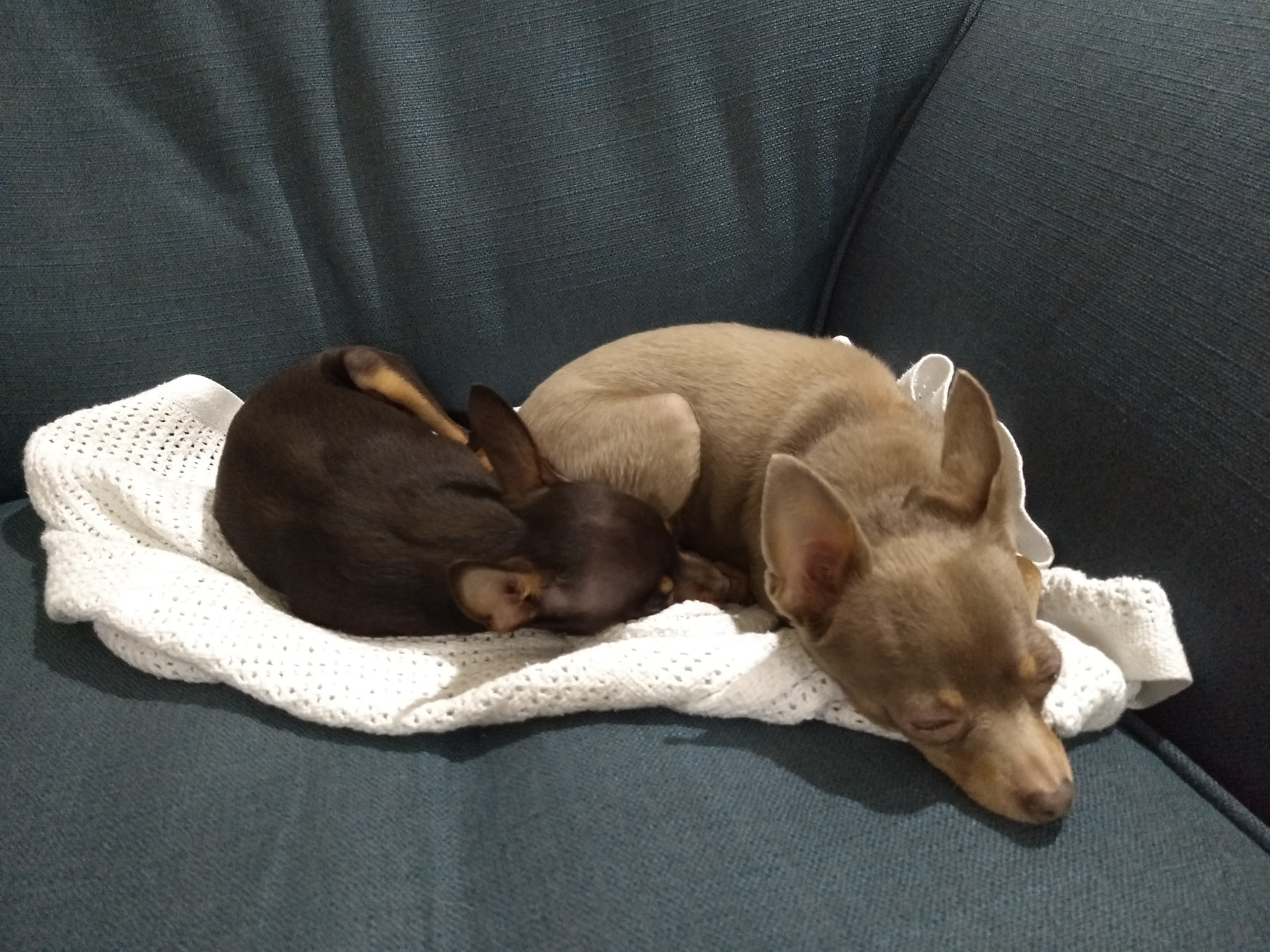
The events are all fictional, but a lot of the mental state of the Narrator is me-from-seven-years-ago. I still have those parts of me, but they don’t control me. Writing Demon Game for Sophie was, in part, an attempt to meet those parts of me and, together, do something constructive, rather than destructive. Maybe that’s why it means so much to me, maybe that’s why I want it to mean something, for people to play it. To prove that those parts of me, however dark, can be made into something positive.
I also want to say a huge thank you to everyone who has played the game: to the playtesters, the reviewers (it really means so, so much that people care enough to write such brilliant reviews), and to the 13 or so other people who played… It really does mean a lot. This is a wonderful community and you’re the ones who make it wonderful.
What’s next for Milo?
My game, No., is out now for Ectocomp. It’s probably the most distressing thing I’ve written. Read the content warnings, they’re important.
I’m also embarking on a new project. If you are one of the zero people who liked my narration, then you’re in luck, because I’m planning to put out narrated micro-fanfics for a variety of (mostly video game) IPs on Youtube once or twice a week for the forseeable future. You can find them here: https://www.youtube.com/@PretentiousGoldfish and the text originals on my new vanity project website here: https://milomesdagwriter.com/. They should all be between 5 and 10 minutes (1000-1500 words) long, so no huge commitment. And you might find out about a cool fictional setting or two! It’s not IF based, but if you’ve ever liked my writing, this should be an easy way to get more of it. I would really, really appreciate engagement (which is a yuck word but here we are), this is such a lovely community and I’ll really miss it moving away from IF for a bit.
I’m also planning to start writing a novel, but we’ll see how that goes. A cosmic horror spy thriller is the plan. My IF has been becoming more linear and in general my passages are very long, so maybe it’s time I go over to the dark side for a while.
Also I’m still debating whether to keep trying with streaming. I’ll probably do the Ectocomp Petite Morts at least. I’ll put up something about that if/when.
And that, I believe, is it. If you’ve read all of this, you should know that there are so, so many other things you could have done with your time. But thank you, really. It’s been another wonderful comp, with some really really strong games (ugh, Kyle…) and it’s been lovely being a part of it. And if you popped along for any of my streams, thank you so much! I loved doing them and I loved the feedback and I love my precious little duck Sasha very very much.
Thank you!
P.S. Not a single review mentioned Immortality? Can’t believe I got away with that.