Nearly all of my successful projects (as in ones I actually completed!) started out as small, throwaway ideas which somehow ended up being much bigger and more ambitious than originally intended. It’s a neat little psychological trick I play on myself—”I’ll just dash out something small and easy to make”—and several years down the line it finally emerges as something that is neither. Anyway, it looks as though the same approach has worked for our chefs—I’m looking forward to sampling what they’ve cooked up!
6 Likes
The tale grows in the telling. And as Lord Henry in The Picture of Dorian Gray said, “The only difference between a caprice and a lifelong passion is that the caprice lasts a little longer.” I’ve long felt that way about creative works: what begins as a little fling is often more enduring than more seriously weighed plans.
4 Likes
15 seconds…
10 seconds…
5…
4…
3…
2…
1…

The development period has ended.
A battle full of surprises, but unsurprisingly compelling. Iron Chef ZIL SomeOne2 adhered to the highest standards of courtesy, going so far as to offer assistance and encouragement to his opponent. Challenger Lancelot encountered many unexpected difficulties, but persevered with admirable fighting spirit.
Next comes the most difficult challenge of all: the test of play.
The chefs’ completed dishes should be delivered to all of you shortly (within the hour). Please be patient just a little longer…
11 Likes
As is traditional, the dish from the challenger is offered first:
Time Swap
by Challenger @Lancelot
[or play online]
… and the dish prepared by the defending Iron Chef is offered second:
Arkanen
by Iron Chef ZIL @SomeOne2
[or play online]
The finished dishes are now released for the audience to enjoy, and the judges retire to contemplate these new creations and issue their scores. We’ll find out their verdict in two days’ time, when audience voting begins at noon UTC on Sunday May 31st.
In the meantime, I congratulate our competing chefs, who conducted themselves honorably and well. Stay tuned for their final thoughts as the post-match interviews with both are posted here over the next two days.
[Audience members are encouraged to discuss the dishes on the audience commentary thread, but please make liberal use of spoiler tags when posting about details of the games!]
11 Likes
A post was merged into an existing topic: Iron ChIF: Season One Episode 2 (Audience Commentary)
Post-match interview with Challenger Lancelot
Lancelot was quick to answer some post-match questions despite feeling somewhat battle-worn…
Q: When you signed on as a challenger last year, you indicated that you planned to spend time learning ZIL to get ready, and you didn’t say anything to the contrary in your pre-match interview. Is it really the case that the first time you tried to compile something in ZIL was after the start of the match?
OB: Yes. I spent a few months going through the material available to me: Learning ZIL by Steve Meretzky, ZIL by Marc Blank, and a few other PDFs I could get hold of. I think all are available through https://zilf.io or https://intfiction.org.
I was originally planning to install the ZILF software on my laptop along with VSCode, but a change in corporate policy a few months ago made that impossible, so I turned to online tooling like https://zilf.io and https://borogove.app.
I did play a bit with REPL to figure out how some commands would be evaluated, because the documentation was not always very clear to me, or gave different interpretations. Now I understand why Tara McGrew decided to put together her own standard library, because apparently there was no real consensus on how things should actually work.
But yeah, actually starting to build a complete program was after the start of the comp, because at that time I was still not aware of differences between ZILF and what Infocom used. If I had known I would have taken the time to learn about ZILF, not learn about ZIL.
Q: What advice would you offer to someone else who wants to get started using ZIL?
OB: Forget about the Infocom manuals which are quite a bit dated. They also turned out to be missing crucial bits which would have been helpful during the comp. Far more useful would be documentation on how ZILF actually works, and of course learn about its standard library. If there is one thing which is important about learning a new programming language (apart from syntax and related semantics, of course) is how its ecosystem functions (how does one make use of libraries, how does one create their own libraries, is there any community of shared libraries, etc.).
Q: You described ZIL as “a very elegant language indeed once one gets used to it.” What kinds of power do you see in it compared to the other platforms you’ve tried?
OB: Well, I do not know a lot of programming languages which have simple yet powerful ways of constructing software. For languages like ZIL, in the end it almost all boils down to making use of list constructs. Which allows LISP like languages to process not only data, but also programs (which are also lists). I once wrote a LISP interpreter which needed very little memory to run, because all it had to do was to be able to parse tokens and construct lists.
A major disadvantage (at least for ZIL), is that in the end, everything is numbers; I was caught several times this week in making typos (forgetting a comma is a nice one) which were extremely hard to debug, because no errors or warnings were shown, it just accepted it all. But of course did not work at all and gave surprising results.
Q: As the challenger, you had the final choice between challenge ingredient candidates. What drew you to the one that you selected?
OB: Interaction! The other option seemed more focused on conversation handling (“A talking door? Sirius Cybernetics Corporation possibly? Stay away from that door!”). [editor’s note: One of the two non-selected challenge ingredient candidates was a talking door that won't open.]
I was playing with a Rubik’s Cube when thinking about what to do with the challenge ingredient and then the swapping one needs to do to solve the cube sounded like the perfect mechanic to express that SPACE == TIME, when treating each of the 6 planes as different time periods. After that selection was made, I literally considered to make an IF version of a Rubik’s Cube. Total madness of course, it would be MUCH harder to solve than an actual Cube. But the idea stuck and in the end was tweaked to make it more suitable for parser play.
Q: With such a broad premise, surely there are some ideas that you had to leave out due to time pressure. Do you plan to expand this game later?
OB: Oh definitely! I basically made a list of things I wanted to do and more or less tried to order them in increasing complexity, so I could tackle the easy stuff and try to have something ready for testing as soon as possible. It did not turn out that way, but the list still stands.
Things like:
- Customizing library messages (especially the x me answer)
- Some interaction with an NPC. I had one in mind which would have been perfect for teaching the ropes of the game to the new player, like a built-in tutorial. That definitely had to go, but in most of my games so far I always try to put a walkthrough or something similar in, so I will definitely add that once I get the basics out of the way.
- Roaming NPCs to keep things more lively, instead of the static entities they are now.
- Handling default commands. I had no time whatsoever to even try anything but the most basic commands.
- Handling input in a more flexible way than just VERB OBJECT. I tried to use objects for the time periods so the player could refer to them, but that did not work at all (standard commands would also try to process those objects); so in the end I turned to a number scheme where the player picks a number to select a time period.
- and others…
Q: What advice would you offer to future challengers?
OB: Get a good toolset! That includes getting a good code editor which is aware of the language you are programming in. Finding missing commas, brackets etc. in Borogove was a pain in the backside.
https://borogove.app kinda worked but was limited in the versions it could handle (and also went down a while for me during the challenge. Always have a backup plan…). I also tried https://zilf.io but then I had to download each build because I could not run the results directly in my browser. No doubt a corporate setting interfering.
16 Likes
Your attention please, members of the audience.
Lancelot has posted an announcement regarding his dish, Time Swap.
As you know, the fixed time limit for development is perhaps the single most important premise of Iron ChIF. While what is being evaluated and voted upon are a pair of games (the “dishes” produced by the competing chefs), it is vital to the competitive aspect that each participating chef have exactly the same conditions and limitations with respect to development.
This is a significant difference from IFComp, which in recent years has allowed authors to submit mid-competition updates to fix bugs. While I agree that this policy creates a better average experience for those playing and rating games, it cannot be adopted for Iron ChIF without the loss of its distinctive character. This is a multi-faceted competition for which preparation, time management and execution discipline are essential skills.
For this reason, the rules of the competition are clear that the dish that is turned in by each chef at the end of the match will be the basis upon which the contest is decided. Consequently, the revised version of Lancelot’s game will not be made publicly available until audience voting closes at noon UTC on Tuesday, June 2nd.
The revised version has been made available to the panel of judges, so that they can optionally use it as input while preparing their written evaluation; this will allow them to better understand Lancelot’s vision for the game and offer feedback based on a complete version. Judges have been asked to refrain from viewing the revised version until after they have submitted their numeric scoring and their choice of winner.
Although this is the third episode of Iron ChIF, we’re still learning as we go. Lancelot’s updated version will be included in the episode archive, and the events of this episode will inform revisions and clarifications of the rules and processes by which the show is run. For this episode, we ask audience members to, like the judges, cast their votes based on the dishes as presented at the end of the match, and we encourage interested players to try the updated version once it has been released.
Thank you for your interest and participation in Iron ChIF. We salute our challenger, Lancelot, along with everyone else – yourself included – whose time and effort have made this episode possible.
15 Likes
Post-match interview with Iron Chef ZIL SomeOne2
Before launching himself back into his studies, SomeOne2 took a few minutes to answer questions…
Q: How did you first hear about Infocom’s games, and what is it about them that makes them so compelling?
MF: It should come as little surprise to those who have played Milliways that H2G2 was the first Infocom game I played. I had finished reading the first three books and was like, “They should make this into a game.” So online I went, and there it was! The BBC 30th anniversary version of The Hitchhiker’s Guide to the Galaxy text adventure. By that point I had only ever played Night House before, so I was a little lost, but the fact that it’s one of their hardest games definitely doesn’t help.
I was enthralled, of course. It held the vibe and wonder of the books while managing to adapt these wacky scenarios into something truly funny and clever, but also super annoying. (In a good way.) Infocom knew how to make good games, whether that’s the iconic Trinity and Suspended or something less known like Arthur or Bureaucracy. The level of skill in writing those games is unmatched, and I’ve been aspiring to match that for, what, nearly four years now?
Q: Your appreciation of The Hitchhiker’s Guide to the Galaxy is well-known, but Trinity is the focus of your band’s most recent album. What do you find most compelling about that work?
MF: So it’s not exactly that I find it most compelling so much as the intro scene (and outro!) is extremely haunting in that you meet all these people that are most certainly doomed, whereas you will escape knowing everything you know is probably gone. And it seemed to me that the bird lady even knew what was going to happen, the way she talks to you. And something about that is extremely haunting to me, and I really wanted to portray that.
It also fit well with the message of “everything is ending” and how listeners could look at that and find very different meanings in lyrics that one way or another pointed to this obscure text adventure from the '80s.
Q: You were fairly quick to make your choice about which challenge ingredient candidate to eliminate. Was the one that Lancelot chose the one that you were hoping for? Did you have any ideas in mind for the other possibility?
MF: Yes. Well, initially, then once Onno eliminated the other option I started thinking “What about that one?” And some ideas popped up.
As Onno mentioned, Sirius Cybernetics Corporation is a classic. But the issue there is dialogue, which unfortunately is not a viable option in five days. Like, you just can’t. It’s so hard to do properly. So, in the end I am glad we got the one we did because it allowed for a slightly more manageable solution but enough room for challenge.
The option I eliminated, my mind just went blank on that one so I thought, “Nope, too hard to find an original idea.” But now that I am thinking more closely about it I would have liked to do that one as well. It had a lot of potential. Probably I would have ended up just completing Tom Bok’s Hypochondriac, which I genuinely love the idea for. [editor’s note: One of the two non-selected challenge ingredient candidates was a small animal that loves to climb things.]
Q: How do you think your dish will do with the judges? With the audience?
MF: I keep going, "Oh no, they’ve already found a game-breaking bug. It’s gonna do really badly. And then I think, 1. We only had 5 days to complete a nearly full game, and 2. Milliways had more game-breaking bugs than this game, for crying out loud. So when I really think about it, it shouldn’t do terribly. But, uh, in reality I think everything is relative.
Q: Are you feeling ready for your GCSEs?
MF: Nope.
But will I ever?
Q: Is there anything that you want to tell the audience about your current projects?
MF: Stay tuned, y’all. Climbing Up the Walls is doing… not so well, but that’s expected when you’re writing a big complex horror game in ZIL. Let’s see if I finish it before I die.
FRIDGETOPIA: Revisited has been put on hold because honestly, I need a writer. I can code Inform 7 just fine and I have the ideas all laid out but the writing is horrendous, and truly it just feels like I’m watching a nonsensical play where instead of going from A to B, you’re going from A to 354 every step of the way until the endgame is reached, and I’m doubtful players will enjoy it. I don’t know how you guys do it! Writing is really, really hard. I like making complicated mechanics though and I overcompensate there, lol.
13 Likes
The judges have been submitting their scoring, but technical problems seem to have delayed one of them. The judges’ verdict will be posted as soon as all results are in.
In the meantime, it’s time to begin deciding the most important question…
Which dish do you, the audience, prefer?
- Time Swap by Challenger Lancelot
- Arkanen by Iron Chef ZIL SomeOne2
0
voters
Make your choice in the poll above, and share your thoughts on the audience discussion thread. Voting will close in 48 hours, and the victor in this episode will be declared at noon UTC on Tuesday June 2nd. Stay tuned for the judges’ verdict…
3 Likes
An update: The numeric scores from the last judge have been received… but there is a question about which chef that judge has chosen as the winner. Remember: Judges are allowed to determine a winner in contradiction to their own numeric scores.
I’ll be posting the judges’ verdict as soon as that’s clarified. Thank you for your patience!
3 Likes
The judges have finished their scoring, each with one eye cast toward the shared rubric and another toward the subjective “X-factors” that influence his or her personal opinions about what makes interactive fiction great. They have pondered at length before rendering their well-considered judgment.
That judgment is not binding, however. Audience voting has already begun (see the previous post above), and the rules of the contest place the ultimate choice within your hands.
Will the judges’ verdict stand? Will their influence be decisive? Only time will tell! We now reveal the judges’ numeric scores, and their determination of the superior dish…
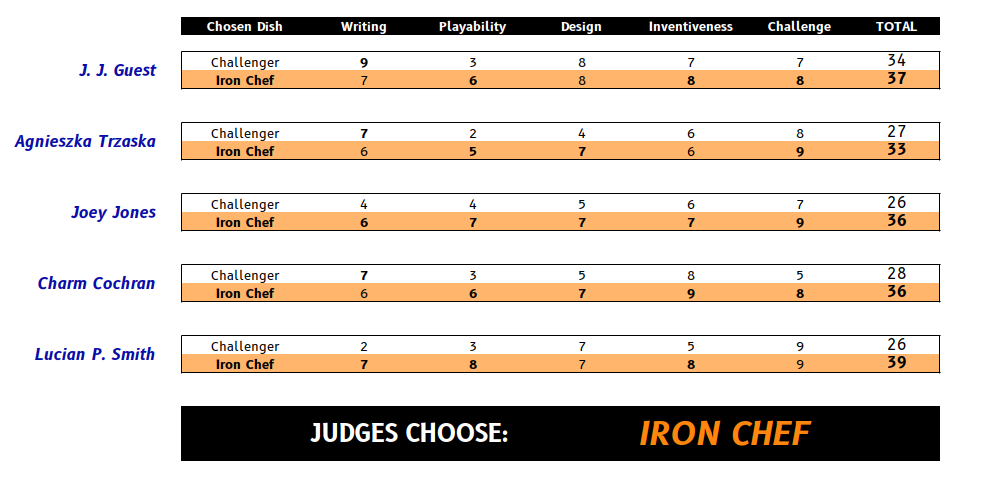
(text version of scoring results)
J. J. Guest
	Challenger:   Writing 9, Playability 3, Design 8, Inventiveness 7, Challenge 7 / TOTAL 34
	 Iron Chef*:  Writing 7, Playability 6, Design 8, Inventiveness 8, Challenge 8 / TOTAL 37

Agnieszka Trzaska
	Challenger:   Writing 7, Playability 2, Design 4, Inventiveness 6, Challenge 8 / TOTAL 27
	 Iron Chef*:  Writing 6, Playability 5, Design 7, Inventiveness 6, Challenge 9 / TOTAL 33

Joey Jones
	Challenger:   Writing 4, Playability 4, Design 5, Inventiveness 6, Challenge 7 / TOTAL 26
	 Iron Chef*:  Writing 6, Playability 7, Design 7, Inventiveness 7, Challenge 9 / TOTAL 36

Charm Cochran
	Challenger:   Writing 7, Playability 3, Design 5, Inventiveness 8, Challenge 5 / TOTAL 28
	 Iron Chef*:  Writing 6, Playability 6, Design 7, Inventiveness 9, Challenge 8 / TOTAL 36

Lucian P. Smith
	Challenger:   Writing 2, Playability 3, Design 7, Inventiveness 5, Challenge 9 / TOTAL 26
	 Iron Chef*:  Writing 7, Playability 8, Design 7, Inventiveness 8, Challenge 9 / TOTAL 39

JUDGES CHOOSE:  IRON CHEF
NOTE: Asterisks denote each judge’s choice for winner, which may contradict that judge’s assigned scores.
We’ll be hearing more from the judges soon as they post their written evaluations of each dish, providing some insight into the reasoning behind their decisions and the laudatory qualities they observe.
12 Likes
So! The following reviews are written solely in response to me playing the official competition versions of both games, meaning that in Time Swap, I essentially only saw the introduction of the piece (the entire map and the playing pieces), but nothing else–the main mechanic of the game was inactive.
Writing: Time Swap: 2. Arkanen: 7. Advantage: Arkanen
Time Swap
The writing in Time Swap was definitely perfunctory. It was presumably tailored for a z3 game, but unfortunately, reading down the rubric, almost every question would be answered ‘no’ by me: no particular narrative voice, no particular mood nor atmosphere, no story (though this is presumably because of the game-blocking bug), so therefore no twists, etc. There’s nothing dynamic that happens when you arrive somewhere; the NPCs don’t talk to you; the monsters don’t attack. They are chess pieces on a board, waiting for you to move them, and seem to have no purpose apart from that; no desires; no motivations; no boggling at the weird places they have been placed.
It does, however, manage expectations. Within a couple moves, you know exactly what you’re in for, and you’re either here for it or you aren’t. I have to score this axis low for the game because I was asked to for the purposes of judging, but in a so-called ‘normal review’, I would simply say that the author’s focus was elsewhere.
If I had one piece of advice for the author for a future release, it would be to have the NPCs be reactive. Even if you don’t want to have them respond to the player (maybe make the player a literal specter, unable to be seen?) at least let me know how they feel about their current location. How does Circe feel about being in a swamp? How do Achilles and Lancelot react to each other? Once I start (presumably) swapping people around, how do Lancelot and Circe react to each other? These are people in highly incongruous settings, and the possibility for humor (if not genuine insight) is huge!
Arkanen
The writing in this game was solid: a definite sense of place, a definite opinion about the world, a definite sense of who the main character was. There’s room for improvement, though perhaps not as much in a ZIL game than your typical IF? I guess the most salient thing I can say about the writing is that I relaxed a few moves into playing it: I just had the sense that I was going to be taken care of, and was in for a fun game. And the fact that I then got through the whole thing without hints means in part that the trust the writing built up at the beginning paid off later on: even when things got a little dicey or confusing, I persisted because the writing just made me confident that the game was understandable.
In retrospect, a couple things could have been nicer: the lore is pretty much lumped entirely into the diary entries, and it could have been nice to expand that into room/item descriptions throughout (probably not ‘instead of’, but ‘in addition to’). The other somewhat unfortunate thing here is that the rooms in the past do indeed have (at least slightly) unique descriptions, but the ‘game over’ screen happens before the room descriptions, so trying to collect them all is difficult, and you’re not in the headspace to wander around and read room descriptions; you’re trying to avoid seeing people.
Oh, and (spoiler) there was a twist at the end, which I thought was fine, assuming you didn’t think about it too much. It would have been nice if the twist stood up to more scrutiny? I don’t think the game needed it, per se, but it would have been nice.
Playability: Time Swap: 3 Arkanen: 8, Advantage: Arkanen
Time Swap
The obvious main problem here is the game-blocking bug, which is unfortunate. So we can still judge the game’s setup and what it promises, we just can’t judge how it follows through on those promises.
The promise of the game is that you need to get various people and monsters back to their original locations. This generally seems to be fairly obvious at least in its final resolution: there’s a dragon; there’s a dragon’s cave. Presumably, the dragon will end up in the cave. The intrigue of how this works is hinted at in two ways that I have no idea if they’ll pay off or not: for one, there’s nothing in the dragon’s cave, so if I can only ‘swap’ things, how do I get it there? And two, many of the NPCs you’re probably going to move are in opposition to each other: there’s a dragon, and there’s Lancelot. Maybe if I put them together, they’ll fight?
The expectation from finding an utterly static introduction (which is all I could visit) is that something dynamic will happen later in the game. Hopefully it will!
Arkanen
There are two things you do in Arkanen: wander the map, and create new connections between locations on the map. And spy on people. Three things you do in Arkanen: wander the map, create new connections, spy on people, figure out a plan, set off an alarm… I’ll come in again.
Amongst the things you do in Arkanen, the most unique is creating portals between locations in time and space, using a device that reminded me of the kid party game from my youth: a ‘Bop-it’ a device that would instruct you (to an increasingly-fast soundtrack) to bop, twist, pull, or pass the device correctly or be out of the game. Here, doing it wrong usually consigns you to the cold reaches of outer space, which is a slightly more dire situation; on the other hand, a Bop-it didn’t have ‘undo’. But I was charmed by the simple commands to push, turn, shake, and point the titular Arkanen, and even when I got it wrong, I was always amused to have messed up. Or, to put it another way, I never blamed the game for my mistakes: the game always played fair with me, and I was never lost due to glitch in the interface. Well, OK, one single glitch in the interface: the scanner tells you the time as ‘N/12’, but instead of telling you where in a 12-count cycle you are, tells you which 12-count cycle you’re on, which is not nearly as useful (and Max has confirmed this to be a simple mathematical bug). But even there, the fact that it said “N/12” led me to realize the cycle was made up of 12 moves, which was still pretty helpful.
Overall a very smooth interface, and easy to master, which made it that much easier to segue into mastering the situation, and solving the larger puzzle there.
Design: Time Swap: 7 Arkanen: 7, Advantage: tie!
Time Swap
Earlier, I said that Time Swap managed expectations well: a couple moves into the game, and you know what’s going on and how to start. Which is good design! Everything is clear; everything is coherent; everything meshes together in a coherent outline/plan for what I would do next. I can’t tell if it follows through on that! Hopefully it will elevate itself more with some unexpected beats later on, but as an introduction to a classic puzzler game, it absolutely tells you what you’re going to be doing and how you’re going to be doing it.
I should also say that the introduction of new verbs is also clean and compelling! It’s clear what the actions are, and it’s fairly clear what they’re likely to do; certainly enough to begin experimenting with (though I was locked out of the experimentation stage)
Arkanen
Unlike Time Swap, which set moderate expectations here and then met them, I feel like Arkanen overpromises a bit, and then underdelivers. After I understood the setup, I assumed the solution would be a sort of four-dimensional maze, where you had the 2D map plus the time zones plus the moving people. I was set to show up in the south rooms, then port to the north rooms, then move southwest, then go back in time, then go south, etc. etc. But no: after exhaustively mapping everything out, it turns out that once you dive in, people then deviate from their routes to come after you (sigh). In the end, there’s exactly one place where you can port in, dash over and grab the thing, then dash out again. No maze at all!
Inventiveness: Time Swap: 5 Arkanen: 8, Advantage: Arkanen
Time Swap
The core premise of this game is “things are not where they should be; put them back.” Which when put like that, sounds like a child being told to put away their toys. But it’s a classic trope, and is perfectly serviceable here. (And I realized kind of late in the process: it’s not miles away from the premise of the IF classic ‘Jigsaw’.) It’s not an utterly amazing I-would-never-think-of-that idea, so it doesn’t have a chance to be extra compelling just from its premise, but the game doesn’t particularly need it to be, I think.
Arkanen
Max shared some of his thought processes that led to this game, and I thought they were a good example of taking an idea and following it a few steps away from the initial premise: enough to be recognizably related to the original thought, but different enough that few other people would have taken the same route to get there. (This is also the strategy I try to employ when playing Balderdash/Fictionary.) It made the game distinctively his own, on many fronts: the setting, the way the artifact worked, the protagonist, and the backstory. I ended up not entirely convinced by some of the bigger stretches–in particular, the protagonist’s mental state as described in the logbook didn’t turn out to be nearly as unhinged during the actual play of the game, nor did it factor much into the game’s ending (IMO, of course), But again, I’m always here for games (and art) that attempts something grand, even if it doesn’t reach it. Overall, it’s just a better experience for me than something that attempts something small and gets it 100% right.
Challenge Ingredient: Time Swap: 9 Arkanen: 9, Advantage: tie
Time Swap
This game is definitely suffused with its use of the ingredient. The only slight mark against it is that the remit was that the artifact should ‘connect locations’, and instead sends our protagonist to the new locations. It expands on things even more by, I think, connecting locations throughout realities? Like, Conan is explicitly fictional in our world, but our protagonist can just Go There. Unless the whole thing takes place in an alternate reality where all of the ages actually happened? I dunno; I feel like I’ve already put more thought into this than our chef did; that’s not really the point of the work.
Arkanen
Arkanen, too, falls down very slightly by not following through on the promise of ‘throughout’ time and space (‘two days at a time’ and ‘two rooms over’ is a much more limited scope). But the places are then indeed connected, and the game does interesting things with those connections, by making them persistent, and by letting you create multiples of them. I also appreciated splitting up the ‘time’ axis and the ‘space’ axis, and actually switching the connections. Overall, our chef here just played with the ingredient in several different ways, and it was great.
Writing: Time Swap: 2. Arkanen: 7. Advantage: Arkanen
Playability: Time Swap: 3 Arkanen: 8, Advantage: Arkanen
Design: Time Swap: 7 Arkanen: 7, Advantage: tie!
Inventiveness: Time Swap: 5 Arkanen: 8, Advantage: Arkanen
Challenge Ingredient: Time Swap: 9 Arkanen: 9, Advantage: tie!
Overall: Time Swap: 26, Arkanen: 39.
Victor, by both points and preference: Arkanen!
I’m going to end this write-up with my standard two questions for each game:
Time Swap:
Did the author have anything to say? I realize I didn’t finish this game, but nothing in the setup led me to believe that the author would eventually have something to say more than ‘here is my puzzle’. I could be wrong!
Did I have anything to do? Literally, no, because of the bug, but here it’s much more clear that I would have had something to do in the debugged game: time swap some characters, messing up their days even more.
Arkanen:
Did the author have anything to say? A bit! There were hints at characterization here and there in the journal entries, and the final bit again hinted at a larger story of… something. Ambition and greed, maybe?
Did I have anything to do? A solid ‘yes’ here. The main puzzle set piece had a clear and satisfying route for me to take from speculation → understanding → mastery.
Congratulations to both chefs! And while I chose to do this write-up without playing the fixed version of Time Swap (as I felt that would more closely adhere to the spirit of the competition), I do plan to play the fixed version in the future. I might even be able to write something later (without my judge hat on) talking about the difference between my expectations of the rest of the game vs. its reality. Both chefs should feel proud of their works.
14 Likes
Here’s my written evaluation of both challenge dishes.
A note: As announced, the Challenger encountered issues with his dish close to the finish line. As a result, the game delivered before the deadline could not be completed: an important action, which built the core of the puzzles, had to be disabled to prevent crashes. According to the rules, I scored the game as delivered before the deadline, but after submitting my score, I was able to play an updated version to completion. In the following written evaluation I’ll refer both to the original version, that one being the result of the show development period, and to the updated version, since one of the goals of the analysis is to give feedback to the author and, well, I think the feedback should be about his original vision, not the bug he’s already patched.
Writing
Challenger: I enjoyed the writing in “Time Swap”, after I accepted its weirdness. Once I was on board with the matter-of-fact descriptions of very strange situations, I found the tone whimsical and charming. Discovering new locations and examining the details was fun. The setup for the story seemed obvious enough in the original version, and when playing the updated game, I was a little surprised we did not see a confrontation with the renegade at the end. This is a surprising case, where I might have actually rated the writing slightly higher based on my expectations after playing the bugged version! But maybe not – the actual ending was nice, and made me smile.
I also applaud the Challenger for including non-standard examine descriptions for much of the scenery, even if they were short and simple. Too bad those were not present for some of the NPCs (only the monsters, I think). That definitely felt unfinished, although getting the response of “You see nothing special about the dragon” in the British Library was at least funny!
The biggest issue I had with the writing was that the NPCs felt static. The did not react in any way to the strange environments they found themselves in, and I think their descriptions didn’t change after they had been returned to their correct time and place. The fact you could do things in their locations, but were unable to interact with them, was disappointing (the only thing I was able to do was trying to TELL them about things, but it only resulted in default responses. No one was interested in talking to me).
Iron Chef: The writing in “Arkanen” did its job. It was succinct and to the point, but both the protagonist and the titular artifact were given enough personality to feel like characters, not just cogs in a puzzle (which sadly can’t really be said about the NPCs). I originally found the setting intriguing and reading the logbook to learn more about what happened was the highlight of my playthrough. On the flipside, when I reached the ending, it felt very sudden and somewhat anticlimactic (although it did have a funny bit of writing I enjoyed). With the existing setup, I think I expected something bigger and more dramatic, probably involving the NPC characters. SomeOne2 made it clear in his progress updates he decided to cut back on the size of the game to finish within the deadline, so maybe he had something more planned there at first?
During most of my playthrough, the writing took a backseat as I deployed SCAN, ROTATE, SHAKE and UNDO to progress through the puzzles.
I was a little disappointed many objects mentioned in the room descriptions were not implemented. With some, I expected them to actually serve a purpose (e.g. the ship’s controls), but examining them only gave the “I don’t know the word ‘X’” response.
Verdict: It was close, but I enjoyed the writing in Challenger’s dish just a bit more!
Playability
Challenger: This is the aspect that suffered most due to the unfortunate bug in the original version. A key action of time swapping was disabled. Since all of the puzzles involve swapping, that meant the game could not be played beyond visiting the locations and marking time anomalies. Originally, I knew the game cannot be completed due to a crash, but not that the swap action was disabled to prevent said crash – since the HELP text informed me “Activate” was disabled, I spent a lot of time trying to find something within the game that would activate it, thinking it was an intended puzzle.
I’m glad I could play the updated version and see how it should all work. After the bug has been squashed, the gameplay is smooth, although there is a lot of going back and forth (through time and space) to restore everyone to their proper place. What’s cool is that you can build longer queues, but if you mess up, you’ll end up with NPCs scattered around in a different way. The longest queue I successfully activated had only 3 entities, but I’m tempted to go back to the game some time, map everything out and try to build the longest possible chain. In any case, I think it’s neat the game lets you choose between “comboing” time swaps, or meticulously performing them one by one.
There were some bugs I found in both versions that made the experience more rough: one involved typing “GO WATER” in the Sacred Lake, which trapped me in a dark ‘room’ with no exit (interestingly, I ran into an almost identical bug in Iron Chef’s game)*, and the other caused me, at some point – I couldn’t determine what exactly triggered that – to be unable to go back to Modern Age, as attempting that teleported me to the swamp with Circe every single time.
Iron Chef: The main gameplay mechanic is implemented well and consistently. The way you manually configure the artifact can feel a bit tedious, but it’s not too bad. The map and scanner you’re given make the gameplay experience smoother – I found them impressive and very helpful.
On a subjective note: I tend to prefer puzzles with no possible fail states, which let me experiment as much as I want, and “Arkanen” made me fail so, so many times! (to be fair, you can easily UNDO out of those situations, and the descriptions of being caught are fun to read – at least, for the first few times). But I found the wandering NPCs a pain – I wished I was given more rooms to try and avoid them, or options like hiding from the NPC/distracting them. Even with the scanner it was difficult not to get caught, as everything takes a turn. Sometimes, I would SCAN the environment, see I can jump through space to an empty room, perform the jump and run into an NPC who just moved. So while I enjoyed the main puzzle, I experienced quite a lot of friction during my playthrough. (The moment I got the message that “they found my portals”, I just sighed and restarted, as I felt there was no way of fixing the mess I had made. But I laughed too, as earlier I wondered why no one noticed the portals I was leaving everywhere.) Some of it was my fault, as I could have tried to map out the NPC movement, but I felt like the game was so small trying and UNDO-ing should be quicker.
Unfortunately, I ran into a bug in the very first room of the game, where phrasing the command to enter the portal in a way the game did not expect send me to a dimension of darkness, outside of the map*. I could still open portals there, but I couldn’t use them in the darkness! I got stuck for a bit, mostly because I wasn’t completely sure that wasn’t a part of the puzzle. Eventually, I managed to free myself with UNDOs and rewording the command to use the portal.
In short, good main gameplay loop that works as intended, but lots of friction resulting from the NPC design (then again, without them the game would be very easy).
Verdict: Based on the original releases, “Arkanen” easily wins here – it’s not free of friction, but completable.
Design
Challenger: This one has been a rollercoaster! It was very hard to properly rate the design in the original release – I thought I knew how the puzzle was supposed to work, but I couldn’t confirm that (and I was wrong, as it turned out). Then, in the updated version, it actually took me a moment to figure out how to properly time swap, and I grew increasingly frustrated. Thankfully, the “error messages” from the swapper device proved helpful. Perhaps because of the “sightseeing tour” I took in the original version, marking everything without being able to swap, I did not immediately figure out I can add myself to the queue. Discovering that was a really cool moment!
Overall, I enjoyed the core design idea. There is a lot of exploration in “Time Swap” – there are 5 eras, discovered as you find anomalies from them in other ages (I liked that aspect, and that there was no set order in which you had to visit the eras), and they’re each a cool little vignette, with many recognisable characters. I believe though that the core concept was too big, in more than one respect, and cutting down on the size of the game would have benefitted it. There is, of course, the matter of the bugged original release, but another issue was that many locations felt unnecessary and empty, and padded the playtime with a lot of walking.
I rated this aspect quite harshly for the original version, and that was based on the feeling the game focused on less important things (number of locations, descriptions of environment), to the detriment of gameplay. I did not only mean the unfortunate bug, but also my guess on what the puzzle could be. In the bugged version some NPCs (Musashi, Conan, Merlin, Thoth) start in their final (correct) locations. As a result, I imagined that the puzzle would be distinguishing between who needs to be moved and who doesn’t, then adding everyone in the first group to the list and swapping, which I thought may automatically reorder everyone correctly. That seemed very simple, since it was obvious who was displaced. Fortunately, I was wrong about how the puzzle actually works! I enjoyed the design way more once I was able to play the finished version, although I still think it could be made tighter. One final puzzle (confrontation with the time renegade), which re-uses the familiar mechanic, but twists it in a new way, would also elevate the design.
Iron Chef: The game revolves around using Arkanen to jump through time and space, and I enjoyed the main puzzle (with the exception of the “getting caught over and over again” part). Figuring out how to use the portals to achieve your goals was satisfying. The scope of the game is intentionally limited. While I’d love to be able to explore more, I understand the effect of deadlines and I’m glad SomeOne2 managed to come up with a compact design, a fitting setting that cleverly limits the scope (as teleporting outside of a spaceship is an obviously bad idea, same as jumping in time to a period when the ship isn’t there), and puzzles involving both time and space. Typing in the final command was satisfying (even if, as I mentioned, I found the ending abrupt). I’m a bit disappointed though that I could not steal the money, then steal it again in the past. What do you mean, game, “I already have that”?
My biggest gripe with the design has already been mentioned in the “Playability” section – it’s the wandering NPCs. I’ll give the game that – there is a very good and logical reason for an instant game over when you run into one of them, and it’s also a smart way of getting around having no conversations implemented. But I sort of wish there was more we could do with the NPCs – if there’s any way of influencing how they move, I could not find it (one time, I tried to distract them with the alarm, hoping they will move towards that one room, but it did not end well for me).
I also had an issue during my playthrough that is mostly on me, but may have been influenced by the design. Even though the game is compact, there’s still quite a few locations and timelines to explore, and this made me think there should be something more to discover when I already had everything I needed to win, and even the hint on the final action required. I just felt like there should be something relevant in some of the rooms in the past, which were very difficult to explore because of the NPCs. So, during my first attempt, I was quite lucky and got the keycard and the money quickly, even without mapping out the NPC movement. But taking the money disabled my scanner, and because I believed I still had exploring to do in the past, and the SCAN command was super helpful there, after stumbling around for a while, I actually restarted my game! (I believe the intention behind taking away the scanner was signalling to the player “You don’t need it any more – you’re close to the finish line”, but I read it as “You messed up, time to UNDO!” instead!)
Verdict: “Arkenen” wins in the design department, for providing a tight puzzle and managing its scope efficiently. I have to point out, though, that the design in “Time Swap” proved a lot better than I had anticipated based on the bugged release. The fixed version of the Challenger’s dish included some really clever ideas with the time queue, and was satisfying to play.
Inventiveness:
Challenger: The core concept of fixing timelines isn’t anything new, but I did enjoy the mix of locations and characters involved. The most inventive aspect was, in my opinion, the aforementioned freedom the player has in tackling the puzzles either through longer queues, or many short time swaps. This means the entire game world opens up early and, once you figure out the core idea, it’s hard to get stuck or frustrated. On the other hand, this all means that the game only has one type of puzzle.
Iron Chef: The omnipresent time and space manipulation, and the protagonists backstory, made what would be fairly mundane puzzles (get a keycard, steal the money…) more interesting. All the moving parts and the freedom with which you could deploy the powers of Arkanen (no guarantees about the results) also made the game feel bigger than it really was (as defined by actions required to restore the timelines). The elements of the setting felt somewhat familiar (research spaceship, money-hungry corporation, an alien artifact that causes madness), but the protagonist’s motivations were not what I originally expected.
Verdict: It’s a draw!
Challenge ingredient:
Challenger: I think the challenge ingredient was quite well integrated, although not as strongly as in Iron Chef’s game, where the artefact itself had personality and was central to the story, as well as to puzzles. In “Time Swap”, your time swapper feels more like a helpful tool than the character Arkanen was. Still, it is a defining element of the gameplay, and the main (in-universe) source of hints thanks to its error messages. Maybe it complained a little often, but I liked it.
Another (small) drawback I found was that manipulating space felt… incidental? The game is called “Time Swap” for a reason and sure, each era is also a different location, but one of the artefact’s properties was definitely given more attention.
Iron Chef: I feel like “Arkanen” does very well in that respect. Both the story and mechanics revolve around the time-and-space-bending artifact – it’s not just a tool you use to solve puzzles, but a central part of the game, the cause of all the trouble for the protagonist, and it has a personality as well!
Verdict: I think both games implemented the challenge ingredient very well, but “Arkanen” wins by a small margin.
*As I learned later, this was due to a bug in a ZIL library when you type “GO (OBJECT)” (described here: (link)). If anything, I think it happened to be worse in “Arkanen”, because the first room actually required using “GO” to enter the portal, and it was easier to accidentally get stuck when phrasing it incorrectly. In “Time Swap”, I just tried to enter the lake for no good reason. In any case, the bug isn’t the chefs’ fault.
FINAL COMMENTS
That’s it. Thanks for reading, and congratulations to both chefs! I was genuinely impressed by how much they were able to achieve in the short development period. If I learned anything about ZIL it’s that the syntax looks threatening and it’s easy to trap yourself in a dark room – but, honestly, this episode made me interested in the system and now I want to learn more about it.
I’ve also came up with a silly headcanon where the protagonist of “Arkanen” is the time renegade from “Time Swap” – he got so mad at being unable to influence the NPCs in his own game he now travels through time and throws people into spatial-temporal portals just because he can.
(Edited the post to blur some major puzzle spoilers.)
14 Likes
Thank you for pointing this out. Just found out what is likely happening here. The swapping queue is managed by a table with 14 entries:
<GLOBAL WAM-QUEUE <TABLE 14 0>>
Or so I thought. The table actually contains only 2 entries and no errors were given during my tests. I guess my swapping queue was never long enough to become an issue. I should have written my table as
<GLOBAL WAM-QUEUE <ITABLE 14 0>>
That is, a table initialized as a length of 14 filled with 0. Something entirely different, and I overlooked the missing “I”. The GO OBJECT bug has already been reported, and I have implemented a workaround. I will do a rebuild using v5 later on so people will also have the UNDO convenience.
6 Likes
Here are my written evaluations of the two Iron ChIF dishes! I’ve based these remarks on the competition versions.
Time Swap
This game reminded me of two Brian Howarth games, The Time Machine and The Feasibility Experiment. We are a time traveller, tasked with correcting temporal anomalies by zapping them back or forth to their own era. But just as in The Feasibility Experiment, these eras aren’t straightforward time periods, they’re mythological eras complete with genre-appropriate creatures and characters. There’s even a visit to Conan’s Hyborian age! Unfortunately the zapping-them-home functionality was broken, so it wasn’t possible to complete the mission, but I enjoyed the idea very much and the writing was atmospheric and lovely. I haven’t played the fixed-up version yet, but I look forward to finishing the game soon.
Writing: 9
Okay, seeing how Lucian scored this game against its opponent, I wonder if there is something amiss with my taste! I enjoyed the writing in this one. It was perhaps a little functional in places, and perhaps a tad florid in others, but I didn’t mind that at all. It’s old-school text-adventure writing, and I happen to like that. Most of all I liked the variety in the settings. It was fun to zap into the different ages not knowing quite what I’d find there. I have to say, I was a little disappointed when Conan was not described as having a “square-cut mane” or “panther-like grace”.
Playability: 3
A low score here, because the Time Swap Activation System was broken. In spite of this, I still felt compelled to travel all over the game and mark everything that needed to be time-swapped, simply because it was fun.
Design: 8
I enjoyed the design of the game with its overlapping worlds. I did wonder if they were all supposed to be the same place, which is to say, London, in different eras. At first I thought that the “modern” age was a dystopian future, since (speaking as a modern-day Londoner) it felt rather abandoned. Anyway, it was very easy to figure out what I was supposed to be doing.
Inventiveness: 7
I scored this game slightly lower for inventiveness than the Iron Chef’s, but that was only because the central “gimmick” was a little more obvious. I think if it had just been a straightforward time-travel game with realistic historical eras, I’d have given it a lower score, but instead it has a “Chivalry Age”, a “Greek Age” and a “Feudal Age” with mythological heroes and Arthurian knights, which was much more fun.
Challenge Ingredient: 7
As with the Iron Chef’s game, the challenge ingredient formed the basis for the whole game. It was a little confusing that the PC had a “transporter”, (like a functional version of Doctor Who’s TARDIS, which has disguised itself to match its surroundings), but that isn’t how one travels through time. Instead you use your “time swapper”, which from what I can gather is more like the tracer from the Key to Time series of stories (Classic Who season 15).
Arkanen
Oddly enough, the Iron Chef’s game also reminded me of a Brian Howarth game, this time Escape from Pulsar 7. That sense of creeping around a stricken spacecraft, playing a deadly game of hide and seek. Whereas Howarth’s Alien inspired game had you crawling around inside heating ducts to avoid an off-brand xenomorph, here, we’re hopping back and forth between time periods and making interdimensional jumps through solid walls, all the while trying to avoid running into past versions of our crewmates, and ourself. Very Red Dwarf.
Writing: 7
The writing in this game is chirpy, chatty and fun. It’s having a conversation with the player. It’s exactly the kind of writing you’d expect to find in a game written by someone who’d spent years writing an unofficial sequel to Infocom’s The Hitch-Hiker’s Guide to the Galaxy. I tend to bounce off games set in space stations and space ships, on the whole, because on the whole, space stations and space ships aren’t very interesting. Dorms, labs and corridors are not much fun, but the writing here has a good go at making them fun, so I gave the game 7.
Playability: 6
Full disclosure here: I didn’t get very far with this game, but not for want of trying! I managed to get the key card from the bridge, but I kept getting killed trying to get back to the portal. unless I’m missing something obvious, this seems to be one of those optimisation games where you have to die over and over in order to learn the ropes. It also reminded me of an Arthur DiBianca game, which are terribly clever, but exactly the type of clever that I’m not.
Design: 8
Just because a game defeats me, doesn’t mean I can’t appreciate how clever it is. I don’t know if you’ve ever seen a game show called The Chase, but this game must feel a lot like it feels to be on The Chase with the Chaser only one step behind you, all way through. One false move, and you’re dead. I’m now wondering if there’s a way to make the ship scanner scan into the past?
Inventiveness: 8
I enjoyed the level of invention in this game. I particularly liked that the PC seemed almost to have become a megalomaniac by the time the game begins, and the contrast with the saner version of only two days before. It’s all sketched out in a few deft strokes, and it works well.
Challenge Ingredient: 7
It’s hard to separate the challenge ingredient from the other categories. The whole game hinges on it. I don’t think I completely understood how the titular artefact functioned—it is quite a capricious thing—but by twisting it and pushing it in various combinations I usually got it pointing the way I wanted.
Final Thoughts
I ended up giving the Max the bigger score, partly because Onno’s game was broken and unwinnable, and partly because I thought Max’s challenge ingredient was slightly more inventive. However, I actually found Onno’s game more fun to play; there’s more variety in the landscapes and it gave me less of a headache! But my congratulations go to both chefs, they have done incredibly well to come up with such a charming pair of games in an ancient, almost lost language. My thanks go to the organiser OtisTDog for inviting me to judge this competition!
14 Likes
That’s one of the lovely things about having multiple judges–you get all sorts of different reactions!
Based on everyone’s ‘writing’ scores, it looks like Joey and I enjoyed Arkanen’s writing more than Time Swap, but the reverse was true for you and the other judges. So you’re in the majority! Presumably that’s just a outgrowth of us caring more about different aspects, and our differing expectations. It’s a good reminder to not worry too much about finding your audience–just write something you’d want to play, and hopefully your game will find its people!
10 Likes
Regarding the writing:
Challenger, I get the sense that the (admittedly very short) time frame was a challenge for you. The prose is a lot of fun in your game (and is in fact on the whole very evocative and engaging), but its completeness is spotty. As humorous as the response “You see nothing special about the dragon.” is, it doesn’t exactly inspire confidence in the completeness of the game’s implementation. I am of the opinion that every noun in a room description *must* be implemented, with full description and unique response sets as needed. While I think that completeness would have been a tall order for this time frame, I think at least descriptions for everything would have been appropriate, and would have given you more chances to let your writing sparkle.
Iron Chef, I found the writing serviceable for the most part—it did its job in communicating your story. It took a backseat to the mechanics of the central puzzle, which is fine. However, there was a major missed opportunity early on. The most interesting part of your game narratively is the captain’s logs we find early on in the med bay. They give good characterization and color to the world in a way I wish was carried over in other responses and bits of prose. The ones that felt like the biggest missed opportunities were X ME and X ARKANEN. The captain is presented as exacting, eccentric, and perhaps a bit prone to fanaticism, and those two early commands that pretty much every player is going to try are the perfect place to solidify or complicate that characterization. Having both of them essentially say “I’m not telling you anything about the world right now” just teaches the player that examining everything isn’t going to be rewarding.
Regarding the playability:
Challenger, we all know what happened here, so I won’t belabor the point. I wasn’t able to play the updated version prior to writing this, so I don’t know how the game ends. Up until that final roadblock though, the experience is fairly smooth. The transition between eras is painless and navigating the map never proves a challenge. There are a couple moments of friction I’d like to flag, though: entering the room with Achilles and Lancelot only flags the former as an anomaly, when I expect both are meant to be, and any time someone is meant to be holding something its described as being “on” them or something similar. Again, though, that’s just polish that I expect would have come with a little more time.
Iron Chef, I’ll get into this a little more in the design section, but I found this game both engaging and frustrating. The traveling characters system was unforgiving, and I often found myself lawnmowering to find my way to the next move that wouldn’t result in a premature game over. I felt like I stumbled my way into the solution of the first puzzle rather than solving it, but as I grew more familiar with the mechanics puzzling out the midgame was actually quite rewarding. I got (very) stuck again at the end, though. In general, an immediate “game over” state as the result of failing a puzzle (even if it can be immediately UNDOne) introduces a fairly high amount of friction for relatively little payoff, especially if it’s going to be happening frequently.
Regarding the design:
Challenger, this is a simple game at its core; it’s a scavenger hunt, all exploration and finding things without any kind of puzzle involved. We even (most of the time) get told that something is unusual in a room immediately upon entering it! I don’t need things to be made *quite* so easy for me—I think there’s enjoyment to be had in trying to decide whether an oni or a bit of rubble are out of place, alongside the more obvious ones. With that said, the exploration of the various maps and discovery of each new incongruity was rewarding in and of itself.
Iron Chef, one thing that I am not infamous for but probably should be is being quite bad at IF puzzles. My brain often doesn’t go in the direction an author expects or wants, and it plagues me to no end. When I struggle, get frustrated, or end up stuck, I tend to assume it’s just my lack of skill with this specific aspect of the genre, but reading through the other judges’ commentary I’m seeing the same friction I felt. Those roaming NPCs are quite unforgiving. Notably, when they move between rooms, both the room they’re leaving *and* the room they’re entering are unsafe, which means it’s possible for there to be only one safe room on the entire ship!
The mechanics themselves, though, were quite clever. Having to shift two rooms spatially made things much trickier, but made the solutions to finding one’s way into the bridge & storage rooms that much more satisfying.
Regarding the inventiveness:
Challenger, you’ve used a well-trodden formula, as I mentioned above, but there’s a reason it’s used so often. It’s a lot of fun to look around for eclectic, mismatched things! I enjoyed the through line of all the warriors preparing for battle, and it made me wonder what showdown might ensue among them should things go wrong again.
Iron Chef, even when I was frustrated, I found the puzzles engaging, and I think you took fairly familiar material and made it fresh. There was a lot to discover and, though the many moving parts were frequently overwhelming, when they weren’t they really sparkled.
Regarding the challenge ingredient:
Challenger, the time transportation is the most obvious part of your artifact. I enjoyed the added wrinkle of it requiring a body of water to work, even if upon thirty seconds of reflection I understood the practical motivation behind that choice. The spatial transportation is a bit more subtle to me at first blush, and I do wish the two were able to be activated separately, but that is certainly outside the scope of this idea.
Iron Chef, I mean, the Arkanen is central to every single thing we do here. It moves us through time, it moves us through space, and though interfacing with it is sometimes clunky, I can only imagine that’s on purpose given how it causes friction with our need for stealth and efficiency. It was also integrated well into the plot, as the medium of the inciting incident.
In conclusion:
The both of you have made something to be proud of, and it’s an honor to have been one of the judges to sample your works. I look forward to seeing how these projects develop and to continuing to follow your illustrious IF careers.
13 Likes
Time Swap
Time Swap is a promising time-travel puzzler, though unfortunately the submitted version didn’t fully work. Ambitiously, there are five ages to visit, with a suite of locations in each. Presumably the puzzle would be to mark different figures out of place in time and then judiciously swap them to the right points. The player can mark themselves, so I imagined that this could be used to swap people to places where there isn’t currently someone there to swap with.[1]
Given the challenges of writing with the system, Lancelot wisely limited the parser and makes clear the exact commands that will work. There were some strong design decisions with the implantation: unveiling new time periods only as you found historical figures from that time. There’s a moreish quality to the exploration, with finding characters rewarding the player with new distinct zones.
While a good range of locations was implemented, the past is a sparse and static place, everything waiting patiently for your intervention. Story-wise, the opening goal is clear and gave a good initial motivation: find the time-interloper and restore the timeline. The villain may have been one of the static mythical figures (the wizard perhaps) but there didn’t seem to be any way of apprehending anyone. The time periods and locations beyond the modern day are imaginatively chosen, though one does wonder that the Age of Chivalry is also technically a feudal age, like the Feudal Age. The different historical characters and monsters were essentially collectibles, there was no sense that (for example), the dragon in the library really was wreaking havoc in the library.
The descriptions are functional and there’s some desultory scenery in each location. You can examine some of these scenery items in each location, but their descriptions are sufficiently plain that the player quickly realises they’re not important. The game could have stripped out the examine verb with no change. As such, the descriptions are primarily a backdrop for the more mechanical swapping puzzle, as there’s little narrative. That said, as a backdrop, it is nevertheless appreciated: much of the pleasure of exploration is in discovering the unexpected, and there were many distinct and unexpected locales.
The player starts with the challenge ingredient, the time swapper device. The use of the device is clearly explained, along with the other commands, in the help text. The implementation of one letter actions for the device (M, A, C, R) was a good bit of design and saved much typing. There were no unnecessary deaths or unwinnable situations, thankfully, but still in an interesting way, the game itself was in conversation with classic adventures. In the typical text adventure from the 80s or 90s, there would be a lot of wandering around places encountering an anachronist blend from the modern and medieval, mundane and fantastical. Your job in Time Swap is to solve crimes against mimesis!
It’s a tough challenge, working to a tight time frame in a difficult authoring system. Even if the cake didn’t quite rise in the oven, the essential mix was good.
Arkanen
Arkanen is a time travel game set on a space station. In essence, there are two different kinds of time travel story: the Historical Romp where the protagonist visits various times and places; and the Timeline Twist, in which the same place is explored at different times to change the future by altering the past. Bill & Ted films and Time Swap are Historical Romps, while Back To The Future and Arkanen are Timeline Twists. They both speak to different reasons why you would want to go through time: is it to see important and interesting and distinct places, or is it to fix something that’s gone wrong? Arkanen is more like the latter.
Arkanen has you muck about with a portal creation device which shunts you around a grid-shaped spaceship, including back and forth through time. I drew a map and experimented with the device a bunch, dying a lot. It took me a while to figure out how to proceed, but it all made sense when I figured it out. It was quite a satisfying puzzle in the end. The implementation was robust and the various possible situations that you could engineer through playing with the device were accounted for (or at least, the ones I found were).
There is something of a narrative involved in Arkanen, in setting up a stable timeloop. The player’s motivations are a bit thinly sketched, and the ultimate mystery remains fairly mysterious— but given the time constraints of the competition, these limitations are understandable. The logbook was a classic way of displaying the narrative, effective enough at showing the timeline and goals of the player character. Before you get to that point, you have to make some guesses, slightly more exposition would have helped smooth in: the protagonist knows what they’re doing, so there was no real reason to hide any of it from the player. Getting to the storage room is only mentioned in a message when you try to do the wrong thing— there’s no particular reason the player couldn’t just be told they need to get some money before they go.
The ship itself was lightly drawn, an empty space to hurtle around in portals. There was scope here for a bit more storytelling in the environment (why was it empty, what’s on the asteroid etc.), though the space was distinct enough for the purposes of the central puzzles.
The core ingredient was the Arkanen device. It had a distinct name and the method of using it was delightfully tactile, twisting, pushing and pointing the thing around instead of using buttons or an interface. It was fittingly mysterious. The actual time travel itself worked very well for the puzzle but somewhat underutilised the potential of time travel (in creating rippling change, in seeing wonderous time periods). Seeing the inside of an airlock on a different day is less interesting that seeing people and places where real change has taken place. A simple solution to this would have been to have more environmental change between the time zones. Again though, what is ideal in a long-form polished game, is not always possible in the breakneck pace of a week’s development.
Overall, Arkanen is a challenging little sci-fi mystery puzzle which is notable for embracing the paradox of the time loop. A piquant dish!
Having tried this with the fixed version, it apparently works a different way, but either way the idea is along these lines. ↩︎
12 Likes
The audience has chosen.
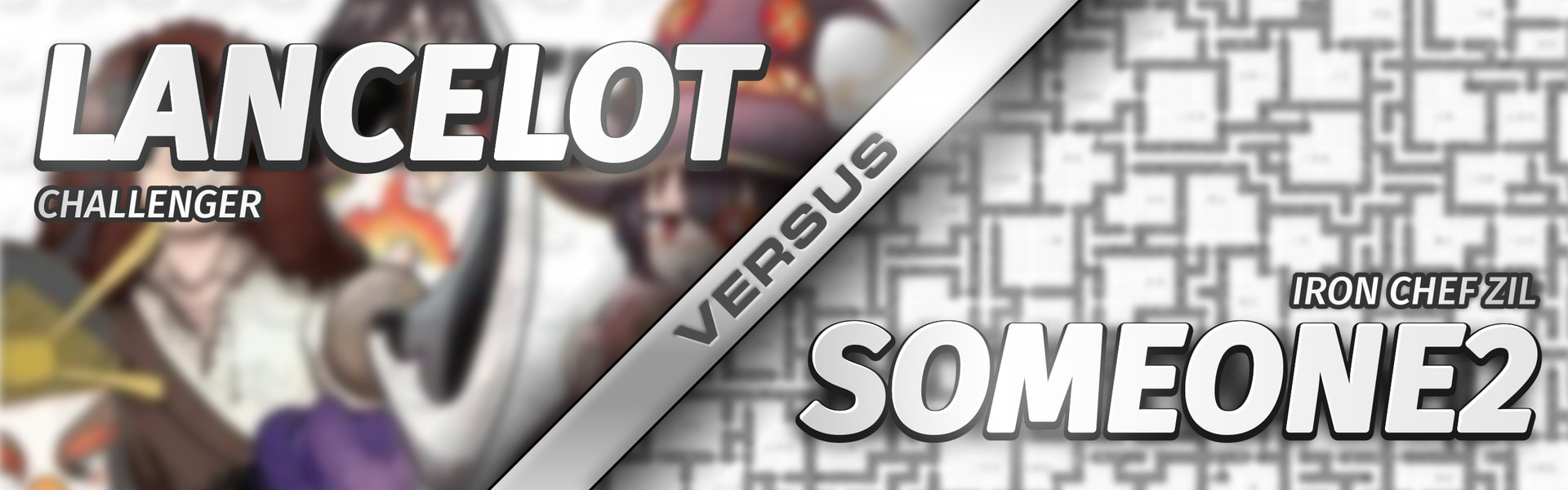

Iron Chef ZIL SomeOne2 has triumphed in both the judges’ verdict and the audience vote! Arkanen’s engaging artifact and satisfying puzzle structure has carried the day.
Challenger Lancelot can take heart in the fact that the majority of judges deemed his writing to be superior to that of the defender. Now armed with fresh lessons and insights with which to further hone his craft, this worthy contestant is well-equipped to produce more and greater creations in other venues – and we can hope that in the future we will see an expansion of Time Swap into something that more closely matches his complete vision.
Congratulations to @SomeOne2 for an impressive display of mastery over ZIL, and a powerful demonstration of the synergy between preparation, insight and discipline. (May these qualities serve you well in your imminent trial of a different type!)
The third consecutive victory by the Iron Chefs has been notched. How long can their winning streak last? More importantly: Who will be next to challenge them?
18 Likes
While the victorious Iron Chef SomeOne2 and technical advisor vaporware retire to the ranks of their colleagues to await future challenges, let’s have a round of applause for our exceptional panel of judges: J. J. Guest ( @J_J_Guest ), Agnieszka Trzaska ( @agat ), Joey Jones ( @Joey ), Charm Cochran ( @OverThinking ) and Lucian P. Smith ( @lpsmith )!
Though they affected a certain cluelessness as a group in their opening remarks, every one of them clearly possesses an admirable knowledge of craft, and they handled some unexpected rockiness with aplomb and grace.
I’ve already started the work of assembling the cast for the next episode, and there is some interesting news to announce shortly. For now, the camera turns to the members of this episode’s cast for some final words, then we’ll wrap up with some updates about what comes next for the show…
19 Likes