Iron ChIF: Pilot Episode (Pacian vs. Draconis, using Dialog)

I don’t have much to show this morning, but I do have this!

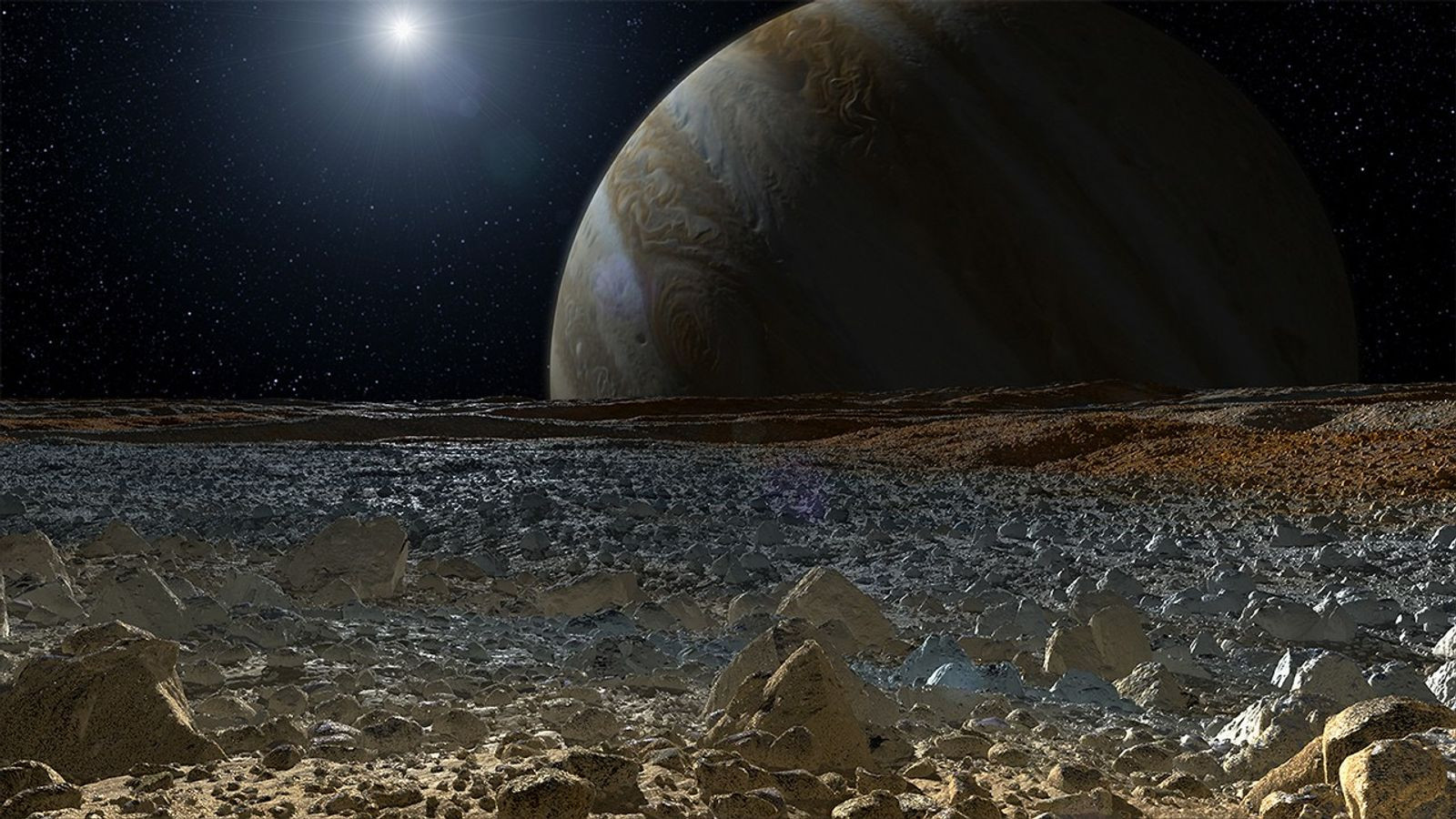
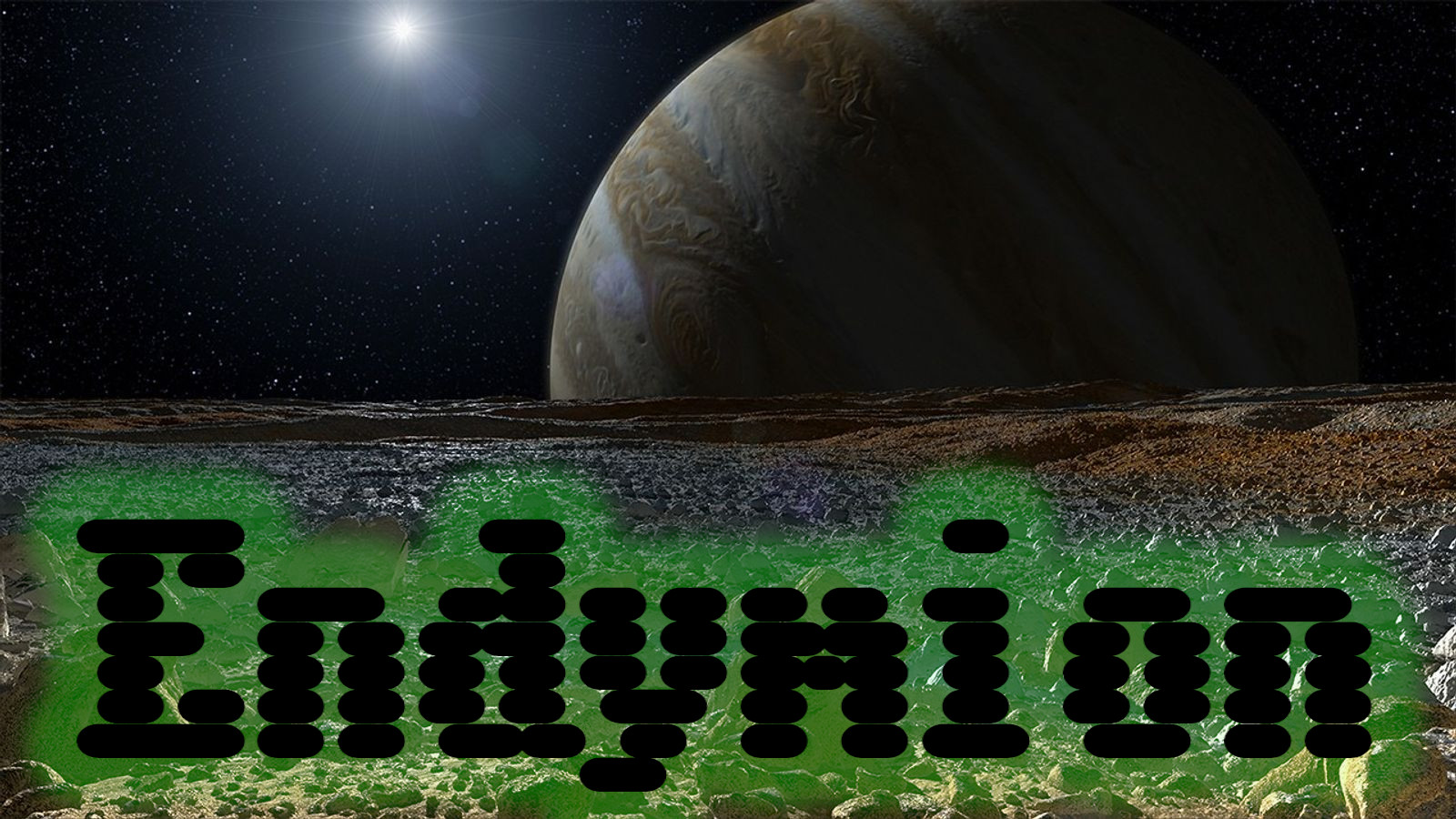
I wouldn’t want to read even a full sentence in the Amiga font, but for a single word, I think it’ll work all right. And the great thing about NASA images is that, as creations of the US federal government, they’re all in the public domain!

An artist’s rendition of the surface of Europa. I believe the entire surface is supposed to be ice, so I imagined it being somewhat smoother, but the JPL people know what they’re doing a lot more than I do!

12 Likes

Me too! I had envisioned a round ball of smooth ice. Although now that I think about it that’s kind of dumb. Given all the space gunk smashing into moons, it makes way more sense for it to be covered in pits and craters and broken bits like our own moon.

8 Likes

And actually, I do have one more thing I can share—a little bit of unrealistic-ness that I couldn’t find a good solution for.

At one point in the game, some of the alien messages include question marks and exclamation points. Meaning, presumably our intrepid hero(ine) can tell by the intonation what’s a question and what’s a command.

Now, I will readily buy that these aliens are shaped basically like humans and their language is full of sounds humans can make and understand. That’s been a staple of science fiction since the second century CE. But even humans on Earth can’t agree on what sounds like a question and what sounds like a command!

In English, for example, we indicate a yes-or-no question by raising the pitch on the last syllable. “Do you un-der-STAND?” But in Swahili, they indicate it by raising the pitch on the second-to-last syllable! “U-na-e-LE-wa?” This means Swahili questions tend to sound like direct statements to new learners (“You understand.”) until they wrap their head around the different pattern.

The more realistic way to do this would be to have the alien language work something like Mandarin, where instead of intonation, extra words are added to mark something as questioning or commanding. But I’m already pushing things, expecting players to decipher 20 words. Adding more would just be too much.

So for now, I must live with this inconsistency that I suspect will bother absolutely no one except myself. Our protagonist lucked out, and the aliens’ intonation happens to line up well enough with their native language that their first guess is right, and the “?” and “!” in the transcriptions don’t need any further refinement. I imagine by that point in the game, players will appreciate something being made a little less complicated!

13 Likes

A playable game by @Pacian ! Even if only the author can get to the finish at this point, that still means that there’s a straight throughline for Pacian’s fairy.

And @Draconis shows us in-game text. A gripping prologue about a castaway…in space!

Until now, I was thinking about the games in rather different terms.

@Pacian’s felt more like a freewheeling excercise in improvisation with an emphasis on mood and characters. Fascinating to see how character descriptions and snippets of code reduce and condense around the motifs in the original notes to something that smells more and more like a complete and rounded dish.

@Draconis’ work stayed in the abstract corner of high-level code-language for a long time, and I’m very glad to see some actual game text so I can put all that talk about automatic language-creation and the implementation of a translation interface in a narrative context.

So this is pretty much an impossible question to answer at this time.

Going on what I’ve seen so far, we have a rather grim or tense story about a ship-wreck survivor on a desolate (for now?) moon trying to piece together information from a lost civilisation’s artefacts on the one hand, and a more comedically inclined tale about a fairy with conflicting loyalties in a cave with a mysterious machine on the other.

I have examples of both kinds of games in my [Rovarsson’s Superlative Games - Recommended List].

  • Inevitable by Kathleen M. Fischer seems to be more along the lines of what Draconis is doing, although in that game there are no language puzzles but more traditional (Myst-like) adventure puzzles about deciphering the workings of great network of alien machines.
  • The Wizard Sniffer by Buster Hudson has a limited parser and a hilarious cast of NPCs, which makes me think of some elements of Pacian’s game. Again, no translating weird words or sounds in this one, but I suspect the concept of nudging NPCs towards the protagonist’s goals will be similar.

Despite their differences in mood and setting and gameplay, I gave both games 5 stars and a raving review.

So I cannot decide which of the two dishes on our contestants’ stoves I will like the most once the time for judging comes around. I’ll have to wait and see…


Isn’t the ocean under the ice of Europa also constantly being churned by Jupiter’s gravity and tidal pull, making it’s surface pile up and crack? A bit like the winter-ice when the polar ocean freezes over on earth?

10 Likes

That’s a really hard question! Stepping back, I’m more of a fantasy person than a sci-fi person, but I also tend to like drama more than comedy, and I like characters interacting more than lone exploration, but I dig translation puzzles more than object manipulation… Those abstract preferences are pretty weak, though, and since they’re more or less in equipoise I don’t think either of our chefs’ concepts are ahead of the other. And as for the previews we’ve been getting of how their ideas are developing, they point to very different risks and pleasures: Pacian’s game, as we’ve seen, might be more vulnerable to bugs, but also contain more scope for players to mess around with a variety of different thingamajigs and people, while Draconis’s seems like it will be more focused and deliberately paced, though with puzzles that might wind up inscrutable.

There are particular things I’m looking forward to trying once I have my hands on the offerings, though – trying to achieve the fairy’s sidekick-and-or-romance dreams (or maybe even getting Trala and Lind to fall for each other?), seeing how far we can go awry if we get one of Endymion’s translations wrong, and of course, seeing what happens when we X ME (hmm, what’s the Dialog equivalent of “as good looking as ever”?)

As for making stuff under time pressure: I’ve actually mostly managed to avoid this, because in the era when I was making games I had tons of time. During the height of COVID and with no kid yet, I had hours and hours to refine my ideas! Since then, of course, I haven’t written much, except for a one-week gag game that by necessity had a pretty limited scope. So I’m pretty much in awe of y’all who are able to churn out impressively robust games with only a limited number of hours at your disposal – I’m a fast writer but a weak programmer, and I really like including lots of custom responses and inessential interactions, so unlike our competitors I’d be cracking under the pressure!

I am deathly afraid of it, actually – now that I’ve done well in the Comp and won some XYZZY’s, my only remaining aspiration for my IF career is that for every game I put out, folks think “wow, I would never have expected this would be your next game!”

(I’m pretty sure I’ve got two or three ideas that should keep me safe on this front, but after that things might get dicey).

9 Likes

Tonight has been scenery night! (And, if I’m honest, more bug-fixes night.)

This is where I deploy my secret weapon: not mentioning things.

Yes, by the advanced trick of not mentioning things that aren’t useful, I can reduce the amount of scenery I have to implement by entire magnitudes. Does that mean I’ve implemented everything? I mean, probably not?! I thought I’d at least got most of it until I noticed that I’d not implemented the bloody gateway that the goblins are trying to get through and which is mentioned in many of the key moments.

Anyway, a taster of some scenery to whet your palates:

#Chamber
(name *) cavernous chamber
(dict *) carved cavern
(descr *)
    Probably carved into the mountain by the ancients.
    You know what they were like!
(dont scan *)
(#AncientSanctum attracts *)
(#Ending attracts *)

#ArchedGateway
(name *) arched gateway
(dict *) arch arches
(descr *)
    That's where you all came in, chased by goblins.
(dont scan *)
(* is #in #AncientSanctum)

#Mountain
(name *) mountain
(descr *)
    You've seen this mountain from the forest all your life, 
    and now, after this long journey, you're inside it.
    (par)
    Not really by choice, let's be clear.
(dont scan *)
(#AncientSanctum attracts *)
(#Ending attracts *)

#Pit
(name *) bottomless pit
(descr *)
    You can't bring yourself to fly over the edge.
    Down there is nothing but darkness.
(scan *)
    The stranger aims his gadget down the bottomless pit.
    It makes a little hiccup noise.
(* is #in #AncientSanctum)

Since I have heard some discussion of titles above the bubbling pots and roaring flames of the kitchen, maybe now’s the time to mention that I named my entry right when I first started writing the code… probably in the same way that they name those animé with titles like “I’m the Ultimate Warrior’s Chartered Accountant But Now I Have to Pretend to be Her at a Deadly Martial Arts Tournament”. So… I probably need to come up with something a bit more permanent. Or commit to the bit, I guess.

I did stay up a bit too late working on my entry yesterday, so I think I emphatically need to not do that tonight. Tomorrow is testing and polishing day. Whether or not I’m well positioned for that will depend on what happens when I try to break things.

(Also, normally I would never release something without a hint system, but, well, we’ll see…)

15 Likes

in an attempt to earn my tips i’ll jump back in with unasked for fukui-san commentary.

speaking of “not mentioning things”, dialog is very deliberate about not mentioning things (now THAT’s a segue).

dialog leaves it entirely up to the programmer what’s described and what isn’t. unlike ZIL and inform6 (i’m not sure about inform7 and i don’t remember what TADS does) everything is initially ‘scenery’ by default. the programmer takes responsibility for describing everything in the room either in the room description itself or with an (appearance) predicate.

if a takeable object needs to be described:

(appearance #tvRemote)
     (* is pristine) 
     The TV remote, dappled with congealed nacho cheese, pokes out from under the futon.

this will stay in effect until the remote is handled by the player (no longer ‘pristine’) and from then on the game automatically takes over and describes it generically (“you see a tv remote here”). or if you wish to continue to customize the description you can supply an (appearance *) predicate without the pristine qualifier.

this might sound like a pain but it actually allows fine granular control over exactly what gets described, how it’s described, and when it’s described.

13 Likes

Thank you Fukui-San @improvmonster And I concur, that was a gold-plated segue.

Now in that same code block Pacian just offered up, I’d like to ask you about bits like this:

(dont scan *)
(#AncientSanctum attracts *)
(#Ending attracts *)

These things like ‘attracts’ and ‘scan’ or ‘dont scan’, are these terms Pacian has set up to be meaningful for his game, or are they Dialog syntax? Or a mixture? What you just told us about ‘pristine’ being a function of Dialog showed me that some of the author’s words and Dialog’s words will easily pass for each other to my layman’s glance.

-Wade

4 Likes

(dont scan *) is a pacian-specific attribute assigned to the object

($ attracts $) defines “floating objects”, that is, items that can be in more than one place at a time (similar to the “found_in” property in inform).

you can assign these individually as he’s done here but, since dialog is all about lists and recursion, you can also assign them to ‘regions’

(room *(forest room $))  %% this sets up a new custom room attribute that inherits from the usual room attribute. 

#trees     %% this creates a movable scenery object
(name *) trees 
(plural *)
(descr *) You see towering oaks all around. 
((forest room $) attracts *) %% now the trees are in every forest room we create.

i would point out one advantage of inform6 in this respect. once you’ve “attracted” an object to something in dialog, you can’t make it disappear or “un-attract” it again. whereas, in inform you can simply zap the found_in property. it’s a small thing but occasionally useful.

EDIT:
actually, ignore this last part. i remembered that you can apply rules to an attract predicate which will let you apply and un-apply them.

(#livingRoom attracts #shagCarpet)
     (year is 1976)
9 Likes

Attracts, eh? It’s an interesting choice of word for this backdrop kind of function, and really changes how I imagine what’s going on. I envision the tree props zapping towards all the forest rooms at incredible speed, like metal chairs flying towards an MRI machine.

-Wade

8 Likes

Okay, since my last major sojourn in Keyboard Stadium, Draconis has offered up a title graphic. I don’t think I expected such a thing from either competitor – again, because I didn’t think they’d have time. The audacity! The sheer temerity!

Draconis’s posture throughout the event has been rock solid. And I think, because of the matching solidity of their originally planned game, we’re safe to say they’ve been spending the majority of time applying an additive approach to the dish.

In my search for interesting contrasts, I see Pacian as having got his souffle risen very quickly, and now he needs to apply a subtractive approach to keep it under control, hence the new strategy of ‘not mentioning things’, where cutting some things mentioned in the prose will eliminate all time it might have taken to implement them. But there’s still clearly a lot in his game that warrants implementation. We will see if he can wrangle it in time…

Or will we? I am reminded of one of the uncountable number of great lines from British sitcom Fawlty Towers: “What the eye don’t see, the chef gets away with.”

-Wade

9 Likes

It’s interesting the range of reactions we have to pressure when the shoe is on our non-judging foot (feet?).

I personally never have the problem of ‘farting around forever’ :slight_smile: . It just doesn’t happen. I get things finished. I am certainly struck by the perfectionism stick @EJoyce described. Yet in my version, it doesn’t tangle me up in a second-guessing of myself that can be dislodged by jams, pressure and constraints. Once I’ve decided the thing is worth making, I commit to making it, and with the perfectionism that can take a long time. I may appear relatively unprolific in the IF context, but I do have over half a million words of unreleased WIP up my sleeve, and my creative time in the long run is probably at least divided in half overall with music, too.

The perfectionism renders me a jam-wuss. Part of me says, ‘Ugh, I can’t stand to release such a rough game,’ even though I particularly enjoy analysing janky games that may result from jams! (See my reviews of The Forest House series – each game made in a matter of hours in ADRIFT, and getting more ambitious each year, and ultimately with the scenery falling apart as a result)… but another part of me is confident to instead bank the time I’d have put into a jam into a bigger thing I’m already working on.

-Wade

5 Likes

I’m afraid that’s not allowed in this competition! (To the best of my knowledge, at least.) That’s part of why I’m trying to do one huge conceptual puzzle instead of a bunch of individual object interactions—fewer moving parts that can break in exciting ways when anyone except me touches them.

7 Likes

Please forgive @AmandaB , it was just that a bit of fairy gunk splashed on that page of her rulebook.

-Wade

5 Likes

Oh, I was mostly saying that for my own benefit—if the mistake was mine, I need to go grab some testers right now!

3 Likes

To avoid all confusion – it is not allowed.

-Wade

4 Likes

Oh, and, right! Update, update, I need an update…

As it gets close to the shiny bit, the device lets out a low squawk: “Zria-rez-ruag-gho-leq-rez-gho.”
For the sake of your fingers, you can type “zria” instead of “zria-rez-ruag-gho-leq-rez-gho”.

> zria means REDACTED
(Assuming “zria” is short for “zria-rez-ruag-gho-leq-rez-gho”)
You make a mental note that “zria-rez-ruag-gho-leq-rez-gho” translates to “REDACTED”.

There are exactly two words in the game that are over twelve letters long: “zria-rez-ruag-gho-leq-rez-gho” and “gie-zhag-leq-zhio-leq-rez-gho”. I imagine most people will use the hyperlinks, but if anyone wants to stick to keyboard, this should make them more manageable!

Plus, the alias system I built is extensible to any other absurd words I might add in a burst of final-day sadistic cruelty. I was assuming the Å-machine trimmed dictionary words to the first few letters like the Z-machine (in both of these cases, midway through the second syllable); it turns out, it does not!

11 Likes

So Draconis’s latest update shows them adding the power of aliases and, to some extent, support for multiple control methods, to their game. Draconis has again one-upped Pacian on the number-of-updates front, which changes the atmosphere in the stadium but probably won’t weigh into the tasters’ eventual taste-testing. And I don’t think Pacian’s the type to be psychologically shaken by the tactic.

Unlike with some advents that have stunned me during this contest, I find I’m taking the control tech polishing a bit more in my stead. Both because Draconis raised its spectre in earlier updates, and because I’m getting the sense that Dialog makes it easy to support if a program needs it.

However, that Draconis is able to spend time polishing control methods lends to the overall sense that their game is shaping up to be a real, well, microcosm of a longer game. I mean, I’d be feeling pretty good about the arrival of a big translation-mechanic game even if it didn’t offer so many affordances. Here it looks like we’re going to get a smaller translation-mechanic game which does offer them.

The combination of Draconis’s labours and, if they’re lucky, the final dish landing the right way, may end up giving it a quality where nothing seems to be missing by scale. Draconis already talked through, in their updates, the kind of excuses for some aspects of the nature of the language stuff that we’ll face, and some of them were pretty high-faluting for the median IFfer.

For me, outside of my judging, I’m getting reinforcement of my original vibe. Liking the sound of my own voice today, I’ll remind what I said about the Iron CHIF back at the start:

I think what’s coming is system as game, which is often a core of the Draconis Way™

I’m wondering if Pacian is too busy for another update before we reach 1 DAYS REMAIN? If he isn’t, what will he say? If he is, it can only increase the mystery box quality building around his entry at this later stage.

-Wade
7 Likes

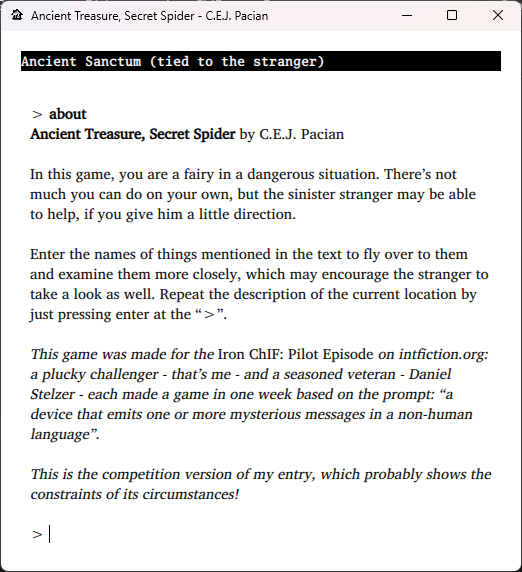
As usual, I’ve grabbed a little time before work to keep hammering away at my entry. This morning I’ve just added the ABOUT and CREDITS responses, two things that are good to have and always take more time than you think…

Oh yes, and while lying in bed, I turned the title over and over in my head until it had morphed into “Ancient Treasure, Secret Spider”. Although it’s still possible that I’ll pull a Dr Strangelove and throw the long title in as well…

Tomorrow morning before work is my last chance to work on my entry before the deadline. But I think if I actually leave anything for then, I’m asking for trouble. That means: tonight is the night.

13 Likes

And there we have it. With three hours to go before this day of the contest ends, Pacian has returned to reveal his game’s real title – or at least its realest title so far.

Ancient Treasure, Secret Spider

I think it’s an excellent one. It mobilises the Crouching Tiger, Hidden Dragon tradition, with the twistiest element as I see it being the spider. Dragons and tigers sound balanced and comparably powerful, whereas here the Ancient Treasure sounds like it has the scale and majesty in Pacian’s title, while spiders are tiny. And this spider, being Secret, is a confounding degree beyond Hidden.

Pacian again demonstrates his talent for dense communication. This whole thing has rewhetted my appetite. At first glance, Endymion to me is the less hooky title. I’d have had to go look it up if it hadn’t been for @DeusIrae 's walking Greek myth encyclopedia-ness. However, Endymion may turn out to be the deeper title in the long run. When we look at the roots of many languages, we’re looking at Greek and Latin. And this first Iron CHIF battle is revolving around language translation and communication.

-Wade

6 Likes