I hope both competitors are keeping up with their daily infusions of Creap (link to the ad in Japanese ad break 1).
-Wade
I hope both competitors are keeping up with their daily infusions of Creap (link to the ad in Japanese ad break 1).
-Wade
After which follows a steaming plate of piping hot transcript straight from the oven, smelling deliciously of doohickeys and generously sprinkled with freshly chopped whosits…
But I understand what @Pacian is getting at. The game-text shows a quite “normal” setup for an interactive fiction game. It being “normal” doesn’t stop it from attracting my curious attention though! After tasting this small bite, I want to have more, muck around in the dish with my fingers and smell what separates the dinguses from the doojiggers.
This whole event being styled as a Japanese cooking show makes me imagine this scene as a heavily cloaked mysterious figure poking various stuff with one of those sharp and pointy meat-thermometers.
The pencil drawing Pacian shared of the location where all the action of (tentatively called) The Fairy and Her Muscle-Man will be taking place sparks all kinds of questions. The one foremost in my mind is a parallel of “What’s in the Stranger’s pocket?”, to wit: “What’s in that bottomless chasm?”
The looming machine looks like it’s connected to the rim of the chasm via an axle and a drive belt… Will the main dish be hauled up from the fiery ovens of Hell itself once we successfully deduce the machine’s workings?
Only in IF do we get to read this sort of sentences. In a technical discussion about a programming language no less!
Written in some ancient arcane language only the initiated can understand.
But I have to say that both Fukui-san (@improvmonster) and @Draconis are doing a splendid job of trying to educate the unknowing. Less than half is readily understandable to my non-coding brain, but I do think that I at least partly grok the general logic.
The contest is reaching a boiling point. After both chefs have finished their mise-en-place , chopped and softly fried their sofritto base, and planned the further development of their dishes, we’ll see how they manage to keep up their creative culinary skills in the blistering heat of the ovens of Keyboard Stadion!
And this is probably where my updates are going to slow down a lot, because I’ve done the most exciting parts of the planning, and I’ve done the most exciting parts of the coding, and now I just have to actually build the world. Placing rooms and objects, coding actions, and writing a bunch of descriptions.
So, probably a good time to talk about my overall design philosophy!
Ever since The Enigma of the Old Manor House, I like having an IF completely designed and plotted out before I put metaphorical ink to metaphorical page. Maps, puzzle dependency graphs, lists of actions—everything that determines how the player will go through it. It’s not perfect at avoiding scope creep—Stage Fright still ended up about twice as big as I’d hoped—but it means the scope creep generally happens in design rather than implementation, so I still have the check of “can I actually finish coding this before the deadline” before I jump in.
In this case, I have a file called notes.txt in my repository that holds the whole design. The grammar and vocabulary of the language; the three-“act” structure (learn mechanic, use mechanic, twist mechanic); the rooms and objects involved in each act. I had that all written the first day, along with the basic code for translating text. So, one day of design, four days of implementation.
And I think that’s a good policy in this case, because out of all my IF-writing skills, I think design is my strongest one. After five years working at an escape room, I have a solid grasp of how to arrange puzzles so that players have enough freedom to not get stuck, with enough constraint to not get overwhelmed. So I was able to quickly throw together an outline with placeholder names and descriptions, which—I hope!—will introduce all the words at a pace that lets the player figure out their meanings.
The next four days, then, are devoted to the part I’m less solid at: the creative writing. It’s not a coincidence that when I collaborate with other IF authors, I tend to handle the coding, while they do all the writing parts! The ability to convey a whole fascinating world with just a few well-chosen words is something my opponent is very good at, so I’m not going to try to compete with him on that front: my game’s focus is going to be solidly on the linguistics and the puzzle-solving. But I also need something more than “outside” “first room” “box” “second room” “box 2” “key” if I want to impress this panel of judges!
So what I’m doing now is implementing that outline and filling in all the placeholders as I go. I’ve worked out a rudimentary voice for the narrator to give the whole thing a less sterile feel, and my goal now is to turn “box 2” into something that will hold the player’s interest and make them want to explore the world further. For my next update, I’ll find some examples of this to show off without involving the alien language (since if that’s spoiled, I have nothing!).
Apologies to @improvmonster if I’m stepping on their toes here, but this is another area that most Dialog-users never actually have to think about the details on—it Just Works the way you want it to. It’s only the compiler maintainers who have to get into the nitty-gritty of it. But that nitty-gritty is a thing of beauty, so I think it’s worth explaining too.
The way Dialog’s text-output mechanism works, whitespace in source code is never actually significant.[1] Whether you have one space, five spaces, tabs, newlines, whatever between your words, all that matters is that the words are separated somehow. Everything else is left up to the compiler. And this is true for anything you want to print: literal words, variables, numbers, anything.
Then, inside the program, there’s an internal variable called the space register (REG_SPACE on Z-machine, SPC on Å-machine). This can be set to a few different values:[2]
(no space)(space)(line)(par) (that is, paragraph break)These four predicates never actually print anything. All they do is set this register—or more specifically, they can only increase this register, never decrease it. If you’ve specified both (line) and (par) since the last thing you printed, no matter which order, the register is set to (par). In other words, this register holds the maximum amount of space requested since the last thing printed.
Then, whenever something gets printed (again, anything at all), the program checks the value of the register. “Automatic” means “print a space, unless the last character printed suppresses space on its right (( [ { < -), or the first character about to be printed suppresses space on its left (. , : ; ! ? ) ] } > % -)”. Anything else means print that thing: nothing, a space, a line break, or a paragraph break (three newlines on Z-machine, a </p> <p> on web).
This means that you can never accidentally get multiple spaces, line breaks, or paragraph breaks—you have to use other mechanisms if you actually want multiple of them (e.g. for drawing ASCII art). If the player’s command is “Bob, take the apple”, that’s internally stored as [bob , take the apple] (the comma is its own word), but the automatic whitespacing will make it look right when it’s printed back. When printing a bulleted list, you can put a (line) after each entry, and a (par) after the end, without ending up with too much whitespace. It Just Works.
Now, it also means if you want more precise control of your whitespace—perhaps you’re a typewriter fiend who wants two spaces after every period—you’re out of luck. It’s possible, but Dialog makes it extremely difficult. Typography is one of those things that Dialog is extremely opinionated about; it’s extremely hard to do any sort of string manipulation, because the compiler handles so much of it automatically for you rather than exposing any sort of “string” data type. That’s the price we pay for convenience![3]
And, this is why I specifically say “(no space) $Word (no space)”. Fancy quote marks don’t suppress space on either side, so I need to explicitly tell Dialog that it’s okay to have space outside them, but it shouldn’t have space immediately inside them. The result is thus “word” instead of “ word ”.
For text output, at least. It’s significant for the language’s syntax! ↩︎
Technically there’s also a “pending space” value, and a bit of extra complexity to handle div margins on Z-machine, but that’s just an implementation detail. ↩︎
This is why Dialog games conventionally capitalize only the first letter of room headings, instead of the first letter of every significant word. The language makes it quite hard to do otherwise! Possible, but not easy. ↩︎
Imagine my surprise that there is actually a type of cake called fairy cake, which appears to be just a sponge cupcake. Sponge cake is OK, but I never make it, preferring to make lighter chiffon cakes-- cakier than angel food but lighter than the fairy cake recipe.
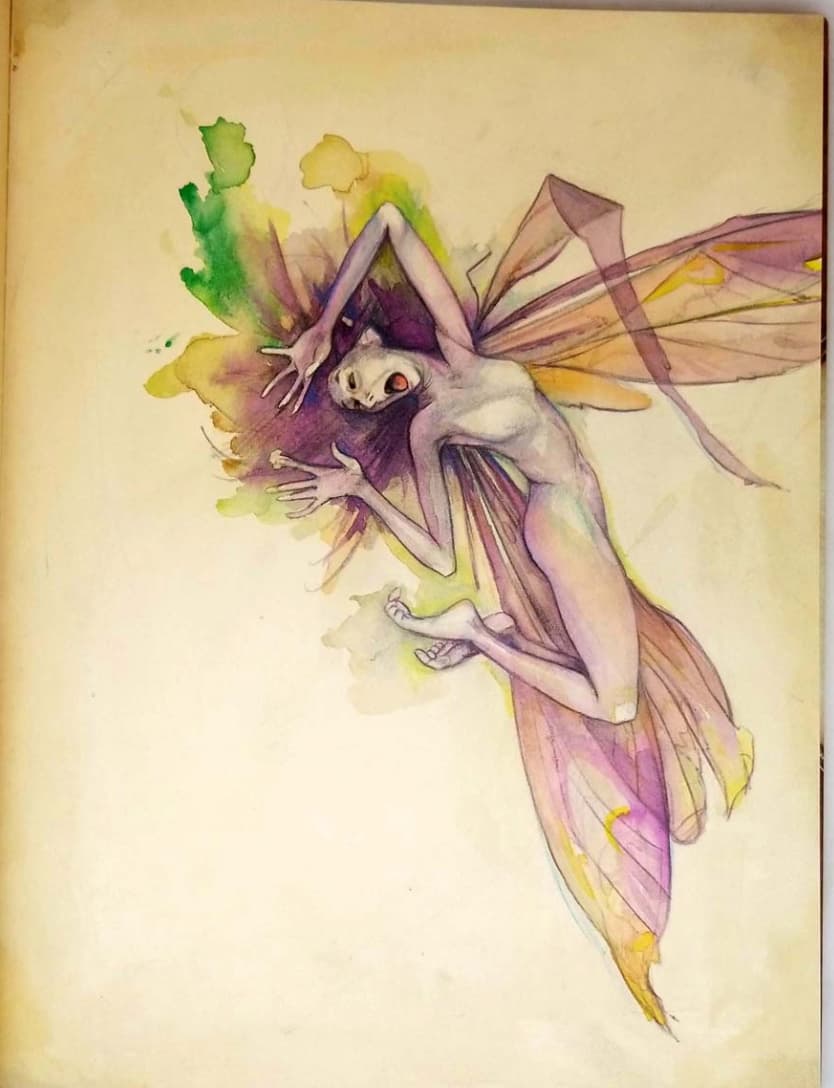
I don’t know how many people remember the fad book Lady Cottington’s Pressed Fairy Book from some years ago, but I thought a picture of one of the pressed fairies might be in order here (CW: nudity, green gore):
I definitely have a sense of both games now. One a fantasy, the other appearing more sci-fi oriented. Vanilla and chocolate. It remains to be seen what other flavors will be added. Both heavily featuring the device, it appears. I wondered before we started how central the secret ingredient would be in the resulting games, and this ingredient almost commands a specific type of game. In future episodes, I’d like to see ingredients that can be interpreted more broadly.
In our top secret elite judges’ room, I was asked to talk about fairy tales a bit as I’m a fairy tale buff. Putting a fairy in a story does not a fairy tale make. IF is well-suited to fairy tales because of the natural quest element in much IF, and the fantasy-heavy history of IF, full of good vs. evil. But if either of our contestants want to make a bona fide fairy tale, there needs to be a heavy-handed morality lesson involved, and it should lean at least partway into actual folklore territory instead of being purely creative fantasy. Or, y’know, it could just be a game about a fairy, an interdimensional spider, and a thingamajig without having to fulfill some academic genre checklist.
----blinks against sunlight----reaches under folding beach chair somehow dragged into Keyboard Stadion----twists open sunscreen tube----squirts generous blob into palm----rubs himself----
November, and the sun is still bright this late in the year. Harsh even, especially with it sitting so low in the sky. Which is why I thought to protect my skin agai…
----stops suddenly----inhales sharply----sniffs open sunscreen tube----
Mmhhh… Whenever I rub this stuff, the smell of it immediately transports me back in time to 1995, and across space to Czechia. A group of teenagers on an early-morning busride to the snow slopes. Checking our gloves and scarfs, zipping up our skiing onesies, pretending to be scuba-diving by making Darth Vader-like breathing noises with our snow-goggles on…
Preparing for our first day of skiing also meant putting on copious amounts of sunscreen. A whole bunch of us doing that at the same time in a bus with shoddy fresh air supply meant the smell of sunscreen hung heavy all around us.
So now when I put on sunscreen, I get a nostalgic shot of imagined skiing fun for free.
----listens to mumbling from the audience----“where’s he going with this? is he on the wrong thread? what’s Rovarsson’s blobby sunscreen fetish got to do with anything?”----raises hand reassuringly----
All this to say that our sense of smell is incredibly powerful for recovering memories and generating feelings, deeply nested in our brains as it is, communicating directly with emotional centers.
And standing here, in this magnificent Keyboard Stadion filled with the aromas of sizzling plists and broiling access predicates, inhaling the fragrant smoke of doojiggering dinguses and smoldering fairy wings (----“fairy wings? fairy wings! quick! get that bucket of tomato sauce!”----*SPLASH!*-----hands towel to fairy----), smelling how the distinctive scent of our chosen challenge ingredient slowly gets incorporated into the savoury bouquet of our chIFs’ dishes, my mind wanders, filled with memories and associations of games that came before…
Gently lifting the lid on one of @Draconis’ bubbling pots brings back, aside from definite hints of karbanátek and bramboračka, memories of one particular game more than any other. A game which I lost myself in for hours in the days of yore, when I was young and Flash was still in its prime. A SF game about a bumbling young interstellar explorer stranded in an alien nest, desperately trying to communicate with the inhabitants to gain their help in getting home. (Without accidentally telling them to “Lick my hairy whale shark balls!” and getting thrown into outer space…)
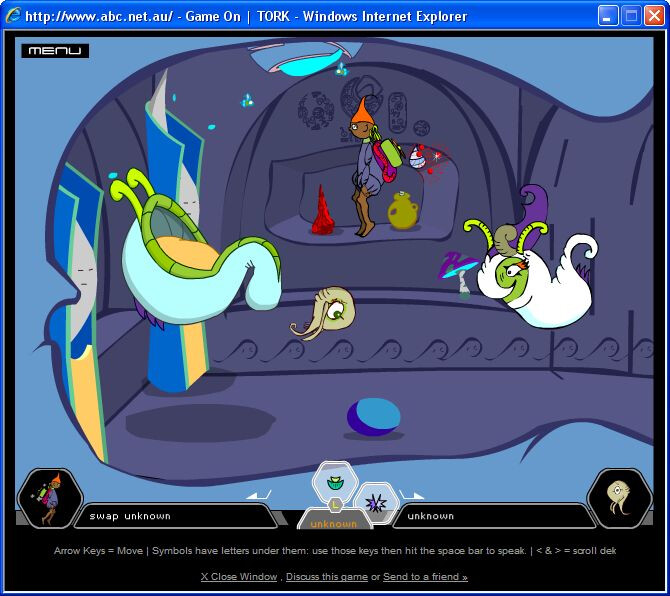
That game was Tork.
Despite being a graphic game, its gameplay mechanism has a lot in common with @Draconis’ proposal. On the underside of the screen there is a rotating wheel of symbols. These symbols are collected by approaching an alien. The alien blurts out one or more of these symbols, sometimes accompanied by an action. Pressing the keyboard letter associated with the symbol makes your PC blurt that utterance back to an alien. From the alien’s actions and reactions, an approximation of the meaning can be inferred.
Now, where this system is really similar to Draconis’ is that once a symbol is in your collection, you type your guess as to its definition into the center of the symbol-wheel. Erasing that guess and replacing it with a better alternative can be done at any time, depending on your experiences with blurting out that word/phrase to various aliens.
Brilliant game, one of those from that era that I remember most fondly. Sadly, I couldn’t find a working version anywhere. (If anyone can, I would be deeply indebted to you.)
Approaching @Pacian’s cooking station on the other side of the Keyboard Stadion (quite a long walk actually, we’re spread out over more than a dozen timezones…), different herbs and spices hit my olfactory remembrance faculties…
The flashbacks here are more diffuse, memories and glimpses of a variety of games, all somewhat similar in some way, but none tasting quite like the unique brew that is simmering on Pacian’s stove.
From the photographs @Pacian posted of The Tome of Game Notes, I gather the game (tentatively called) The Fairy and Her Muscle-Man will be a one-room affair. The obvious one-room language game that comes to mind is of course Suveh Nux.
Suveh Nux has the protagonist locked in a magical strongroom. To escape the room, the protagonist has to uncover various enchantments and learn their meaning by experimenting with them on the sparse few objects in the room. No doubt, this experimentation leads to many and more shenanigans, a point of likeness with Pacian’s game as foretold in The Tome of Game Notes.
The most interesting phase of Suveh Nux happens once you’ve mastered enough of the magic words to be confident of their effects. Here, it becomes necessary not only to understand (i.e. translate) the enchantments, but to combine them into new spells. In other words, after discovering and translating the basic words, you must deduce and construct novel utterances in this magical language.
But what we’ve seen of Pacian’s preparations so far gives me the feeling that besides being a one-room language game, Suveh Nux might not share that many similarities with (tentatively called) The Fairy and Her Muscle-Man.
One thing that can easily make a world of difference is the presence of NPCs. In Suveh Nux, the protagonist is all alone in the magical strongroom. What a contrast with Pacian’s diverse cast of characters! Think of all the possibilities for interaction, influencing or persuading NPCs to act as you want them to… The Branching Tree of Interpersonal Shenanigans is much wider here!
But I detect another familiar smell in the smoke coming from Pacian’s oven
(@Pacian , you might want to check that smoking oven…), a smell that take me back to the Wild Wild West…
Hoosegow has nothing to do with translations or language puzzles. (Except if you count my headscratching trying to figure out what in the name of whale shark balls a “hoosegow” is… I seriously thought it was some sort of chicken coop until I looked it up.)
This game is, on the other hand, a multi-character one-room escape game filled to the brim with high-level shenanigans. Mentally visualising the room you’re in, its furniture and the spatial relations of that furniture to other furniture, your PC, and other characters is central to solving the chain of puzzles that will lead to your final escape.
In the minds of many of you, the lack of language-puzzles may immediately set Hoosegow apart from whatever Pacian will do in this contest, with this specific challenge ingredient. However, I urge you to take a good look at those pages from The TOME of Game Notes that I reffered to before.
-There’s a pencil drawing of the cave Pacian plans to use as the main (only?) location. It’s pretty evocative to my mind, with several elements precisely placed in the space. Especially the placement in the game-space of a “looming machine” with a drive-belt connecting to the edge of the gap below it feels like there could be a set-piece waiting for manipulation, presumably with the intermediary step of translating the *chirp* and *chu* of the Stranger’s meat-thermometer.
-The first glimpses of in-game text that Pacian chose to share with us were the character descriptions. These were from the deeply subjective viewpoint of the Fairy PC. A lot of interpersonal drama is already set up in these few bits of description, and given how skilled this author is with writing intricate characters, I for one am very curious how these possibilities will be exploited…
----tummy grumbles----tummy grumbles again, louder----
I am getting a bit hungry from all these delicious aromas. But we mustn’t be hasty. The dishes should be ready to taste in just a few days… I’ll just have to eat a ham-and-ghost sandwich instead.
You can now play my entry from start to finish!
Okay, that’s a lie, I can play it from start to finish, everyone else probably needs all the extra implementation that will help you figure out what to do.
But my goal of implementing all the puzzles today appears to have been met! I just need to not think about how brittle it probably all is, all the bugs with all the complicated moving parts, all the typos and clunky phrasings… (It’s not working! I think I’m thinking about it!)
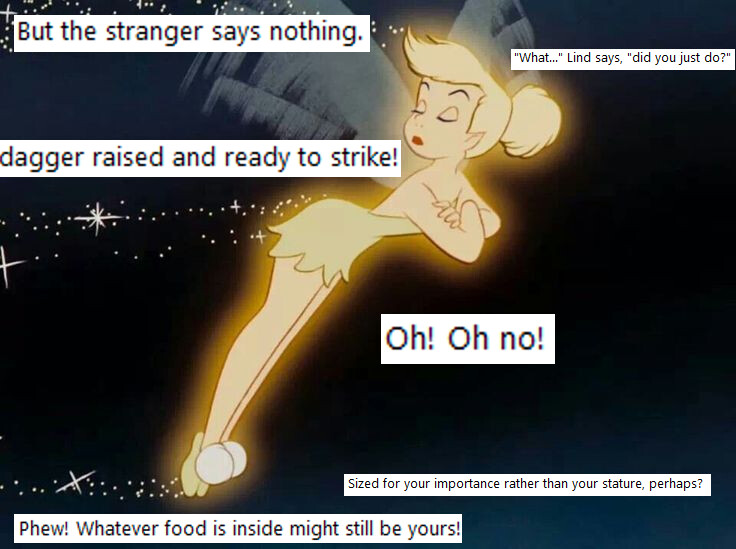
Also, it seems we’re posting pictures of fairies?
For a little snippet of code, my handling for the stranger picking things up and/or putting them in his pocket has evolved a bit, to start with through necessity and then through a bit of paranoia.
In theory, he should never hold more than one item at a time… But what if somehow he does end up with more than one thing in his hands? I updated the code to use (exhaust) so that in this situation, if you can find something new for him to pick up, he’ll empty his hands into his pockets, hopefully getting out of the erroneous state.
    %% if he can pick it up he does
    (if)(item $obj)~(useless $obj)(then)
        The stranger
        %% first put down anything already held
        (exhaust) {
            %% SHOULD only ever have one thing held by the stranger
            %% but let's use exhaust in case of bugs
            *($item is #heldby #Stranger)
            (item $item)
            (if)(ropelike $item)(then)
                (now)($item is #in #AncientSanctum)
                drops the end of (the $item) on the floor and
            (else)
                (now)($item is #in #StrangerPocket)
                puts (the $item) in his pocket and
            (endif)
        }
        (if)($obj is #in #StrangerPocket)(then)
            takes out
        (else)
            picks up
        (endif)
        (the $obj).
        (now)($obj is #heldby #Stranger)
    (endif)
Okay, the competitors are getting pretty locked in at this point. Each has stated what they’re going to do with their remaining time. Let’s refresh ourselves on the two initial approaches and where they’ve led to at this point.
Draconis came out of the gate apparently feeling so solid about the seed premise that they were able to spend time educating everyone in Keyboard Stadium on written language design and comprehension. They described specific approaches on how these things could be handled in a game program, and how they would be handled by theirs.
Pacian
Pacian shared with us his initial imaginative brainstorming in written and visual forms. He didn’t give much impression of having to turn down too many ideas upon consideration. Of course, we aren’t privy to every dimension of his process, but I got the feeling he came up with some character/creature ideas he liked and was confident to reflect off of those, and that he felt he’d make whatever happened next work in the writing. I do expect he laid down a base of “What’s the game going to be” during the post-seed, pre-match thinking day, so that the more imaginative stuff could then be riffed on safter footing.
Draconis’s updates continued from their initial trajectory. Elaboration upon the programming, leveraging some intense Dialog code, and elaboration upon design and interface ideas for the alien language. They talked about how players would interact with it, including something of a dictionary system. As of their most recent update, with the scaffolding built, they’re going to fill it in.
Pacian has not followed such an A to Z approach. His updates have zigged and zagged and joked. He’s quoted an endscreen twice. I’ve found the code and writing shared to be surprisingly prolific. As in, I’m surprised to see this volume and variety of coding and writing in the time.
Wade’s take on the match as we approach TWO DAYS REMAINING
Pacian’s serendipitous approach has created, for me, a bit more anticipatory excitement about his final dish than Draconis’s. However I’m guessing the depth of Draconis’s mechanic will be a surprise whose effect we can’t anticipate. And neither can Draconis!
This is shaping up as a danger/excitement. Draconis is creating one of those puzzles whose challenge in general, or to different players, is hard to gauge without testing. But the competitors can only test their own work until it’s tasting time. We’ve just learned Draconis has worked at an escape room for five years. We already know they have a ton of puzzle design under their belt, as well. So, how strongly will Draconis’s puzzles land when revealed? It will be very exciting to find out.
-Wade
My initial plan was to have six rooms in the map:
        (5)
         |
(1)-(2)-(3)
         |
        (4)     (6)
(Numbered for convenience.)
I implemented rooms 1 and 2 on Sunday, rooms 3 and 4 yesterday, and I’m working on room 5 today. If I can finish that tonight, and room 6 tomorrow, then I’ll have all of Thursday to test, fix, edit, rewrite, and refine. 5 and 6 have significantly more stuff in them than the earlier rooms, so I have a lot more to code for them!
As far as an actual update goes, I haven’t said much about the actual setting and plot. Time to fix that!
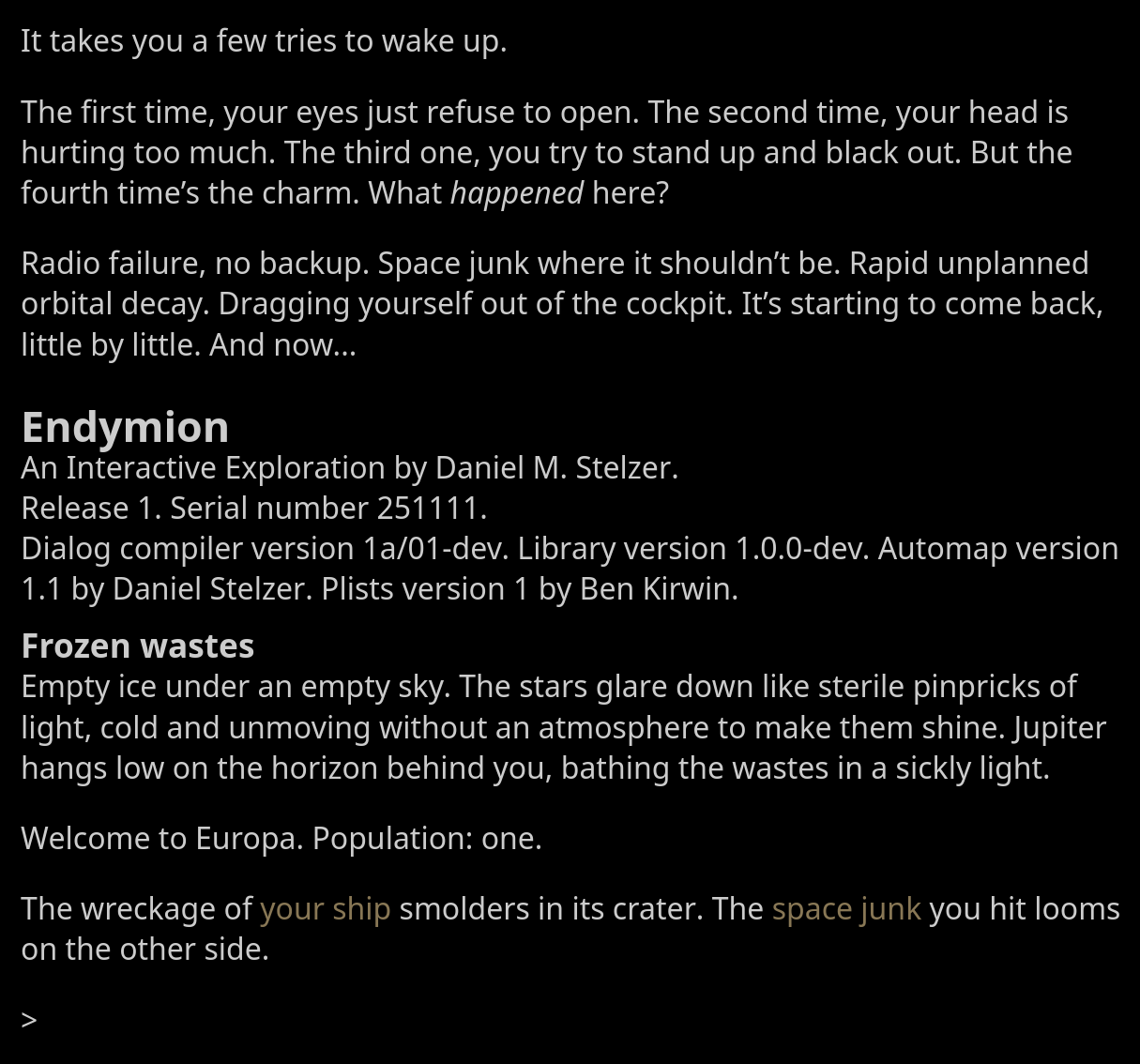
It takes you a few tries to wake up.
The first time, your eyes just refuse to open. The second time, your head is hurting too much. The third one, you try to stand up and black out. But the fourth time’s the charm. What happened here?
Radio failure, no backup. Space junk where it shouldn’t be. Rapid unplanned orbital decay. Dragging yourself out of the cockpit. It’s starting to come back, little by little. And now…
Endymion
An Interactive Exploration by Daniel M. Stelzer.
Release 1. Serial number 251111.
Dialog compiler version 1a/01-dev. Library version 1.0.0-dev. Automap version 1.1 by Daniel Stelzer. Plists version 1 by Ben Kirwin.Frozen wastes
Empty ice under an empty sky. The stars glare down like sterile pinpricks of light, cold and unmoving without an atmosphere to make them shine. Jupiter hangs low on the horizon behind you, bathing the wastes in a sickly light.
Welcome to Europa. Population: one.
The wreckage of your ship smolders in its crater. The space junk you hit looms on the other side.
>
chif pacian’s latest code release demonstrates a couple of things worth pointing out.
we’ve previously talked about multiqueries, where a predicate like:
*(item $Obj)
will set up a choice point and repeat until it succeeds (or fail if it ultimately doesn’t succeed).
in this block:
he uses (exhaust).
this will also repeat but, unlike a multiquery, it won’t stop when it succeeds but will continue to perform the operations between { } until it’s exhausted all possibilities. this ensures that everything held by the stranger is evaluated, not just the first item.
this might also be a good time to mention dialog’s linguistic trait predicates, an extensive collection of predicates that take into account an object’s gender and number and markedly simplify pronoun usage.
we’ve already seen (the $Obj) and (The $Obj). there are many others, such as (a $Obj), (An $Obj). some mark possession such as (its $Obj) (expands to ‘its’ ‘their’ or ‘your’), some mark verbs - (is $Obj) will become ‘is’ ‘are’ ‘are’.
so something like:
(That $Obj) (has $Obj) (its $Obj) faults.
will turn into anything from:
‘THAT couch HAS ITS faults’ to ‘THESE lobsters HAVE THEIR faults’ simply based on what $Obj is bound to.
it’s a little thing but cuts down on typos.
Creative writing may not be the area where Draconis feels most confident, but they’ve done a good job picking a setup for which a spare, laconic style works. The PC here is clearly in survival mode, and the starkness of the sentences helps to convey that. It’s easy for this kind of style to slip into short, repetitively-structured sentences, but what we’ve seen so far avoids that pitfall.
Having paid my dues talking about code yesterday, and as our competitors shift from the initial burst of brainstorming to the labor of building out their ideas, I’m going to retreat back to my comfort zone and take stock of what these games are shaping up to be about. We’ve gotten a fair bit of detail on mechanics and some solid hints about premise, but my favorite pieces of IF tend to have something to say – I don’t mean anything so stolid as a message or, heavens forfend, a moral, but the games I like best engage with themes, they connect their plots to their gameplay, they’re more than the sum of their parts.
On the challenger’s side of Keyboard Stadium, there are so many ingredients being flung around that the task feels like it hinges on identifying which are keystones are which are ornamental. Is Pacian weaving a fairy tale for us? I’m not convinced – as @AmandaB says, there are rules for such things, and the mere presence of a fairy isn’t determinative (otherwise Tinkerbell, who we’ve seen flitting about the thread, would make Peter Pan a fairy tale, and that can’t be right). With that said, we do seem to have two stock fantasy characters in Trala and Lind, but what jumps out to me from the few bits of description we’re given is how much they foreground relationships – and specifically, frustrated relationships. The fairy wants to be Trala’s Sancho Panza, but she barely notices us at all, while Lind keeps stubbornly avoiding falling head-over-feet for us, whether because of his eyesight or some other defect. Meanwhile, the fairy is literally tied to the stranger, who wears a disguise that works on the others but not on you.
Everything here has to do with perception, in other words – there’s no mutuality of focus, each character is a node on an interconnected, tangled web (I sure am using a lot of spider words here, huh?) that loops fruitlessly around on itself. It makes for an apt backdrop for a story where a communication device that’s notably uncommunicative, at least at first, will play a leading role. Is this a comedy, where all these illusions and misunderstandings will fall away in a climax where everyone sees each other as they are, with treasure recovered, marriages promised, and obstacles left laughingly in the past? Or a drama, where failures of perception are tragic flaws that earn punishment? Or some genre more recondite than those offered by this hoary dichotomy? We’ve got the pieces in place to understand what Pacian’s getting at, but I think we won’t fully know how they all connect until we see the climax.
Meanwhile, chez our Iron ChIF, we’ve gotten our first non-mechanical bits in this except from the opening. “Lone survivor of a spaceship crash seeks rescue” is one of the very classic IF plots, of course, but there’s some interesting texture even in these few sentences. For one thing, we’ve got a title – Endymion, who’s the lover of Selene, the moon goddess, in Greek myth; he’s best known for falling into an eternal, deathless sleep, for reasons that vary according to which particular version of the myth you’re reading (“Endymion” is also the name of one of the sequels to the classic sci-fi novel Hyperion, which is a sort of retelling of the Canterbury Tales in space, but I uh never got through the first one, much less the follow-ups, so if that’s one of the intended reference points I’m in the dark!)
We’re also on Europa, which has a mythological namesake too – the eponymous Phoenician princess was carried away by Zeus in the form of a bull, giving birth to King Minos of Crete and giving her name to the continent upon which she alit. You might recognize her from Titian’s Rape of Europa – “rape” in the ancient context was more about kidnapping than sexual assault – a painting that might be most famous for not being stolen, inasmuch as it was easily the most valuable thing in the Isabella Stewart Gardiner Museum on the night when thieves made off with Rembrandts and Vermeers but left it behind.
But it’s probably the geophysical aspects of Europa that are most relevant for present purposes; it’s got a liquid-water ocean underneath a surface shell of ice, so has long been one of the solar system’s leading candidates for extraterrestrial life, though admittedly the plankton-y stuff most scientists have in mind probably wouldn’t have much in the way of human-comprehensible language! But per Draconis’ initial musings, those are exactly the kinds of aliens whose writing we’re expecting to come across – human-like ones who are ultimately understandable to us. Europa is frozen, Endymion is a symbol of sleep… perhaps there are aliens cryogenically suspended, and finding them will be our lonely castaway’s deliverance? If so, that would likewise be a standard sci-fi plot, but one that resonates with the other parts of the design: the journey from solitude to community, from ignorance to communication, would create a mirror between the narrative and the player’s eventual mastery of the alien tongue.
Plenty to chew on, and who knows whether this is all just idle musing? Even getting a marginally functional game up and running in the limited time our competitors have available is a challenge, all the more so given that they’re both going for nonstandard gameplay systems! So pulling together a playable, novel experience would definitely count as a success regardless. But I think both @Draconis and @Pacian have ambitions higher than that – and as far as I’m concerned, the harmonious combination of gameplay with story is the special sauce that makes a dish truly memorable.
I tried to get Tork working, too, but the furthest I could get was through the animated intro, then find my character rotating when movement keys were pressed, but not moving.
The game seems to be the product of our (Australia’s) national broadcaster, the ABC.
-Wade
After coming up with plenty of ideas for doohickeys and whatsits to include, I actually ended up with an accidental red herring: an object with no use. Except the perfect role for it came to me when I should have been sleeping!
My plan was to try and quickly implement this behaviour before work, but instead I ran into a series of bugs and spent my time fixing them: actions that could be performed twice, items that could be removed from their correct positions, flags triggered at the wrong time…
It’s a kind of progress, I guess, but it doesn’t fill me with confidence for how polished this game can be by the final deadline!
It is perhaps a relief, for this judge at least, to see, from this latest peek behind Pacian’s cooking screen, that things aren’t all necessarily teflon-coated back there.
I’m not very worried about Draconis in the technical dimension, so this could be a spot of danger creeping in for Pacian’s dish. Looming danger for Pacian’s obviously not great for Pacian, but for tension-ratcheting purposes vis-a-vis this broadcast, it’s great! Just think of the ratings!
-Wade
Now, while I’m waiting for the other judges to tell me what’s revving them the most at this point (Draconis’s WIP? Pacian’s? The table of fairy cakes? Or, in a worst case scenario, Rovarrson’s sun cream) I’m going to cast my thoughts out to Making Stuff Under Pressure.
I reckon with the explosion of game jams, the generation of IFmakers after mine are probably much better at it in general. Recalling the severely time-limited 2012 Ectocomp I entered, I remember instinctively turning to what was comfortable turf for myself for a game concept. As a kid, I’d started programming with those David-H.-Ahl-edited books like Basic Computer Games. A lot of them were ASCII grid/maze’n’manoeuvering-type games (Wumpus, Twonky, Chase et al.) So Ghosterington Night was a bit like one of those but with the power of prose on top to generate humour and atmosphere. I see a broad parallel here to Pacian’s game, where the limited parser can keep the concept simple (or simplish) while the energy of the writing itself can do a lot of work.
Over time I’ve also considered the question: When, as an artist, do you find yourself repeating yourself? In some ways, everything you do is an interation of your concerns. Maybe it’s a question of how much are you varying their performance? My favourite electronic group, Autechre, suggested (paraphrasing) they’d repeat themselves when they were just doing their thing. That is, using all relaxed instinct without too much supervision from thought resulted in them repeating themselves more.
I don’t think either competitor here has a chance to avoid supervision by their own thoughts if they’re going to get the job done in time! And while time pressure can lead creators to turn to the comfort of habit, this factor has probably been mitigated in this contest by Draconis’s great comfort with the seed choice, and Pacian’s apparent also-comfort with it and general flexibility.
So other judges, I wanna ask you: How do you feel about time pressure? Does it help you or hinder you? Do you turn to habit? And how concerned are you about repeating yourself in general, if at all?
-Wade
Mike stole what I was going to say about Europa, so I’ll just quote it:
I was once a bench microbiologist and finding alien life as complex as plankton would allow me to die happy. It just bothers me that we aren’t going to find aliens in my lifetime. Finding an alien prokaryote (the most likely thing to exist) would thrill me into hyperventilation. I have spent long, rapturous nerd-hours imagining how an alien bacterial genetic code might work, what it might be made of. Exobiology is the coolest thing. Or would be if it weren’t all pure speculation because those annoyingly elusive aliens remain out of reach. I suppose maybe we should fix our planet’s problems before we go lumbering into some other life form’s world.
And agree with Mike that the title Endymion evokes sleeping aliens, and that waking them may be our task in Draconis’s game, using whatever device controls the sleep. AHHHH. This is looking good. I am concerned about where the cake is, though. This doesn’t seem like a promising setup for alien cake.
This twingled me because getting to this point in writing a game is simultaneously the best and worst feeling. Best, because you have a game! You got the whole skeleton done and it’s something you like enough to flesh out! Hooray! Worst, because the amount of work it’s going to take to flesh it out is crushing.
I sure hope both competitors have off-site testers. If I were in this contest I’d be in trouble because nobody IRL would help me test.
EDIT:
I have to have time pressure or I’ll fart around forever. I doubt I’d ever finish anything if I didn’t have a deadline. I am concerned about repeating myself-- I’ve tabled several projects because they’re too derivative of myself. It’s depressing how the same things come blorping up out of my subconscious time and time again.
It’s a real toss-up for me! Pacian has been one of my favorite IF authors since I got into the scene in 2010, and this game promises to have all the strong characterization and focus on relationship dynamics that I tend to enjoy in his work. (Wait, is it perhaps time for my unpopular opinion that I never really clicked with Superluminal Vagrant Twin because it had so much less of that up-front? Anyway, in terms of increasing appreciation for his later games, I’m doing my part by bringing up Forsaken Denizen whenever it’s even slightly relevant.)
But I’m also an amateur linguistics nerd and a lover of language puzzles, so I’m very excited about Draconis’s game as well, and between their expert background in the field and their well-established puzzle IF chops, I have very little doubt that they can pull it off in a satisfying way.
I would say I’m very lucky to get two dishes so well suited to my palate, but I did vote for Pacian in the challenger poll so it wasn’t all luck.
I love time pressure because (1) the adrenaline of a rapidly approaching deadline really kicks my productivity into high gear and (2) it gets me out of my own way. I can be a bit of a perfectionist and spend a lot of time self-editing and second-guessing, sometimes to the point where the project doesn’t get done at all. But if I have a very limited time to make something, and everyone looking at it is going to know that, then I know perfection isn’t feasible and no one expects it to be, so I can stop rewriting every sentence ten times and making sure to include handling of gameplay situations that shouldn’t be possible and whatnot. And I can give myself permission to make something that kinda sucks without it being too much of a blow to my ego if everyone says it kinda sucks, because what can you really expect on that kind of schedule? (Not that the reception of any of my speed IF has been characterizable as “it kinda sucks,” I’m just always prepared for that possibility.)
Regarding the question about repeating myself, I do worry about it in the context of an ongoing series, but otherwise if anything I worry about being a little too eclectic. Whenever someone says “I’m looking forward to your game because I loved unrelated games X and Y that you did!” I’m like “uh… well, this one’s nothing like those, so don’t get your hopes up?”