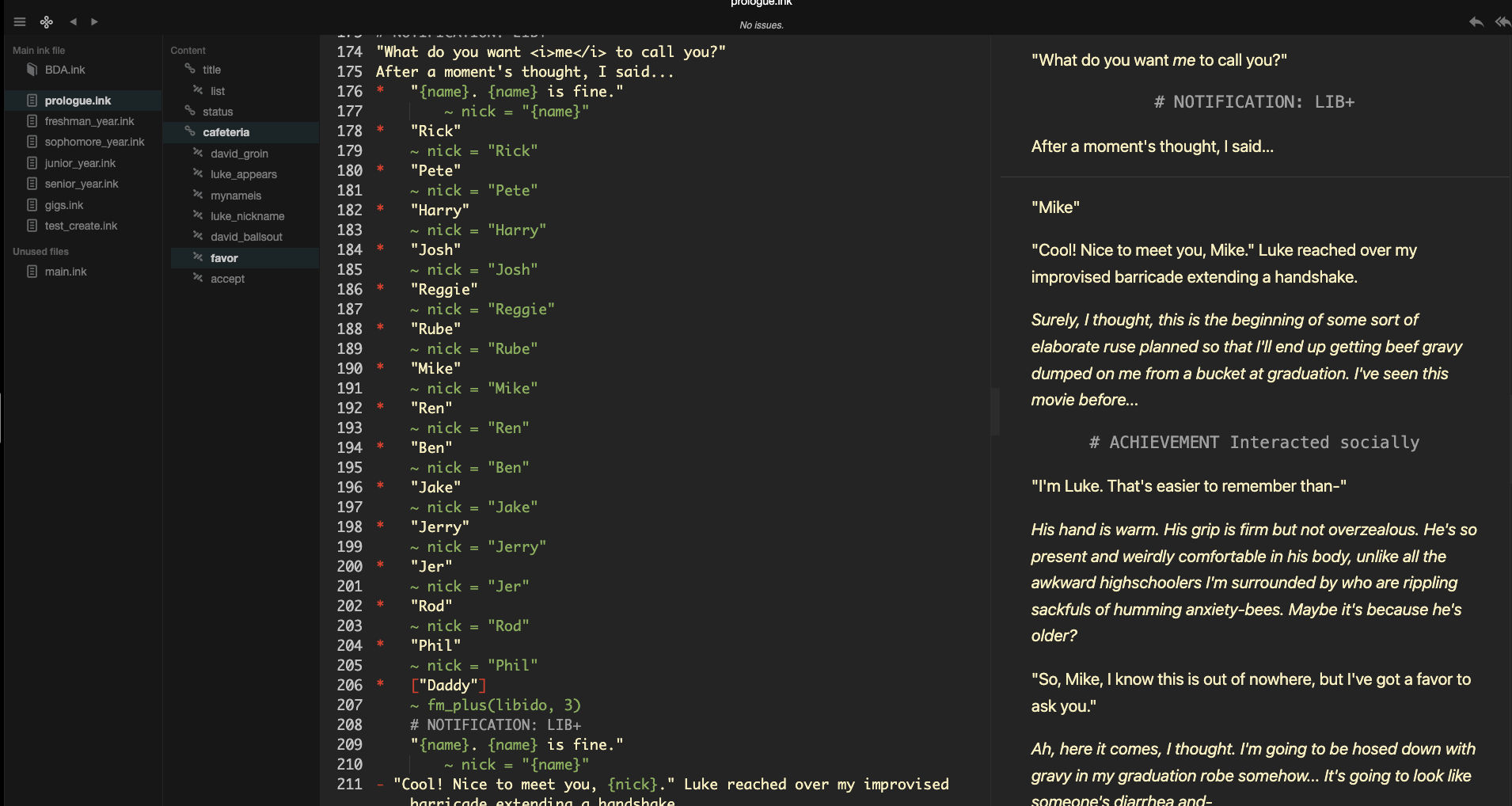
I’ve only used Twine to make stories, so I’d be worried like “I already tried to learn Twine, do I really have to learn another creation program?”. XD
But I saw a few games that use it on Steam and they have full VN graphics and interfaces and all and now I’m wondering if it’s easier to pretty up the UI in Inky than Twine, LMAO.
Ink feels kind of like Twee, and Inky gives a really good file manager and side-by-side play and editing. Ink is actually middleware initially designed to plug conversations into bigger games, but it can be used to make choice narratives and Inky will export a playable HTML or a game you can zip up with index.html and media potentially.
I’m also using Rémy Vim’s Ink IF Story Template from itch which is like an interpreter for Ink which makes it look really nice and adds support for things like notifications, backgrounds, and ChoiceScript style stat bars.
The thing I really like about Ink is it allows the author to create choices and then can specify how they transmogrify when chosen so the transcript reads like prose instead of being interrupted by choices and non-story meta information the author didn’t include. The choices get out of the way when used and the scroll back is really clean.
Ink has been my favorite way to write choice-based IF! I find it intuitive to work in, and it lends itself to integrating the writing & coding process in a very fluid way while still supporting some fairly complex functionality (albeit with constraints).
Most of my games were written with ink, and are powered by a custom interface called Lamp Post Ink Player (developed with @jeresig), which is open source.
As you say, since ink was originally designed to plug into other game dev platforms (like Unity) and not primarily to create browser-based IF games, the built-in web export is fairly limited in its capabilities compared to Twine (as far as I can tell, having not worked with Twine much myself!).
Yeah, beyond basic font styling, prettying up the default Ink web export is harder than Twine: the things you’re seeing on Steam are almost certainly people plugging Ink into a full custom graphical game.
There’s also my attempt at a point-and-click engine, which I haven’t updated in a while but still have plans to substantially overhaul when I have time.