Albeit the 'Comp remains stricken (“radiato”, that is, without readmission) from my list of competitions, I have some solid criticism on this specific rule:
Entries must not require judges or players to interact with external AI or generative services during play.
which implicitly bars entries in non-english language, because the use of translator is needed for anglosaxons (that is, native english-speakers) which don’t know the foreign language used in the entry.
I believe that this rule refers to things such as needing connection to a specific AI service in order to play the game at all. If I write and publish a game in Polish, which is my native language, it’s still fully playable from start to finish, and for someone who’s familiar with Polish just as I am, there’s no requirement for translation. Unfortunately, we participate in a highly anglicized part of the internet, and while it’s not stated in the rules, IFComp’s “default language” seems to be English. I assume that upon seeing a game in Polish, people wouldn’t bother that much with translation, unless they were really fond of me or curious about the premise, and would simply skip the game altogether.
This means I can build games in Sharpee for IFComp.
It’s exciting!
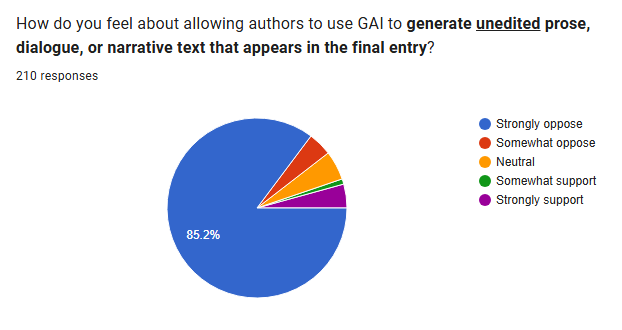
Note I resigned from the IFTF board to focus on writing games and to alleviate any concerns about my GenAI interests influencing the Foundation. Others can confirm that my initial input was a complete ban to avoid controversy, but I think after discussion and survey results, the committee chose the right approach.
If the entry has a option to show/no show gen-ai graphical content. Is that allowed? It’s not player facing content if it’s turned off by default? Or is it just having the option to possibily show the gen-ai content - is that what prohibits the game?
Like the others said, I don’t think the rule would apply to that. An LLM (or even a translator in general) isn’t required; we could also just learn Italian from a textbook and play the game that way! Or make our best guess at what the Italian meant, and probably not have a very good experience with the game, but that would still be “playing” it, according to the rules. The problem comes in when the game automatically connects to ChatGPT and sends its output to the screen.
A more realistic version, perhaps: someone writes a game in (say) Chinese, machine-translates it to English with no human oversight or editing (maybe the authors aren’t fluent English-speakers so they can’t tell good translations from bad ones), then releases a bilingual version that can be played in either language. You have the choice to either play the human-written Chinese or the LLM-generated English.
Now, this wouldn’t be a good idea, and I wouldn’t recommend anyone do it! But I could see it happening. (In which case the organizers could make their decision once it actually comes up, instead of just being a weird hypothetical.)
Content has to be “entirely created by humans”, but AI “editing” is allowed?
From what I’ve seen with AI “editing”, it can suggest rephrases or wording alternatives, not just spell and grammar check. Would such suggestions (if accepted) be “editing” and also “entirely created by humans” ?
this might be a dumb question, but will authors still be required to acknowledge AI-use? (that is, of course, now mostly in regard to games that use AI during development)
From the rules: All entries’ player-facing content must be entirely created by humans, including cover art, prose, and all in-game assets.
So by my interpretation, a toggle is not allowed.
The exact percentages are in the alt text of each image.
Good point. I guess now maybe not, since you can’t regulate whether AI was used in the workflow. However, I think IFComp should encourage submitters to disclose it.
No. You can use GenAI to help write code. That’s not banned, though likely still needs to be disclosed.
Not sure why there’s confusion. You can’t present any GenAI to the player and that includes toggled content. In that case, wait until after the comp and submit the toggled version afterwards.
True. But there’s another little wrinkle. A game might use an AI service as a reasoning engine, not as a content generator. So if an AI is being used to evaluate the player’s input in order to determine the next human-written response, (example: did the player successfully bluff the guard) all of the player-facing content would still be created by humans.